Join me for an exclusive in-person event for LNCs to hear the behind-the-scenes legal process from 12 attorneys! ❱❱

Empowering Nurses at the Bedside and in Business

Author Archives: Lorie A Brown, R.N., M.N., J.D.

  1. There are no shortcuts to becoming a successful New Nurse

    Leave a Comment

    You graduated from nursing school and passed the NCLEX and now you have your first job. The excitement is rampant. You want to be successful but how do you know if the unit norms are in compliance with the Nurse Practice Act or even the facilities policies and procedures? For many new nurses, entering the clinical environment can be an overwhelming experience. The need to adapt quickly, coupled with staffing shortages and high patient loads, can make it tempting to adopt unit shortcuts as a way to get your work done. Unfortunately, shortcuts are often a slippery slope that can lead not only to professional disciplinary action but also to compromising patient care and the nurse’s license.

    The Appeal of Shortcuts

    Imagine being a new nurse, eager to do well, yet faced with a sea of patients, endless tasks, and limited time. When experienced staff or well-meaning peers demonstrate shortcuts—omitting certain documentation, skipping patient checks, or bypassing protocols to save time—it can be incredibly enticing. These shortcuts may appear efficient in the moment, and might even be encouraged by colleagues as “the real way” to manage the demands of the job.

    For those who are new to nursing, this “informal training” becomes a quick survival tool. They learn to rely on what appears to be a common practice rather than following the detailed steps taught in nursing school. But what often gets lost in this process is the reason why these steps exist.

    The Hidden Costs of Improper Training

    Shortcuts have consequences. In the heat of the moment, they might seem beneficial, but over time, they erode the quality of patient care. Without proper assessment, documentation, or critical thinking, vital signs can be missed, patient symptoms can be overlooked, and crucial interventions can be delayed.

    For example, imagine a nurse decides to skip double-checking a medication dose, signing for a med that was wasted that you did not witness or documenting a thorough patient assessment. This might save time in the short run, but it could lead to medication errors, missed symptoms, and adverse events. Such omissions can open the door to liability for the nurse, the facility, and most significantly, harm to the patient.

    The Legal and Professional Ramifications

    When shortcuts replace best practices, it’s only a matter of time before serious issues arise. Inadequate documentation can leave a nurse unable to defend their actions in court, putting their license at risk. If the patient care provided doesn’t reflect the standards of practice due to these “shortcuts,” the nurse may be held accountable for negligence.

    Medical record documentation serves as proof of patient care. When a record is incomplete, altered, or improperly done, it raises red flags during audits or legal proceedings. New nurses trained in unit shortcuts might lack the awareness that their documentation habits could lead to severe consequences—termination, investigation by the board of nursing, and potential license revocation.

    Breaking the Cycle: Proper Training and Ethical Leadership

    As a nurse, it’s crucial to know that being efficient is not the same as cutting corners. When starting out, it’s better to ask questions, seek clarification, and adhere strictly to

    protocols—even if it feels slow or cumbersome. Fish do not know what air is because their environment is water. Do not get sucked in to the unit norm. You may not realize you are doing something wrong so ask someone who works outside your institution. Nurses should remember that their primary responsibility is to the patient, and any steps skipped can have a direct impact on the safety and quality of care they provide.

    Unit leadership also has a significant role to play in how new nurses are trained. Mentors, preceptors, and unit managers need to be mindful of the messages they are conveying, both explicitly and implicitly. Teaching new nurses proper protocols, highlighting the importance of every aspect of care, and showing them how to use critical thinking can create a safer environment for everyone and making sure the nurse knows the facilities policies and procedures. Leadership must discourage shortcuts and instead foster a culture that values patient safety above all else.

    Redefining Efficiency Without Sacrificing Safety

    New nurses are at a critical juncture where they’re eager to fit in and succeed. If their unit’s culture prioritizes speed over accuracy, they may adopt poor practices without realizing the potential consequences. It’s the responsibility of both the new nurse and the team to challenge this dynamic.

    To new nurses: know that there is no shortcut worth losing your license over. It’s better to take the extra time to ensure things are done correctly than to face a lifetime of regret over a preventable mistake. To seasoned nurses and leadership: remember that your guidance sets the foundation for a new nurse’s career. Teaching shortcuts might feel helpful in the short term, but it endangers your patients and puts your colleagues’ careers on the line.

    In nursing, the right way is often the safest way. Take the time, ask the questions, and always put patient care first—because shortcuts may cost far more than they save.

  2. The Irony of Nurse Layoffs During a Nursing Shortage: A Broken System in Crisis

    Leave a Comment


    The healthcare industry is facing a perplexing and unfortunate contradiction: hospitals are laying off nurses even as a nationwide nursing shortage continues to worsen. For those of us who live and breathe nursing, this seems illogical—how can hospitals justify layoffs when they struggle to staff their units adequately? Let’s dive into why this is happening and what it means for the future of nursing care.

    The Ever-Deepening Nursing Shortage

    The nursing shortage in the United States is not a new phenomenon, but it has reached critical levels in recent years. The pandemic exacerbated the strain on an already overwhelmed system, resulting in widespread burnout, early retirements, and a mass exodus of skilled nurses from the profession. Many nurses have called for legislative action, and many leaders have suggested practical solutions—yet hospitals, ironically, are choosing to lay off staff, including nurses, at this crucial time.

    Financial Pressures and Short-Sighted Decisions

    One of the primary reasons behind these layoffs lies in the financial pressures hospital systems are under. Rising costs, changes in reimbursement structures, and the increasing expense of providing care have led many institutions to make budget cuts to balance their finances. Unfortunately, labor costs often top the list, and cutting nursing staff can be an easy target for quick savings since nursing is considered a cost center and not a revenue producing center.

    Hospitals are also dealing with a decrease in patient volumes for non-emergency procedures, as many individuals delayed elective surgeries during the pandemic. With reduced revenue, some hospital administrators have responded by cutting costs across the board, including eliminating nursing positions—even though these actions may negatively impact patient care in the long run. In addition, many hospitals are putting money into growing or refurbishing the physical buildings.

    Replacing Experience with Lower Cost Alternatives

    Another troubling trend is the replacement of experienced nurses with less expensive alternatives, like new graduates or unlicensed personnel. Hiring new graduates may seem like a cost-saving measure, but this often results in higher turnover and increased burden on the existing staff who must mentor and train these newcomers. Nurses with years of experience bring a depth of knowledge and experience that is irreplaceable—something hospital systems seem to be ignoring in favor of trimming budgets.

    Relying on Temporary Staffing

    Many hospitals rely on travel nurses or agency nurses. This temporary staffing solution fails to address the systemic issues causing the nursing shortage in the first place.

    The Impact on Patient Care and Morale

    The most significant consequence of laying off nurses during a shortage is the effect on patient care. Fewer nurses mean heavier patient loads, longer wait times, and reduced time for individualized care. This “do more with less” mentality leads to burnout, compromised patient safety, and ultimately, a diminished quality of care.

    Layoffs also send a demoralizing message to the nursing workforce. Many nurses already feel undervalued and exhausted, and seeing their peers laid off only reinforces the idea that they are replaceable. Nurses enter this field not just as a profession, but because it is a

    calling—something deeply embedded in their DNA. Being treated as mere numbers on a balance sheet is not only disheartening but also drives more nurses away from the bedside, deepening the staffing crisis even further.

    A Call for Change

    Hospitals must rethink their strategies if they truly wish to provide quality care to patients and ensure a sustainable healthcare system. Laying off nurses at a time when they are more needed than ever is a short-sighted solution to a complex issue. Investment in nursing staff should be seen not as an expense, but as an investment in the quality of care, patient outcomes, and the well-being of an entire healthcare system.

    We must advocate for policies that support nurses, promote safe staffing ratios, and incentivize retention through appropriate compensation and working conditions. For too long, nurses have been expected to fill in the gaps created by systemic failures—now it’s time for a change.

    The nursing shortage isn’t just a numbers problem; it’s a symptom of a broken system that is failing to value its most critical resource: people. To truly solve the nursing crisis, hospitals and healthcare administrators need to put patients and caregivers first—because without nurses, the entire system collapses. Let’s demand better, for the nurses who tirelessly give of themselves, and for the patients who deserve safe, compassionate care.

  3. Call To Action

    Leave a Comment

    Maybe I am dating myself but when you used to look at those ads in the Yellow Pages you likely saw that they all looked alike and said the same thing. This was especially true with ads for attorneys.

    “If you’ve been injured in a car accident, call ME!”

    At that time, investing in a Yellow Pages ad was very expensive. How was anyone supposed to know whether the ad was working to justify the investment? Therefore, every marketing piece that you create should have a “call to action” and you should track where your leads come from to know if it is effective. A call to action is something that encourages the potential customer to take action and respond. For example, if you are a legal nurse consultant and you’ve sent out a mailing (which I don’t recommend), how can you know if that mailing is effective? A call to action is needed.

    A call to action for a mailing would be saying something like “If you call me in the next 30 days of the date of this letter, I would be happy to provide you with a 20% discount on your first case.”

    If you are a home health care agency and put an ad in a senior targeted magazine, the call to action could be something as simple as “Mention this ad and get a 10% discount or call us today for a free in-home safety inspection.

    Again, a call for action is anything that convinces your potential client to take action towards utilizing your services.

    My call to action today is that if you found this newsletter informative and valuable, please share it with other current and future nurse business owners.

    Another call to action that I offer is that if you would like to receive a complimentary 15 minute nurse to nurse business owner assessment call. CallwithLorie.com.

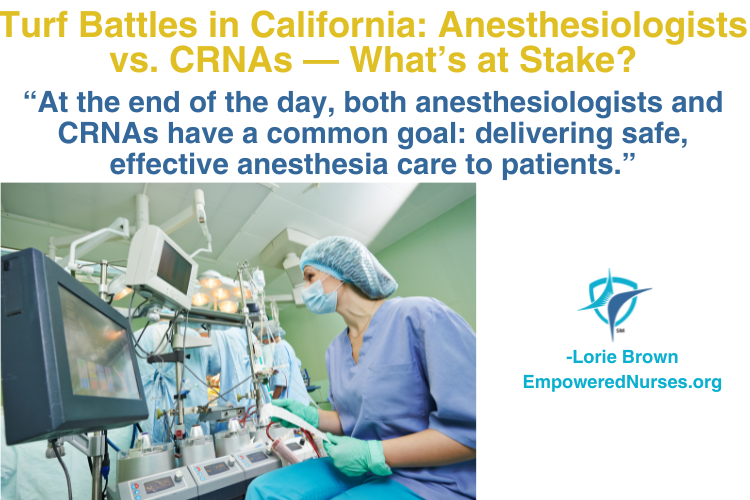
  4. Turf Battles in California: Anesthesiologists vs. CRNAs – What’s at Stake?

    Leave a Comment

    The healthcare field is no stranger to professional turf battles, but few are as heated or impactful as the ongoing conflict between anesthesiologists and Certified Registered Nurse Anesthetists (CRNAs). In California, this battle over roles and responsibilities continues to raise questions about autonomy, safety, cost, and access to care, shaping the future of anesthesia services in the state.

    At the heart of this turf war lies a central issue: Should CRNAs be allowed to practice independently, without the direct supervision of an anesthesiologist? For years, California has been one of the key battlegrounds, as CRNAs push for expanded scope of practice and anesthesiologists defend their territory, citing concerns about patient safety and quality of care.

    What Are CRNAs and Anesthesiologists?

    Both CRNAs and anesthesiologists play essential roles in delivering anesthesia care, but their training and paths to practice differ significantly.

    • CRNAs are advanced practice nurses who specialize in anesthesia. Their path to certification includes obtaining a nursing degree, working as a registered nurse (often in a critical care setting), completing a master’s or doctoral program in nurse anesthesia, and passing a national certification exam.
    • Anesthesiologists are physicians who complete medical school, followed by a residency in anesthesiology, and in many cases, a fellowship in a subspecialty area. This extensive training equips them to handle complex medical situations.

    While both groups are capable of delivering anesthesia services, the battle arises over whether CRNAs can do so without the oversight of a physician.

    The California Debate: Autonomy vs. Supervision

    California is one of 19 states that have opted out of the federal Medicare requirement that CRNAs must be supervised by a physician to be reimbursed for services. This opt-out allows CRNAs to practice independently in certain settings, particularly in rural areas where access to anesthesiologists is limited. Proponents argue that CRNAs provide high-quality care at a lower cost, helping to fill healthcare gaps in underserved communities.

    However, anesthesiologists argue that removing physician oversight jeopardizes patient safety. They contend that anesthesia is inherently risky, and that the more extensive training and experience of anesthesiologists is critical to managing the complexities and potential complications of anesthesia.

    The Cost and Access to Care Argument

    One of the primary arguments in favor of allowing CRNAs to practice independently is the cost-effectiveness of nurse anesthesia services. Studies show that CRNAs can provide the same level of care at a lower cost, which is particularly important in rural or underserved areas where healthcare budgets are tight and access to care is limited.

    Supporters of CRNA independence also point to the growing demand for anesthesia services, especially as the population ages and surgeries increase. With a shortage of anesthesiologists in many areas, CRNAs offer a solution to providing timely and affordable anesthesia care.

    Safety Concerns: Is Physician Supervision Necessary?

    Anesthesiologists have long argued that their advanced medical training is vital for patient safety. While CRNAs are highly skilled, anesthesiologists emphasize the complexities that can arise during surgery and anesthesia administration, from allergic reactions to heart complications. They argue that physician oversight ensures that someone with the highest level of medical expertise is present to handle emergencies.

    However, several studies have shown that CRNAs can deliver safe, high-quality anesthesia care independently. For example, a 2010 study in Health Affairs found no significant difference in patient outcomes between states that require physician supervision and those that do not.

    The Future of Anesthesia in California

    The battle between anesthesiologists and CRNAs in California is unlikely to resolve any time soon. Both sides have valid points, and the stakes are high for patients, healthcare systems, and professionals. As the state continues to grapple with this issue, several factors will influence the outcome:

    • Legislation: California’s lawmakers will continue to play a significant role in determining the scope of practice for CRNAs. Bills seeking to either limit or expand CRNA autonomy will shape the future of anesthesia care in the state.
    • Workforce Shortages: The growing demand for anesthesia services, coupled with shortages of anesthesiologists, may push the state toward granting more independence to CRNAs, especially in rural areas where access to care is a pressing concern.
    • Collaboration Models: Some hospitals and healthcare systems are exploring collaborative models that allow anesthesiologists and CRNAs to work together, combining their expertise to provide the best possible care. This middle-ground approach could ease tensions and improve outcomes for patients.

    Conclusion: Finding Common Ground

    At the end of the day, both anesthesiologists and CRNAs have a common goal: delivering safe, effective anesthesia care to patients. While the turf war in California is far from over, it’s clear that collaboration, rather than conflict, may be the key to moving forward. By recognizing the strengths and expertise of both professionals, the state can ensure that all patients—whether in a major city or a remote rural area—receive the high-quality care they deserve.

  5. Getting In Touch With Your Limiting Beliefs

    Leave a Comment

    A limiting belief is a state of mind or belief about yourself that restricts you in some manner.

    I had a limiting belief that I was not smart enough to go to medical school, so I became a nurse. Many nurses experienced these limiting beliefs without realizing it. Limiting beliefs are learned from our parents, media, our environment even though we may not recognize it. How so? How can we confront and overcome these obstacles as nurses?

    You need to identify the limiting belief which is a deeply ingrained idea about us that holds us back. They might sound like, “I’m not smart enough to become a nurse leader … I’ll never be good at public speaking so I can’t teach or present … I’ve always worked bedside … I can’t trust transition into a new role.”

    The first step is to recognize these thoughts when they appear. Pay attention to your inner dialogue, especially when facing challenges. In nursing, we are programmed to believe in lack and limitation such as we don’t have enough equipment, supplies, support or time to adequately take care of our patients.

    We become so entrenched in this belief of lack that we don’t realize that the rest of the world is, in reality, very abundant. In fact, if you look at many hospitals, they seem to all have construction underway. These hospitals are nonprofit and must reinvest the profits back into the hospital system. Rather than investing in attracting nurses to maintain and provide quality patient care, they would rather turn these facilities into something like hotels with concierge service. When people are sick they don’t care about the color of the room’s walls; they just want to get the care they need.

    Ask yourself if these beliefs are true. Once you identify your limiting belief, the next step is to question their validity. Are these thoughts rooted in fact? Are they assumptions that you’ve made over time? For example, “I’ve never led before” can turn into, “I’ve led patient care teams in difficult situations” or “I don’t have enough experience” can be reframed as “I have years of experience in patient care and my skills are transferable to other roles.” The process of reframing helps us realize that many limiting beliefs are based in fear or lack of self-confidence and are not grounded in reality.

    Next you need to develop a growth mindset which is the belief that we can learn new skills or improve the ones we already have. If you say to yourself, “I’m not good at technology” you can shift that to, “I can learn more about technology to improve my practice.”

    Adopting a growth mindset helps you turn limiting beliefs into goals for improvement. The shift empowers you to take control of your professional development and push beyond any self-imposed limits.

    Seek support and mentorship. No one breaks through limiting beliefs alone. Sometimes we need the help of others because we can’t always see our own limiting beliefs. They can be hidden deep in our subconscious.

    Mentorship can provide a mirror, reflecting on strengths that you may not see in yourself. A supportive mentor can help you work through doubt and affirm your abilities, especially when you’re on the verge of a breakthrough.

    Set small achievable goals. Overcoming limiting beliefs doesn’t happen overnight. Start by setting small, achievable goals that put you just outside your comfort zone. Growth only occurs outside your comfort zone. If you’ve always believed you can’t

    lead a team, try stepping up during your shift and offering to lead in small ways. Gradually build up your confidence by taking on more responsibility or exploring new roles.

    Practice self-compassion. Nursing is a demanding profession, and it’s easy to be hard on ourselves when we don’t immediately succeed, or we feel overwhelmed by self-doubt. One of the best ways to get in touch with limiting beliefs and move beyond them is through self-compassion. Instead of beating yourself up for perceived shortcomings, treat yourself with the same kindness you would offer to a colleague or patient. Nurses are hardest on themselves.

    Self-compassion creates space for growth and helps you navigate the emotional difficulties of challenging your limiting beliefs.

    Visualized success! Visualization is a powerful tool. Take time to imagine yourself breaking free from your limiting beliefs and achieving something that you once thought was out of your reach. Whether it’s landing a leadership position, transitioning to a new specialty, or pursuing higher education, seeing yourself succeed can be a motivating force.

    Give yourself permission to dream big and remind yourself that you are capable of growth, change and achievement. If you can conceive it and believe it, you can achieve it.

    Lastly, limiting beliefs are not unique to nurses, but they can be particularly challenging in a profession as demanding as ours. By getting in touch with these beliefs and actively working to challenge them, we can unlock our full potential.

    Remember, you are more than capable–sometimes the biggest hurdle is simply a matter of believing. Whether you’re at the bedside, in research or exploring legal nurse

    consulting, overcoming limiting beliefs opens new pathways for growth and fulfillment. Step-by-step with reflection, support, and a belief in your capacity for change, you can breakthrough these barriers and thrive.

  6. Breaking Free from the Nursing Rut: Finding Your Path Forward

    Leave a Comment

    As nurses, we’re used to managing chaos, making quick decisions, and handling life-or-death situations. But what happens when you start feeling stuck in a rut? The excitement and passion that once fueled your every shift begin to fade, and you find yourself going through the motions. It’s a place many of us have been, yet few talk about openly. So, let’s break that silence.

    The Reality of Hitting a Rut

    Nursing is more than a career; it’s in our DNA. But even when something feels like it’s part of who you are, it’s normal to face times when the weight of the job becomes too much. Long hours, emotional exhaustion, and the sheer pressure of caregiving can drain you. This rut can sneak up slowly, and before you know it, you’re questioning your passion, your career choice, and your future.

    If you’re in this place, first, know you’re not alone. This feeling doesn’t make you any less of a nurse, nor does it mean that you’re failing. It simply means you’re human.

    Signs You Might Be Stuck in a Rut:

    · Burnout disguised as routine: You might think you’re just getting used to the job, but if you’re no longer engaged, that’s a red flag.

    · Loss of motivation: If you’ve lost your enthusiasm for learning new things, taking on new challenges, or engaging with patients, it could be a sign you’re in a rut.

    · Feeling stuck in your role: You may feel like there’s no room for growth or that your career is stagnating.

    · Emotional exhaustion: If you feel emotionally drained before your shift even starts, it might be time for a change.

    Why Does This Happen?

    Sometimes, the job demands become too much without adequate time for recovery. Other times, it’s a lack of professional growth or feeling unsupported. Maybe it’s a mismatch between your values and the environment you’re working in.

    How to Climb Out of the Rut

    1. Reflect on Your “Why” Take time to remember why you became a nurse in the first place. Was it the connection with patients? The challenge? Whatever it was, revisit those roots. Sometimes, reconnecting with your original purpose can help you regain clarity.

    2. Talk About It Don’t keep these feelings bottled up. Share them with trusted colleagues, mentors, or a professional therapist. Sometimes, just knowing others understand your struggle can lighten the load.

    3. Explore New Opportunities If your current role feels limiting, start exploring other areas within nursing. There are so many paths you can take — from clinical specialties to leadership roles, teaching, consulting, or even becoming a legal nurse consultant (LNC). Sometimes, change is exactly what you need to reignite your passion.

    4. Prioritize Self-Care Nurses are notorious for putting others first, but it’s essential to prioritize your own mental and physical health. Regular breaks, exercise, and mindfulness practices like yoga or meditation can help you recharge.

    5. Set Boundaries Saying no can be one of the hardest things for nurses to do, but protecting your time and energy is critical. Establish boundaries with work and at home to create balance.

    6. Consider a Career Reset If the rut runs deeper than burnout, it might be time for a career reset. This doesn’t necessarily mean leaving nursing but could involve moving into a different specialty or shifting into an entirely new role within healthcare.

    You Are Not Alone

    Ruts are part of any career, even in a profession as fulfilling as nursing. What matters is recognizing it and taking steps to break free. You deserve to feel fulfilled in your career, not stuck.

    Remember, nursing is in your DNA. And just like every great nurse, you’re resilient. This phase doesn’t define you. The beauty of this profession is that it offers endless possibilities for growth, learning, and personal fulfillment. Find your path forward — it’s out there waiting for you.

    Have you ever found yourself in a rut? What did you do to break free? Share your thoughts and experiences with us!

  7. Investing in Nursing Education: Can $30 Million Solve South Carolina’s RN Shortage

    Leave a Comment


    The South Carolina state legislature has pumped $30 million into collegiate nursing programs over the past three years.

    It is anticipated that the Palmetto State has the seventh largest shortage of registered nurses in the nation which leaves one-in-five (20%) positions unfilled due to nurses retiring and current low staffing levels.

    An article published in Becker’s Hospital Review talked about the top ten states for R.N. shortages by 2036 of which South Carolina sits in the seventh position. The surveys suggest that nurse staffing levels are improving, the health systems continue to face recruitment and retention challenges.

    I wonder what effect pumping $30 million into collegiate nursing programs will accomplish? Will more nurses attend school? And what about the decrease in the number of qualified faculty and would master’s prepared nurses be able to work at these facilities to train nurses?

    I speculate what effect pumping all this money would have. I would much rather see that money go towards salaries for nurses and retention efforts rather than injecting it into education because, as I have said many times, I really believe that nursing is in your DNA.

    You couldn’t pay many people enough money to do the job that nurses do. Providing people with educational opportunities to go into the field of nursing causes me concern that if nursing is not in your DNA, you might become disillusioned and quit the

    profession. So, I am not sure what pumping money into education is going to achieve because it does take a special person to be a nurse.

    What do you think? How about sharing your thoughts with the rest of us! Let us read your comments below.

  8. Are You Proactive or Reactive?

    Leave a Comment

    “The best defense is a good offense” is a maxim that everyone has heard. But a better position to come from is to never have the problem in the first place. How do you do this? By being proactive.

    Proactive means that if you smell the handwriting on the wall: leave! Leave before you get fired. As I often say, “You can get another job, but you can’t get another license.”

    Proactive also means that you are not taking shortcuts, that you’re crossing your t’s and dotting your i’s and making sure you follow your facility’s policies and procedures. Proactive also means that if a client’s condition is deteriorating that you should respond immediately rather than wait until the patient codes. It’s important to get the rapid response team in early. By being proactive, you can significantly impact patient outcomes, workplace efficiency, and professional satisfaction.

    Proactive nurses anticipate potential problems and implement preventive measures, while a “reactive” nurse responds to problems only after they arise. Shifting from a reactive to a proactive mindset will help you immensely in your practice.

    A proactive nurse is one who anticipates changes and doesn’t wait as a patient’s condition deteriorates but intervenes early. A proactive nurse is always prepared and maintains a state of readiness. She’s/he’s sure to have everything she/he needs, including supplies, equipment, and keeping up with continuing education. A proactive nurse maintains effective communication with the healthcare team, patients, and families so that everyone is informed, reducing the likelihood of misunderstandings or delayed interventions. A proactive nurse asks for help! A proactive nurse uses critical thinking by consistently analyzing situations and potential outcomes to make informed decisions. They recognize subtle cues that may signal a future problem.

    And lastly, a proactive nurse uses her time wisely to manage or reduce the stress that comes with rushing to fix a problem that perhaps could have been prevented altogether.

    To develop a proactive mindset, I recommend one regularly review patient data. If a previous nurse says a patient had regular bowel sounds and now you don’t hear bowel sounds, that’s a change that needs to be addressed. When you know patterns, you can anticipate patient needs and act accordingly.

    Stay informed. By being informed, you can take preventative measures confidently. Collaborating with the care team regularly, productive nurses seek input and offer insights that could prevent future issues.

    Reflect and learn from experiences because, if you have a situation that does not turn out the way you want, become a Monday morning quarterback, and figure out what went wrong so you know how to mediate it in the future.

    Being proactive in nursing isn’t just about staying busy or being prepared, it’s about a mindset that embraces anticipation, readiness, and strategic planning to improve patient care, reduce stress, and elevate your practice to a higher standard.

    In this profession, every moment counts. Being proactive can make all the difference in the world, or in a patient’s life.

  9. What If Time Were Money

    Leave a Comment


    What if time were money?

    The only non-renewable asset that we have is our time. We can always make more money, right? What differentiates us from Oprah Winfrey or Tony Robbins is how we spend our most valuable asset: our time. Are we spending our time watching Netflix and scrolling on social media or are we spending our time being productive?

    My philosophy is do, delete, and delegate. I don’t believe in “to do lists” because they just rob your energy when you see how many things you must do. In reality most of those things will never get done.

    So, pick your battles and figure out what you can do, who you can delegate a task to, or what needs to be deleted because these days we have so much on our plates that we have to undertake. So much that we need to simplify our lives and work more effectively to accomplish everything we need in your business.

    I suggest that you calendar everything. I believe in Parkinson’s Law, which states “work will expand to fill the time allotted for its completion.”

    It’s interesting how you can go to a movie that you love and it’s over before you know it. But if you go to a movie that you’re not enjoying and it seems to take forever to get through it, you just want to pack up your popcorn and go home. The movies can have the same running time, yet the passage of time feels different in each situation.

    The more you can get into the zone where time seems to stand still, you can get everything you want to get done. It makes a big difference.

    I block schedule and figure out how much time something is going to take. And I get it done in that amount of time. I schedule everything and that way I know everything has a home and will get done.

    If I need to reschedule something, I will reschedule once. But if I want to reschedule it again, I ask myself why, what is the resistance? The only way to address the resistance is to just do it. I think the Nike slogan is correct. Just do it!

  10. Indiana APRN Audit

    Leave a Comment

    According to Indiana Code § 25-23-1-19.8, before December 31st of every even numbered year, the Board is required to randomly audit at least one per cent (1%) but not more than ten per cent (10%) of the APRNs with authority to prescribe legend drugs. This was enacted last year, and the board is still in the process of auditing.

    Currently, an Indiana APRN is required to complete at least 30 hours of continuing education of which eight (8) hours must be in the area of pharmacology and if you prescribe controlled substances, two (2) hours of the eight (8) hours must be in opioid prescribing practices. The continuing education must be provided by a nationally sponsored organization.

    APRNs are not required to submit the continuing education however, if they are audited, they must provide all the certificates of their continuing education done within the audit period.

    The Board conducts this audit to make sure that the APRN has completed the continuing education and that the APRN has a valid collaborative practice agreement in place and is operating within the terms of the agreement.

    Apparently, some APRNs have collaborative practice agreements where the collaborating physician does not review the charts or do some things that are required by the collaborative agreement. Therefore, during the audit, the APRN must provide a

    sworn statement from the collaborating physician that they are working within the terms of the agreement.

    If you are receive an email and/or letter saying you are being audited, you will be required to upload your continuing education certificates, Collaborative Practice Agreement and the sworn statements to the Professional Licensing Agency portal. If you have more than one collaborator, then you must submit sworn statements from each.

    If the Board feels you have not complied with the requirements of the audit, they will call you in for an order to show cause signifying you have complied with the requirements. Of course, we would be happy to assist you with this process.

    In the meantime, I just wanted to share valuable information on how this process works so that you can be prepared should you be in the process of being audited now or in the future.

As Seen On:

Women's Week