Join me for an exclusive in-person event for LNCs to hear the behind-the-scenes legal process from 12 attorneys! ❱❱

Empowering Nurses at the Bedside and in Business

Author Archives: Lorie A Brown, R.N., M.N., J.D.

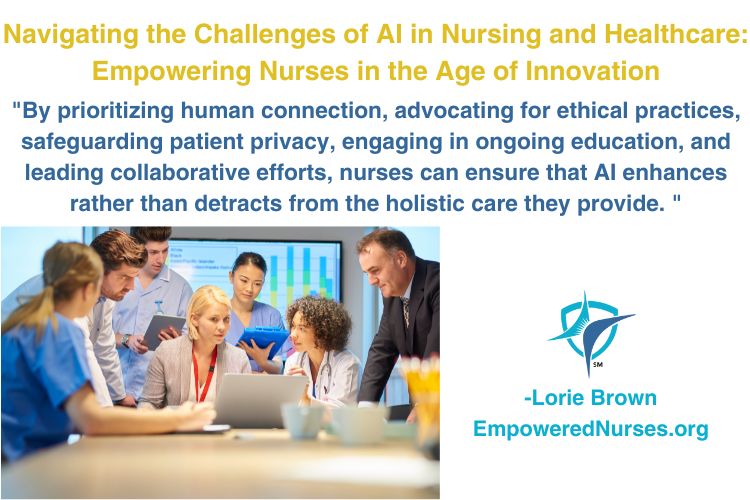
  1. Navigating the Challenges of AI in Nursing and Healthcare: Empowering Nurses in the Age of Innovation

    Leave a Comment


    As the healthcare industry embraces the power of Artificial Intelligence (AI), nurses find themselves at the forefront of this transformative shift. While AI brings exciting possibilities for improved patient care, it also presents unique challenges. We will delve into the problems nurses face with the integration of AI in healthcare and explore how they can play a proactive role in mitigating these challenges while preserving the human touch that defines our profession.


    1. Emphasizing Human Connection


    Nurses understand that compassionate care goes beyond mere medical procedures. They recognize the significance of human connection in fostering trust, providing emotional support, and enhancing patient outcomes. Despite the rise of AI technologies, nurses can actively contribute by dedicating time to establish meaningful connections with patients. By spending quality time at the bedside, actively listening, and addressing patients’ concerns, nurses can ensure that the human touch remains at the core of healthcare.


    1. Advocating for Ethical AI Practices


    Nurses are well-positioned to be advocates for ethical AI practices within healthcare organizations. They can actively participate in discussions and decision-making processes related to the use of AI. By raising awareness about potential biases, the importance of diverse data representation, and the need for transparent algorithms, nurses can help ensure that AI systems are designed and deployed in an ethically responsible manner. Through collaboration with interdisciplinary teams, nurses can play a pivotal role in shaping guidelines and policies that govern AI usage in healthcare.


    1. Safeguarding Patient Privacy


    With the integration of AI comes an abundance of patient data. Nurses can take an active role in safeguarding patient privacy by promoting secure data handling practices. By adhering to established protocols for data collection, storage, and transmission, nurses can help protect patient information from unauthorized access and cyber threats. Additionally, by educating patients about their rights and providing them with information on how their data is being used, nurses can empower patients to make informed decisions about their privacy and data security.


    1. Engaging in AI Training and Education


    To effectively navigate the complexities of AI integration, nurses should engage in ongoing training and education programs. By staying abreast of the latest advancements in AI technologies, nurses can adapt their skills to work collaboratively with AI systems. Organizations can provide specialized training that focuses on the integration of AI tools, data interpretation, and the ethical implications of AI in healthcare. Equipped with this knowledge, nurses can confidently utilize AI as a valuable tool while maintaining their critical thinking abilities.


    1. Leading Change and Collaboration


    Nurses possess a deep understanding of the healthcare ecosystem and are well-suited to lead change initiatives related to AI integration. By fostering collaboration between AI developers, healthcare professionals, and IT specialists, nurses can drive the development and implementation of AI systems that align with patient-centered care principles. They can actively participate in interdisciplinary teams, providing valuable insights on the practical application of AI in diverse healthcare settings.


    Kenrick Cato R.N. says, “AI should be used as clinical decision support and not to replace the expert. Hospital administrators need to understand there are lots of things an algorithm can’t see in a clinical setting.”


    As the healthcare landscape evolves with the introduction of AI, nurses have a crucial role to play in shaping the future of nursing and patient care. By prioritizing human connection, advocating for ethical practices, safeguarding patient privacy, engaging in ongoing education, and leading collaborative efforts, nurses can ensure that AI enhances rather than detracts from the holistic care they provide. By embracing AI as a supportive tool and leveraging their expertise, nurses can navigate the challenges of AI integration while upholding the human touch that is essential to nursing and healthcare.

  2. Advanced Practice Registered Nurses: The Case Against State Medical Board Regulation

    Leave a Comment

    In recent years, the role of Advanced Practice Registered Nurses (APRNs) has expanded significantly, bringing forth a debate over whether state medical boards should regulate their practice. While some argue in favor of increased oversight, I firmly believe that state medical boards should not regulate Advanced Practice Registered Nurses. The ANA joins me in opposing state medical board oversight of APRN practice.  In this blog, I will delve into the reasons why APRNs should be granted autonomy, highlighting the benefits for patients, the healthcare system, and the nursing profession as a whole.

    1. Expertise and Education:

    Advanced practice registered nurses undergo rigorous education and training to develop their expertise. They hold master’s or doctoral degrees in nursing and specialize in areas such as nurse practitioners (NPs), certified nurse midwives (CNMs), clinical nurse specialists (CNSs), and certified registered nurse anesthetists (CRNAs). Their advanced knowledge equips them to provide high-quality care and make informed decisions independently.

    1. Expanding Access to Care:

    One of the key advantages of APRNs is their ability to address the growing shortage of primary care providers and enhance access to healthcare, particularly in underserved areas. By allowing APRNs to practice autonomously, state medical boards can increase the availability of vital healthcare services, reducing wait times and ensuring that patients receive timely and appropriate care.

    1. Patient-Centered Care:

    APRNs are known for their holistic and patient-centered approach to healthcare. With a focus on building strong therapeutic relationships, APRNs prioritize effective communication, patient education, and shared decision-making. By allowing them to practice independently, patients have direct access to APRNs, fostering continuity of care and promoting patient empowerment.

    1. Cost-Effectiveness:

    The rising cost of healthcare is a significant concern for individuals, families, and the healthcare system as a whole. Studies have consistently shown that care provided by APRNs is cost-effective, often resulting in comparable or better outcomes at a lower cost compared to physician-delivered care. Allowing APRNs to practice without burdensome regulations can help reduce healthcare costs while maintaining quality care.  I do believe APRNs should be reimbursed at the same rate as physicians since they are providing the same service.

    1. Collaboration, Not Regulation:

    Rather than imposing stringent regulations, fostering collaboration between APRNs and physicians should be the focus. By establishing collaborative practice models, where APRNs work in coordination with physicians, the strengths and expertise of both professions can be leveraged to provide comprehensive, team-based care. This collaborative approach promotes interdisciplinary learning and enhances the overall quality of care delivered to patients. I believe in the collaborative approach but think APRNs should have full practice authority.

    1. Enhancing the Nursing Profession:

    Regulating APRNs under state medical boards sends a message that their expertise and abilities are not valued independently. By granting APRNs autonomy, we recognize the unique contributions of the nursing profession to the healthcare landscape. This recognition will not only attract more aspiring nurses to pursue advanced practice roles but also encourage professional growth and innovation within the field.

    The time has come to embrace the full potential of Advanced Practice Registered Nurses and acknowledge their invaluable contributions to healthcare. By granting them autonomy and refraining from excessive regulation, we can enhance patient access, provide cost-effective care, and foster collaboration among healthcare professionals. It is essential to recognize the expertise of APRNs and trust in their ability to deliver high-quality, patient-centered care. Let us advocate for a future that empowers and supports Advanced Practice Registered Nurses in their mission to improve healthcare outcomes for all.

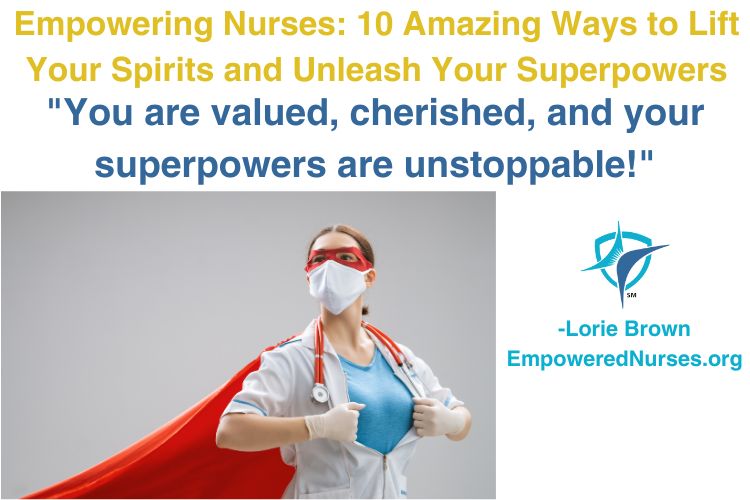
  3. Empowering Nurses: 10 Amazing Ways to Lift Your Spirits and Unleash Your Superpowers

    Leave a Comment

    Dear Nurses, you are the unsung heroes of the healthcare system, spreading compassion and care with every step you take. We understand that your journey can be challenging, but we’re here to support you. In this blog post, we will delve into the top 10 ways to empower and uplift you, so you can shine even brighter in your invaluable role.

    1. Embrace the Power of Appreciation:

    Nurses, your dedication and tireless efforts deserve nothing less than our heartfelt appreciation. We want to celebrate your achievements, recognize your hard work, and honor the vital role you play in patient care. Your commitment does not go unnoticed!

    1. Unlock Your Superpowers Through Continuous Growth:

    Empowerment comes hand-in-hand with professional growth. Nurture your superpowers by seeking opportunities for learning, certifications, and specialization. We’re here to support your pursuit of higher education and provide resources to advance your career. The sky’s the limit!

    1. Step into the Spotlight: Become a Nursing Leader:

    You possess extraordinary leadership potential! Unleash your leadership skills by embracing programs that nurture your abilities. It’s time for you to step into the spotlight and drive positive change within the healthcare system. We believe in you!

    1. Find Balance: Let’s Tackle Nurse-Patient Ratios Together:

    We understand the challenges of heavy workloads. You deserve a manageable ratio that ensures safe and high-quality care for your patients. Together, let’s advocate for appropriate staffing levels, because your well-being matters as much as theirs.

    1. Prioritize Your Emotional Well-being:

    Nursing can tug at your heartstrings, leading to burnout and compassion fatigue. Your well-being matters to us. Let’s create comprehensive wellness programs that prioritize your mental health. Counseling services, stress management resources, and work-life balance initiatives are here to support you.

    1. Embrace the Power of Technology:

    Technology can be your ally in streamlining your workflows and empowering you. Discover user-friendly electronic health record systems, telehealth platforms, and mobile applications that boost efficiency and enhance patient care coordination. Let’s leverage technology together!

    1. Unleash Your Collaboration Superpowers:

    Teamwork makes the dream work! Nurses, you have unique expertise and insights to offer. Embrace interdisciplinary collaboration and actively engage with other healthcare professionals. Together, we can achieve remarkable outcomes for our patients.

    1. Champion Fair Compensation and Benefits:

    You deserve more than just a pat on the back. We’re here to advocate for fair compensation and comprehensive benefits that reflect the incredible value you bring to the profession. Competitive salaries, paid leave, health insurance, and retirement plans are just the beginning!

    1. Create a Safe Haven for Your Superpowers:

    Your safety is paramount. We’re committed to fostering an environment where you feel physically, emotionally, and psychologically secure. Let’s implement measures to prevent workplace violence, enhance security, and nurture a culture that celebrates diversity and inclusion.

    1. Your Voice Matters: Let’s Shape the Future of Nursing:

    Nurses, your voice holds immense power! You are agents of change. We want to empower you to participate actively in policy discussions and decision-making processes. Together, we can create reforms that elevate patient care and enhance the nursing profession.

    Dear Nurses, you are our everyday superheroes, spreading warmth and care to those in need. We’re here to empower you, uplift your spirits, and ensure you have the support you deserve. Let’s celebrate your extraordinary contributions and work hand in hand to create a brighter future for nursing. You are valued, cherished, and your superpowers are unstoppable!

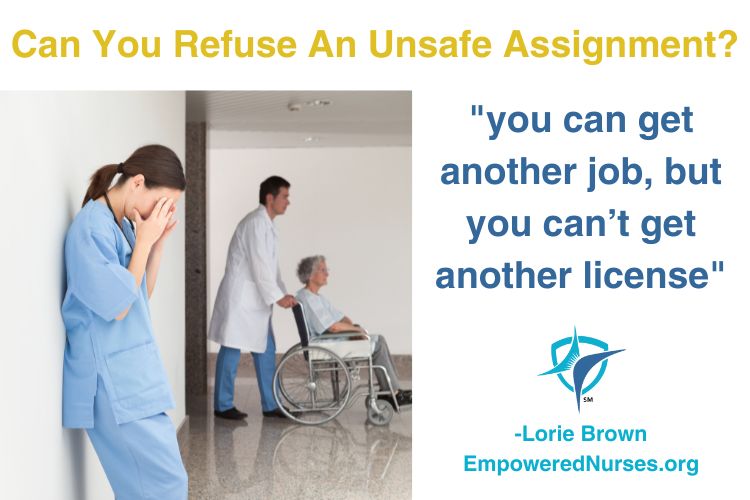
  4. Can You Refuse An Unsafe Assignment?

    Leave a Comment

    Here’s the scene: you walk into work for your 12-hour shift and immediately find yourself facing an exceptionally heavy patient load.  What can you do?

    Your first thought is probably “I don’t want to commit malpractice; I want to provide the best care for my patients, and I want to protect my license.”

    When you look at the staffing assignments, it can be both overwhelming and stressful.  You may be thinking, “How am I going to get this all done and make sure that my patients are provided with the best care?”

    According to the American Nurses Association, nurses not only have a right, but also an obligation to refuse such an assignment.  However, that’s the American Nurses Association talking and what they say is not law.  It is simply a guideline.

    Unfortunately, many states do not follow these guidelines and therefore it is important to know what your state’s Nurse Practice Act and guidelines are about this subject.

    I understand that Texas has “safe harbor rule” where one can refuse a heavy assignment without repercussions.  However, in other states, an employee is required to accept whatever assignment that they are given.

    In that latter situation, I suggest that if you genuinely believe that you have been assigned too many patients and cannot provide safe care, you should first speak to the supervisor.

    If that doesn’t provide you with any assistance, you should send to your manager an e-mail or letter about the staffing situation and your concerns about patient safety.  Be sure to keep a copy for yourself, because should there be a problem, at least you will be able to show that you have spoken up and expressed your concerns.

    Unfortunately, there is no easy answer for a situation like this.  I suggest that if you frequently encounter heavy patient loads you might consider changing jobs because, as I always say, “you can get another job, but you can’t get another license.”

    Therefore, if you do refuse and leave an assignment in a state where you are required to take on such a dangerous assignment, you could be terminated for patient abandonment.  Many nurses mistakenly believe that if they don’t accept the assignment, they can just leave but this is not necessarily true.

    I hope you’re never faced with this situation, but the way things are in healthcare, it seems to have become more common.


  5. How Much Information Is Too Much Information

    Leave a Comment

    Caitlin Bernard, MD, a family planning fellowship trained obstetrician and gynecologist in Indianapolis, performed an abortion on a 10-year-old Ohio girl who was just over 6 weeks pregnant after being raped.  Regardless of your views on abortion, read the rest.

    On June 29, 2022, she attended a rally against abortion laws during which a reporter from the Indianapolis Star overheard her speaking with another physician about how patients living in other states would be harmed by abortion restrictions there.

    Dr. Bernard reportedly mentioned to the physician that just 2 days after an Ohio law imposing abortion restrictions took effect, she saw the young patient.  The reporter asked Dr. Bernard to confirm the comment to which she obliged saying she had received a call from an Ohio child abuse doctor that a minor child had been raped and the family wanted to pregnancy terminated.

    Within 2 weeks of the Indianapolis Star article, a reporter with his camera recording, located the victim’s home and knocked on the door.  It is quite worrying that the news team was able to find this child.

    The evidence of conception was transported from Indianapolis to Ohio for use in identifying the alleged rapist who had been living with the girl’s family.

    Dr. Bernard has been very vocal about her concerns with abortion laws in this type of situation.  According to one published article, she had gone through her employers to determine exactly what could be disclosed after which she was given the “green light” to do so.

    On November 30, 2022, the Indiana Attorney General’s Office filed an administrative complaint against Dr. Bernard.  Unfortunately, the Medical Board saw this as disclosure of protected health information and summarily filed charges against Dr. Bernard.  According to HIPAA rules, 45 CFR §164.5148 states that “Health information that does not identify an individual and with respect to which there is no reasonable basis to believe that information can be used to identify an individual is not individually identifiable health information.”

    After a 15-hour hearing before the Medical Licensing Board of Indiana, Dr. Bernard was given a reprimand and a $3,000.00 fine.

    Both Indiana University Health, the American Medical Association, and Planned Parenthood defended Dr. Bernard stating that they disagreed with the Board’s finding on patient privacy.  Planned Parenthood described the doctor as a victim of Indiana Attorney General Rokita’s “politically motivated attacks.”  Rokita denied this yet, interestingly, I got a press release from Mr. Rokita in the wee hours of the morning about the victory in this case.  Regardless of what you think about abortion or who it should apply to, this decision has chilling effects for all healthcare providers as we are now being silenced to not discuss any patient information, even if it is in what you thought was a private conversation and you don’t use identifying information.

  6. On The Yellow Brick Road To Nurse Business Ownership

    Leave a Comment

    We nurses are passionate and dedicated to our patients with a unique set of skills and genuine desire to make a difference.  Sometimes, we get a whisper, a nudge or even a hit over the head that there is just something more for us.  For nurses dreaming of taking their career to new heights and becoming business owners, the journey may seem as daunting as Dorothy’s quest to find the Wizard of Oz.

    Like Dorothy, you have the potential to discover your own path, overcome obstacles, and unlock the magical world of nurse entrepreneurship.  The journey to nurse entrepreneurship is filled with challenges and triumphs as you embark on your own yellow brick road to business ownership.

    1. EMBRACE THE CALL TO ADVENTURE:  Dorothy’s journey began with an unwanted invitation to leave her family home in Kansas by stepping outside her comfort zone to pursue something greater.  Similarly, as a nurse considering business ownership, you may feel a tug at your heart, and a desire to explore new horizons to create something meaningful.  Answer the call!  Trust in your abilities and recognize that your nursing background has equipped you with invaluable skills and experiences that can serve as a solid foundation for nurse business ownership.
    2. GATHER A TEAM OF ALLIES.  On her journey, Dorothy met companions who became allies offering support and guidance.  As nurse business owners, it is crucial to surround yourself with a network of individuals who can provide insights, mentorship, and encouragement.  Seek professional networks, joint entrepreneurial communities, and connect with fellow nurse entrepreneurs.  I particularly enjoy the National Nurses in Business Association with its amazing tribe of likeminded nurses who can understand and relate to your unique aspirations and challenges.  Together, you can navigate the path to success and empower each other to thrive.
    3.   FOLLOW THE PATH OF KNOWLEDGE.  Just as Dorothy followed the yellow brick road to seek wisdom from the Wizard, you must embark on a quest for knowledge to succeed as a nurse business owner.  Take advantage of resources such as business courses, workshops and mentorship programs designed for healthcare professionals.  Develop a solid understanding of business principles, marketing strategies, financial management, and legal considerations. 

    Acquiring this knowledge will empower you to make informed decisions, adapt to the ever-changing business landscape, and build a strong foundation for your entrepreneurial venture.

    1. OVERCOME THE WICKED WITCHES OF DOUBT AND FEAR. Throughout her journey, Dorothy encounters wicked witches and flying monkeys that try to thwart her progress. Similarly, as a nurse business owner you will undoubtedly face doubts and fears that will hinder your progress. The key is to confront and overcome them, advice you should remember from your first job as a registered nurse. 

    Recognize that self-doubt is a natural part of any new endeavor. But also remember that your nursing background has instilled in you 3 things: resilience, adaptability, and problem-solving skills.

    Surround yourself with positive influences, practice self-care and believe in your abilities to navigate the challenges that arise on your path.

    1. EMBRACE YOUR RUBY SLIPPERS OF PASSION. In The Wizard of Oz, Dorothy’s ruby slippers held the power to take her home, a symbol of her unwavering passion and determination to reach her goal.  As nurse business owners, your passion for making a difference in health care is your greatest asset.  Let it guide you in defining your business’s mission and values and infuse them into every aspect of your venture.  Your passion will not only fuel your drive, but also resonate with your clients helping create a business that genuinely makes a positive impact and serves those in need.  Who needs your services?
    2. CONCLUSION.  Just as Dorothy’s journey was a discovery and transformation, your journey as a nurse business owner has the potential to redefine your career and unlock your new possibilities.

    Embrace the adventure, gather allies, acquire knowledge, conquer doubts, and let your passion be your guide.  As you navigate the winding road of business ownership, remember that you possess the unique combination of nursing skills and entrepreneurial spirit to build a successful and fulfilling business.

  7. Top Reasons Nurses Are Leaving The Profession

    Leave a Comment

    There have been several studies predicting that over the next several years nurses will be leaving the profession in droves.  Bolstering those predictions are some of the top reasons for this exodus.

    1. BURNOUT:  Nurses often experience high levels of stress and burnout due to heavy workloads, long hours, and exposure to traumatic situations.  I remember when my son, Evan was in elementary school when, tragically, one of his friends passed away over the summer.  The school provided grief counselors and skilled therapists to help the youngsters process their grief.

    In nursing, when we deal with traumatic situations, we are supposed to hide or bury our emotions and just show up the next day.  There is no one there to help us deal with these difficult situations.

    1. LOW PAY:  Despite nurses being the largest workforce in healthcare and providing such a critical role in the field, nurses are inadequately compensated.  You can’t pay people enough money to do some of the things that nurses do every day while sporting a smile on their faces.
    2. LACK OF ADVANCEMENT:  Nurses feel that there’s a limited opportunity for growth and advancement in their careers, especially if they don’t want to work in management.  Many feel stuck and continue with their education only to find that the problems in nursing continue regardless of your education level.
    3. POOR WORKING CONDITIONS:  Nurses work in physically demanding environments and may not have access to resources they need to perform their jobs effectively.  Even though nurses are phenomenal as “MacGyvers” who create workarounds to these problems, they shouldn’t have to.
    4. INSUFFICIENT STAFFING:  When there are not enough nurses on staff, those who are working to compensate for the overall unit feel overworked and are unable to provide the level of care that their patients deserve.  Sometimes, nurses are required to work mandatory overtime, which is hard in and of itself, and they feel they don’t have the energy or stamina to do their best at their job?  Still, they feel compelled to stay because of guilt.
    5. LACK OF MANAGEMENT SUPPORT:  Many nurses feel their concerns are not taken seriously by management and thus do not feel valued and appreciated.
    6. INADEQUATE TRAINING AND EDUCATION.  Many nurses feel that fulfilling their duties is hampered by their lack of knowledge and skills needed to perform their job effectively.  Getting a patient for whom they have not been properly trained can negatively impact their self-confidence or being floated to a different unit to which they are unfamiliar.
    7. SHIFT WORK:  Some nurses work irregular schedules that can prove disruptive to their personal lives and make it difficult to maintain a work-life balance.  From working weekends and holidays to prolonged 12-hour shifts makes it all difficult to have any type of life.
    8. ETHICAL CONFLICTS:  Nurses may be faced with ethical conflicts such as being asked to provide care such as in Catholic institutions that conflicts with their personal or professional values or if they are Catholic and work at a non Catholic institution and be required to provide care that conflicts with their values.
    9. PHYSICAL DEMANDS:  Nurses may suffer physical injuries like strains from 12-hour shifts of walking on hard concrete floors.  They can be injured from tasks such as lifting patients and other physically demanding assignments and tasks.

    Based on all these considerations, it’s a wonder fewer people go into the nursing field.  Yet I know we love helping patients and that doing so is in our very DNA.  It’s a calling that we cannot refuse.

    Nursing will only get better and improve when we are able to speak our minds and stand together.

  8. Nurses: The Heart of Healthcare – Uniting for Positive Change

    Leave a Comment

    Nurses, you are the heartbeat of healthcare, the steadfast champions of patient care, and the driving force behind the existence of hospitals. Without your unwavering dedication, expertise, and compassion, the healthcare landscape would be incomplete. In this heartfelt blog, I want to express my deepest gratitude and remind you of the profound impact you have. Let us stand together, recognizing the need for change in healthcare and how, united, we can make a difference.

    1. The Foundation of Healthcare: Nurses, you form the solid foundation upon which the entire healthcare system is built. Your tireless efforts, long hours, and unwavering commitment ensure that patients receive the care they desperately need. From administering medications and providing comfort to being the eyes and ears of the healthcare team, you are the backbone of hospitals. Without you, the very essence of healthcare would crumble.
    2. Compassion and Healing: In the midst of busy hospital corridors, you bring a gentle touch and a compassionate heart to patients’ lives. Your caring nature and empathetic approach make a world of difference to individuals facing health challenges. You listen attentively, offer comfort during difficult moments, and provide solace to both patients and their families. Your presence creates an environment of healing and hope, fostering an atmosphere that goes beyond clinical treatment.
    3. Advocates for Change: As healthcare professionals, you witness the gaps and shortcomings within the system. You experience firsthand the challenges patients face, the strain on resources, and the need for improvements. Nurses have a powerful voice to advocate for change. By standing together, united in purpose, we can drive transformation in healthcare policies, staffing ratios, patient safety measures, and the recognition and support of the nursing profession. Let us be the catalysts for positive change.
    4. Collaboration and Unity: Nurses, you possess a wealth of knowledge, skills, and experiences that, when shared, can have a profound impact on the healthcare landscape. By fostering a culture of collaboration, respect, and support, we can stand together as a powerful force. Let us lift each other up, share best practices, and advocate for the necessary changes to improve patient outcomes, enhance working conditions, and strengthen the nursing profession as a whole.
    5. Embracing Innovation: Healthcare is an ever-evolving field, driven by advancements in technology, research, and patient care. Nurses, as trailblazers, must embrace innovation and actively participate in shaping the future of healthcare. Embrace digital health solutions, leverage technology to streamline processes, and champion evidence-based practices. By staying informed and embracing new possibilities, we can revolutionize patient care and create a healthcare system that truly prioritizes both patients and providers. Yet, not losing our compassion and skills without being dependent on technology.

    Nurses, you are the heart and soul of healthcare. Your dedication, compassion, and expertise make all the difference in the lives of countless individuals. Together, we can create a movement for positive change in healthcare. Let us stand united, advocates for patients, and catalysts for transformative improvements. The impact of nurses reaches far beyond the hospital walls. By standing together, we can shape the future of healthcare and ensure that the care we provide reflects the heart and soul that you embody each day.

  9. Mentors Are A Must In Nursing

    1 Comment

    As nurses, we are assigned a mentor or preceptor at a new job. Mentors are critical in your development and success.  A mentor is an experienced and knowledgeable nurse who guides and supports the nurse still growing in their experience by guiding them to navigate the complexities of the nursing profession and how to help them to gain success in their new role.

    However, I strongly suggest that you get a mentor who is outside of your employer because when you are swimming in the water, you can’t always see the shore.  A mentor from the outside has a different perspective on things and can actually see the land because they are not in the water with you.  This allows them to guide you more effectively in your progress.

    The benefits of having a mentor include one of improved job satisfaction.  Starting a new job is stressful and can be overwhelming.  A mentor can provide guidance and support to allow you to adjust to your new role.  This leads to an increase in your satisfaction which is essential for success in your long-term career.

    A mentor can give you enhanced learning opportunities.  Someone more experienced in the field can provide you with practical advice on patient care, offer guidance on clinical procedures and share their knowledge of evidence-based practices.  This can accelerate your learning and help you develop skills and confidence to excel in your new role.

    Third point, a mentor assists with career development and advancement.  A good mentor provides valuable advice on your future career development.  They can provide guidance and professional development opportunities, conferences or training programs to help you identify areas from improvement.  With the support of a mentor, new nurses can find they will advance their careers and be able to take on new challenges.

    The fourth consideration is that a mentor can help diminish the stress and anxiety of a new job.  When you start a new position, it’s nerve wracking and can make you feel unsure of yourself in this new environment.  A mentor can provide encouragement, support, and help build your confidence in your abilities by giving you valuable feedback.  This experience will allow your confidence to grow, make you ready to take on new challenges and have a positive impact on patient care.

    Lastly, another benefit of mentorship is improved patient care.  A mentor can help nurses develop their skills and knowledge which can result in improved patient outcomes.  As you gain experience and confidence, you will find more ease in taking on more complex patient cases and providing better care.

    Nurse mentorship is a valuable tool for any nurse.  It provides guidance and support, enhances learning opportunities, and promotes career development and advancement.  By building confidence and improving patient care, nurse mentorship can help nurses excel in their careers and make a positive impact on the healthcare industry.


  10. The Mess In Healthcare

    Leave a Comment

    Surprisingly, or maybe not so surprisingly, a survey performed by AMN Healthcare, one of the largest staffing agencies in the country, did a survey.  18,000 nurses responded and surprisingly, or maybe not so surprisingly, only 15% of nurses who work in a hospital setting stated they plan to stay in their current position 1 year from now. 

    But what about the other 85%?  They plan to leave their current position within the year.  They said they may be seeking travel nursing opportunities, considering going back to school, looking for part time or per diem work or departing the profession altogether.  This is both sad and shocking!

    The profession is still in crisis mode with unparalleled feelings of burnout and stress.  It seems that new nurses, who already have the highest turnover rate, report significantly lower job satisfaction than do older career nurses.

    I can’t imagine coming into this profession at the time of the pandemic or now.  There are no other words to describe it except healthcare now is a mess.  The survey found that things which can reduce the negative effects of stress include increasing support staff, decreasing nurse to patient ratios, increasing salaries, a safer working environment, and nurses’ input at decision making tables.

    Certainly, putting money by increasing salaries is not the answer.  I am not saying nurses do not deserve more because they do! The stress and the burnout will still exist and continue to paralyze the profession, with nurses leaving in droves.  Any suggestions on how to improve the situation in healthcare?  I would love to hear your comments.


As Seen On:

Women's Week