Join me for an exclusive in-person event for LNCs to hear the behind-the-scenes legal process from 12 attorneys! ❱❱

Empowering Nurses at the Bedside and in Business

Author Archives: Lorie A Brown, R.N., M.N., J.D.

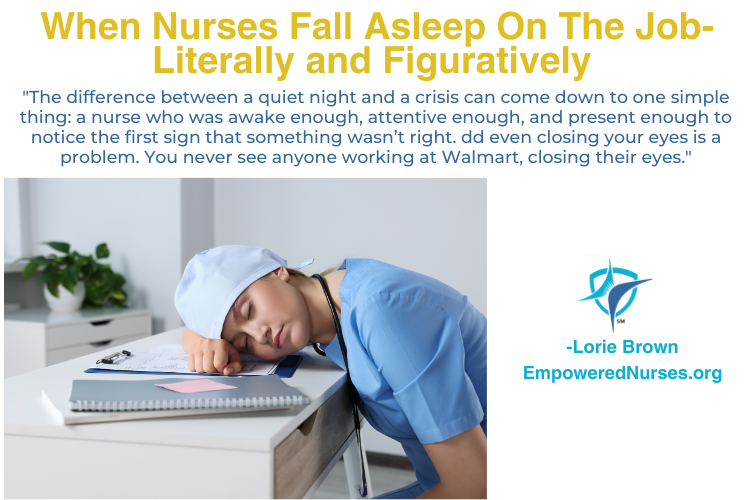
  1. When Nurses Fall Asleep on the Job—Literally and Figuratively

    Leave a Comment

    There is a moment on night shift that almost every nurse recognizes. The hallway lights are dimmed, the call lights are quiet, and the steady hum of monitors fills the silence. The rest of the world is asleep, and the hospital feels like it has slowed its pulse. Somewhere around three in the morning, the body feels it. Eyelids grow heavy. The chair feels a little too comfortable. Someone jokingly says, “Wake me if something happens.” In those quiet hours, the temptation to close your eyes, even just for a minute, can feel strong.

    But sleeping on the job, even during a slow night shift, is not harmless. It is not simply part of working nights, and it is not something nurses should normalize. At its core, it is accepting pay for work you are not doing. Hospitals are not paying nurses to be present only when something dramatic happens. They are paying nurses to be present the entire shift—to monitor, assess, anticipate problems, and intervene before a situation turns into an emergency.

    Patients rarely deteriorate with a loud announcement. It often happens quietly. Oxygen saturation may begin to drift downward. A confused patient may start trying to climb out of bed. A cardiac rhythm may change subtly before it becomes dangerous. These early warning signs require a nurse who is alert, observant, and engaged—not someone dozing at the desk hoping the monitors will sound an alarm.

    There is also another kind of sleeping on the job in nursing, and it may be even more dangerous. This is the figurative kind. It happens when nurses move through their shifts on autopilot—charting without thinking deeply, following routines without questioning them, and simply going through the motions. Over time, familiarity and fatigue can dull the sharpness of clinical judgment. A nurse can technically be awake but mentally disengaged, missing the bigger picture unfolding right in front of them.

    Nursing has always required presence—mental presence, ethical presence, and professional presence. When nurses disengage, whether through exhaustion or complacency, that presence fades. The result may not be dramatic negligence, but it can still lead to real consequences. A missed assessment. A delayed response. A decision made without fully processing the situation.

    None of this is meant to shame nurses who are tired. Fatigue is real, and healthcare systems push nurses to their limits. Twelve-hour shifts stretch into thirteen or fourteen. Staffing is thin. Breaks are skipped. Night shift is physically demanding in ways many people outside healthcare never understand.

    But professionalism still matters. When a nurse is on duty, they are responsible for human lives. That responsibility does not dim when the lights are turned down for the night. Being awake, alert, and oriented on the job is not simply a workplace expectation—it is part of the ethical commitment nurses make when they accept the privilege of caring for patients.

    Night shift will always have those quiet hours when the hospital feels almost peaceful. Those moments can be deceptive. They are not an invitation to disengage. In many ways, they are when vigilance matters most. The difference between a quiet night and a crisis can come down to one

    simple thing: a nurse who was awake enough, attentive enough, and present enough to notice the first sign that something wasn’t right.

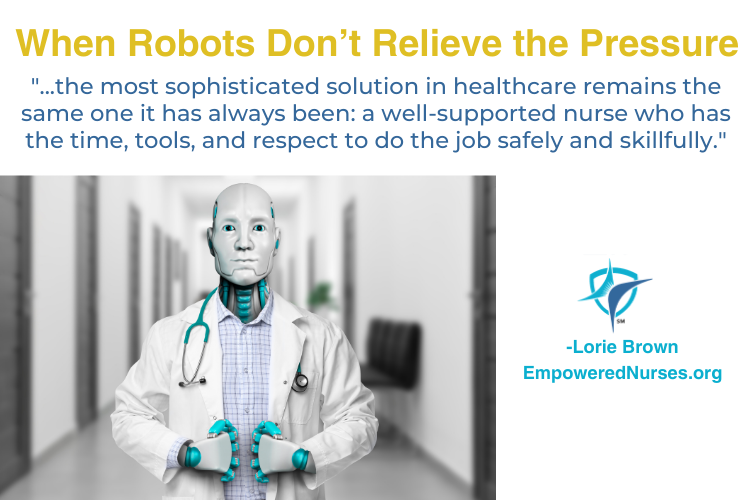
  2. When Robots Don’t Relieve the Pressure

    Leave a Comment

    Recently, MultiCare Health System made headlines after discontinuing its use of Moxi service robots at Tacoma General Hospital and Mary Bridge Children’s Hospital. The robots were introduced with big promises: reduce nurse walking time, transport supplies, handle specimen runs, and free nurses to spend more time at the bedside. On paper, it sounded like the clinical equivalent of calling in extra staff during a surge. In reality, many nurses reported the robots became obstacles rather than relief—slowing traffic in hallways, requiring supervision, and adding one more variable to an already unpredictable shift.

    The coverage by nurse.org highlighted what many bedside clinicians quietly know: technology that isn’t built around real workflow doesn’t reduce workload. Instead of eliminating steps, the robots sometimes created them. Nurses had to help them navigate elevators, maneuver around tight corners, and troubleshoot glitches. It’s a little like adding a new electronic health record update mid-shift—technically designed to “help,” but practically increasing cognitive load when you’re already triaging five priorities at once.

    The robots, developed by Diligent Robotics, have shown success in some health systems. But healthcare isn’t a sterile lab environment; it’s fluid, emotional, and constantly adapting. A unit can shift from calm to chaos in seconds. Nurses anticipate needs before alarms sound. We read rooms the way cardiologists read EKGs. That intuition—honed by experience—doesn’t translate easily into algorithms.

    What’s especially telling is where MultiCare ultimately redirected its investment: into its nursing workforce, including significant pay increases through newly negotiated contracts. That decision speaks volumes. When administrators stepped back and evaluated cost versus impact, they chose people over programming. In a time when burnout feels like a chronic condition across the profession, that shift matters.

    Artificial intelligence and robotics are not inherently the enemy. Like any intervention, the question isn’t whether the tool is powerful—it’s whether it’s appropriate. In medicine, we don’t treat hypotension with antibiotics simply because antibiotics are advanced. We choose interventions that address the root problem. Burnout and staffing strain are human issues. If AI is layered on top without redesigning workflow around the nurse experience, it risks becoming another task to manage rather than a support to lean on.

    The deeper lesson here is this: innovation must begin at the bedside, not in the boardroom. Nurses don’t need shiny gadgets that require babysitting. They need staffing ratios that make sense, compensation that reflects responsibility, and systems that decrease friction instead of increasing it. Technology can absolutely play a role—but only when nurses are central to its design, implementation, and evaluation.

    Until then, the most sophisticated solution in healthcare remains the same one it has always been: a well-supported nurse who has the time, tools, and respect to do the job safely and skillfully.

  3. Don’t Forget Your Beginner Mindset

    Leave a Comment


    When a nurse decides to start her own business, something subtle but powerful happens inside her. The confident clinician who can manage a crashing patient, juggle five priorities at once, and advocate fiercely for her license suddenly feels… new. Unsure. A little wobbly. And instead of recognizing that feeling as normal, she often interprets it as a sign she’s not cut out for entrepreneurship.

    But think back to your very first shift as a new nurse. You didn’t know everything. You understood safety. You knew how to assess, how to follow protocols, how to protect your patient. But you didn’t yet know the rhythm of the unit. You didn’t know which physician preferred a phone call versus a secure message. You didn’t know how to chart efficiently or where the IV start kits were hidden. You were safe, but you were still learning. And no one expected you to have all the answers.

    Starting a business requires that same beginner’s mindset.

    Somewhere along the way, many nurses adopt the belief that because they are experienced professionals, they should automatically be competent in business from day one. They think they should instinctively know how to price their services, draft contracts, market online, negotiate with attorneys, manage bookkeeping, and build systems. When they don’t know these things, shame creeps in. They assume everyone else is ahead. They question whether they’re “business material.”

    That thinking is as unrealistic as expecting a brand-new graduate nurse to run a code independently on her first day. Competence in one domain does not magically transfer to mastery in another. Clinical expertise does not equal entrepreneurial fluency. And that is not a flaw—it is simply reality.

    When you were new, you relied on a preceptor. You asked questions. You double-checked dosages. You clarified orders instead of guessing. You didn’t see that as weakness; you saw it as practicing safely. Business works the same way. A beginner’s mindset does not mean reckless or incapable. It means curious. It means teachable. It means humble enough to seek mentorship and structured guidance rather than trying to “wing it.”

    In nursing, refusing to ask for help can harm a patient. In business, refusing to seek mentorship can harm your growth, your finances, and your confidence. Isolation is not independence. It’s simply slower learning with more preventable mistakes. The most successful nurse entrepreneurs are not the ones who knew everything at the start; they are the ones who stayed coachable.

    There is also an ego shift that must happen. Nurses are high achievers. Many have spent decades being the go-to person on their unit. Walking into a new arena and feeling awkward can sting. But discomfort is not incompetence—it is the early symptom of growth. Just as muscle fibers tear slightly before they strengthen, your confidence stretches and rebuilds through repetition and exposure. You did not become calm in emergencies overnight. You earned that steadiness by showing up repeatedly. Business confidence grows the same way.

    A beginner’s mindset also keeps you adaptable. Healthcare changes constantly. Policies evolve. Technology advances. Markets shift. The nurse who assumes she already knows everything becomes rigid. The nurse who remains curious stays relevant. Approaching business with an attitude of assessment—observe, gather data, test, reassess—mirrors the nursing process you already know so well. You are not abandoning your training; you are applying it in a new context.

    If you are in the early stages of building something of your own and thinking, “I should be further along,” pause. You are exactly where beginners are supposed to be—learning. Every nurse entrepreneur you admire once searched basic questions online. She mispriced her services. She stumbled through early conversations. She refined her systems over time. Just like you once fumbled through your first patient handoff and gradually became the nurse others trusted.

    The truth is, you have already proven you can grow into competence. You have stepped into high-stakes environments and developed expertise through mentorship, repetition, and humility. Entrepreneurship is no different. It does not require perfection. It requires safety, ethics, resilience, and a willingness to learn.

    Give yourself the same grace you extend to new nurses on your unit. Stay teachable. Ask for guidance. Build strong foundations. You do not need to know everything to begin. You simply need to begin with the understanding that being new is not a liability—it is the starting point of mastery.

  4. When the Board of Nursing Causes Harm: Kansas Proposes a Compensation Fund for Nurses

    Leave a Comment

    Nurses understand accountability. It is part of the profession. Licensure exists to protect the public, and disciplinary action is appropriate when patient safety is at risk. But what happens when harm to a nurse has nothing to do with patient care — and everything to do with how regulation is applied?

    In Kansas, lawmakers are grappling with that question in a way few states ever have. The Kansas Legislature has proposed a $1 million Nurse Fair Treatment and Recovery Fund, designed to compensate nurses who experienced nonclinical harm caused by actions of the Kansas State Board of Nursing. This proposal represents a significant shift in how states may begin to view the consequences of regulatory overreach.

    What Is “Nonclinical Harm”?

    Nonclinical harm refers to damage that does not involve patient care, but still carries serious consequences for a nurse’s career and livelihood. This can include:

    · Loss of income

    · Damage to professional reputation

    · Barriers to future employment

    · Public disciplinary records tied to administrative or technical issues

    These are not trivial outcomes. For many nurses, licensure is not just a credential — it is their identity, financial stability, and ability to support a family.

    The Case That Sparked Legislative Action

    One of the cases drawing legislative attention involved Kansas nurse practitioner Amy Siple. While caring for her husband during his terminal cancer illness, her license renewal lapsed for several months. During that time, she was not actively practicing. Despite this, she was accused of practicing without a license and pressured to sign a consent agreement labeling her conduct “unprofessional” in national nursing databases.

    The issue was not patient harm. It was an administrative lapse during a period of profound personal crisis — yet the professional consequences were permanent and public.

    Other nurses testified that they were investigated or disciplined for matters unrelated to patient safety, including social media activity and paperwork errors, raising concerns about proportionality and fairness in enforcement.

    Legislative Intent: Oversight, Not Leniency

    Lawmakers supporting the fund have been clear: this is not about weakening standards or protecting unsafe practice. It is about acknowledging that regulatory systems can cause harm when discretion is misused or policies are applied without context.

    Representative Kristey Williams emphasized that the goal is balance — ensuring patient safety while also protecting nurses from unnecessary or excessive penalties that have lifelong consequences.

    Another proposal under consideration would require the Board to review past disciplinary actions related to administrative errors, particularly those stemming from licensing system failures or technical issues over the last several years.

    Why This Matters Beyond Kansas

    Even if you do not practice in Kansas, this proposal should matter to you.

    Across the country, nurses face increasingly complex regulatory requirements — renewals, reporting obligations, disclosures, and compliance rules that leave little room for human error. When those systems fail to account for real life, the consequences can be devastating.

    This fund sends a powerful message: Regulators must be accountable, too.

    For the first time, a state is publicly recognizing that nurses can be harmed by the very bodies meant to oversee them — and that fairness includes providing a remedy when that happens.

    A Broader Conversation We Need to Have

    Nurses are not asking for immunity. They are asking for proportionality, transparency, and due process.

    The Kansas Nurse Fair Treatment and Recovery Fund may be the beginning of a larger national conversation about how nursing boards operate, how discipline is imposed, and whether the punishment always fits the conduct.

    Accountability should protect the public — not unnecessarily destroy the professionals who serve it.

    If Kansas moves forward with this fund, it could become a model other states will be forced to examine. And that, in itself, may be long overdue.

  5. When Caring Hearts Go Silent: What Lexi Lawler Teaches Us About Nurses and Online Speech

    Leave a Comment

    In the intensive care unit, we measure pressures, saturations, reflexes, and responses. Outside the hospital walls, we measure trust, influence, reputation, and the sacred bond between nurse and community. When one of our own—like Lexi Lawler—becomes wrapped up in polarizing, harmful speech online, it’s not primarily a First Amendment issue. It’s a professionalism and ethics issue.

    Lexi Lawler, a former labor and delivery nurse, who spewed hate on TikTok. She used explicit and profane language to express that it gave her “great joy” to wish a fourth-degree tear—a severe obstetric injury—on White House Press Secretary Karoline Leavitt, who was pregnant at the time. She lost her job and now her license is in jeopardy.


    Let’s draw a parallel that every nurse can feel in their bones: If a patient’s vital signs are unstable, we don’t shrug and say, “Well, they’re breathing, so it’s free to fluctuate.” We intervene because standard of care demands it. In the same way, nurses aren’t free to let our professional conduct fluctuate based on personal grievance or social media irritation.

    This isn’t about political opinion. This is about professional identity.


    1. Nurses Don’t Turn Off Our Uniform at the Keyboard

    When a nurse pins on scrubs, they are visible, trusted, and held to a higher standard. That standard doesn’t dissolve the moment Wi-Fi kicks in or the video camera turns on. If anything, our reach expands with every post and share.

    Most nurses wouldn’t walk into a patient’s room and spew hate. We wouldn’t berate a family. We wouldn’t gaslight or demean. And yet, social platforms can sometimes feel like a “no-accountability zone,” a place where civility gets a flat tire.

    Professionalism isn’t a shift you punch out of at 0700. It’s the heart rhythm of our vocation.


    2. The Nursing Code of Ethics Isn’t Optional Even Off Shift

    The American Nurses Association Code of Ethics doesn’t have an asterisk that says “applies only between charting and hand-off.” It emphasizes:

    “Nurses must practice with compassion and respect for the inherent dignity…of every person.” — ANA Code of Ethics

    That means online too.

    Hateful speech—from slurs to shaming to dehumanizing commentary—violates those core ethical landmarks. It directly opposes the principles we pledge to uphold: dignity, respect, altruism, human flourishing.

    If our keyboard becomes a megaphone for exclusion or harm, we compromise the very foundation of our professional ethos.


    3. Influence Is a Form of Power—and Nurses Have It

    Lexi Lawler’s situation is a stark reminder that many nurses today are not just clinical caregivers—they are content creators, influencers, and public faces of the profession. With that influence comes responsibility.

    We don’t get to say “I was just venting” when we have thousands of followers who treat our words like care plans.

    Your online voice matters because your audience isn’t random—they see you in your scrubs, with your credentials, as the voice of nursing. In that sense, every post is a public health communication of sorts.


    4. Words Leave Bruises That Medicine Can’t Always Heal

    A patient once told me, “The nurse’s smile was stronger medicine than any pill.” But words can also be like shards of glass—small, sharp, and lodged deep.

    When a nurse uses language that targets groups, spreads hate, or incites division, it doesn’t just hurt feelings—it undermines community trust.

    Patients don’t just trust our clinical judgment; they trust our moral compass. That’s fragile. That’s earned. That’s easily lost.


    5. Accountability Isn’t Censorship—It’s Professional Integrity

    Some argue robust debate or heated language is just “free speech.” In a civil rights sense, that may be legally true. But in the nursing profession, free speech is not the same as consequence-free speech.

    Hospitals, boards, employers, insurance companies, and the public at large don’t differentiate between your keyboard and your badge. When speech crosses into hate, bias, or threat, it becomes a professional risk—just like ignoring a patient’s deteriorating vitals is a clinical risk.

    Ethics committees, board reviews, and HR don’t regulate speech because they enjoy bureaucracy—they do it to protect patients, communities, and the integrity of the profession.


    Nursing Isn’t Just What We Do—It’s Who We Are

    We are stewards of trust.

    We hold the fragile, the frightened, the vulnerable.

    Our words—typed, spoken, and shared—carry weight.

    Hateful speech is not a matter of can I say it? but should I? And for nurses, the answer is clear: what we say—in person or online—must reflect the dignity we are sworn to protect.

    Because hearts hurt. Souls bruise. And trust, once broken, is harder to heal than a wound.

  6. The Money Is in the Building—It’s Just Not Reaching the Bedside

    Leave a Comment

    If you’ve ever worked a shift so short-staffed that you skipped water, skipped the bathroom, skipped your own humanity—while being told, “There’s just no money right now”—this one’s for you.

    Because here’s the uncomfortable diagnosis healthcare doesn’t want to chart:

    The problem isn’t a lack of money. It’s a failure of distribution.

    This isn’t a revenue issue.

    It’s an ethical one.

    “There’s No Budget” Is the New “It’s Probably Just Anxiety”

    Nurses have been gaslit for years.

    We’re told there’s no funding for safe staffing.

    No money for meaningful raises.

    No flexibility for benefits.

    No room in the budget for retention.

    Yet when you pull the financial labs, the numbers tell a very different story.

    Some of the largest healthcare systems in the country are posting record-breaking revenues—the kind of numbers most bedside clinicians can’t even conceptualize because we’re too busy calculating whether we can afford groceries and gas in the same week.

    Healthcare isn’t broke.

    It’s just allocating resources like a patient circling the drain while admin argues over the color of the drapes.

    Follow the Money—It’s Loud

    While bedside staff are told to “do more with less,” major systems are reporting billions in operating revenue:

    • Kaiser Permanente reported over $115 billion in revenue
    • HCA Healthcare surpassed $75 billion
    • AdventHealth brought in nearly $20 billion
    • NewYork-Presbyterian Hospital reported more than $10 billion

    That’s not survival money.

    That’s thriving money.

    Yet somehow, the bedside is still running on skeleton crews and pizza parties.

    Executive Pay: A Different Planet, Same Building

    Let’s talk compensation—because this is where the numbers start to feel like satire.

    Healthcare executives are pulling in eight-figure compensation packages while the people keeping patients alive are told to be grateful they still have jobs.

    When a CEO makes $20+ million a year, that’s:

    • Over $1.6 million a month
    • Roughly $10,000 an hour
    • More in a single day than many nurses earn in an entire year

    That’s not leadership alignment.

    That’s a hemorrhage at the top while the bedside is asked to apply pressure with bare hands.

    And when you look at CEO-to-worker pay ratios—400:1 in some systems—it’s clear this isn’t about sustainability.

    It’s about priority.

    Branding Over Bodies

    If there’s “no money” for staffing, explain this like we’re in a deposition.

    Why are nonprofit health systems paying millions to slap their names on stadiums while units are in crisis?

    Naming rights.

    Luxury boxes.

    Private charters.

    Executive perks.

    Meanwhile, nurses are doubling assignments, CNAs are stretched past safe limits, and support staff are leaving because they can’t afford to stay.

    Patient safety doesn’t come from logos.

    It comes from people.

    The People Doing the Actual Work

    Let’s refocus the camera where it belongs.

    The people catching subtle changes before they become codes.

    The ones running toward alarms, not away from them.

    The ones cleaning rooms, delivering meals, managing airways, titrating drips, and holding hands when families can’t.

    Median U.S. salaries tell the real story:

    • Environmental services, dietary, CNAs—barely scraping livable wages
    • LPNs, RNs, RTs—asked to shoulder impossible responsibility
    • Advanced practice clinicians—still nowhere near executive compensation, despite enormous liability

    These aren’t replaceable roles.

    They are the infrastructure of healthcare.

    Those billions in revenue?

    They exist because of bedside care.

    When Workers Say “Enough”

    Strikes don’t happen because healthcare workers are greedy.

    They happen because the system stopped listening.

    Standing on a picket line means choosing patient safety over a paycheck—knowing full well the rent is still due.

    That’s not abandonment.

    That’s advocacy.

    Healthcare workers don’t strike because they don’t care.

    They strike because they care too much to keep pretending this is sustainable.

    Final Assessment

    The money is in the system.

    The staffing crisis is a choice.

    And “there’s no budget” is no longer a credible explanation.

    It’s time nurses and healthcare workers stop internalizing a lie that was never ours to carry.

    You are not expendable.

    You are not the problem.

    And you are not wrong for demanding better.

    Healthcare runs on your labor.

    It’s time the resources reflected that reality.

  7. Top 10 Nursing Practices That Are No Longer Approved

    Leave a Comment


    (A nostalgic, slightly alarming walk down memory lane)

    I jokingly say I was practicing nursing when the dinosaurs roamed the earth but here are some things we did that we no longer do. I am sure you have some examples on your own.

    1. Unclogging G-Tubes with Coca-Cola For years, Coca-Cola was treated like a medical device hiding in plain sight. If a G-tube clogged, nurses reached for a can, confident that carbonation and acidity would save the day. While this was historically common, evidence now shows that carbonated beverages and juices are inferior to warm water and can actually make clogs worse by curdling proteins in formula. The vending machine has officially been removed from enteral therapy.

    2. Using Saline for Suctioning Instilling saline directly into a tracheostomy or endotracheal tube before suctioning was once thought to loosen secretions and make suctioning more effective. Research later revealed that this practice can cause hypoxia, increase infection risk, and add unnecessary discomfort. What felt helpful turned out to be harmful, and routine saline instillation is now firmly discouraged.

    3. Shaving Pre-Operative Patients Routine shaving of surgical sites used to be standard pre-op care. The cleaner the skin looked, the safer the surgery—or so we thought. Evidence showed that shaving creates micro-abrasions that increase surgical site infections. Clipping, not shaving, is now the preferred method, and razors have been officially banished from pre-op prep.

    4. Routine Gastric Residual Checks Checking gastric residuals on tube-fed patients was once considered essential for preventing aspiration. Nurses measured, documented, discarded, and worried. We now know that frequent residual checks do not reliably predict aspiration risk and can lead to clogged tubes and accidental dislodgement. Less poking, fewer problems.

    5. Sliding Scale Insulin with Urine Dips Before glucometers became commonplace, urine dipsticks were used to estimate glucose levels, and insulin was adjusted accordingly. The problem? Urine glucose lags far behind blood glucose and is wildly inaccurate. Blood glucose monitoring has replaced this practice entirely, and urine dips have been retired to nursing history trivia.

    6. “Milking” or Stripping Chest Tubes Stripping chest tube tubing was once taught as a way to prevent blockages and maintain drainage. Unfortunately, this practice can generate dangerously high negative

    pressure, risking lung tissue damage. Current standards strongly discourage routine stripping, reserving it only for rare, provider-directed situations.

    7. Routine Soaking of Feet for Diabetic Patients Warm foot soaks were once considered soothing and hygienic for patients with diabetes. We now know that soaking can macerate skin, increase infection risk, and cause injury in patients with neuropathy who may not feel heat or trauma. Modern diabetic foot care focuses on protection, inspection, and keeping skin dry and intact.

    8. Reusing Needles, Catheters, and Other Instruments There was a time when supplies were reused after sterilization due to cost, availability, and necessity. Today, this practice is unthinkable. Reusing syringes, urinary catheters, or other single-use instruments carries an unacceptable infection risk and is strictly prohibited under modern infection-control standards.

    9. Using Alcohol Rubs or Baths to Reduce Fever Alcohol rubs and baths were once used to bring down a patient’s temperature. While they appeared effective, alcohol causes vasoconstriction and shivering, which can actually raise core body temperature and increase discomfort. Evidence has fully retired alcohol from fever management.

    10. Placing Antacids or Food Products on Pressure Ulcers At one time, antacids, sugar, honey, and other household substances were applied to pressure ulcers in hopes of promoting healing or controlling bacteria. These practices have been replaced by evidence-based wound care products designed specifically for tissue repair, moisture balance, and infection prevention.

    None of these practices were done out of carelessness. They were done by nurses who were resourceful, committed, and working with the best knowledge available at the time. Nursing didn’t get safer because nurses were wrong—it got safer because nurses were willing to learn, adapt, and change. And that, arguably, is still the most important nursing skill of all.

  8. For Nurse Business Owners: Focus on the Destination, Not the Plane Ride

    Leave a Comment

    Here’s something no one tells nurse business owners early enough:

    There will be parts of this journey you do not want to do.

    Not because they’re wrong. Not because they don’t work. But because they’re uncomfortable.

    And nurses? We’re very good at confusing comfort with commitment.

    The plane ride of business ownership looks like: Learning sales when you’d rather perfect your service. Marketing yourself when you were taught to be humble. Having hard conversations about money, boundaries, and value. Showing up before you feel “ready.”

    And for me, it was dealing with the money and taxes when I can’t balance my checkbook.

    None of that feels cozy. None of it feels natural at first. And none of it means you made a bad decision.

    It just means… you’re in transit.

    The destination—the reason you started—was never about loving every step. It was about freedom. Autonomy. Impact. A business that works for you, not one that drains you like an extra shift you never agreed to.

    Here’s the shift that changes everything:

    Commitment asks, “Where am I going?” Comfort asks, “How do I feel right now?”

    If you only move when it feels comfortable, you’ll taxi forever and never take off. Also, feelings are the worst business owners because you will never feel like doing something that makes you feel uncomfortable.

    Some days, commitment looks like: Sending the email you’ve been avoiding or making the call. Raising your rates before your nerves calm down. Hiring help before you feel “big enough.” Staying the course even when the turbulence makes you question everything.

    You don’t judge a destination by the plane ride. You don’t cancel the trip because the seat is uncomfortable. And you don’t quit your business because growth feels awkward.

    This is the part most people turn around.

    But nurse business owners aren’t “most people.”

    So if today feels bumpy, ask yourself: Am I choosing comfort—or am I honoring my commitment to where I said I was going?

    Keep your eyes on the destination. That’s where the exhale lives.

  9. When one nurse is lost, all of us feel it

    Leave a Comment

    That’s not just a line from a press release—it’s the quiet truth beating in the heart of every nurse, every patient, and every person who knew and even those that did not know Alex Pretti. On January 24, 2026, the world lost a bright light: a man who chose nursing not just as a job but as a calling through a needless and senseless murder.

    Alex was just 37 years old—a registered ICU nurse at the Minneapolis Veterans Affairs Health Care System, where he cared for some of the sickest and most vulnerable among us. Colleagues remember him as kind, skilled, and ready with a joke even when the shift was long and heavy.

    We enter nursing because we want to ease pain, hold hands, steady trembling hearts—not because we seek comfort for ourselves, but because someone must be there in another’s darkest hour. Alex embodied that truth. Patients and coworkers alike saw in him not only competence but profound compassion: the sort that wraps around families as much as it wraps around patients’ trembling hands.

    In one deeply moving moment now shared online, Alex stands at the bedside of a veteran patient, honoring him with a “final salute”—a tribute spoken not with routine words, but with reverence for a life that served others. “Freedom is not free,” he said, reminding us all of the debt owed to those who sacrifice.

    To know that someone with a heart like his was taken so suddenly and violently is devastating. In Minneapolis on that January morning, federal agents shot and killed Alex during a confrontation that has since sparked intense debate, mourning, and calls for accountability. The circumstances remain under investigation, and conflicting narratives swirl—but what remains clear to all who knew him is this: Alex was not a threat; he was a caregiver, a neighbor, a friend, and a healer.

    His parents described him as a “kindhearted soul” who cared deeply for family, friends, and the veterans he served each day. “Alex wanted to make a difference in this world,” they said—words that now carry both aching grief and stubborn hope.

    Because nurses see life up close, we understand how fragile it truly is. We’ve watched monitors flatline, held phones so families could say goodbye, and stood in silence when goodbyes were overdue. And we know that loss radiates far beyond a single moment—through shifts unfinished, through coffee mugs left warm, through the echo of laughter that once filled a break room.

    But we also know legacy: a name spoken with love, a story shared to remember, a life that mattered fiercely to people who knew him and even to those touched by his example. Alex Pretti’s legacy lives in every act of kindness, every nurse who pauses to truly see a patient, and every person who today feels the weight of loss mixed with the warmth of having known him.

    This is not just a sad story—it’s a call to remember why we serve, why we care, why human life matters. In the quiet moments between beeps and breaths, we keep his memory alive. When we

    advocate for safety, accountability, and dignity for all caregivers, we honor him. When we choose compassion over convenience, courage over complacency, we honor him.

    Because Alex didn’t just wear scrubs—he lived the promise of nursing: to show up, to shield, to comfort, to heal. And when someone like that is lost, the world feels a little colder, a little quieter, a little less sure of itself.

    But his impact? That stays. That never leaves. That becomes part of all of us who continue to care.

  10. Nursing strikes in New York, California, and Hawaii: where things stand and what it really means

    Leave a Comment


    Right now, nursing labor disputes across New York, California, and Hawaii feel less like isolated events and more like a system-wide stress test. When multiple regions are striking or preparing to strike at the same time, it’s not just a contract dispute anymore when nurses are already stretched thin.

    In New York, the strike is no longer theoretical. As of mid-January 2026, thousands of nurses represented by the New York State Nurses Association walked out of multiple hospitals across New York City, including facilities within the Mount Sinai, Montefiore, and New York-Presbyterian systems. The strike began on January 12 and has continued into its second week, with negotiations restarting intermittently but without a comprehensive resolution. Nurses have been vocal about staffing ratios, workplace safety, and benefits, while hospitals maintain that they are continuing operations through the use of temporary replacement staff. From the outside, the lights are on and the doors are open—but anyone who has ever worked a unit held together with travelers and emergency staffing knows that “open” is not the same as “stable.”

    Meanwhile, California and Hawaii are bracing for what could become one of the largest coordinated healthcare strikes in recent years. Tens of thousands of nurses and healthcare professionals at Kaiser Permanente facilities have issued notice of an open-ended strike scheduled to begin January 26, 2026. The planned walkout would affect hospitals and clinics across both states, with union leadership citing staffing levels, access to timely care, wages, and bargaining practices as core issues. Kaiser, on the other hand, has publicly framed the dispute as largely economic and has emphasized its contingency plans to maintain patient safety if the strike proceeds. At the time of writing, this situation remains a “strike pending” scenario—no resolution has been announced, and both sides are digging in.

    As these disputes unfold, one of the most emotionally charged questions nurses face is whether to cross the picket line. This decision is rarely philosophical and almost never simple. Nurses who cross often do so because they need immediate income, or feel a deeply ingrained ethical pull to remain at the bedside. For some, strike pay does not come close to covering the cost of living, particularly in high-cost regions like New York City, California, and Hawaii. In those moments, the decision feels less like a labor stance and more like choosing between oxygen and principle.

    At the same time, crossing a picket line can carry significant personal and professional consequences. Relationships with colleagues may fracture in ways that do not easily heal once the strike ends. Union members who cross may face internal disciplinary processes depending on the union’s bylaws. There is also the patient safety reality that replacement staffing, while legally permissible and operationally necessary for hospitals, often lacks unit-specific familiarity. Policies, workflows, and subtle patient cues can be missed. From a nursing standpoint, the patient may technically be monitored, but the margin for error grows thinner.

    For nurses weighing this decision, it can help to think in familiar clinical terms. Assessment means taking an honest look at finances, family responsibilities, and professional risk. Diagnosis means naming what is truly driving the decision—fear, necessity, ethics, or exhaustion. Planning involves deciding how to act intentionally rather than reactively, and evaluation comes later, when the dust settles and lessons are learned. There is no universal right answer, only informed ones.

    Behind all of this is a question hospitals rarely want discussed publicly: what do strikes actually cost medical centers? The answer is far more complex than “higher wages.” During active strikes, hospitals may pay replacement nurses rates reported as high as several thousand dollars per week per nurse, particularly in high-demand urban markets. I read $9,000/week. That figure does not include agency fees, travel and housing expenses, onboarding costs, or the overtime required for managers and supervisors to maintain coverage. Elective procedures, which are often the financial backbone of hospital operations, may be postponed or cancelled due to staffing instability, further eroding revenue.

    Operational inefficiencies also multiply. Running a hospital with large numbers of temporary staff slows throughput, increases reliance on workarounds, and diverts leadership attention away from quality improvement and risk reduction. Even when adverse events do not make headlines, near-misses and system strain quietly accumulate. In past large-scale strikes, replacement staffing costs alone have reached tens of millions of dollars per week, offering a sobering reference point for how quickly financial losses can escalate. Why don’t they just pay nurses a fair wage rather than paying these exacerbated costs?

    The hidden costs may be even greater. Prolonged labor disputes can damage a hospital’s reputation, make recruitment more difficult, increase long-term reliance on agency staff, and deepen turnover once the strike ends. In healthcare, winning a contract battle while losing the trust of your workforce is a short-term victory with long-term consequences.

    As of now, New York nurses remain on strike, while California and Hawaii nurses are watching the calendar inch toward January 26. For nurses across the country, these events are being closely watched not just as labor actions, but as signals of how much strain the healthcare system can absorb before something gives. Like any patient under prolonged stress, the system may keep compensating—until it can’t.

As Seen On:

Women's Week