Join me for an exclusive in-person event for LNCs to hear the behind-the-scenes legal process from 12 attorneys! ❱❱

Empowering Nurses at the Bedside and in Business

Author Archives: Lorie A Brown, R.N., M.N., J.D.

  1. Nurses: There Is a Path to Loan Relief — Here’s How Washington Is Helping

    1 Comment


    For many nurses, student loan debt shapes career decisions long after graduation. It influences where you work, whether you pursue an advanced degree, and if teaching or serving in an underserved area is even financially possible.

    Washington State has taken steps to address this reality through loan repayment initiatives designed specifically to support nurses while strengthening the healthcare workforce.

    Here’s what’s happening and why it matters.


    Why Washington Created These Programs

    Washington is facing ongoing shortages in:

    · Rural and underserved communities

    · Primary care and behavioral health settings

    · Nursing faculty and nurse educators

    At the same time, the cost of nursing education continues to rise, especially for nurses pursuing graduate degrees. Many nurses want to serve in high-need areas or transition into teaching but simply cannot afford to do so while carrying large student loan balances.

    These loan repayment programs are intended to reduce that barrier — not as a bonus, but as a workforce strategy.


    Washington Health Corps Loan Repayment Program

    The Washington Health Corps Loan Repayment Program offers student loan repayment for licensed healthcare professionals, including registered nurses and advanced practice nurses, who work in approved shortage areas.

    Key points nurses should know:

    · You must work at an approved site serving a high-need population

    · Loan repayment is provided in exchange for a service commitment

    · Awards can be substantial and are applied directly to qualifying student loans

    · Applications are typically open once per year, usually January through early March

    For nurses already working in these settings, this program can provide financial relief without requiring a job change. For others, it may make a previously unaffordable position realistic.


    Nurse Educator Loan Repayment Program

    Washington also offers loan repayment for nurses who teach in accredited nursing programs.

    This program recognizes a critical issue: nursing schools cannot expand enrollment without qualified educators, yet teaching salaries often do not match the financial investment required to obtain advanced nursing degrees.

    What this program supports:

    · Registered nurses with advanced degrees

    · Teaching roles in approved nursing education programs

    · Loan repayment tied to a teaching commitment

    Supporting nurse educators is essential to maintaining and growing the nursing workforce statewide.


    Why This Matters Now

    Recent federal policy discussions have raised concerns about reduced access to graduate-level student loans for nurses. If those changes move forward, nurses pursuing advanced practice or faculty roles could face even greater financial strain.

    Washington’s loan repayment initiatives help offset that risk and demonstrate a commitment to keeping nurses in roles that are critical to patient care and education.


    What Nurses Should Do Next

    If you are interested in these programs:

    · Review eligibility requirements early

    · Confirm whether your employer or school is an approved site

    · Gather loan and employment documentation ahead of the application period

    · Speak with leadership or HR — many organizations are familiar with the process

    These programs are competitive, and preparation matters.


    Bottom Line

    Loan repayment programs do not eliminate the challenges nurses face — but they can significantly reduce financial pressure and expand career options.

    For nurses who want to serve where they are needed most or teach the next generation, Washington’s initiatives may provide the support that makes those paths sustainable.

    If you are not in Washington State, share this initiative with your legislators in your states.

    This isn’t about incentives. It’s about keeping experienced nurses in roles the healthcare system depends on.

  2. Focus on the Destination, Not the Plane Ride

    1 Comment

    Most nurses don’t quit because they don’t love nursing. They quit because the plane ride is exhausting.

    Turbulence. Delays. Cramped seats. No legroom. Someone kicking the back of your chair while asking you to “do more with less.” Sound familiar?

    Somewhere along the way, many nurses start believing that the plane ride is the trip. That if it’s uncomfortable, chaotic, or downright miserable, then maybe the destination isn’t worth it—or worse, doesn’t exist at all.

    But that’s not true.

    The plane ride is just the process. The destination is the life you actually want.

    And nurses? We are very good at tolerating uncomfortable processes. Sometimes too good.

    When the Plane Ride Becomes the Focus

    When you’re in survival mode, it’s hard to see anything beyond the next shift, the next chart, the next crisis. Your world shrinks to tray tables and seatbelt signs.

    You start thinking:

    · “Once staffing gets better…”

    · “Once leadership changes…”

    · “Once I’m less tired…”

    But that’s like staring at the flight map while ignoring why you booked the trip in the first place.

    You didn’t become a nurse to sit in perpetual turbulence.

    The Destination Matters

    The destination might look different for each nurse:

    · More autonomy

    · Time with family

    · A business, a pivot, a new role

    · Peace without guilt

    · Work that doesn’t require recovery days

    Destinations don’t require perfection. They require direction.

    And here’s the part nurses forget: You’re allowed to adjust the route.

    You can change planes. You can upgrade seats. You can decide that nonstop is worth it—even if it costs more energy upfront.

    A Gentle Reframe

    When things feel unbearable, ask yourself:

    “Am I judging my entire career based on the plane ride instead of the destination?”

    Because no one posts vacation photos of the airport security line. They post sunsets, laughter, and the moment they finally exhale.

    Your current discomfort does not mean you chose wrong. It means you’re in transit.

    Final Thought

    Nurses are trained to endure. But you were never meant to live in turbulence.

    Keep your eyes on where you’re going. The destination is still there—even if the ride is bumpy.

    And if it’s time to land somewhere new? That’s not failure. That’s navigation.

  3. Your License Is Your Lifeline: What the NSO 2025 Claims Report Reveals About License Defense

    1 Comment

    Most nurses think about malpractice insurance the way we think about crash carts — important, but something we hope we never have to use.

    License protection? That’s more like oxygen.

    You don’t notice it… until suddenly, you can’t breathe.

    The 2025 NSO/CNA Nurse Professional Liability Claim Report (5th Edition) offers a sobering but empowering look at what actually happens when nurses face State Board of Nursing (SBON) investigations — and why license defense coverage is no longer optional, even for nurses who “do everything right.”


    License Protection Is Not Malpractice — And That Distinction Matters

    One of the most important clarifications in the report is this:

    License protection matters are fundamentally different from malpractice claims.

    · Malpractice is a civil lawsuit brought by a patient or family.

    · License protection matters arise when the State Board of Nursing investigates you

    And here’s the part many nurses don’t realize until it’s too late:

    👉 A civil court cannot take your license. 👉 A nursing board absolutely can.

    Boards exist to “protect the public,” not to protect nurses. Their outcomes range from dismissal… all the way to probation, suspension, or revocation. That’s not a slap on the wrist — that’s career-altering.

    Think of it like this: A malpractice case is a complicated wound. A board complaint is a threat to your central line.


    The Numbers Nurses Can’t Ignore

    According to the 2025 report, license defense costs are rising sharply, even though the number of matters has slightly decreased.

    Here’s what stood out:

    · 1,125 license protection matters closed between 2020–2024

    · Total defense costs exceeded $7 million during that period

    · Average cost per license defense matter rose 18.3%, from $5,330 to $6,304

    And remember — that’s just defense costs. Even cases that end with no discipline still require attorneys, responses, preparation, and time.

    In nursing terms? That’s a long ICU stay… even when the patient survives.


    What Triggers Board Complaints? (Hint: It’s Not Just Patient Care)

    The most common reason nurses faced board action in the 2025 dataset?

    Professional Conduct — 38% of all license protection matters

    These included:

    · Substance use or diversion

    · Criminal charges (including DUI)

    · Social media behavior

    · Boundary violations

    · Documentation and disclosure issues

    · Even how information was reported on a license renewal

    More than half of all board matters (52%) involved professional conduct or scope of practice — not bedside errors

    This is where nurses often say:

    “But I wasn’t even taking care of a patient…”

    Exactly. And the board still has jurisdiction. They have a duty to ensure safety to the public. You are a nurse 24/7 and your actions off duty can cause discipline because of ethical issues. If

    you chose to get behind the wheel of a car after drinking, what other judgments could affect patient care?


    Scope of Practice: The Slippery Slope Nurses Don’t See Coming

    Scope-of-practice allegations accounted for 14% of license protection matters

    Many of these cases involved:

    · Medspas

    · Clinics

    · Home care

    · Situations with poor supervision or unclear policies

    The report calls this “scope creep” — when nurses step slightly beyond authorized practice, often trying to help, move things along, or be a “team player”

    In other words: Good intentions… poor outcomes.

    Like pushing meds without a clear order because “that’s how we always do it.”


    Why Your Employer’s Insurance Won’t Save You

    This is the part I wish every nurse learned before they get the letter or email from the Board.

    Employer insurance:

    · Protects the facility

    · Responds to patient claims

    · Often does not provide independent license defense

    Once the board comes knocking, nurses are frequently on their own — unless they have individual coverage that includes license protection.


    The Real Takeaway: Preparation Is Protection

    The NSO report isn’t meant to scare nurses. It’s meant to prepare them.

    Here’s what it makes clear:

    · Board complaints are common — and increasing in complexity

    · Defense costs are rising

    · Many matters involve non-clinical behavior

    · Nurses with coverage and early legal support fare better

    Your license is not just a credential. It’s your livelihood. Your identity. Your ability to keep doing the work you love.

    Protecting it isn’t paranoia.

    It’s professionalism.


    Final Thought

    Nurses are trained to assess risk early — before the patient crashes.

    Your career deserves the same vigilance.

    Because when it comes to your license, hope is not a strategy — preparation is.

  4. Time Management for Nurse Entrepreneurs: Stop Treating Your Business Like a PRN

    Leave a Comment


    Nurses are masters of time.

    You can pass meds, answer call lights, chart, calm a family member, and somehow still know it’s exactly 10:59 and the IV antibiotic must be hung by 11:00. That skill didn’t disappear when you became a nurse entrepreneur.

    So why does your business feel like a patient circling the drain while your to-do list codes every afternoon?

    Because most nurse entrepreneurs are running their businesses like an understaffed med-surg unit on a holiday weekend — reacting instead of leading.

    Let’s fix that.

    First, a Diagnosis 🩺

    Most nurse entrepreneurs don’t have a time problem. They have a boundary problem.

    You’re treating every email like a STAT order. Every request like it’s life-or-death. Every opportunity like you have to say yes “just in case.”

    Sound familiar?

    In healthcare, we triage. In business, many nurses forget that skill entirely.

    Triage Your Time Like You Triage Patients

    Not everything deserves immediate attention.

    Ask yourself:

    · Is this revenue-generating?

    · Is this mission-critical?

    · Or is this busywork dressed up in scrubs?

    If it doesn’t move your business forward, protect your license, or put money in the bank — it goes to the waiting room. My favorite saying is do, delete or delegate!

    You would never start an IV on someone with a paper cut while a stroke patient waited. Stop doing that with your calendar.

    Stop Charting on Everything

    Perfectionism is the silent time thief of nurse entrepreneurs.

    You don’t need:

    · The perfect website before you start

    · The perfect logo before you pitch

    · The perfect plan before you act

    In nursing, we chart what matters. In business, document the essentials and move on.

    Progress beats pristine every single time.

    Block Time Like It’s a Medication Pass

    Here’s a hard truth: If it’s not scheduled, it’s not going to get done.

    Calendar everything and treat your time like it was money. How would you spend it? Would you network or not work!

    Time blocking isn’t restrictive — it’s protective.

    Create blocks for:

    · Client work

    · Marketing

    · CEO thinking time (yes, that’s a thing)

    · And off time (because burnout is not a badge of honor). I always block time for vacations first or I would not take one.

    You wouldn’t randomly pass meds whenever you “felt like it.” Don’t run your business that way either. Your business is a baby. Don’t stick it in the closet!

    Delegate Like a Charge Nurse

    You don’t have to do everything.

    And no — doing it yourself is not “saving money.” It’s costing you growth.

    If someone else can do it 80% as well as you, hand it off.

    · Bookkeeping

    · Scheduling

    · Tech

    · Social media posting

    In addition, hire out to make your life easier and give you more time to grow your business such as housecleaning, laundry, grocery shopping and even cooking.

    Your highest and best use is strategy, vision, and leadership — not playing whack-a-mole with admin tasks.

    Build White Space Into Your Shift

    Here’s the part nurses struggle with the most: rest.

    White space isn’t laziness. It’s clinical judgment.

    That’s where creativity lives. That’s where clarity shows up. That’s where your next big idea breathes.

    If you run your business at 100% capacity all the time, something will fail. In healthcare, we call that a sentinel event.

    Final Discharge Instructions 📝

    Time management for nurse entrepreneurs isn’t about doing more.

    It’s about:

    · Doing fewer things

    · On purpose

    · With intention

    · And without guilt

    You already know how to manage chaos. Now it’s time to manage your energy, your priorities, and your future.

    Because you didn’t leave bedside to create another exhausting shift — you left to build freedom.

    And that, my friend, deserves protected time.

  5. Are We Shortchanging the Teachers of Nurses? The Stark Salary Gap Between Nurse Educators & Clinical Nurses

    1 Comment

    Imagine you’re in a busy hospital unit at 0700: monitors beeping, report ending, meds due. That’s clinical nursing — high stakes, high stress, high compensation compared to many other nursing roles. Now imagine standing before a classroom of eager students, each hoping you’ll turn their anxiety into confidence — that’s the role of a nurse educator. But here’s the surprising twist: the clinicians at the bedside often make significantly more money than the educators preparing tomorrow’s nurses.

    The Numbers Don’t Lie (But They Do Surprise) Recent research shows the average annual salary for nursing faculty — the people tasked with turning seasoned RNs into experienced educators — sits around $81,600, compared with about $90,400 for clinical RNs in direct care roles. That’s more than $8,000 less yearly on average, even before you adjust for experience, education, and hours worked.

    Once those adjustments are added in, the gap widens dramatically:

    · Nurse educators earn about $18,300 less than staff nurses

    · $19,800 less than charge nurses

    · And a whopping $27,500 less than front-line nurse managers who often still spend part of their time at the bedside.

    Thus, educators are sending new grads off to earn more than you do for teaching it.

    So Why Does This Matter?

    This isn’t just about paychecks — it’s a workforce crisis. When educators make less than their clinical counterparts despite often having higher degrees and more experience, fewer seasoned nurses choose to step into faculty roles. That means fewer instructors for nursing programs, and fewer seats for students eager to enter the profession. That’s a pipeline issue with real-world repercussions — patients needing care and classrooms needing teachers.

    To keep nursing education healthy, we can’t treat faculty like an afterthought. After all, they’re the ones teaching clinical judgment, triage skills, and the art of compassionate care — arguably more important than memorizing lab values.

    What’s Driving the Gap?

    Several factors contribute:

    · Academic budgets often lag behind clinical revenue streams. Universities may not have the financial agility of hospital systems that bill — and get paid — for every procedure and nursing service.

    · Clinical roles, especially in specialty areas, command premium wages, particularly in high-cost regions or when overtime and shift differentials are factored in.

    · Some nurse educators work academic calendars, which can reduce the annualized pay compared to 12-month clinical contracts.

    Why Nurse Educators Still Matter (and Deserve Better Pay)

    You know that moment when a student finally masters an IV start they’ve been struggling with? That “aha!” moment lights up the room — and that’s the everyday reality of nurse educators. They are the heart specialists of knowledge transfer: diagnosing learning gaps, crafting teaching plans, mentoring through clinical uncertainty, and prepping nurses who will look after your family in their darkest moments.

    Educators often do it with fewer resources — and less compensation. This isn’t just an economic disparity — it’s a mismatch between impact and reward.

    What Can We Do?

    Nursing organizations and policymakers are already sounding the alarm. Bills like the Nurse Faculty Shortage Reduction Act aim to bridge this gap by supporting faculty salaries and recruitment efforts so that educators aren’t pushed back into the bedside purely for financial reasons. Please call your congressmen to support this.

    Conclusion

    Clinical nurses save lives every day — that’s undeniable. But nurse educators save the profession itself. We wouldn’t tolerate an ICU with half the nurses we need, so why tolerate a faculty shortage that limits the nurses we can train?

    We owe it to future patients, future clinicians, and future nurse educators to close the salary gap — to respect the educators who educate nurses with the same vigor we respect those at the patient’s side.

    After all, a well-prepared nurse is the best medicine of all.

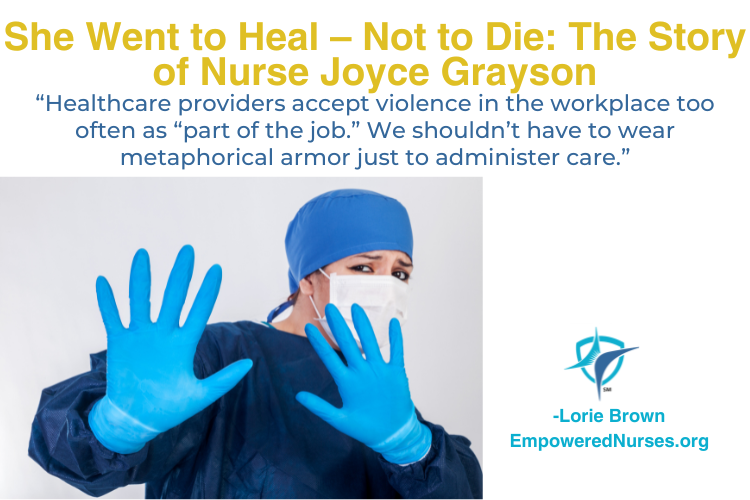
  6. She Went to Heal — Not to Die: The Story of Nurse Joyce Grayson

    Leave a Comment

    It was just another October day in 2023, but for Licensed Practical Nurse Joyce Grayson, it was the beginning of a final chapter that would ripple across the nation of caregivers. Joyce walked into a home clinical setting — a halfway house in Willimantic, Connecticut — carrying her nursing bag, her years of experience (36 of them), and that nurse’s instinct to help. What she didn’t carry were the tools she needed to protect herself from what she already knew could be a dangerous situation.

    A Hazard We Knew Was There — But Didn’t Fully Protect Against

    Home health nursing is like being a solo paramedic clinician walking into a dynamic scene: the environment is uncontrolled, the patient’s history may be incomplete, and the safety net is thin. Joyce’s employer, one of the country’s largest home health care agencies, knew — or should have known — that the client visited that day was a convicted violent offender with a history of aggression. Yet Joyce went in without systems in place to protect her: no comprehensive background info, no panic alert device, no safety escort — nothing to buffer the unpredictable tension inherent in that setting.

    OSHA’s investigation later concluded that the employer failed its legal duty to protect its workers from a recognized hazard: workplace violence in a home care environment. They cited the agency for not having adequate measures to reduce that risk — a general duty violation that cost a nurse her life.

    The Cost of Caring

    Nurses are trained to triage, to assess, to plan — but no amount of clinical skill can substitute for a broken system that doesn’t prioritize caregiver safety. When Joyce stepped into that home, she was simply doing her job. But the job, in this case, included hazards no nurse should face without protection.

    Workplace violence in healthcare isn’t rare — OSHA reported hundreds of worker deaths from violence in 2022 alone — yet too often, the shield meant to protect clinicians is missing.

    A Family, A Community, a Profession Changed

    Joyce was more than a statistic. She was a 63-year-old nurse, a mother, a veteran of healthcare, and a heart full of care that outlived her body. Her death sparked outrage, grief, and a fierce conversation about how we protect those who protect life. Within legislatures and nursing organizations, the call for workplace violence prevention standards is growing louder — fueled by hearts broken but not silent. In Connecticut, lawmakers moved forward with new safety requirements for home care workers — tools clinics should have offered her long before she walked into harm’s way.

    What Nurses Deserve — Always

    Joyce’s story is tragic — this should have never happened. But it’s also a stark reminder:

    · Every nurse deserves a workplace that recognizes and mitigates risks.

    · Every home visit must come with intelligence, tools, protocols, and backup.

    · Every agency must do more than train — they must protect.

    Healthcare providers accept violence in the workplace too often as “part of the job.” We shouldn’t have to wear metaphorical armor just to administer care.

    A Call to Action

    We owe it to Joyce, and to every clinician who shows up wearing scrubs and compassion, to demand safety systems that work before tragedy strikes. The best protocol in the world can’t bring her back — but it can save the next nurse.

    That’s how we honor her — not with statistics, but with real safety change.

  7. “Stay in Your Lane”: How Good Nurses Cross the Line Without Even Knowing It

    Leave a Comment

    Most nurses who cross a scope-of-practice line don’t do it out of arrogance, recklessness, or a
    desire to overstep.
    They do it because they’re trying to help.
    They do it because a patient needs something now, the unit is short, and someone says, “Can you
    just…?” And in that moment, it doesn’t feel like crossing a line. It feels like being a nurse and
    wanting to help.
    That’s what makes scope-of-practice issues so dangerous — the nurses who get into trouble
    rarely think they’re doing anything wrong.
    They think they’re doing what they’ve always done. What the unit expects. What keeps the day
    from unraveling.
    And most of the time, nothing bad happens. Until it does.
    Scope of practice isn’t something nurses wake up thinking about at the start of a shift. It doesn’t
    announce itself with a red flag or a stop sign. It rarely says, Warning: License risk
    ahead. Instead, it sneaks in quietly — wrapped in teamwork, urgency, and good intentions.
    A nurse helps because a coworker is overwhelmed. A nurse fills a gap because the system has
    trained them to be the safety net. Over time, those small accommodations become normalized.
    The line doesn’t feel like a line anymore. It feels like the job.
    But here’s the hard truth: intent does not redefine scope.
    Scope of practice isn’t determined by how competent a nurse feels or how many times they’ve
    done something without incident. It’s defined by law. And the law doesn’t adjust based on
    staffing shortages, patient acuity, or good deeds.
    Nurses often assume that if an action is part of unit culture, it must be allowed. Or that if a
    supervisor approves it, they’re protected. Or that if a facility policy permits it, it must be within
    scope.
    That’s where the disconnect lives.
    Most nurses who face Board investigations are shocked. They replay the moment over and over,
    thinking, I was helping. I wasn’t being careless. I didn’t know this was a problem. And they mean
    it — because no one ever stopped them before.

    Healthcare systems quietly benefit from this gray area. Nurses are expected to stretch, adapt, and
    compensate without being fully informed of the legal boundaries they’re crossing. The lane
    widens when it’s convenient and narrows when accountability arrives.
    And when that accountability arrives, it doesn’t land on the system.
    It lands on the nurse.
    This is where “stay in your lane” becomes deeply unfair. You can’t stay in a lane that isn’t clearly
    marked, especially when you’ve been praised for drifting outside it in the name of helping.
    Saying “that’s outside my scope” requires more than knowledge — it requires courage. It means
    slowing down care in a profession that values speed. It means risking eye rolls, frustration, or
    being labeled “not helpful.” And for nurses who define themselves by service, that’s not easy.
    But boundaries are not the opposite of caring. They are part of caring.
    In medicine, we understand that skill without safeguards is dangerous. That’s why we have
    protocols, dosing limits, and checklists — not because clinicians aren’t capable, but because
    systems fail and fatigue happens. Scope of practice is one of those safeguards.
    Instead of asking, Can I do this? nurses need to start asking, Would I be stunned if this were
    questioned later? If the answer is yes, pause. Ask for clarification. Document concerns. Protect
    yourself before something goes wrong.
    Because the nurses who cross scope lines aren’t trying to break rules.
    They’re trying to keep patients safe or they just want to help.
    And ironically, it’s that instinct — unchecked and unsupported — that puts their own careers at
    risk.
    Staying in your lane isn’t about withholding care. It’s about practicing nursing in a way that
    honors both the patient in front of you and the license you carry.
    You shouldn’t have to sacrifice one to keep the other.
    Your license is not a group project.
    Staying in your lane isn’t about doing less. It’s about practicing safely, legally, and sustainably so
    you can keep doing the work you love without sacrificing the career you’ve built.
    And in today’s healthcare climate, that’s not weakness.
    It’s wisdom.

  8. The Most Powerful Word in Nursing Isn’t “Yes.” It’s “No.”

    Leave a Comment

    There’s a moment every nurse knows far too well.

    You’ve just clocked out. Your scrubs feel glued to your skin. Your feet are screaming louder than a trauma bay. You’re dreaming of your pillow the way most people dream of winning the lottery.

    And then it comes… That familiar voice from staffing… “Hey, can you stay an extra four? We’re short.”

    Suddenly, your heart rate spikes. Not because you want to stay. But because saying no feels like you’re letting your patients’ down or your coworkers.

    Nurses—let’s talk about it.

    No is not a failure.

    Somewhere along the way, we were conditioned—trained, even—to believe that “yes” equals dedication, and “no” equals letting the team down.

    But here’s the truth we don’t say loud enough:

    Saying yes when you’re exhausted doesn’t make you a hero. It makes you a human with a dangerously low battery.

    And just like with any patient, when a system is running on fumes, mistakes happen, burnout escalates, and compassion fatigue snowballs into resentment.

    Your “no” doesn’t harm anyone. Your no protects something precious: you.

    Nurses have been conditioned to people-please—and it’s costing them.

    We’re wired to fix, soothe, save, patch, and rescue. We want to be reliable. We want to be helpful. We want to be the one who keeps everything running.

    But hospitals have taken advantage of that trait for decades.

    They rely on your guilt. Your desire to “be a team player.” Your fear of looking lazy, uncommitted, or not strong enough.

    Let me say this clearly and lovingly:

    🩺 You are not a backup generator for a broken staffing system. 🩺 You are not an emotional support human for your manager’s scheduling mistakes. 🩺 You are not obligated to sacrifice your wellbeing to save a shift that was already sinking.

    No is a complete sentence. And a life-saving intervention.

    You don’t need to say:

    “I’m sorry, but…” “I would, except…” “I feel bad, however…” “I wish I could, but…”

    Nope. Full stop. End of story.

    Just: “No, I can’t stay.” “No, I’m not available.” “No, that doesn’t work for me.”

    No apologies. No guilt. No emotional CPR required.

    Because here’s the magic: Every no you say to someone else is a yes to yourself.

    A yes to rest. A yes to your mental health. A yes to the family who hasn’t seen you vertical in three days. A yes to your sanity.

    If you need permission to say no… here it is.

    From one nurse to another, from someone who’s seen the disciplinary cases, the burnout, the injuries, the tears:

    ✨ You are allowed to protect your energy. ✨ You are allowed to go home. ✨ You are allowed to refuse extra shifts. ✨ You are allowed to not be everything to everyone. ✨ You are allowed to put yourself first.

    And if someone makes you feel guilty? That’s a reflection of their staffing problems — not your commitment.

    **The healthiest nurses aren’t the ones who say yes the most.

    They’re the ones who know when to say no.**

    So today, draw your line in the sand. Let your “no” be your IV bolus of empowerment. Let it be the boundary that keeps you whole. Let it be the word that reminds you: You matter. Your rest matters. Your life outside the hospital matters.

    Because you’re not “just a nurse.” You’re a human being with one precious body, one precious mind, and one precious life.

    And none of those are replaceable.

    So go ahead. Say it. Strong, steady, and with your chin high: No.

    Your future self will thank you.

  9. From Employee to CEO: How to Make the Leap Without Creating Another Job for Yourself

    3 Comments

    There’s a moment every nurse-turned-entrepreneur knows all too well. It sneaks up right after the excitement of launching your business… and right before the “wait… why am I more exhausted now than when I worked 12-hour shifts?”

    It’s that moment you realize: You didn’t leave bedside nursing just to create a brand-new, even more demanding job for yourself.

    Yet so many nurses accidentally do exactly that.

    We trade in our badge and scrubs for a laptop and an LLC, but deep down, our brains are still wired for clocking in, putting our heads down, and doing all the tasks. It’s the employee mindset we spent years mastering. And without even realizing it, we bring that mindset straight into entrepreneurship.

    But being an employee in your business and being the CEO of your business… those are two completely different worlds.

    And if you don’t intentionally shift into CEO mode, your business will happily hand you a triple workload, zero PTO, and a supervisor (also you) who expects miracles by lunchtime.


    The Truth No One Tells You:

    If you don’t step into the CEO role, you’ll default right back into being an employee in your own company.

    Employees keep things running. CEOs make things grow.

    Employees do the tasks. CEOs design the systems.

    Employees put out fires. CEOs prevent them from starting in the first place.

    Employees row the boat. CEOs chart the course—and pick the crew.

    And here’s where so many nurse entrepreneurs get stuck: We’re so used to jumping in, fixing everything, and making sure nothing crashes that we forget we’re not in the ICU anymore. We’re building something bigger—something meant to free us, not drain us.


    Signs You’re Still Operating Like an Employee in Your Business

    ✔ You feel guilty delegating (classic nurse guilt). ✔ You’re doing tasks someone else could handle for $20/hr while you’re worth $200/hr. ✔ You wake up tired because your to-do list slept in the bed with you. ✔ You constantly say, “It’s just easier if I do it myself.” ✔ You’re the CEO, receptionist, admin, marketing department, HR, billing, and janitorial staff.

    If this sounds familiar, don’t worry—you’re not alone. You’re just overdue for a mindset upgrade.


    What Shifting Into CEO Mode Actually Looks Like

    1. You build systems instead of stress.

    Systems turn chaos into calm. They take tasks out of your brain and put them on autopilot.

    2. You hire support before you’re drowning.

    In nursing, we’re trained to call for help early. In business? We forget and wait until we’ve coded twice.

    3. You stop being the default do-er of everything.

    You’re not the entire hospital staffing grid. You shouldn’t be running every department.

    4. You start protecting your time like a controlled substance.

    Locked. Counted. Not casually given away.

    5. You work ON your business, not IN it.

    Growth doesn’t happen from the trenches. It happens from the strategy table.


    The Big Danger:

    If you don’t intentionally step into being a CEO…

    you’ll accidentally build yourself another job.

    A job with worse hours. A job with no boundaries. A job with a boss (again, you) who has very high expectations and doesn’t approve vacation requests.

    That’s not why you became an entrepreneur.

    You stepped into this journey for freedom. For impact. For control over your time and your life. For the ability to build something meaningful—something that supports you instead of swallowing you whole.


    Your Business Doesn’t Need Another Employee.

    It needs its CEO.

    It needs your vision, not just your hands.

    So take a breath. Lift your eyes off the task list. Give yourself permission to lead, to delegate, to build systems, and to grow.

    Because the minute you stop playing employee and start acting like the CEO you are… your business finally has the leader it’s been waiting for.

  10. Nursing Is a Profession — and the DOE’s Loan Proposal Puts Our Entire Healthcare System at Risk

    Leave a Comment

    Nursing has always been more than a job. It’s a profession built on rigorous education, critical thinking, ethical judgment, and a deep commitment to the people and communities we serve.

    That’s why the Department of Education’s proposal to exclude graduate nursing programs from the definition of “professional degree programs” eligible for higher federal loan limits is deeply troubling. Even if this is framed as “just a loan classification,” the ripple effects are enormous — and dangerous. This proposal will go into effect in July 2026 unless we do something now.


    1. This isn’t simply about financial categories — it’s about access

    If this proposal goes forward, graduate nursing students would have access to only half the federal loan funding available to students in medicine, dentistry, and other fields the DOE continues to classify as “professional.”

    Half.

    That means fewer people will be able to pursue advanced practice and faculty roles — roles that are absolutely essential if we want to stabilize and strengthen the workforce.

    And they’re needed now more than ever.


    2. The American Nurses Association is raising the alarm — and they’re not alone

    The ANA states it clearly:

    “Nursing is a profession, essential to the health and safety of every American.”

    Yet this proposal suggests the opposite, at least in how graduate nursing education is funded.

    And the public agrees: In just a few days, more than 130,000 people have signed the ANA’s petition urging the DOE to reverse this decision.

    Why? Because the consequences reach far beyond the classroom.


    3. The proposal threatens to shrink the nursing workforce at the worst possible time

    Here’s what limiting graduate loan access means in real-world terms:

    Fewer Nurse Practitioners and Advanced Practice Providers

    These clinicians are often the primary source of care in rural and underserved communities. Reducing their educational access means reducing access to healthcare — period.

    Fewer Nurse Educators

    We can’t solve the nursing shortage without faculty. Yet faculty roles often require graduate degrees that are expensive and already under-compensated.

    Fewer leaders, specialists, and experts

    Healthcare grows more complex every year. We need nurses who can lead, teach, innovate, and advance practice — not barriers that prevent them from doing so.

    Worsened patient access nationwide

    This is not a small, internal policy issue. It affects the entire healthcare system and every community that depends on it.


    4. The proposal contradicts the broader federal push to strengthen advanced practice nursing

    Other federal initiatives have invested heavily in expanding APRN roles and addressing healthcare shortages. This loan proposal undercuts those efforts and sends a conflicting message about the value of nursing education.

    You cannot expand the workforce while simultaneously restricting the ability of nurses to pursue the education required.


    5. This affects every nurse, every patient, and every community

    Whether you are a bedside nurse, an APRN, a nurse educator, or someone who simply cares about the future of healthcare, this matters.

    Graduate nursing education is how:

    · new providers enter communities

    · faculty are trained to teach future nurses

    · innovations in care are developed

    · access expands in underserved areas

    · the next generation of leaders emerges

    If we limit access to education, we limit everything that follows.


    6. Now is the time to speak up — loudly and collectively

    The response already shows the power of our voices. Over 130,000 people have signed the ANA petition, and that number is climbing.

    This is the moment to add your voice.

    This isn’t just a matter of fairness. It’s a matter of public health, patient access, and the future of a profession that holds up the entire healthcare system.

    Nursing is a profession — and it deserves to be treated, funded, and respected as one. 👉 Please take a moment to sign the ANA petition and help correct this mistake.

As Seen On:

Women's Week