As much as we may believe nursing is all about the care, health care these days basically has taken most of the “care” out of nursing. We have devices like the one that can take blood pressure and put those readings into the medical record. We also have machines that dispense medications.
While nurses are more than just machines, we are educated and intuitive clinical providers. Nurses can recognize when a patient’s condition is deteriorating, take steps to stabilize the patient and call the physician if the problem escalates.
In Japan, there are now nurse robots being tested that will place IVs and automatically draw blood. Elsewhere, there are EICUs where a nurse can watch several patients at the same time and, should a problem arise, the nurse can get help. There are now even robotic devices that are like “Transformers” such as the robotic bed that can convert into a wheelchair. Robotic nurses also can to triage patients in clinics, emergency departments and by telehealth services to streamline patient care. Robots can also turn and position patients.
In fact, a company called AETHON now has robots in some hospitals that can deliver medications, supplies, linens, lab specimens and equipment. A company in Winnipeg, Canada, is offering Robotic IV Automation (RIVA) while another in Sweden has developed LUCAS that can deliver automatic chest compressions.
If you think nurses won’t become obsolete, look again at society. We have self-scan at the checkout, self-driving vehicles and even iPad ordering at some restaurants. Do you think the advent of automation will make nursing easier or harder? Are you prepared for what’s next if automation developments decrease the needs of a nurse?
By no means am I a football fan! Frankly, I didn’t even know who was playing in this year’s Super Bowl until I noticed that all of California seemed to be rooting for the Rams.
I believe a football game is a metaphor for your business. The Patriots had a decision to make. They could have used one strategy or another to defeat the Rams. Fortunately, they chose correctly. There was no amount of wishing, hoping or wanting to make that strategy decision, there was no choice.
The same is true with your business, you have to take action. You must make those hard decisions. The good news is that if you make a decision which turned out to be a wrong decision, you can course correct as there is no failure, only learning lessons.
The better news is should you decide on the correct action, you will get results like a big payday (or the Lombardi trophy for the Super Bowl). The team had all year to adjust their strategy to winning the Super Bowl and they did lose games over the season. Therefore, if you make a wrong decision, like I said, you can course correct as business is marathon, not a sprint. By wishing, hoping and wanting something, it will never happen. You must make the decision and take the proper actions.
What decisions have you been avoiding making in your business? If that decision turned out the way you wanted, what results would it have? What is keeping you from making that decision? I would appreciate reading your comments below.
We all have an ego which serves the purpose of keeping us safe. One thing it does in protecting us is it causes us to judge others which then makes us feel better.
Now you’ve got it. The biggest poison in nursing is judgment.
We, as nurses, don’t even realize how judgmental we are. Even though in nursing school we are taught to have a non-judgmental approach toward our patients, we still have that little voice in our head that says things like: “Oh, they are so whiny” or “That patient really needs too much pain medication.”
Sometimes we cover our judgments under the guise of our professional opinion. But this is a trick of the ego. We judge patients and even each other mercilessly. The nurse says, “I took over her care, she’s so lazy, she never does ____.” “My charge nurse is so mean and gives me the worst assignments.” And our judgments go on and on and on.
Judgments cause wars, judgments cause disagreements in relationships and judgments cause heartache and discontent.
And then there’s that sad part, we never know why a person behaves in a certain way. Maybe they are abused at home or have lost a family member or pet.
While judgments are part of the ego, they do not serve us. The first step is to recognize the judgments that you have without judgment of yourself. The second step is to release the judgment by asking yourself is it really the truth or is this just a judgment. The third step is to send the person love. They are a person just like you with hopes, fears, dreams and problems. The last step is to forgive. Don’t just forgive the person that you judged but forgive yourself for judging. After all, we are all human.
This may sound esoteric but give it a try with an open mind. When you are in control of your judgment and replace it with more positive thoughts, you will be much happier and I would not be surprised if your patients, co workers and family notice it.
What are your thoughts about judgment? What techniques do you have to deal with judgment?
If you don’t have your health, you don’t have anything. Maybe as a nurse and a generally a healthy person, I have taken my health for granted. This year has shown me that if I don’t take care of myself, no one else will. Using S in GIFTS, you’re the source of everything that happens in your life. If you don’t like something that is happening, you can do something to change it.
Environment is everything. If I am not doing what I love or not living where I love, it robs me of energy to do the things that I really want to do. I love living in California and find I am much more productive doing what I love in this environment. I find inspiration watching the ocean!
People will not remember you for what you give them but how you treat them. As I think fondly of the people that I have lost this year, I remember how they treated others. It was who they are in the world that made them so special and how they treated others.
Be present in the moment. Many times over this year, I’ve caught myself thinking about what might happen in the future rather than what is actually happening now. I know I’ve wasted a lot of energy thinking about what may be versus what is.
Be true to yourself. If something is out of alignment or doesn’t sit right with me, I need to be a stand for what I want rather than tolerating it.
Trust my intuition. This year I’ve really tapped into my intuition to guide me. When I listened to my head instead of my heart, things did not go as well as I had planned.
Things happen for a reason. I see it over and over again with myself and my clients. When something that I perceive as bad happens, there really is some good behind it.
Embrace your allies. I have found the people in my life that support me and want me to win. These are the people I want to be with rather than the naysayers.
Respond, do not react. When I become reactive to a situation, I’m acting out of fear and not faith. I can choose my ability to respond and trust that the right outcome will occur.
Let go of fear and walk in faith. Fear will always be there. It is how we are programmed. But in order to truly have what I want and to create success for others, I get to let go of the fear
I hope some of my life lessons from this year have inspired you. What are your takeaways from 2018? I would love to read them in the comments below.
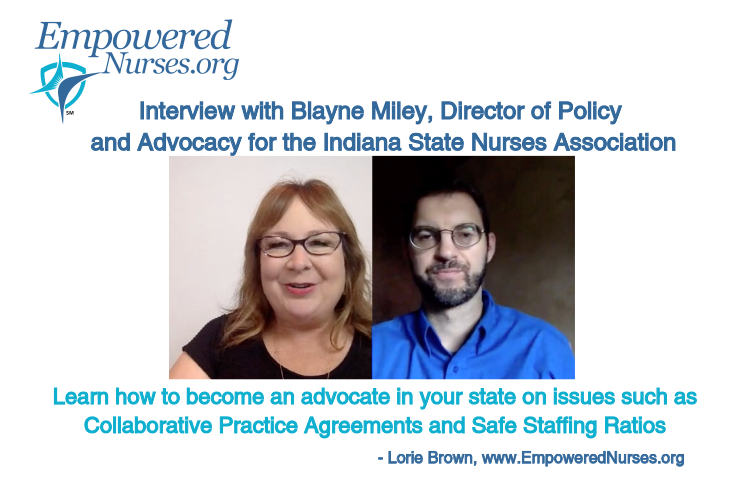
LAB: Hey, everybody. It’s Lorie Brown with empowerednurses.org and today’s special guest is Blayne Miley, Director of Policy and Advocacy for the Indiana State Nurses Association. Blayne also is an attorney so I’m really excited to be with him because I want him to hear about how nurses can go about making change, how nurses can be active in the legislature and make the necessary laws to protect ourselves and our licenses. Welcome, Blayne.
BLM: Thank you, Lorie. Glad to be here.
LAB: Before we go on, tell us a little bit about yourself.
BLM: My role with the Indiana State Nurses Association would be a resource for all nurses interested in advocacy and also to be their advocate in trying to improve health care policies for the betterment of nurses and patients. A lot of my time is spent sharing information with nurses that is important to know about opportunities to be involved in the policy making process like pending legislation, that they should be reaching out to their legislators on. And then to collect input from them about what direction we should be trying to push health policies.
LAB: At the Indiana State Nurses Association we have like a political action committee. How does that work?
BLM: There are a number of different ways to try to get our members engaged in the policy making process. One that you mentioned is the political action committee which does fundraising throughout the year and then decides on campaign contributions that the organization is going to make to the candidates that are running for office. Additionally, we encourage all of our members as well as any nurse to be actively engaged with their state legislators so they are trying to make sure that they’re sharing their input and their expertise when the legislators are considering a bill that impacts nursing because we often find is a knowledge gap sometimes in certain specialties or areas of health care practice because many in the legislature are not health care professional themselves. So, they can really benefit from the knowledge and expertise of their constituents or nurses helping to guide them in what’s going to be effective legislation.
LAB: For those who are not in Indiana, do they have something similar with their state Nurse Association?
BLM: Yes, there’s going to be a big Nurse Association in every state, all of which are members of the American Nurses Association and there are also specialty organizations for virtually every type of nursing practice: emergency nurses, the advanced practice nursing specialties, oncology. All of these different subject areas have their own sort of specialty organizations and from state-to-state there’ll be a little bit of variance on how active those organizations are as a whole as well as how active they are in the advocacy sector. Sometimes it’ll be sort of the State Nurses Association that is really the primary voice of nurses at the legislature and collecting input from individual nurses as well as all these different specialty organizations to try and speak with the voice of all nurses in the state. There’ll be some variance across all the different states but there are plenty of opportunities for organizational support being more active in policy making regardless where you live.
LAB: You said that you were the only organization that’s for all nurses because it’s not a specialty organization.
BLM: The Indiana State Nurses Association represents registered nurses of all levels across any specialty, anyone with an R.N. license.
LAB: If a nurse has an issue on which they would like to propose legislation, what would you recommend?
BLM: I would recommend that that nurse first connect with their State Nurses Association or other organization that pertains to the involved specialty just to try to get some initial feedback on their idea for a policy proposal. There may be some factors that they hadn’t considered that can help them improve the concrete action item. The general life cycle of any policy change especially with the legislature is the legislator is to be convinced that there is a problem, that the problem is serious enough to require government intervention and that there is an effective developed evidence-based solution for that problem. So, a nurse who is interested in addressing a problem should work with their State Nurses Association and other organizations and also should be reaching out to their State legislators, specifically the legislators for whom they are constituents to begin advocating for this policy change.
LAB: What some of the initiatives that you are now working on?
BLM: Right now, the Indiana State Nurses Association is working on a number of different issues. We’re in the interim so we are looking forward to 2019 but the Indiana General Assembly currently is not in active session. We are working our nursing workforce pipeline and trying to have regular State support for some of the schools that can limit our ability to produce enough and educate enough nurses at all levels, to be able to satisfy the growing demand for health care services. So, we’re working at both the undergraduate and graduate levels, trying to improve State support for nurse faculty because in Indiana that’s one of the primary bottom issues, a lack of faculty. We have plenty of students who want to be educated to become nurses but we struggle with recruiting and retaining enough faculty to meet that demand. And then the second issue is that we’ve made a great deal of headway in the last 5 years or so in improving the provider neutrality of Indiana regulation so that nurses of all levels are able to practice to the full extent of their educational experience without arbitrary barriers limiting their practice. One of the areas we’re still working on is retiring the Collaborative Practice Agreement Requirement for Prescriptive Authority for advanced practice registered nurses in the State of Indiana.
LAB: What do you think about getting advanced practice nursing being a full practice authority in Indiana?
BLM: I think it is a matter of when, not if, and it is just going to depend on how quickly we give some of that education back between the health care professionals and the APRNs and their State legislators to be addressed. Because many legislators are somewhat unfamiliar with the education, training and all of the research about APRN practice. And it’s also a matter of getting others outside of nursing who stand to benefit greatly from increased access to health care to take a more active role in the advocacy. So, those are probably the 2 keys I think in making that happen sooner rather than later in the State of Indiana, but I do believe it is a matter of when, not if.
LAB: I’m speaking at the American Association of Nurse Attorney’s Preconference to Nurse Practitioners on Medical Malpractice and what I have found is that all the studies show that the malpractice is much less against nurse practitioners compared to physicians.
BLM: Yeah, there is definitely some research demonstrating that retiring the Collaborative Practice Agreement Requirement for Prescriptive Authority does not have any negative effect on patient safety or patient outcomes and only serves to increase the efficiency of our health care system.
LAB: What about mandatory staffing requirements.
BLM: Staffing is an issue that we get asked about a lot and is an issue also coming up in a lot of other states. I know Ohio is currently considering legislation to address mandatory overtime and that’s one of the ways that staffing can be addressed from a regulatory perspective. I know there are a lot of different ideas about how to approach staffing, one of which is a set ratio, which Indiana currently has only for nursing homes, not in a hospital or any other type of setting and those are currently averaged on a weekly basis. So, I know there’s some interest in putting a little bit more teeth in that mandate so that you don’t have as much variation in the staffing levels across a biweekly period, because we know we have dedicated research indicating that in any setting, better nurse staffing means better patient outcomes. It is tricky trying to find, OK, how do we design a staffing regulation that allows for flexibility, because obviously the different units are going to have different patient acuity and varying levels. But the more flexibility and variability there is, the less enforcement there is for the regulations. That’s a careful balancing act. Right now for any nurse interested in staffing I would say that the very first thing to do is to look at all of the research out there about how improved staffing leads to better patient outcomes and the American Nurses Association is a great resource for that, and trying to advocate organizationally within their employment for organization to choose to improve staffing levels on their own based on better patient outcomes and better long-term cost savings as an initial first step. Beyond that, we can look at ways to try and craft regulation that both creates some enforcement to ensure that staffing levels are adequate and that allows for some variability within units and based on the type of patients.
LAB: It seems to me that they want mandatory staffing, minimum staffing requirements, but they also want mandatory overtime. And if mandatory staffing requirements improve patient care, but if you have mandatory overtime that probably decreases safety, because the nurse is exhausted.
BLM: Right! And I do certainly counsel nurses on occasion who feel like they are caught choosing between their job and their license because the job is requiring them to work hours that are putting them in a physical state of fatigue and that creating a danger to patients’ safety based on how thin they are being stretched, not only from their own hours, but also based on patient load and how many patients they are dealing with. And, at times, that can lead to that nurse, if their individual organizational advocacy is trying to change that policy within the organization is unsuccessful then they have to choose between their job or their license and what I typically tell them that it is a lot easier to find a new job than it is to deal with disciplinary action on their licenses.
LAB: That’s exactly what I say: you can always find another job, but you cannot get another license. I so appreciate everything that you do for the Indiana State Nurses Association and the lobbying that you do for us. I also really enjoy your weekly newsletter, I got one today. And I’m very excited for the initiatives, the 2 that are coming out before the ISNA and especially Meredith Addison. She has put her heart and soul in Regional State Trauma Centers of rural areas.
BLM: Yes, she is a wonderful advocate for improving trauma preparedness and trauma care. I really do want to encourage any nurse to take a more active role in advocacy and in shaping health policy, because it really does impact their profession and the patients and we need all nurses to be actively involved to ensure that crafting legislation is moving us in the right direction to improve nursing care and patient safety.
LAB: That’s wonderful. Blayne, it’s just been a pleasure talking with you. Thank you for sharing your expertise with our nurses.
BLM: Glad to be here. I always will do everything I can to help be a resource for Indiana’s nurses. and all nurses.
Lorie Brown, Nurse Attorney, discusses her recent informal survey on Show Me Your Stethoscope on the 1 thing that Nurses would change in Nursing. The results may surprise you – or maybe not! If you are interested in reading the Empowered Nurses’ Bill of Rights, you can click on this link: https://empowerednurses.org/nurses-bedside/empowered-nurses-bill-of-rights/
In 1999, a seminal study was performed by the Institute of Medicine which identified that 44,000 to 98,000 deaths each year result from medical errors. Unfortunately, over the almost 2 decades since, not much progress has been made. It seems that despite our high-tech society, we are losing our touch.
A review study revealed that a majority of those deaths were from surgical patients who did not follow the standard trajectory. The researchers looked at 5 core elements as being the key components of what they call “successful rescue” of surgical patients.
► TEAMWORK: Working together in moments of crisis;
► ACTION TAKEN: Responding swiftly after identifying a complication;
► PSYCHOLOGICAL SAFETY: Ability of all clinicians to feel comfortable in expressing their concerns regardless of where they stand in the clinical hierarchy;
► RECOGNITION OF COMPLICATIONS; and
► COMMUNICATION.
The clinicians interviewed stated that recognition of complications and communications are the most important.
They talked to these clinicians many of whom said they had “hunches” that something was going wrong yet did not feel comfortable in communicating this information. This is the “T” in GIFTS, trusting your gut.
In the high-tech environment of nursing, we tend to lose the touch. We tend to dismiss our intuitions, our hunches, our guidance because the monitors don’t show a problem. However, the hunches seem to be the most important thing in decreasing unnecessary deaths.
By using your GIFTS in communicating your hunches, you can improve patient care. Just remember to be G-giving to the physician, ask for what they need. This is also giving to the patient. Be in I-integrity. By dismissing your hunches, you are not being in integrity. F-focus and follow through on the result you want. Be solutions based and ask for the help your patient needs. T-Trust your gut. Your gut is there for a reason and this study just confirms that the hunches are the most important. You get to be the S-source to advocate for your patient and recognize impending problems early.
Have you ever gotten a hunch that something isn’t quite right? What do you do? Do you say something and, if so, how do you say it? Are you concerned about the fallout? Do you know of a way that we can communicate our hunches that will be accepted by the medical community so that early interventions can be made to save people’s lives? Let me hear your thoughts to these issues below.
Were you aware that 69% of all workplace violence and injuries were suffered by healthcare and social service workers? This is terrifying.
And it isn’t only patients who are causing the violence. Recently a nurse in an operating room was choked not by a patient, but by an anesthesiologist! [Link to article] He is facing second-degree assault charges and reportedly “retired” following this incident.
At Chicago’s Mercy Hospital this past week, a man with a gun walked into an emergency room, intent on killing his fiancé to get back his engagement ring. The resultant mayhem ended the lives of 3 people. [Link to article]
Registered nurses and LPN/LVNs have been punched, kicked and assaulted while on the job in many facilities around the country … sometimes with deadly results. There has been a 110% spike in the number of such incidents. Without question, hospitals are places of healing, not of hurting. Nurses and all healthcare providers should feel safe going to work. What is going on in the healthcare system is very scary. Check out the Empowered Nurses’ Bill of Rights and one is a nurse should not be hurt by a patient.
Earlier this month, U.S. Representative Joe Courtney (D-CONN) introduced a bill in Congress to protect healthcare employees by hiring more security guards, purchasing more surveillance cameras and training staffs how to respond to violent situations.
In 2016, California passed the toughest rules in the nation, requiring healthcare employers to individually tailor plans to protect employees from workplace violence.
Elsewhere in California in 2016, a nurse who was 2 months pregnant, was kicked in the pelvis by a delirious patient. The nurse, thinking she was going to die, was surprised to hear her manager say that she would see the nurse at work the next day!
When incidents of violence erupt in a school, possibly resulting in a death, there are social workers, counselors and even hospice nurses who will step forward to help the students grieve and manage the situation. What about when healthcare workers must deal with violence? As a point, what about the healthcare providers who took care of the victims of the Pittsburgh Synagogue shooting? What was done to help those folks with their mental health as a result of their assistance to those victims?
Some of those professionals who cared for the shooter were Jewish! What about their mental well-being in providing care to a clearly racist man who was dependent on them for his care after committing such carnage?
Healthcare professionals are expected to give, but who gives to the healthcare professionals? More needs to be done to assist healthcare professionals in dealing with these situations that really should never happen in the first place.
The mental health of any of us is just as important as that of our children. Our needs should be met and we must take care of our emotional well-being just as much as we should take care of our physical well-being.
Have you witnessed workplace violence? Does your facility have anything to support your mental health when these situations occur?
As nurses, when we enter a patient’s room, we are expected to immediately get into a relationship with the patient to create trust. The patient then shares their most intimate medical history along with their pressing problems. We meet them when they are in their most vulnerable state and enter into a most personal aspect of their lives.
It is important to share gratitude for being able to do what we can in caring for the people who we serve. We are privileged to take care of patients because we are nurses. In doing so, we are honored to serve in this fashion.
Being a nurse gives us so many privileges for which we need to be grateful.
This is why I suggest B.I.G. which stands for “Begin In Gratitude.”
When I wake up each morning, I choose at least 3 things that I am grateful for. To be honest, there are a few days I felt grateful only for waking up and breathing. The other mornings I am grateful for everything.
If you begin your morning in gratitude, the day is so much nicer and easier because you are focusing on what is good and not what’s bad, what’s working rather than what’s not working.
How would it go if we began each nursing shift in gratitude? I encourage you to try it and you will see that your shift will go much smoother by being in gratitude.
As a gift for you, I would like to share my Clarity Cards. There is now an app I created which can be downloaded at no charge. They’re available on the iTunes or Google Play stores by searching for “empowered nurses.” This will inject positivity into your day to help you to get clarity when you need it.
Now, tell me how you express gratitude. Do you begin your shift in gratitude?
Share your thoughts about this with us in the comments below.
In the recent Midterm Election, the Commonwealth of Massachusetts had on its ballot a referendum proposing mandatory nurse staffing. Unfortunately, the measure was defeated with only 30 percent of the electorate in favor of the measure.
Question: Where were the nurses?
If Massachusetts has 125,000 registered nurses with an additional 25,000 Licensed Vocational Nurses, where were the nurses?
So, what happened? The Coalition to Protect Patient Safety spent as much as $26,400,000 on scare tactics and negative ads with the Massachusetts Health and Hospital Association providing over $25,000,000 of that amount. Altogether that was more than twice the amount available to the Committee to Ensure Safe Patient Care which supported the referendum with only a little under $11,800,000 available to inform the voting public. Over $10,6000,000 of that came from the Massachusetts Nurses Association.
Unfortunately, the nurses in Massachusetts did not band together!
In order for nurses to have change, we need to unite and be together as one. It would have been good to have a grass roots effort.
When first running for president, Obama won and did so through a grassroots effort. He got people to the polls who actually cared about achieving results and voted to do so.
One of the criticisms was the way in which the question was presented. I believe it was written simply and understandably. Regardless, the benefit would have been that the patient’s get the care that they deserve and no patient is neglected because of poor staffing.
A scenario where a facility chooses not to provide a full staff or if staffing is lowered due to an illness of a nurse … that no longer would have been tolerated. As it is now, the ones who suffer are the patients because of fewer nurses to provide their care. Nurses in the Bay State had to deal with this every day in the past and, since the balloting, they are still dealing with it.
What concerns me the most is the reaction from American Nurses Association (ANA) President Pamela Cipriano who released this statement: “We are pleased that the Massachusetts voters soundly rejected Question 1.”
I am greatly disturbed by her stance. On the one hand, she states the ANA has long been a strong advocate for appropriately staffing health care systems. On the other hand, claiming she is pleased with the voting results is not in line with the ANA having a strong advocacy for appropriate nurse staffing. Instead, ANA wants to leave staffing in the hands of hospital committees.
Should hospitals appropriately staff their facilities, there would be no need for such a proposed referendum or legislation mandating appropriate staffing. Yet hospitals are not properly staffing in every situation. You and I and all nurses know that.
We are the only ones who can affect change in this. Nurses are the only ones who know this problem first hand and have to deal with it. And we need to stick together to do something about it … for the good of those we care for.
Where were the Massachusetts nurses?
I know this ballot represents a subset of nurses in a variety of settings but remember we ALL started together, working in clinicals in a hospital and someday it could be any one of us (or a family member) being the patient lying in that bed who does not get proper care due to short staffing.
It is time for all nurses to speak up for safe staffing. You owe it to the lives you are protecting.
I know this is a controversial topic but I invite you to share your comments below.