Lorie Brown and her daughter Jillian, discuss what it is like to have a mom as a business owner, how it affected their family and the benefits. Jillian also talks about how she was inspired to start her own business, participating in National Novel Writing Month and co-writing a book with her friend. The email to Jillian’s book is ElementsBook1@gmail.com. Lorie discusses the importance of being a role model.
Lorie Brown, Nurse Attorney, from YourNurseAttorney.com and EmpoweredNurses.org interviews Beth Hawkes, MSN, RN-BC. Nursing Author, Speaker and Career Columnist with AllNurses.com and CEO of NurseCode.com (also known as Nurse Beth). Beth has also authored “Your Last Nursing Class: How to Land Your First Nursing Job”. Her book will also assist you in finding a position if your nursing license is on probation or if you have been terminated. They also discuss the Nurse Residency Program.
Recently I attended the National Nurses in Business Association. Each year they have a “shark tank” competition, like the TV show, and this year was the best so far. I can’t believe these business and product ideas created by these amazing nurses.
Gwen Jewell is a wound care nurse and founder of jewellnursingsolutions.com. She created a product which, unlike foam wedges, actually does a much better job at reducing pressure on vulnerable areas.
Lori Forneris, co-owner of Nurse Expert Consultants, wants to create an app to improve communications among staff members. I love how nurses are getting on the tech train.
Yordis Morrison is founder and CEO of Nurses Off The Clock, LLC. When her mother fell ill with cancer, Yordis realized how patients’ bodies are exposed and are not given privacy with the gowns that are normally provided because of all the medical lines and appliances. She created this really cool set of medical pajamas that are covered with buttons and snaps for any type of medical equipment.
Sharon Dopak created an app for staffing agencies. Frustrated with the nurse staffing industry’s ability to adopt smart phone technology, Sharon created an app to allow agencies to let nurses know of available nurses. Nurses simply need to only swipe right if they want that shift. I believe this technology is brilliant and will have a lot of uses in the future.
Amy Wenham devised a way to sync a pillbox with smart phone technology that allows families to see if their elderly loved ones have taken their medication(s). If a box was locked, it would open at the approved time and then relock after one hour. If the meds were not taken, this prevents overdoses and allows the family to know when their loved ones are not taking their meds and can be given a gentle reminder.
Karen Kearsley, who created the Keysie, which is somewhat of a key chain that helps people to locate their keys. As long as the little device is attached, people will never lose their keys.
The winner of this year’s competition is Laura Futrell who created patientlearningcenter.com. She worked with a plastic surgeon and explained the ins and outs of breast cancer reconstruction. However, she didn’t have time to do proper education which left patients confused, overwhelmed, scared and at the mercy of their doctors. Laura empowers women through the Patient Learning Center in giving the most up-to-date interactive education online where they can watch from the privacy of their own home, to help them to be an advocate for their own choices.
I applaud the creativity and genius of each and every one of these nurses. They are seeing a need and then figuring out a solution. I frequently say that I believe nurses have answers to all the problems of health care but are neither asked nor listened to.
It’s time for you nurses to share your brilliant ideas and let your genius shine! Yes, your ideas can help so many people.
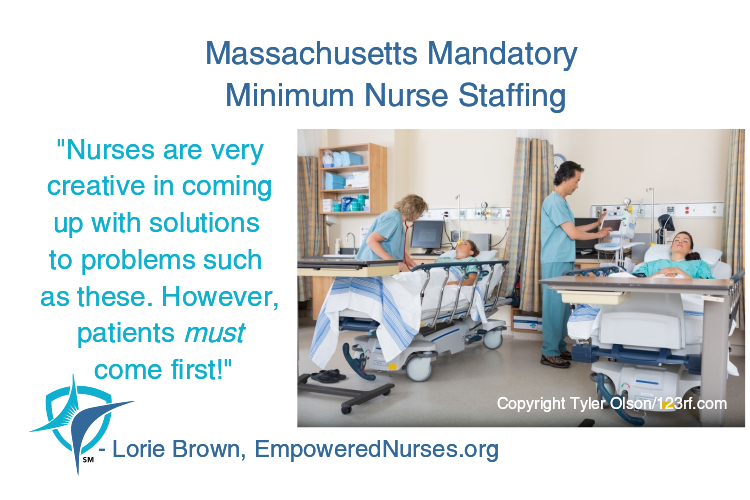
As of today, California is the only state requiring mandatory minimum nurse staffing. However, in November, Massachusetts citizens will vote on a ballot question as to whether mandatory nurse staffing should be required in that commonwealth.
There are vehement forces on both sides of this referendum question. One physician wrote an article published in Becker’s Clinical Leadership and Infection Control that mandatory nurse staffing ratios will hinder emergency department care. This physician believes that the existing processes are effective, that the mandate would force hospitals to cut their work force and nurse/patient ratios would fuel premature discharge and emergency room waiting times would increase.
Other oppositional arguments include that it would cost hospitals too much money and would even put some hospitals out of business. This is concerning to me as it clearly puts profits over patients’ wellbeing. Clearly, there is evidence to support that increased nurse/patient ratios improve patient care. After all, this is what health care should be about.
Rural communities also are concerned about not being able to hire enough nurses.
Some initiatives moving forward to help with the nursing shortage include an app that allows a nurse staffing agency to fill shifts on demand because this way, nurses at the facility will not be required to pull a mandatory double or overtime.
Nurses are very creative in coming up with solutions to problems such as these. However, patients must come first!
If you live in Massachusetts, I urge you to vote “yes” on this issue next month. It has made a huge difference for nurses in California and I think the same would be true for those professionals in Massachusetts. See interview with Sharon Dopak, a nurse from California.
What are your thoughts? Any comments you would like to make are welcomed below.
Today, September 28, 2018, The Indiana State Nurses Association is hosting among its keynote speakers a nurse who was in the national spotlight late last year.
You may remember the July 2017 story about Alex Wubbles, RN, the Salt Lake City nurse who was caring for a patient in the University of Utah emergency room when a detective entered the room, insisting that Nurse Wubbles draw blood from a patient. There was no physician order, warrant or patient consent for the demanded action pursuant to the facilities policies and procedures. Upon refusing the demand, Detective Jeff Payne roughly handcuffed her, removed her from the emergency room and strapped her into the police car. You can see the detectives body cam video of this incident by clicking on this sentence.
The patient Nurse Wubbles was treating was an off-duty reserve police officer driving a semi when he was hit by a man in a pickup truck while fleeing police. The patient never was a suspect and there was no basis to draw his blood.
The abusive detective was wearing a body camera which showed the entire incident. He was later fired by the police authorities. While Nurse Wubbles settled her case, the embarrassment and shame of this kind of harassing and wrongful imprisonment was completely inexcusable.
Ms. Wubbles will be one of the keynote speakers before the Indiana State Nurses Association on ending nurse abuse initiatives. She believes that what happened to her can lead to positive change in the nursing profession. She is working with the ANA to stop this culture of violence.
In January 2018, she testified before the Utah House of Representatives stating that this type of abuse toward health care providers must stop. The bill requires that police who would like blood drawn from anyone must have the person’s consent, or a physician’s order, warrant or court order. In Utah, it takes only 10 minutes to get a warrant.
While I am pained that Nurse Wubbles suffered this detestable situation, I am grateful that she used her voice to advocate for her patient and now uses her voice to create lasting legislation.
While many of us may be afraid to speak up for fear of retribution, speaking out is the only way for change to occur.
I for one applaud the continued effort of Alex Wubbles in advocating for patient safety. What initiatives does your facility have to help nurses advocate for patient safety? I would love to hear your comments below.
Recently on “Show Me Your Stethoscope” Facebook group for nurses, I said, “Let’s spread some positivity!” and asked, “What do you love about your job?”
I received almost 400 comments and what was most surprising to me was that the majority of the responses noted that their favorite part of their job was their co-workers. I realized that in the female-dominated profession, as women in modern times, we are more isolated in our homes and have lives different and separate from each other.
In ancient times it took a tribe to provide care for the children, gather food and cook together. Women comforted, supported and nurtured each other. Being with other women in the tribe helps us to be better mothers and to create physical, emotional and mental support as well as stimulation to create a wonderful environment for our offspring.
Nurses come to me after they’ve been terminated from a job. One thought I always had was why didn’t they leave sooner? I now suspect the reason was those nurses didn’t want to leave the tribe.
In ancient days, if someone were kicked out of the tribe, they would be left to fend for themselves in a hostile environment outside their safe existence. However, those same belief patterns are installed in us so that fear overtakes us when we think of being cast from the clan.
While I think it is great women feel like a tribe member and love going to work because of those who share their duties, I also believe nurses need to feel empowered that when it is time to leave, it is time to leave and another opportunity will arise. It is scary to be evicted from the tribe but as a nurse, it is better to voluntarily exit than be forced and shunned away. Nurses can always get another job but they can’t get another license.
The beauty of being in a healthy tribe is that we are supported, nurtured and uplifted. Unfortunately, if we are part of an unhealthy group, we tend to stay there as well because of the fear of being cast out.
Healthy tribes do exist so just know that if you are in an unhealthy one that you may be happier and more fulfilled in a different tribe. Although it may be scary to venture away, it’s worth it if you are going to be happier.
I invite everyone to join us in our nurse tribe on my private Facebook group at https://www.facebook.com/groups/EmpoweredNursesGroup/. This is a soft place to land for nurses to feel supported, nurtured and of course empowered! I will be in there doing Facebook lives and giving content and answering questions. This community is one where there is no competition, only uplifting each other. I also believe that nurses have all the answers to the problems in health care so this group can be a venue to find answers to problems you are experiencing in your career. I would love to hear what you would like to get out of such a tribe and how I can support you. Please leave your comments below.
In the midst of the nursing shortage, nurses have authorized, by an overwhelming majority, a strike against 15 facilities of the Hospital Corporation of America (HCA) in Florida, Kansas, Missouri, Nevada and Texas.
Nurses are in dispute over pay, staffing and security. Their goal is to provide excellent patient care and they’re taking a stand to have this happen.
The authorization to strike does not mean that a strike will happen but, if negotiations fail, a strike is the alternative.
There are 7,000 nurses affiliated with the union with 4,000 of them in Florida. The local HCA employed nurses are affiliated with National Nurses United, the largest and fastest growing union for registered nursing which claims 150,000 members.
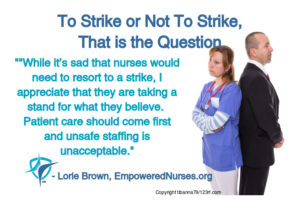
While it’s sad that nurses would need to resort to a strike, I appreciate that they are taking a stand for what they believe. Patient care should come first and unsafe staffing is unacceptable.
Whether it’s a union or not, nurses need to stick together and take a stand for what they believe in. Don’t work in a unit where you believe the staffing is unsafe. If every nurse who felt that the nurse staffing was unsafe would leave the facility, then the hospital would have no choice but to ensure safe staffing.
Other avenues to ensure safe staffing includes efforts in Pennsylvania where over 1,000 bedside nurses across that commonwealth consider staffing levels dangerous due to high staff turnover and putting patient care at risk. Legislation is pending in Harrisburg to establish minimum staffing levels.
For those not in Pennsylvania and if your state does have such legislation pending, I once more urge you to call your representatives and senators to let them know what you think because this is the only way that change can come about. Share with them from your heart about your concerns on this crucial issue.