Join me for an exclusive in-person event for LNCs to hear the behind-the-scenes legal process from 12 attorneys! ❱❱

Empowering Nurses at the Bedside and in Business

Author Archives: Lorie A Brown, R.N., M.N., J.D.

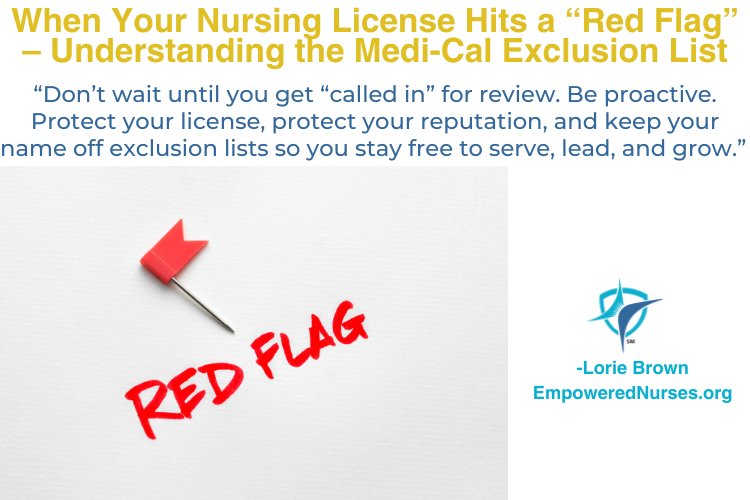
  1. When Your Nursing License Hits a “Red Flag” — Understanding the Medi-Cal Exclusion List

    Leave a Comment

    As nurses, our license and our professional participation are tied to our identity. The Exclusion List is a serious events. It’s not talked about enough, but it matters. Even if you are not in California, being on this list can still affect you.

    1. How a Nurse Might End Up on the List

    Here are key reasons that may trigger being placed on the Medi-Cal Suspended & Ineligible Provider List or other exclusion databases in California:

    · A serious conviction (felony or a misdemeanor) related to fraud, abuse of the Medicaid/Medi-Cal program, or conduct “substantially related” to your nursing license.

    · A disciplinary action by your licensing board: suspension, revocation or surrender of your nursing license or certificate under questionable circumstances. Surprisingly, many nurses do not know action was taken against their license.

    · Being excluded by a federal health-care program (for example the Office of Inspector General (U.S.) (“OIG”) List of Excluded Individuals/Entities) and then the state picks up on that and bars you from participating in Medi-Cal.

    · Serious enrollment or credentialing violations in a Medi-Cal program: billing misconduct, submitting false claims, etc. While some cases remain under investigation, being flagged may trigger suspension.

    As a nurse, you might think “I don’t bill directly,” or “I just work as staff,” but even then: if your employer participates in Medi-Cal, and you are involved in the services or documentation, your status matters. More on that next.


    2. What It Means for You: The Implications

    If you get placed on the exclusion list, the effects ripple out — affecting not only your ability to work in certain settings, but also raising personal risk. Key implications:

    · You cannot provide services under Medi-Cal (or be part of those services) while you are excluded. That means you may lose employment opportunities in places that serve Medi-Cal beneficiaries or even outside of California.

    · If you are in a setting where Medi-Cal funds are involved, your exclusion may affect your employer (and vice versa). If you render services while excluded, those services may not be reimbursable.

    · Your professional reputation suffers. Even if you continue working in non-Medi-Cal parts of healthcare, having been excluded may lead employers or peers to question your compliance or license status.

    · It may limit your mobility: if you ever decide to do consulting, legal-nurse-consulting, or even want to shift into home health, long-term care, or other segments that bill Medi-Cal, you’ll face smoother sailing if you’re clear.

    · Recovery is not automatic. Being excluded doesn’t always mean you’re off the hook after a short time — it may mean an indefinite exclusion or long wait.

    In simple nursing terms: being on the exclusion list is one of the major “code reds” for your career. It’s like having a serious credentialing block — and you don’t want that during rounds.


    3. How (Sometimes) You Can Get Off the List

    Okay — here’s the hopeful part. Being placed on the list doesn’t necessarily mean “game over.” There are steps and there is a process for reinstatement, though it takes time, effort, and responsibility.

    Step-by-Step:

    · Understand the reason you were excluded. Get full documentation of what triggered it — license issue, billing issue, fraud issue, etc.

    · Take corrective action. If licensing was revoked/suspended, get it resolved. If there’s a billing or documentation root cause, rectify it. Show compliance.

    · Wait for the required time. In California, there is a requirement that a provider may petition for reinstatement no sooner than one year after the exclusion/decision in many cases.

    · File a petition for reinstatement. Once you meet the requirements, you submit to the state (through California Department of Health Care Services — DHCS) for review. It’s not guaranteed, but possible.

    · While waiting, maintain your professionalism and integrity. Keep clean records, keep renewing your license, maintain continuing education, document improvements.

    · Be proactive about future compliance. Once reinstated (or to stay clear of trouble), screen yourself, know your employer’s compliance policies, document meticulously, stay on top of changes in Medi-Cal rules.

    Important caveats for nurses:

    · Even if you don’t directly submit claims, if you provide care that is billed under Medi-Cal and your name or license is tied in, the exclusion may apply.

    · Some exclusions are indefinite or long-term. The longer you delay corrective action, the harder it may become to restore full participation.

    · Getting off the list doesn’t automatically mean immediate return to full privileges — you may have conditions or probation.


    4. What You Can Do RIGHT NOW to Protect Your Nursing Career

    Since you help nurses and you live in that clinical/legal interface, here are proactive steps you—as a nurse—can take to stay off the list or to recover if you’re at risk:

    · Stay current with your license. Don’t let it lapse. Avoid board discipline. If something arises — minor or major — address it immediately and keep all Boards apprised of your current address even if your license is expired.

    · Know your employer’s payer mix. If you work in a setting that bills Medi-Cal, ask: what screening do they do? Are you aware of exclusion risks?

    · Document carefully. Errors in documentation, billing references, service misalignment can trigger investigations. Your name might be on the incident report; make it clean.

    · Monitor your status. Even though it’s more often organizations doing this, you can check publicly accessible exclusion lists (state and federal) to ensure your name is clear.

    · When in doubt, seek guidance. If there is any hint of investigation, license trouble, major deviation — consult with a healthcare attorney or someone versed in provider enrollment/exclusion issues.

    · Use this knowledge as a tool. If you ever provide mentoring, leadership, or have LNC-type involvement with nurses, you can advise them on these risks and help them navigate the “credentialing health” of their careers.


    5. The Moral of the Story

    Your nursing license and credentialing status are your professional heartbeat. Being placed on the Medi-Cal exclusion list is like a major arrhythmia in that career pulse. But here’s the powerful takeaway: you’re not powerless. With swift action, clarity, and integrity, you can recover or avoid the crisis entirely.

    Don’t wait until you get “called in” for review. Be proactive. Protect your license, protect your reputation, and keep your name off exclusion lists so you stay free to serve, lead, and grow.

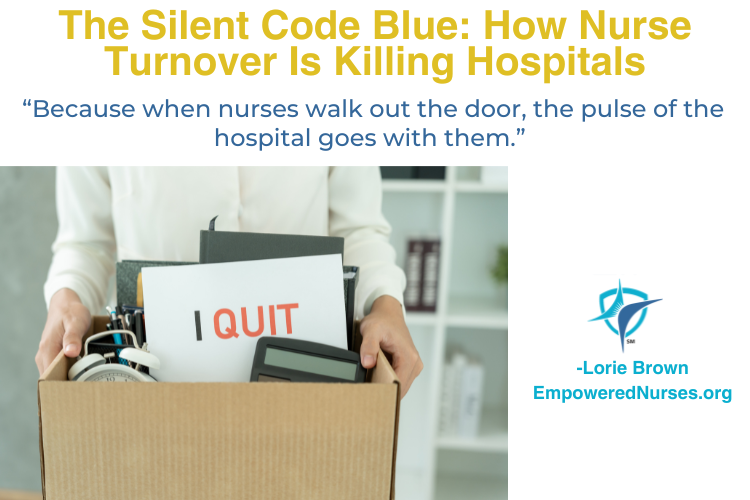
  2. The Silent Code Blue: How Nurse Turnover Is Killing Hospitals

    2 Comments


    When we hear that 22 U.S. hospitals and emergency departments closed in 2025, we imagine empty hallways, dwindling patient loads, maybe policy failures. But that’s not the whole story.

    The real killer wasn’t a lack of patients — it was a lack of nurses.

    Hospitals are bleeding out financially, not because the waiting rooms are empty, but because the break rooms are.

    💸 $5.7 million.

    That’s what nurse turnover costs the average hospital each year. Not from some rare accounting trick — from recruitment, training, and the lag in productivity when a new nurse takes over a seasoned one’s assignment.

    And while leaders hold another meeting to “study retention trends,” the budget is flatlining on the monitor.

    🚨 The Numbers That Should Terrify Every CFO

    · $61,110 to replace just one bedside RN Recruitment, orientation, and the six months it takes before they’re truly efficient again.

    · 16.4% turnover rate nationally That means one in six nurses is leaving every year. For a 200-bed hospital, that’s at least $3.9 million hemorrhaging straight out of payroll.

    · For every 1% increase in turnover, add another $289,000 in losses. If your turnover climbs from 16% to 18%, congratulations — you just lost another half a million dollars.


    🩸 The Hidden Truth

    Hospitals aren’t shutting down because of competition or regulations. They’re shutting down because they can’t afford to keep losing nurses. Every resignation is a silent drain — one that slowly pulls community hospitals under, one unit at a time.

    🩺 So what’s your hospital’s real turnover cost? Here’s the simple math: Your RN count × 16.4% × $61,110

    Now ask yourself — can your budget survive another year of losing your best nurses?

    Because when nurses walk out the door, the pulse of the hospital goes with them.

  3. 🩺 Do Your Homework Before Saying “Yes” to That Nursing Job

    Leave a Comment

    We teach our patients to advocate for themselves — but when it comes to our own careers, too many nurses skip the most important step: doing our homework.

    Finding a nursing job isn’t just about pay and benefits. It’s about safety, support, and sustainability. Because let’s face it — no paycheck is worth your mental health, your license, or your back.

    Many nurses are so excited to get the offer and they feel like it’s going to be a great marriage until it’s not. Save yourself some time and energy.

    Nurses are so excited to get the job offer. It feels like a marriage and you go in trusting without anticipating a divorce. Here’s the homework every nurse should do before signing on the dotted line.


    🧠 1. Research the Facility’s Reputation

    Start with the basics:

    · Google reviews & social media: What are patients saying? What are employees whispering? BBB Better Business Bureau?

    · Glassdoor & Indeed: Read reviews — not just the five-star ones. Look for repeated concerns like short staffing, favoritism, or burnout.

    · State Department of Health: Any disciplinary actions or complaints against the facility? It happens more often than you think. https://www.medicare.gov/care-compare/

    · CMS and Joint Commission reports: These can reveal safety citations, infection rates, and other red flags.

    Think of it as reviewing your “patient’s chart” — before you agree to be part of their care plan.


    🩺 2. Talk to Current and Former Staff

    You wouldn’t rely solely on a patient’s self-report, right? You’d check with family, chart notes, and the previous shift.

    Same goes here:

    · Ask nurses who work (or used to work) there about workload, teamwork, and management support.

    · Join local nursing Facebook groups or Reddit threads — nurses love to share the real tea.

    · Attend networking events or professional meetings and casually ask, “Anyone ever worked at ___?”

    If you start hearing the same horror story from three different people… believe it.


    💬 3. Ask Smart Questions in the Interview

    An interview isn’t just for them to assess you — it’s for you to assess them. Here are some nurse-to-nurse power questions:

    · “How often do nurses work short-staffed?” Mandatory Overtime?

    · “What’s the orientation process like for new hires?”

    · “What’s the nurse turnover rate on this unit?”

    · “How are breaks and overtime handled?”

    · “What’s your policy on workplace violence and reporting safety concerns?”

    Watch their face. Do they light up with pride — or get defensive? That tells you everything.


    🧾 4. Review the Job Offer Like a Chart Audit

    Grab your red pen and check every line:

    · Pay: Hourly vs salary? Shift diff? Overtime rate?

    · Schedule: Rotating weekends? Mandatory call?

    · Benefits: Insurance, tuition reimbursement, retirement match, CEU support.

    · Policies: Floating? Non-compete clauses? PTO approval rules?

    · Sign-on bonuses: What’s the fine print? (Many require a 2-year commitment or full payback if you leave early.)

    Never let HR rush you. “We need an answer by tomorrow” is not a good sign — it’s a pressure tactic.


    🧭 5. Visit in Person — Trust Your Senses

    Take a walk through the unit if possible. You’ll learn more from ten minutes on the floor than from ten pages of HR policies.

    Ask yourself:

    · Do nurses look burned out or supported?

    · Is the unit clean? Smell?

    · Are supplies stocked, or are people scrambling?

    · How do team members talk to each other — and to patients?

    Your gut knows the truth before your brain does.


    🧍‍♀️ 6. Check the Leadership’s Track Record

    Google the CNO, nurse manager, or director:

    · How long have they been in their roles?

    · Do they have a reputation for listening — or for ruling by fear?

    · What’s their communication style like in staff meetings?

    A good leader can make a tough job manageable. A toxic one can make your dream job a nightmare.


    💻 7. Look at the Numbers

    · Turnover rate: Anything over 20% is concerning.

    · Patient satisfaction scores: Often reflect staff satisfaction, too.

    · Magnet status or awards: Not a guarantee, but a positive sign.

    · Financial stability: If the facility is laying off staff or in the news for budget cuts — proceed with caution.


    ❤️ 8. Know Your Non-Negotiables

    Write down what matters most to you:

    · Work-life balance

    · Shift length

    · Type of patients

    · Commute

    · Management style

    · Growth opportunities

    Then, stick to it. You can teach a new charting system — but you can’t fix chronic understaffing or bullying.


    🩹 9. Ask About Safety and Support

    Before you agree to join the team, ask:

    · “What’s your policy for responding to patient aggression?”

    · “Do you have security on site 24/7?”

    · “How do you handle nurse fatigue and burnout?”

    Because no job is worth your safety or your sanity.


    💬 10. Follow Your Intuition

    Nurses have the best radar on the planet. If something feels “off” — even if you can’t explain why — pay attention. That same intuition that’s saved patients will protect your career, too.


    💡 Final Thoughts

    Doing your homework doesn’t make you picky — it makes you professional. It shows you value your time, your license, and your well-being.

    The right job will meet you where you are, challenge you to grow, and support you as a nurse and a human being.

    Because your calling deserves more than “we’re desperate for staff.” You deserve to walk into work each day knowing you’re respected, safe, and supported.

    That’s not too much to ask — it’s just good nursing practice. 💙

  4. Building the Plane While We Fly: How Nurses Can Launch a Business While Still Working Our Day Job

    1 Comment

    Nurses know what it’s like to keep moving even when everything feels like it’s happening at once. We’re charting in one window, answering a call light in another, all while anticipating the next code before it happens. That skill set — triaging, adapting, and pushing forward under pressure — is exactly why so many nurses are uniquely positioned to start businesses while still working full-time.

    Entrepreneurs often describe this balancing act as “building the plane while flying it.” You don’t wait until the plane is on the runway, neatly parked, with every screw tightened and every system tested. You build as you soar, patching, adjusting, and adding new wings as you go. And while it might sound risky, research shows it’s actually one of the smartest ways to start. In addition, your salary is the best interest free loan to start and grow your business.

    A 2014 study by professors Joseph Raffiee and Jie Feng found that entrepreneurs who started their businesses while keeping their day jobs — sometimes called “hybrid entrepreneurs” — were about one-third less likely to fail than those who quit their jobs and went all-in immediately. By holding on to the stability of a paycheck, they gave themselves the time and space to test ideas, pivot when needed, and grow steadily. In other words, the data proves what nurses already know: stability gives you room to save lives — or in this case, save your business.

    The numbers back it up further. In recent surveys, nearly 40% of working Americans report having a side hustle. Some do it for extra income, others to explore a passion or create a pathway out of corporate work. And this isn’t just small money on the side — payroll firm Gusto reported in 2024 that nearly 44% of new business owners launched while still holding a job, up dramatically from just 27% in 2022. This surge shows that people are no longer waiting until everything is “perfect” to start. They’re building mid-flight.

    And while anyone can start a business this way, nurses bring something extra to the cockpit. Our training in critical thinking, resourcefulness, and communication equips us to thrive in the turbulence of dual roles. We already make split-second decisions that have life-and-death consequences. We already innovate when supplies run low. We already juggle competing demands, often with little sleep and no margin for error. These are the same muscles required to launch and sustain a business.

    The beauty of starting while working is that you don’t need to have it all figured out before takeoff. You can carve out small “pocket hours” before or after shifts. You can test services or products on a modest scale. You can reinvest early income into tools and support rather than depending on the business to feed your family on day one. And you can decide — on your own terms — when the moment is right to leave the runway of traditional employment and fly full-time into entrepreneurship.

    This isn’t to say it’s easy. Like a night shift where everything seems to happen at once, there will be turbulence. You’ll feel stretched, tired, and sometimes even question whether the dual roles are worth it. But remember: you’ve already done harder things. You’ve comforted grieving families, advocated for patients who had no voice, and carried the weight of decisions that mattered. Compared to that, building a business while working full-time is simply another version of resilience.

    The truth is, thousands of businesses that survive today started exactly this way — in the cracks of time, with a steady paycheck in one hand and a dream in the other. For nurses, this path isn’t just possible; it’s a natural extension of who we are. We’ve been building planes while flying our entire careers. Now we get to build one that carries us toward freedom, purpose, and ownership of our future.

  5. You Can Have “Enough” Nurses—but Not Enough Nurses: Why Ratios Matter

    Leave a Comment

    Nursing care is the main reason why patients are hospitalized. And yet too many hospitals treat nurse staffing like ordering enough IV tubing or gloves: “Yep, we’ll have enough in stock.” But what we’re learning—and now our accreditor is affirming—is that just having enough nurses isn’t the same as having the right number at the right time with the right mix.

    Earlier this month, The Joint Commission published its new National Performance Goal 12 for hospitals:

    “The hospital is staffed to meet the needs of the patients it serves, and staff are competent to provide safe, quality care.” The key words? Staffed to meet the needs of the patients and number and mix of qualified individuals appropriate to the scope and complexity of the services offered.

    While I am happy JCAHO is addressing this matter: It’s not enough to say you have “sufficient staffing.” You must have specific numbers and ratios that align with patient acuity, the unit’s complexity, and the skills required. That’s not mere semantics—it’s the difference between a crash cart that’s “available” and one that’s “ready, charged, and functional.”


    Why ratios matter — the clinical analogy

    Think of a CCU where you’ve got one nurse for seven patients on mechanical ventilation, post-op, monitoring for arrhythmias … and you’re short someone. It’s like trying to run a telemetry unit on one EKG lead. Yes, you have some monitoring—but you’re blind to important change. And that’s where harm creeps in.

    Here’s what evidence and the new standards tell us:

    · If nurse staffing is too thin, patient outcomes suffer: increased infections, lengthened stays, greater risk of falls, and even mortality.

    · To meet meaningful safety and quality standards, we must look beyond “we hired enough” and ask: how many per shift? what skill mix? what backup when acuity rises?

    · The Joint Commission makes it clear: leadership must ensure the number and mix of competent individuals are appropriate.

    In nursing language: You can’t just have three IV pumps on a unit and hope for the best—you must have the correct staffing ratio to monitor those pumps, catch when one alarms, manage lines, anticipate complications. If you don’t, alarms go unanswered, trends go unnoticed, and the patient suffers.


    The gap between “enough” and “right”

    In practice, many facilities operate under “we have enough” assumptions:

    · “Our budget allows X number of nurses per shift.”

    · “We’ve got coverage, so we’re good.”

    · “Our turnover rate is stable, so headcount is steady.”

    But those aren’t metrics of safe, responsive care. Because what they don’t account for:

    · Variation in patient acuity: The floor today isn’t the floor yesterday.

    · Skill mix: Not all nurses bring the same experience, certifications, or comfort with high-stakes care.

    · Workflow burdens: Documentation, lifted weights, time on the phone, interruptions—all these eat into the “available” time of a nurse.

    · Margin for surges: Code blues, rapid deteriorations, admissions from the ED—those will stretch any staffing plan if the ratio was already lean.

    And when the ratio is off, nurses go into “triage mode” instead of “care mode.” It’s like running a code with four people instead of six: you’ll probably get something done, but will it be optimal? Will you anticipate next changes instead of reacting to what already happened?


    From policy to practice: What nursing leadership should do

    As someone who helps nurses and business owners in healthcare, here are actionable takeaways:

    1. Define the ratio standard — Not “we will staff as needed,” but “we will staff at X:1 (nurse:patient) when acuity is A, and Y:1 when acuity escalates to B.” These numbers should be visible and used in scheduling.

    2. Assess skill mix and competence — A nurse with 3 months’ orientation is not the same as a nurse with 10 years of telemetry and rapid-response experience. Competence enters the ratio equation.

    3. Build flexibility/margin — Just like you’d keep a spare defibrillator battery, build in head-room. Have float pool, charge nurse on standby, quick-call list.

    4. Use real-time acuity data — Systems exist now to track acuity and staff accordingly. Don’t wait for the patient census alone.

    5. Involve nursing leadership in budgeting — The new standard emphasizes the nurse executive’s role in policy, staffing, and the mix.

    6. Measure staffing as a quality indicator — Treat ratios like any other safety metric: monitor, report, analyze when the standard isn’t met, and build improvement plans.


    Why this matters for nurses

    The ratio discussion has multiple dimensions:

    · Quality-of-care standard: When you review charts, staffing levels (numbers + mix) can be a root cause of care breakdowns or sentinel events.

    · Risk management: Facilities that know their ratios and adhere to them are less vulnerable to regulatory, survey, and litigation risk.

    · Regulatory compliance and accreditation: With the Joint Commission’s new goal effective January 1 2026, hospitals will face stronger scrutiny.

    Final thoughts: Ratios save lives

    In nursing, we don’t just count heads—we monitor hearts. We don’t just clock hours—we watch changes, anticipate decline, intervene early. Staffing isn’t just a logistic. It’s the foundation of safe care.

    So when I say “there must be numbers and ratios,” I mean that every shift should count like a code: who is at the bedside, how many patients, what complexities, what backup plan. When that balance is right, nurses can practice the art and science of care. When it’s off, we become firefighters instead of caregivers.

    Let’s not wait for more tragedies, more near-misses, more “if only we had…” lines. Because the new accreditation standard means facilities must answer this question:

    Are we staffed to meet our patients’ needs? Yes or no? And proof please.

    Nurses have long known the answer. Now the world is catching up.

  6. Travel Nurses Saved the System — Now the System’s Failing Them

    1 Comment

    “We uprooted our lives for a promise. Then the rug was yanked out.”

    That’s the story thousands of travel nurses are telling — and now, some are finally being heard in court. But the settlement is only a symptom. The real disease is deeper: contracts drying up, wages collapsing, and the trust fracture between nurses and agencies.

    Let me pull back the curtain. Here’s what’s happening — and what every nurse, attorney, and advocate needs to see.


    💰 The Settlement That Speaks Volumes

    In a case against NuWest Group, over 2,300 travel nurses alleged that once they had relocated and started an assignment, the agency cut their pay, reclassified compensation to dodge overtime, and forced “take-it-or-leave-it” renegotiations.

    Here are some of the chilling details:

    · Some nurses saw 81% cuts to weekly stipends mid-contract.

    · Base pay rate drops of 6% or more, after the nurse had committed to the assignment.

    · The agency allegedly recategorized compensation (e.g. stipends) so they wouldn’t count toward overtime.

    · Average settlement for affected nurses: ~$980. Some got over $9,000 (for the ones hardest hit)

    · 123 nurses with documented claims got ~$3,000 each for the pay cut claims; the rest received smaller amounts. A federal judge approved the settlement as “fair, reasonable, and adequate.

    But that’s only one battle. The war is still raging.


    ⚠️ The Cracks We See — And Why They’re Widening

    The settlement is an alarm bell. Here are the structural problems travel nurses are facing now — and no, they’re not anecdotal.

    1. Contracts are drying up

    Hospitals and health systems, squeezed by lower reimbursements, staffing fatigue, and shrinking margins, are cutting back on temporary staffing. Many facilities are favoring leaner permanent staffing or internal float pools. In some states, dozens of travel contracts have been canceled or allowed to expire without renewal.

    2. Pay-slashing in mid-contract has become routine The “bait-and-switch” era is no longer shocking — it’s expected. Nurses report hourly rates being cut 25% to 70% after assignment start.

    For example:

    · One nurse started at $85/hour + stipends. A few weeks later, the rate was cut to ~$50. Then cut again.

    · Nurses allege agencies reclassify portions of pay (stipends) so they don’t count for overtime.

    3. Mandatory arbitration clauses trap nurses

    Many contracts force disputes into arbitration, barring class actions. That’s a huge asymmetry: the agency has more leverage, resources, and legal heft.

    Lawyers are fighting back, arguing that when the contract was procured fraudulently (i.e. misrepresenting pay, changing terms later), the arbitration clause may be unenforceable.

    4. Demand is weaker — supply is shaken

    During COVID-19, travel nurses were an emergency valve. Agencies paid top dollar. But that surge is contracting. Hospitals are pushing back on bill rates, some are minimizing use of premium staff, and many are prioritizing cost containment. Some decline in travel nurse demand is expected as permanent staffing stabilizes or alternative internal staffing strategies emerge.

    5. Financial instability & uncertainty for nurses

    Imagine uprooting your life — lease, travel, licensure, child care — and then having your contract slashed. That’s not just frustrating; it’s financially toxic.

    Nurses report last paycheck issues, inconsistent communication, and a feeling of having been “preyed upon.”


    💔 Why This Hurts Every Stakeholder

    · For nurses: Loss of trust, financial risk, burnout, and the emotional toll of broken promises.

    · For agencies: Reputation damage, litigation risk, and pressures to either absorb margin or pass costs to hospitals.

    · For hospitals/patients: Staffing gaps, disruptions, and increased turnover costs.

    · For the system: Erosion of a flexible workforce safety net precisely when shortages loom.


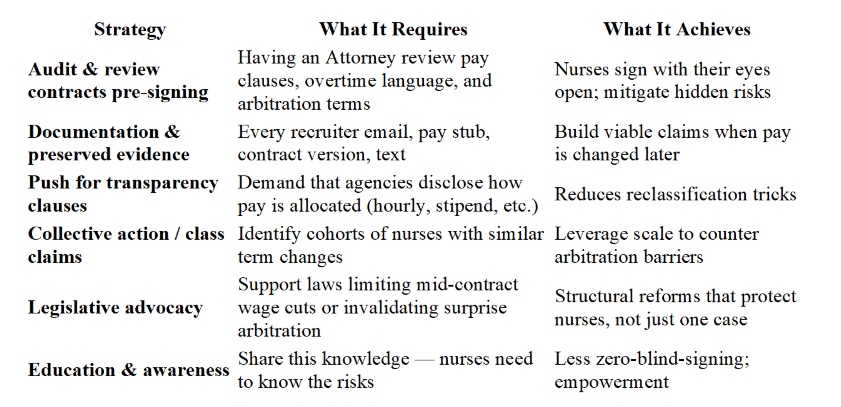
    🔧 What Can (and Should) Be Done — From Your Nursing-Legal Lens

    Because you and I both know: pointing fingers isn’t enough. Here are paths forward — and some strategic angles for legal nurse consultants to leverage:

    🩺 A Nursing Analogy

    Think of a patient you’ve cared for whose vital signs look stable — but hidden lab values are crashing. On the surface, everything looks okay. Then suddenly, the patient spirals. That’s what’s happening with the travel nursing industry: the surface (contracts, high pay) looked robust during COVID, but underneath, the systemic stress fractures are exposing deep wounds.

    Travel nurses have been frontline in the health crisis. Now, some are frontlining to hold agencies accountable. Their fight is not just about pay — it’s about dignity, fairness, and the principle that no one should be forced to pay the price for broken promises.

  7. 🎸 “All in all, it’s just another brick in the wall…”

    1 Comment

    Every time I see what’s happening in California healthcare right now — the strikes at Kaiser, the protests at Sharp, the layoffs at UCSF — I can’t help but hear Pink Floyd echoing in my head.

    Except this time, the “bricks” aren’t faceless schoolchildren. They’re nurses. One by one, brilliant, compassionate, exhausted nurses being stacked into a wall built by corporate indifference, profit margins, and burnout.

    But unlike that song, this story isn’t about resignation — it’s about resistance.


    When the Walls Are Shaking: What’s Happening to Nursing in CA (and Why It Matters)

    I’ve been a nurse, I’ve worn whites (before scrubs) in the trenches, I’ve felt the weight of each patient’s pain and each administrator’s demand. And lately, something in California is shaking — and it’s not just the hospitals.

    Across this state, nurses are standing up. At Kaiser, Sharp, UCSF, and beyond, the fault lines are visible: contract impasses, strikes, layoffs, ever-worsening staffing, and union fights. It’s not drama. It’s survival.


    The Front Lines Are Fraying

    Kaiser’s Historic Strike

    On October 14, 2025, about 31,000 Kaiser Permanente nurses and health professionals walked off the job in a five-day strike across 500 facilities in California (and some in Oregon and Hawaii). These nurses, respiratory therapists, midwives, and others aren’t asking for luxury. They’re demanding a 25 % wage increase over four years, safer staffing ratios, respect for their voices — and compensation that keeps up with inflation.

    Kaiser counters with an offer of 21.5 %, asserting their wages already exceed industry norms — but the disagreement is steep because many workers say that doesn’t translate into real safety or sustainability on the floor.

    Some in leadership warn the strike is “disruptive to patients,” but unions argue the real disruption comes from chronic understaffing, burnout, and silencing frontline caregivers.

    For too long, we’ve patched leaks. We’ve closed gaps with overtime, moonlighting, and shared shifts. But now the dam is cracking.

    Sharp Nurses Rally—and Demand Change

    In San Diego, nurses at Sharp HealthCare (more than 5,700 of them) are in contract negotiations that have reached a breaking point. They’ve rallied publicly to demand fair pay, better sick leave policies, protection from burnout, and more support to safely care for patients.

    Their contract’s expiration at month’s end is looming, and tensions are rising. This isn’t about greed. Nurses at Sharp make heartfelt pleas: “meet us halfway.” They wear shirts printed “respect nurses,” handing over petitions to executives. It’s dignity, not indulgence.

    UCSF Layoffs, Integration Threats, and Frontline Cuts

    Meanwhile, UCSF Health has announced 200 position cuts, including frontline staff in ICUs, lab, and emergency departments. Many of those impacted were already stretched thin — the workforce you rely on in life-or-death moments.

    And it gets worse. UCSF is attempting an “integration plan” that forces workers at UCSF Benioff Children’s Hospital Oakland to become UC employees under new contracts — stripping away union protections, increasing healthcare costs, decreasing take-home pay, and even risking loss of seniority.

    Add to that: more than 130 frontline workers (nurse assistants, lab techs, vocational nurses, radiology techs) have already been let go across UC campuses. The loss is not just economic — it’s clinical. The holes left in those roles will be felt by patients.


    Why This Feels Like a Storm (Because, It Is)

    I want you to picture a hospital as a body. The nurses are its beating heart, sustaining life. The labs, the techs, the therapists — vessels carrying information and function. Now imagine you cut off blood flow, starve the tissues, and tell the organs to keep working harder.

    We are at that point.

    · Burnout is epidemic. When workload doubles, emotional reserves dwindle, and mistakes rise.

    · Moral injury is everywhere. Nurses are forced to do less than they can, delay care, triage tasks, while their souls argue with their orders.

    · Financial strain is real. When pay doesn’t keep up, many nurses carry second jobs, clinical debt, mortgage stress.

    · Voicelessness is deadly. To be a nurse and have your voice silenced in decisions that affect patient care is a betrayal of both these professions you serve: nursing and humanity.

    Nurses in this state are pushed to the edge. And if we don’t stand with them, the cracks widen — the care patients receive crumbles.


    Why Crossing the Picket Line Hurts More Than It Helps

    There’s always that inner conflict — “patients need us.” It’s true. But if we keep accepting unsafe, unsustainable conditions, there will be no nurses left to care for anyone.

    · The picket line is medicine. Strikes are a last resort, a flush valve so the system doesn’t collapse entirely. By refusing to cross, you honor the gravity of what’s at stake.

    · Avoiding the line is enabling. If voices are muffled by crossing, the institutions feel no urgency to change.

    · Solidarity saves lives. When caregivers coalesce, the pressure on administration increases — forcing investment in safe staffing, equipment, fair pay, sustainable systems.

    · Patient care long term depends on it. Short-term disruption is brutal. But the greater disruption is a drained workforce, compromised safety, and an exodus of skilled nurses.

    Let me be clear: I’m not asking for heroism beyond reason. I’m asking for principle, for backing those who heal us.


    A Closing Plea from Someone Who’s Watched Too Many Cries Go Unheard

    I have scrubbed in beside nurses who cried silently because a patient died while they were three people down. I have stood beside therapists who stayed past shift because no one else would chart. I have argued with administrators who saw numbers instead of flesh and spirit.

    This moment in California is not a skirmish. It is a crucible. If we lose the nurses — not just the individuals but the profession’s ability to sustain itself — we lose so much more: trust, safety, humanity.

    It may feel bleak. Yet here’s the secret: solidarity is a balm. When nurses see that we — the community, the patients, the families, the fellow healers — stand with them, it lifts more weight than any pay raise.

    So today, I ask you: Stand. Don’t cross. Speak. Resist. Support. Because in doing so, you’re not just backing nurses — you’re defending the very heart of healthcare.

  8. “If It Wasn’t Documented, It Wasn’t Done”: The Nurse’s Reality Check

    2 Comments

    We’ve all heard it a thousand times. That phrase has been tattooed on the heart (and charting hand) of every nurse since Florence Nightingale picked up her first pen: “If it wasn’t documented, it wasn’t done.”

    It’s part warning, part wisdom—and let’s be honest—part trauma response. Because we’ve all had that moment where you know you did something—gave the med, changed the dressing, repositioned the patient—but the next day someone says, “It’s not charted.” And your stomach drops faster than a patient’s O₂ sat during suctioning.

    🩹 Why Documentation Matters (More Than Ever)

    Documentation isn’t just paperwork—it’s protection. It’s the only witness that never forgets. Your chart is your defense, your memory, your voice when you’re not in the room. In a world where healthcare is scrutinized by lawyers, boards, and insurance companies, that little click in the EMR could mean the difference between you being seen as a hero or a hazard.

    You might roll your eyes when you hear, “Chart like your license depends on it.” But here’s the truth: sometimes, it actually does.

    ⚖️ The Legal Side: Protecting Your Practice

    If you ever find yourself before a Board of Nursing—or heaven forbid, in court—what matters isn’t what you remember, but what’s recorded. Even the best nurses can get questioned when the chart is silent. A missing note can make excellent care look like neglect. And when the record’s incomplete, the assumption isn’t “She probably did it.” It’s “She didn’t.”

    I’ve represented too many nurses who said, “I swear I did it!”—and I believe them. But the Board believes the documentation.

    💻 Charting is a Form of Advocacy

    Think of documentation not as busywork, but as storytelling. You’re telling the story of your patient’s journey—and your part in keeping them safe. That shift you just powered through? You assessed, comforted, intervened, saved. Your chart is how that story gets remembered. Without it, your care disappears into the ether like it never happened.

    When you document, you’re advocating not only for your patient—but for yourself.

    🧠 A Few Tips for “Real World” Charting

    · Chart in real time when possible. Your brain after a 12-hour shift is like a crashed computer trying to reboot on decaf.

    · Stick to the facts—no drama, no assumptions. The chart is no place for your inner novelist.

    · Be specific. “Dressing changed” tells us nothing. “Dressing changed to right hip incision, site clean, no drainage, patient tolerated well” speaks volumes.

    · Don’t forget the follow-up. Interventions mean nothing without outcomes.

    ❤️ The Bottom Line

    Nurses do extraordinary work every day that no one sees. But documentation makes it visible, credible, and defensible. It’s not about mistrust—it’s about memory, accountability, and respect for the profession we love.

    So next time you sigh and mutter that age-old phrase, “If it wasn’t documented, it wasn’t done,” remember—it’s not punishment. It’s protection. For your patients. And for you.

    Because you did do it—and the world deserves to know.

  9. Can Nurse Practitioners Call Themselves Doctor?

    2 Comments


    · In September 2025, a U.S. federal district court (Central District of California) ruled that nurses holding Doctor of Nursing Practice (DNP) degrees in California cannot legally refer to themselves as “Dr.” in clinical settings if doing so might mislead patients. Medscape

    · The court rejected a First Amendment challenge by the nurses, holding that the state’s prohibition is a permissible regulation of commercial speech because “Dr.” in a clinical/healthcare context is “inherently misleading” when used by nonphysicians. Medscape+1

    · California’s Business & Professions Code § 2052 bars anyone from referring to themselves as a “doctor” in health care settings unless they hold a valid physician license, and a violation can be charged as a misdemeanor. Medscape

    · The court leaned heavily on patient‐confusion concerns: the judge found it reasonable to infer that some patients would assume a person calling themselves “Dr.” is a physician or surgeon, even if disclaimers are added. Medscape

    · The medical professional associations (e.g. California Medical Association, American Medical Association) supported the state’s position; the judge cited an AMA-commissioned survey showing that 39 % of patients mistakenly believe a DNP is a physician. Medscape

    · The plaintiffs (three DNPs in California) had used “Dr.” in various ways — nameplates, clinician jackets, social media, signage — sometimes coupled with clarification (e.g. “Dr. Jane Doe, nurse practitioner”). They contended that their use was truthful, not misleading, and that the state’s regulation was more restrictive than necessary. Medscape

    · The court dismissed those arguments, accepting the state’s view that such uses are “commercial speech” tied to attracting patients and professional branding, and thus subject to regulation. Medscape

    · The court also observed that other doctoral professionals (EdD, PhD, etc.) do not practice in health care in a way that would lead to the same confusion, implying that regulating “Dr.” in healthcare is a distinct context. Medscape


    Why this ruling matters — and why it stings

    This is more than a title fight. The ruling is layered with implications for professional identity, free speech, public trust, and the future of advanced nursing practice. Let me lay out the stakes — as I might explain to a nurse student during a clinical rotation:

    1. Identity, worth, and educational investment

    Imagine doing years of readings, clinical work, capstone projects, maybe even publication — investing sweat, stress, and student-loan dollars — to earn a DNP. It’s no small feat. It is frustrating not being able to use “Dr.” in your professional life (or worse, being criminally barred if misused).

    It’s a symbolic and practical rebuke: your credentials matter, but the state says your use of “Dr.” is off-limits in your workplace of clinical care.

    2. Free speech and precision of regulation

    The plaintiffs argued that the state’s ban is too broad: it suppresses truthful, non-misleading speech. They claimed the state could instead require disclaimers or contextual wording rather than a flat ban.

    But the court applied the commercial speech doctrine: because using “Dr.” in a healthcare context is functionally a way to market one’s services, it is subject to more scrutiny. The court held that patient confusion is a sufficiently weighty concern, and the regulation is substantially related to that goal. In practical terms, the court sided with safety and clarity over expressive freedom in this domain.

    This raises a broader question: how far can states go in policing professional titles in regulated fields under the banner of preventing confusion? The balance between protecting consumers and chilling speech is delicate.

    3. Slippery slope: could this precedent spread?

    Though this ruling is specific to California, it is not trivial:

    · Other states may look to this decision as persuasive precedent when considering or defending their own title laws.

    · Nurses and nurse-attorneys elsewhere will watch closely to see whether similar challenges are pursued. (An amicus brief was filed by The American Association of Nurse Attorneys TAANA.org in favor of allowing DNPs to use the title they earned)

    · In states without explicit title restrictions, this decision might embolden lawmakers or boards to introduce stricter controls.

    If you view this as a kind of “scope creep (in title control)”, then yes, we could see a domino effect.

    4. The patient perspective — safety or paternalism?

    One of the core justifications the court accepted is that patients deserve clarity about who is treating them and what their training is. That’s a principle we all support (as clinicians, as advocates, as human beings). The question is: does prohibiting all “Dr.” use by advanced practice nurses best serve that goal?

    Could alternative models — required qualifiers (“Dr. Jane Doe, DNP, nurse practitioner”), standardized disclosure forms, or mandated explanations — give patients clarity without erasing the rightful use of earned credentials?

    Critics of the ruling would argue that the law treats nurses like fragile patients who cannot parse credential nuances — a paternalistic outcome. Moreover, if a nurse says “I’m Dr. X, a nurse

    practitioner” upfront, is that really more misleading than the risk of surprise when someone in a white coat introduces themselves as “nurse Jane”?

    5. Tension within the professions

    This decision underscores, and perhaps exacerbates, entrenched tensions between physicians and nurse practitioners/advanced practice nurses. Historically, battles over autonomy, scope, prescribing rights, reimbursement, and hierarchy already exist. The title issue now becomes another flashpoint.

    Physician groups likely see this ruling as protective of clarity and their “domain.” Nursing leaders may worry that disallowing the title undercuts the professional legitimacy of advanced practice.


    What comes next: what nurses, advocates, and policymakers should watch for

    · Appeals — The losing side may appeal to the Ninth Circuit. A decision at that level (or beyond) could reshape the landscape more broadly. (It is my understanding that TAANA will appeal this matter)

    · Legislative reform — Advocates may push for state statutes that explicitly permit “Dr.” use for nurses under conditions (e.g. always accompanied by “nurse practitioner,” or “DNP”) or create safe harbors for disclosures.

    · Professional guidance — Nursing organizations (ANA, specialty groups) may issue model language or policies to help DNPs navigate introductions, signage, publications, social media bios, etc., in compliance with evolving rules.

    · Public education — If confusion among patients is a concern, transparency requires efforts to educate patients (and the public) about what titles mean in healthcare.

    · Research & surveying — More empirical work may be needed to assess how actual patient perceptions respond to different title practices, disclaimers, or introductions — to inform whether bans are justified or overkill.


    My reflections (nurse-attorney hat on)

    As someone who crosses both worlds, this ruling feels like a “code blue” for professional autonomy. While I understand the desire to protect patients from confusion, I worry that the court’s logic is too blunt a scalpel. Licensing and scope of practice should operate through training, oversight, and clear communication — not authoritarian suppression of professional identity.

    Medicine and nursing are already interdependent. We need title clarity, yes—but punished silence on credentials is not the answer. Like a nurse withholding vital information from a patient, forbidding lawful identification is a risk to dignity, trust, and progress.

    If I were counseling DNPs today, I’d say:

    1. Don’t panic — this is not yet settled law.

    2. Be mindful: check your state’s statutes, regulations, and advisory opinions on title use.

    3. Advocate: get involved with your state nurse association, nurse-attorney allies, and lobby for clear, fair title rules.

    4. Use clarity: even if you can’t say “Dr. Jane Smith,” get fluent in stating credentials, role, and education in ways that patients understand.

    5. Document and track: if confusion arises in practice settings, collect data and narratives — this will be ammunition in future legal and legislative fights.

  10. Why 100 Cold Calls a Day is Not the Cure for Your Nurse-Owned Business

    1 Comment

    👩‍⚕️ Let’s talk about something I’ve been hearing a lot lately—and it’s not just frustrating, it’s downright harmful to so many amazing nurse entrepreneurs.

    More than a few nurses told me recently, “My mentor said I need to make 100 cold calls a day if I want to grow my business.”

    One. Hundred. Calls. A. Day.
    Every. Single. Day.

    As if you have nothing better to do than be glued to a phone, dialing strangers who never asked to hear from you.

    Let’s break this down like we’re in nursing report, because what they’re prescribing?
    💊 It’s a treatment plan with major side effects.


    🚑 The “Cold Call” Mentality: Outdated and Out of Alignment

    Cold calling is a tactic ripped straight from the 1990s — back when people actually answered unknown numbers and had landlines with answering machines.

    But today? You know exactly what you do when you see a random number pop up on your phone.
    👀 You send it to voicemail and hope they don’t leave a message.

    Now imagine that attorney or potential client you’re calling is in the middle of:

    • A trial
    • A deposition
    • A surgery
    • Their one and only 30-minute lunch break

    They’re not waiting for your call. And worse—calling them out of the blue could actually leave a bad impression.


    😣 Cold Calling Creates Burnout, Not Business

    As a nurse, you’ve already dealt with impossible workloads, ridiculous staffing ratios, and being stretched so thin you felt like a human Silly Putty.

    You didn’t leave bedside nursing just to burn yourself out again in a different way.
    Making 100 cold calls a day isn’t building a business—it’s setting yourself up for rejection fatigue and self-doubt.

    You start to wonder:

    • “Maybe I’m not cut out for this…”
    • “Why is no one responding?”
    • “What am I doing wrong?”

    You’re doing nothing wrong. You’re just using the wrong approach.


    👩‍⚕️ Nurses Know Better: You Were Built for Connection, Not Cold Scripts

    You spent years at the bedside. You didn’t win trust by barging into patients’ rooms and demanding to be listened to.
    You built rapport. You assessed first. You observed. You listened.

    Business is no different. Cold calling skips all the trust-building steps nurses are naturally brilliant at.

    And let’s face it—most nurses didn’t get into business to become telemarketers. We’re not transactional. We’re transformational.


    💡 So What Does Work?

    Here’s how nurse business owners build sustainable, joyful, client-attracting businesses:

    🧠 Educate – Share your expertise. Teach something. Show you know your stuff.
    💬 Engage – Have real conversations. Be human. Listen more than you pitch.
    🌱 Nurture – Give value before asking for anything.
    🔗 Connect – Be where your ideal clients are: online, in person, and in their inbox (but not unsolicited!).
    ✨ Position – Show how you solve their problem in a way no one else can.

    This is what I teach every day. Because you don’t need to hustle like a stockbroker to succeed as a nurse CEO.

    You just need to market like a healer who leads.


    🔄 Cold Calls vs Connection-Based Marketing

    ❌ Cold Calling

    ✅ Connection-Based Marketing

    Feels pushy and awkward Feels authentic and empowering
    Interrupts people Meets people where they already are
    Starts with “what can I get?” Starts with “how can I help?”
    High rejection, low conversion Higher trust, better referrals
    Drains your energy Energizes and builds momentum


    🩺 You Don’t Need 100 Cold Calls. You Need One Clear Strategy.

    If you’ve been told to cold call, please know this:

    You’re not behind.
    You’re not doing it wrong.
    You’re just using a tool that doesn’t match the kind of business (or person) you are.

    You are a nurse. A leader. A problem-solver.
    And now, a business owner.

    The very skills that made you incredible at the bedside—observation, intuition, advocacy, compassion—are the same ones that will build your brand, connect with clients, and make you unforgettable.

    Let’s leave the cold calls behind and build a business that feels like you.

    Warm. Real. And built to last.

    cid:clip_image001.png

    Because nurses don’t chase.
    We attract—with heart, skill, and soul.

As Seen On:

Women's Week