Join me for an exclusive in-person event for LNCs to hear the behind-the-scenes legal process from 12 attorneys! ❱❱

Empowering Nurses at the Bedside and in Business

Author Archives: Lorie A Brown, R.N., M.N., J.D.

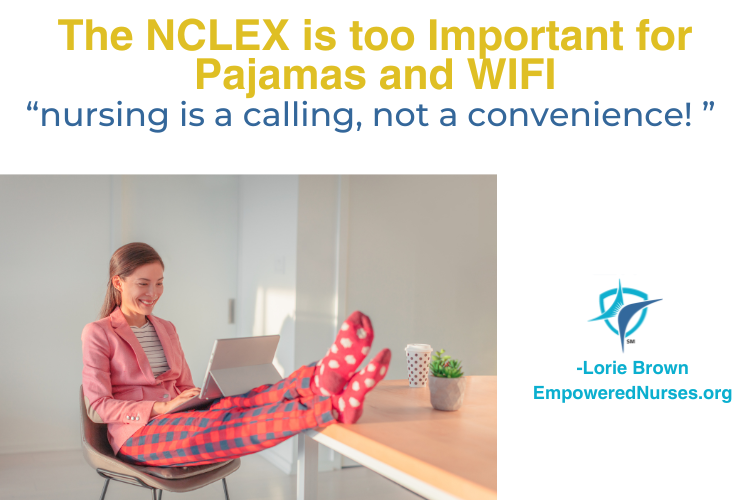
  1. The NCLEX is too Important for Pajamas and WIFI

    1 Comment


    Imagine this: You’ve just finished nursing school, you’ve pulled all-nighters, survived on bad coffee, and practiced every skill from inserting IV’s to perfecting head-to-toe assessments. And now comes “the moment of truth – the NCLEX.”

    But instead of walking into a secure testing center, you are now sitting at your kitchen table with a camera that provides a 360° view of your surroundings, you’re sitting in pajamas with your laptop.

    Well, that sounds comfortable, right? The problem is that nursing is not about comfort but about accountability, ethics, and trust. That’s exactly why allowing the NCLEX exam to be taken at home is not a good idea.

    I had the opportunity to take the California bar exam in the next best place to my home, a hotel! I chose to go to a hotel so I would not be disturbed in the middle of the exam by barking dogs, dirty dishes in the sink, laundry to be washed and dried or someone ringing my doorbell.

    When I checked into the hotel, I noticed the Wi-Fi was not really that good. I spoke with the manager and they put a router in my room to improve my access. Fortunately, it turned out well for me, but for hundreds, if not more than a thousand test takers faced problems with their Internet and the tech associated with taking the exam to the point that they could not properly complete the examination.

    I reached out to the National Council of State Boards of Nursing to tell them about my experiences and why if the NCLEX goes virtual in the home, it would be a bad idea.

    In my situation, I had to turn my computer around 360° for them to check my surroundings after every essay. We were allowed to have a dry erase board next to us, but they never asked me to lift up the dry erase board to look under it or under my

    computer or even my desk.

    Of course I didn’t have any notes there, but I felt it could have been easy to cheat. In addition, we had a 5-minute break every hour and I could have used that brief time to, say, go to the bathroom and review my notes. When I took the Bar exam the previous year in a standard testing scenario, there was a proctor monitoring the bathroom.

    I am concerned about the NCLEX being done in the candidate’s home because:

    1. The integrity of the profession is at stake! Nursing is one of the most trusted professions in the world and that trust is built on knowing that every RN and LPN was obligated to prove themselves by passing the same secure standardized exam.

    Even with remote proctoring software at a test site, there have been documented instances of cheating where some nurses purposely ignore stowing everything into their locker to use “cheat sheets” during the exam and facing the possibility of being disqualified.


    · Use of concealed electronic devices: In one case, nursing students were caught using earpieces hidden under head coverings to receive answers from an outside source during an exam.

    · Irregular behaviors: A candidate may be dismissed from the testing center for violating rules, such as accessing prohibited aids (phones, smartwatches, etc.) or creating a disturbance. One individual on Quora described being reported for using their phone in a prohibited area shortly after completing the exam. · Intentional irregularities: According to Credentialing Insights, examples of intentional cheating include using proxy test takers, falsifying identification, and unauthorized communication with others.

    2. Patient safety comes first! When you step into a patient’s room, no one cares if you aced an examination in a quiet home environment, they care that you can think critically under pressure.

    In the testing environment, it is quiet but structured with strict rules. Allowing at-home testing lowers the stakes in the wrong way. Patients’ lives depend on nurses who bring their license under conditions that reflect the weight of the role.

    3. Equity and access are a concern! Not everyone has a stable Internet connection, acquired environment or the right technology at home. While testing centers will still be available, imagine what would happen if your home Wi-Fi dropped out mid exam, or a family member comes barging in. A secure testing center levels the playing field. Everybody gets the same environment, the same rules, and the same level of seriousness.

    4. It erodes public trust in nursing licensure! When patients hear that the nurses could take the licensing exam at home, it chips away at confidence. It plants doubt. “Did my nurse really earn that license?” Public trust is fragile and the NCLEX is the cornerstone of protecting it. Making the test less secure undermines the credibility of every nurse who worked hard and played by the rules.

    5. It sends the wrong message to future nurses! Becoming a nurse isn’t just about knowledge, it’s about discipline, responsibility, and ethics. The NCLEX is not just another exam. It is a gateway into a profession where people’s lives are in your hands. Taking the test at home trivializes the process, and it turns what should be a sacred milestone into just another online quiz.

    6. The bottom line – nursing is a calling, not a convenience! And while the in-home NCLEX testing might sound easy in theory and practice, it threatens the very things that our profession is built on: integrity, patient safety, and public trust. When you pin on that RN or LPN badge, the world needs to know that you earned it and that means passing NCLEX the right way — not in your living room, but in a secure, standardized environment worthy of the responsibility that comes with being a nurse.

  2. What’s Wrong With the Kansas Board of Nursing Investigation

    Leave a Comment

    Nurses are among the most trusted professionals in our society—people whose hands hold healing, whose judgment can mean life or death. So when the regulatory body meant to protect nurses starts dismantling their careers for clerical errors or missed deadlines, we all should pay attention. The recent legislative investigation into the Kansas State Board of Nursing (KSBN) is one of those moments.

    What’s Going On?

    Kansas legislators—particularly a House Select Committee on Government Oversight—are investigating complaints against KSBN about how it handles licensure renewals, consent orders, and “unprofessional conduct” allegations. Kansas State Legislature+3Kansas Reflector+3https://www.kwch.com+3

    Key issues raised include: · Nurses claiming they were pressured to sign consent orders admitting “unprofessional conduct” for mistakes like letting a license lapse while caring for a sick spouse.

    • Others who clicked the wrong box during the renewal process and faced investigations or had their ability to prescribe revoked.
    • Being caught in databases (state and national) as having committed or admitted to unprofessional conduct, even when the root cause was clerical, nonclinical, or arguably understandable.
    • Tests of whether the penalties fit the errors. Many legislators are calling them “draconian.”

    Why This Is So Troubling

    As someone who cares about both nursing and regulation, this rings so many alarm bells:

    1. Patient safety vs. bureaucratic overreach The purpose of a Board of Nursing is to protect the public. But when the consequences for clerical missteps (missing a renewal deadline, clicking the wrong box) are punitive rather than corrective, the balance is lost. We risk punishing good nurses who pose no risk to patients.
    2. Credibility & trust in the profession Nursing depends on public trust. If the licensing board seems capricious, or if unfair labeling (e.g. “unprofessional conduct”) becomes common for harmless errors, it undermines the public’s belief in what a “licensed nurse” means.
    3. Mental, emotional, and financial harm These aren’t just bureaucratic lines on paper. Getting labeled “unprofessional,” losing the ability to practice (prescriptions, clinical work), facing inflated malpractice premiums, or being unemployable—all because of a clerical error—can wreck lives. KSBN’s actions have allegedly done exactly that.
    4. Barrier to nursing retention & access to care Nurses leave the profession when regulatory burdens feel unfair or unpredictable. In Kansas, where staffing is already a serious issue, pushing nurses out (or preventing them from returning) over nonclinical infractions exacerbates shortages. It also harms patients if care is delayed or fragmented.

    What Legislators Are Asking For (and What’s Possible)

    From recent hearings and testimonies, here’s what lawmakers are pushing for:

           · Revised rules: Make sure that the severity of discipline fits the nature of the mistake—for example, recognizing the difference between                clinical incompetence vs. clerical error.

    • Grace periods / corrections: Allow for fixing mistakes without being punished. For example, if someone misses the renewal deadline by a short time, or if a license renewal form has a minor mis-click, there should be a procedure to correct the error and maintain licensure.
    • Better notice & communication: Some nurses say they weren’t even told their license had lapsed until a pharmacist flagged it. KSBN has begun pushing more email reminders, but many believe more robust, proactive communication is needed.
    • Review of consent order practices: The practice of offering—or coercing—consent orders that require admission of unprofessional conduct, without full due process or appeal, is under scrutiny.
    • Removing unfair records & restitution: If nurses have been added to databases for behavior that’s not clinical or dangerous, some legislators propose removing those records and compensating for the harm done.

    What Kansas—and Other States—Can Learn From This

    • Regulation should resemble triage, not punishment. In medicine, triage is about assessing severity and urgency, treating what needs immediate attention, and preserving resources. Regulatory boards should think similarly: serious patient safety issues require swift action; clerical missteps should be handled with remediation.
    • “Due process” isn’t just legal jargon—it’s vital. Being forced into consent orders without real opportunity to defend oneself is more than unfair—it’s damaging to careers. Boards must provide fair hearings, transparent process, and proportional disciplinary measures. North Carolina Board of Nursing has a Complaint Evaluation Tool so you can see their approach to discipline.
    • Communication is care. Just like in patient care, clarity, reminders, transparency matter. If renewals are going to lapse, or if renewals require certain steps (boxes to check, forms to submit), the board should ensure nurses know, ideally in multiple ways, ahead of time. Don’t rely on the Board to remind you to renew your license. Put it as a recurring event on your calendar. The DMV does not remind you to renew your license.
    • Trust is fragile. Hold on to it. Nurses already carry heavy mental and emotional loads. If the regulatory agency feels more like an adversary than a protector or partner, morale suffers—and so does the quality of care.

    What’s at Stake If Things Don’t Change

    If KSBN and similar boards don’t course-correct, the consequences can ripple widely:

    • Nurses might leave the profession or move out of state.
    • Patient access could suffer—clinics scrambling to find APRNs or RNs to cover gaps.
    • Legal challenges and costs may pile up for both individuals and the state.
    • Public confidence in nursing licensure may decline, which undermines the entire framework of regulation.

    The Bottom Line

    Nurse regulation exists to protect the public. But regulation gone too far—or applied without compassion—hurts those who’ve dedicated years of study, service, and sacrifice. The KSBN investigation is showing what happens when rules—often written with clinical errors in mind—are used punitively in nonclinical cases.

    Especially when health care is already stretched thin, we need regulatory justice: proportional, fair, transparent. The nursing profession deserves nothing less. Patients deserve nothing less.

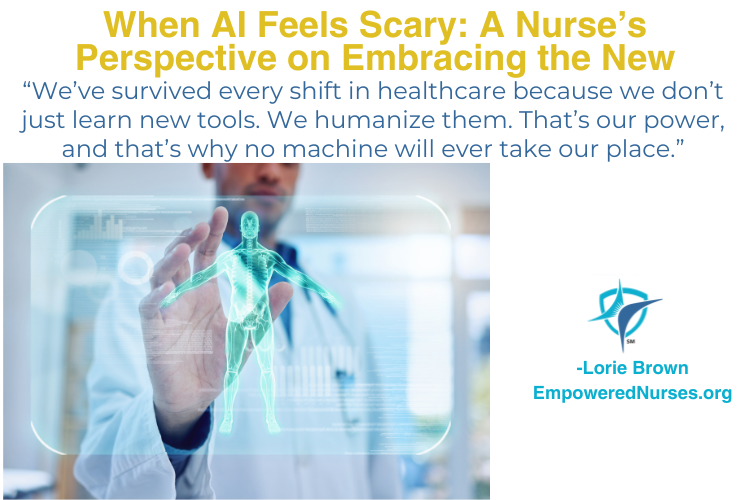
  3. When AI Feels Scary: A Nurse’s Perspective on Embracing the New

    Leave a Comment

    Let’s be honest — AI is intimidating. The headlines make it sound like robots are rolling into the hospital tomorrow, ready to push meds, chart assessments, and even give report. For many nurses, it feels like one more threat to our profession, our livelihoods, and even our sense of purpose.

    But here’s the truth: this isn’t the first time something new has scared us.

    Think back.

    · When electronic medical records (EMRs) showed up, we all groaned. Paper charts were simple, quick, and familiar. Suddenly, we were staring at endless clicks, passwords, and “nursing note templates.” Many of us thought, This will never work. Now? We can’t imagine trying to manage a 30-patient load without an EMR flagging drug interactions or trending lab results.

    · Remember when smart pumps were introduced? At first, we didn’t trust them. Nurses double- and triple-checked every calculation, worried that a machine would override our critical thinking. Now, they’re standard — catching errors that save lives every day.

    · And let’s not forget telehealth. Once upon a time, the idea of caring for patients through a screen felt cold and impersonal. Today, it’s expanded access, brought specialists into rural communities, and kept vulnerable patients safe during a pandemic.

    Each time, fear whispered: This will replace us. Each time, experience proved: This will support us.

    AI is just the next chapter in that story.

    What’s Different — and What Isn’t

    AI can scan, summarize, and highlight patterns faster than we can. That’s true. But what AI cannot do is bring the depth of lived experience, empathy, and judgment that nurses carry. AI doesn’t know what it feels like to hold a patient’s hand before surgery. It doesn’t notice the way someone’s color changes when their O2 dips. It doesn’t connect the dots between “something feels off” and a subtle but life-threatening decline.

    We’ve always been the bridge between technology and humanity. That’s not going to change.

    Moving Forward with Courage

    Instead of resisting, what if we leaned in? What if we learned how AI works — and then made it work for us? Just like EMRs, smart pumps, and telehealth, this new tool can become a partner, not a replacement.

    Nursing has always been about adaptation. Our profession is built on it. The stethoscope, the ventilator, the IV pump — all once “scary new things.” And every time, nurses rose up, embraced the change, and kept our focus where it belongs: on the patient.

    Final Thought

    AI may feel scary today. But so did every other innovation we now take for granted. The heart of nursing hasn’t changed — and it never will.

    We’ve survived every shift in healthcare because we don’t just learn new tools. We humanize them. That’s our power, and that’s why no machine will ever take our place.

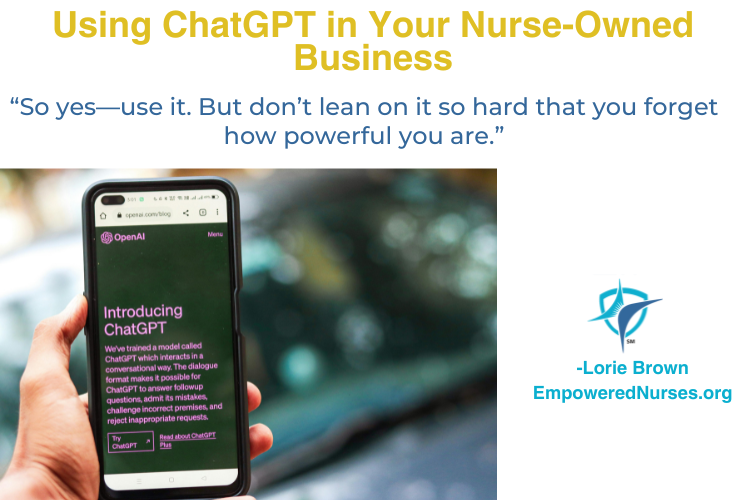
  4. Using ChatGPT in Your Nurse-Owned Business

    1 Comment

    I get asked all the time should I use ChatGPT in my nurse owned business. There are pros and cons to using it. Here are the pros:

    1. Saves You HOURS (No More Blank Screens or Writer’s Block)

    You need to write a blog, draft a lead magnet, or create an email campaign—and your brain feels like it just did after a 3 day shift stretch with no caffeine. ChatGPT can give you a first draft in seconds, which you can polish with your nursing voice and heart.

    2. Affordable Support, Especially When You’re Bootstrapping

    Hiring a copywriter or VA can cost hundreds (or thousands). ChatGPT is like having a full-time assistant for under $30/month. If you’re just starting out, it’s an incredible tool to help you look polished and professional without blowing your budget. You should definitely use the paid version. It’s only $20/month and it has built in security.

    3. Can Help You Think Like a CEO

    It’s not just for writing. You can brainstorm offers, refine your packages, map out social content, generate legal or compliance questions to ask your attorney—and start thinking strategically, not just clinically.

    4. It Learns Your Style (with a Little Training)

    The more you use it, the better it gets at mimicking your tone. You can feed it examples of past emails or blogs, and say: “Write in this voice.” It’s like teaching a new grad to chart the way you do—eventually, they catch on.

    5. 24/7 Support When Inspiration Hits at 2 A.M.

    When you’re up late dreaming of your next business move, ChatGPT is always awake and ready to riff ideas with you. No waiting for a reply from your team or coach.

    6. Embrace AI

    As nurses, we feel we have to do everything ourselves. Using chatGPT is the difference between taking a manual blood pressure or using the machine that saves you time and money. It’s a tool that will save you time and money. Just like when any new technology is introduced in nursing, the early adopters do better.

    🚫 CONS of Using ChatGPT in Your Nurse-Owned Business

    1. It’s Only as Smart as You Train It

    ChatGPT doesn’t have your clinical experience, your heart, or your nuance. If you don’t prompt it well, it may give you generic, robotic, or even flat-out incorrect answers. You still have to think like a nurse and edit like a boss.

    2. It Can Sound “Off” if You’re Not Careful

    Without your edits, AI content can come across as stale, overly formal, or totally inhuman. And as a nurse, your audience expects empathy, clarity, and connection. Don’t hand over your voice—just let ChatGPT draft your outline.

    3. It Doesn’t Know State Laws or Your Scope

    If you ask legal or compliance questions—like “Can I open a med spa in California without a medical director?”—ChatGPT might give you outdated or wrong info. Always verify regulatory advice with actual attorneys or board sources.

    4. You Risk Losing Your Brand Personality

    If you use it too much or too blindly, your content starts sounding like everyone else’s. And let’s be honest—your brand isn’t “everyone else.” It’s you, in scrubs and stilettos, with stories and sass and smarts. Always infuse your personality back in.

    5. It Can’t Build Relationships

    ChatGPT can draft an email, but it can’t follow up on a lead. It can brainstorm a webinar title, but it can’t pitch your value in a Zoom room. You still need to show up and be visible. No bot can replace your energy.

    💡 Final Thoughts: A Tool, Not a Replacement

    ChatGPT is like a really good stethoscope—it helps you listen and analyze, but you still have to use your judgment. It’s a tool that can accelerate your momentum, spark ideas, and lighten the load, but it can’t replace your heart, hustle, or healing presence.

    So yes—use it. But don’t lean on it so hard that you forget how powerful you are.

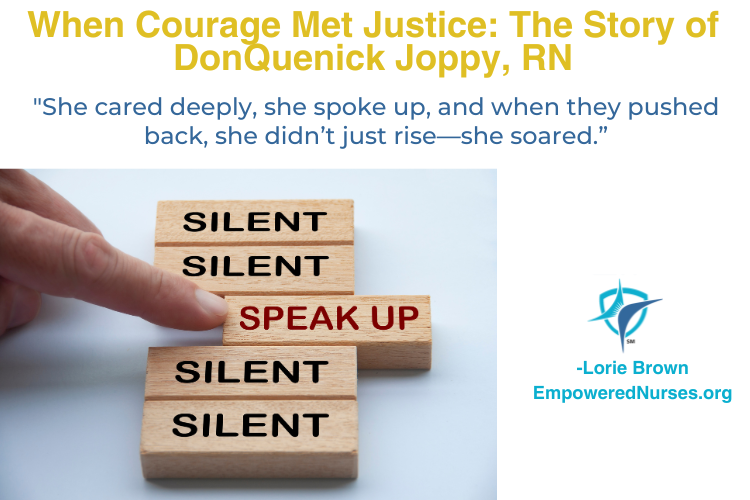
  5. When Courage Met Justice: The Story of DonQuenick Joppy, RN

    Leave a Comment

    This is a story of a nurse’s resilience, why we raise our voices even when the world tries to silence us.

    A Crisis Fueled by Courage

    In Colorado, a nurse named DonQuenick Yvonne Joppy found herself at the eye of a devastating storm. After advocating against discriminatory behavior, she faced termination—not for poor performance—but after a critical patient death. Soon, the hospital escalated the situation, and she was charged with manslaughter. Charges that were later dropped in September 2021 “in the interest of justice” but the personal and professional damage was already done—from homelessness to a shattered reputation.


    The Power of a Jury’s Unanimous Voice

    But Joppy didn’t fade into the background. She brought a civil rights lawsuit against HCA HealthOne Medical Center of Aurora, asserting she was retaliated against and discriminated against. Fast-forward to this summer: a federal jury in Colorado delivered a staggering $20 million verdict in her lawsuit for racial discrimination and retaliation. That’s $5 million for emotional distress and reputation harm, and $15 million in punitive damages. (I am not sure what the law is in Colorado but in Indiana, 75% of punitive damages goes to a state fund rather than the pocket of the person it was awarded to).

    Her victory wasn’t just monetary—it was a statement that bias and silencing nurses won’t be tolerated.

    From Scrubs to Standing Tall

    Picture this: a nurse who spent her career caring for others, now fighting for her own life and dignity. Instead of crumbling under the weight of legal battles, she stood strong—with every subpoena and court document another dose of adrenaline pushing her forward.

    Her verdict isn’t just numbers. It’s a message—steady, resilient, and undeniably powerful. It’s a reminder to every nurse: documentation matters, truth matters, and courage matters.

    What This Means for Nurses Everywhere

    · Accountability for institutions: The verdict sends a firm message that hospitals cannot weaponize patient incidents to silence whistleblowers.

    · Emotional validation: Facing wrongful accusations damages more than your reputation. Joppy’s compensation acknowledges the stress, anxiety, and trauma she endured.

    · Legal precedent: This case shines a bright light on discrimination and retaliation within healthcare—proof that justice is possible, even when the system feels stacked against you.

    A Nurse’s Survivor’s Guide

    If you’re a nurse or healthcare leader reading this, imagine this verdict as 20 million reasons to keep raising your voice:

    · Document everything. Advocacy is your shell; evidence is your shield.

    · Don’t ignore discriminatory behavior—even subtle bias compounds into real harm.

    · Seek support. Legal counsel isn’t a luxury; it’s self-defense.


    In Conclusion: Nurse Joppy’s story resonates because it is urgent, clear, and necessary. She cared deeply, she spoke up, and when they pushed back, she didn’t just rise—she soared. This isn’t just a legal victory. It’s a landmark for nursing, compassion, and justice.

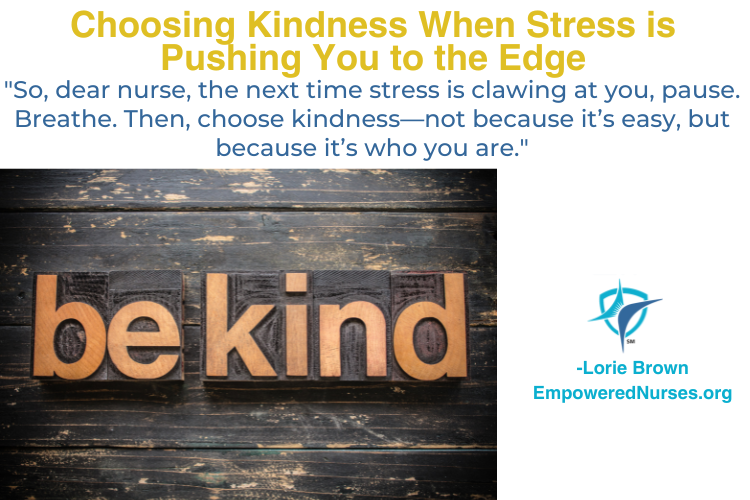
  6. Choosing Kindness When Stress is Pushing You to the Edge

    Leave a Comment

    Nurses know stress better than most people. We carry it in our shoulders, in the ache of our feet after twelve hours, in the pile of unfinished charting, in the relentless beeping of machines that seem to never stop. Stress can feel like a constant companion—sitting on our shoulder, whispering irritability, impatience, and exhaustion into our ear.

    And yet… in those exact moments, we hold the power to choose something different. We can choose kindness.

    Why Kindness Feels Hard Under Pressure

    When our nervous system is in overdrive, the brain slips into survival mode. Fight, flight, or freeze. In that mode, kindness can feel like an impossible luxury. After all, how can you be gentle when your charting is overdue, a family member is yelling, and your patient’s blood pressure just tanked?

    But here’s the truth: kindness isn’t another item on your to-do list. It’s a lifeline—for you and for those around you.

    Kindness lowers your stress hormones. Kindness diffuses tension in others. Kindness reminds you that you are more than the chaos around you.

    Shifting Toward Kindness in the Moment

    So, how do we make the shift when stress has us by the throat?

    1. Pause and Breathe. One slow inhale and exhale sends a message to your body: You are safe enough to soften.

    2. Reframe the Situation. Instead of thinking “This family member is difficult,” shift to “This family member is scared.” Kindness flows more easily when we see the humanity under the frustration.

    3. Offer Small Acts. A gentle touch on a patient’s hand. A smile. A word of reassurance. Even if you don’t have an extra minute, you can always offer an extra ounce of grace.

    4. Redirect the Inner Voice. Stress often turns our self-talk sharp: I’m failing, I can’t keep up, I’m not enough. Practice flipping it: I’m doing my best. This moment is hard, but I am steady. I can choose calm.

    5. Anchor in Purpose. Remember why you started nursing. Not for the endless documentation. Not for the paychecks. For the people. Choosing kindness—even in stress—keeps you aligned with that core purpose.

    A Ripple Effect

    Here’s the thing about kindness: it’s contagious. When you choose a kind word instead of a sharp one, you lower the temperature of the entire room. Patients feel safer. Families feel heard. Your coworkers exhale. And—you guessed it—your own heart beats a little steadier.

    Kindness doesn’t erase stress. But it transforms it. It turns chaos into connection. It turns burnout into resilience. It turns ordinary days into moments of grace.

    So, dear nurse, the next time stress is clawing at you, pause. Breathe. Then, choose kindness—not because it’s easy, but because it’s who you are.

  7. When Bureaucracy Turns Punitive: Nursing Board Overreach in Kansas

    2 Comments

    The Kansas State Board of Nursing (KSBN) is charged with protecting the public and ensuring the integrity of the nursing profession. But recent cases have raised serious concerns about whether that mission has been overshadowed by disproportionate and punitive actions toward nurses for administrative missteps. Two recent articles — one from nurse.org and another from The Kansas Reflector — have brought these stories into the public eye, prompting outrage from nurses, legislators, and the public.


    Real People, Real Consequences

    Amy Siple: 32 Years of Service, Career on Hold

    In early 2024, nurse practitioner Amy Siple stepped away from her career to care for her husband, who had been diagnosed with metastatic prostate cancer. When she returned to work, she realized her license had lapsed. Her continuing education was complete, and no patients were harmed. Still, KSBN demanded she sign a consent order admitting to “unprofessional conduct” for practicing without a license. The penalty was not a warning or fine, but a disciplinary action that now jeopardizes her career and will be public record forever.

    Ana Ahrens: A Renewal Error Turned Into Discipline

    Psychiatric nurse practitioner and addiction counselor Ana Ahrens mistakenly renewed both her RN and APRN licenses twice. She was never notified of the duplication. Months later, a pharmacist told her patients couldn’t receive prescriptions because her license was listed as inactive. When she contacted KSBN to resolve the issue, she was met with an investigation and pressure to sign a consent order admitting unprofessional conduct. She described the process as “tyranny as a form of punishment.”


    The Problem with This Approach

    These are not cases involving patient harm, negligence, or misconduct. They are administrative errors — the kind that can happen to anyone working in a demanding profession with complex licensing requirements. Yet the consequences have been severe and life-changing, placing careers, livelihoods, and patient care at risk.

    At an August 7, 2025, Kansas House Select Committee on Government Oversight hearing, legislators openly questioned the board’s approach. Some even suggested defunding KSBN or overhauling its procedures entirely. The central question was simple: Is this justice?


    What Needs to Change

    To rebuild trust and ensure fairness, several steps are necessary:

    1. Proportional Discipline Reserve harsh penalties for serious violations involving harm or clear risk to the public. Administrative mistakes should be met with corrective action, not career-threatening discipline.

    2. Clear and Timely Communication Notify licensees immediately when an error is detected, and give them a chance to correct it before opening a formal investigation.

    3. Transparent Standards Clearly define what constitutes “unprofessional conduct” and ensure it is applied consistently and appropriately.

    4. Paths to Resolution Offer remediation and education for minor mistakes rather than forced admissions of misconduct.


    Why It Matters

    Boards of nursing hold immense power over the careers of those they regulate. With that power comes a responsibility to balance public protection with fairness and due process. When that balance tips toward punishment for minor errors, the consequences ripple far beyond the nurse — impacting patients, families, and communities.

    The recent Kansas cases are a call to action. Oversight must be exercised with fairness, compassion, and common sense. The integrity of nursing regulation depends on it.

  8. When the Healing Hands Betray: A Story of a Nurse Who Lost Her Way

    2 Comments

    Once, Scharmaine Lawson  Baker was a beacon in our profession—a seasoned nurse practitioner, author, mentor. She wrote guides on patient-provider trust, taught about medical necessity, and inspired nurses to deliver house-call care with compassion.

    But somewhere along the way, the code of ethics was traded for the currency of fraud.

    The Scam Under the Lab Coat

    Between 2018 and 2019, Baker worked remotely as an independent contractor for a telehealth outfit. Over calls shorter than lunch breaks—often less than 60 seconds—she signed hundreds of orders for genetic cancer tests. Patients she never met or physically examined were told they were receiving free cancer screenings.

    In some jaw-dropping moments of dishonesty, she falsely diagnosed male patients with cervical cancer—something that truly should have triggered medical alarms, not Medicare alarms. She never reviewed test results, even when they revealed no actual cancer risk. She ordered tests purely to fuel claims—ventricles pumping falsehoods instead of care.

    The Toll on Trust and Taxpayers

    The scheme defrauded Medicare of more than $12.1 million. Labs got over $1.5 million in kickbacks. Baker accepted bribes she later hid in a bankruptcy petition. It was six counts of health care fraud, and the Justice Department delivered a verdict: guilty. Now, she faces sentencing scheduled for November 19, 2025, and up to 60 years behind bars—10 years per court.

    Your Heart Knows It’s Wrong

    As a nurse and an attorney, I feel the sharp edges of this betrayal. A trusted professional used her credentials to exploit the most vulnerable—to turn the oath of non-maleficence into a headline of greed.

    It’s like a nurse giving IV fluids that are actually toxic—only here, the victims were taxpayers and patients who believed they were cared for.

    Lessons for the Healing Field

    • Ethics must be our compass. A license is not just a paper—it’s a pact with patients, the profession, and society.
    • Telehealth demands vigilance. Brief phone calls cannot replace clinical judgment or physical assessment.
    • Watch for red flags: genetic tests ordered without evaluation, Medicare claims that spike unnaturally, providers with too many “free screening” promotions. · Whistleblowers save lives—sometimes from fraud, sometimes from ruin. The False Claims Act rewards them, and protects them from retaliation.

    Healing the Profession

    When a nurse practitioner falls into fraud, it feels like a punctured line—it leaks trust, morale, financial stewardship, and the very ethos of our profession.

    But good nurses still pour compassion and skill into every IV, every wound care plan, every patient dignity preserved. We must let the few who falter motivate rigorous ethics training, stronger oversight, and stronger culture.

    Final Thoughts

    This isn’t just shameful—it’s heartbreaking. It shows how, under the white coat, the heart can sometimes be replaced by greed.

    Yet, every day, good nurses quietly rebuild trust: holding hands, calling families, advocating for fair care. That is our true legacy.

    May this story be a cautionary tale and a call to arms—let’s keep nursing noble, keep systems transparent, and keep every patient’s best interest at the center of our compass.

    Nurses, I’d love to hear from you: Have you ever encountered fraud in practice? How do we teach ethical vigilance—especially in telehealth?

  9. Top 10 Networking Tips for Nurse Business Owners

    Leave a Comment


    Build Your Business, One Relationship at a Time

    As a nurse business owner, you’re used to wearing many hats—clinician, CEO, marketer, and sometimes, head janitor. But one of the most powerful roles you’ll ever step into is that of a connector.

    Whether you’re launching a legal nurse consulting firm, wellness coaching practice, or healthcare staffing agency, networking isn’t optional—it’s essential. It’s how you find clients, collaborators, mentors, and opportunities that don’t show up on job boards.

    So how do you network effectively, especially if you’re new to business or naturally introverted?

    Here are the Top 10 Networking Tips for Nurse Entrepreneurs:


    1. 🌟 Lead With Value, Not a Pitch

    Don’t start every conversation with, “Here’s what I do.” Instead, ask how you can help others. Share a resource. Offer a connection. Give give, give before you ask. No one goes to a networking event to hire someone. It’s a start to the conversation so ask to meet for coffee at another time.

    🤔 Ask: “What’s the biggest challenge in your business right now?”


    2. 📇 Always Have a Business Card (Digital or Paper)

    Yes, even in 2025, business cards still matter. Use a beautifully designed paper card, or try digital tools like HiHello or Popl for a QR-based option that saves to phones instantly which is great because you get their phone number to follow up.

    🧠 Tip: Add your photo so people remember who you are.


    3. 📍 Attend the Right Events

    Stop showing up everywhere and start showing up strategically. Choose conferences, webinars, or local events that align with your niche—whether that’s legal nurse consulting, nurse coaching, or direct patient care services.

    🛠 Make a plan: 1 live event + 2 virtual events per quarter or more!.


    4. 🤗 Be Curious, Not Just Confident

    Networking isn’t about proving yourself. It’s about getting to know others and making friends. Be genuinely curious about people’s stories, goals, and challenges.

    🗣 “Tell me how you got started in your business.”


    5. 🧾 Follow Up Within 48 Hours

    The magic happens after the meeting. Send a quick note, text or LinkedIn message that says:

    “It was great to meet you at [event]. I loved hearing about [something specific]. Let’s stay in touch!”

    📅 Pro Tip: Set a calendar reminder to follow up with new contacts weekly.


    6. 💻 Use LinkedIn Like a Pro

    Your LinkedIn profile should clearly state what you do, who you serve, and what problem you solve. Then use it to engage, not just post—comment on others’ updates, share valuable tips, and message people after connecting.

    📣 Post a short “Did you know…” tip once a week to stay top of mind.


    7. 🧍‍♀️ Practice Your Elevator Pitch—but Make It Personal

    Have a brief intro ready, but don’t make it robotic. Focus on how you help people, not just your job title. Focus on the value and benefits you bring.

    🧾 Example: “I’m a nurse consultant who saves attorneys time and money by,,, to help you settle your cases sooner and for more money.”


    8. 🧠 Join a Mastermind or Business Group for Nurses

    Surround yourself with others who “get” you. These groups offer accountability, support, and potential referral partners. Business ownership is a solo sport and gets lonely.

    💬 Search for local nurse entrepreneur meetups or online masterminds through AALNC, NNBA, or Facebook.


    9. 📚 Give Talks, Not Just Business Cards

    Position yourself as an expert by offering to give a free presentation—online or in person. You’ll be seen as helpful and credible, not salesy. Ask what they want to learn.

    🗣 Topics could include: “Top 5 tips to get peer reviewed medical information” or “How to get a great night sleep even with a new baby.”


    10. 💖 Be Yourself. Your Voice Is Your Brand.

    People do business with people they like and trust. You don’t have to be the loudest in the room. Just be the most authentic, consistent, and generous version of yourself.

    🧩 You’re not just building a network—you’re building relationships.


    💼 Final Word: Networking Is Nursing, Just in a Different Scrub Top

    As nurses, we’re trained to assess, connect, and build trust quickly. Use those same skills in the business world. When you network with intention and authenticity, you don’t just find clients—you find community.

    You’re not just selling a service. You’re showing up as a trusted partner, a problem-solver, and a nurse who knows business.


  10. Crossing State Lines: Can a School Nurse Travel to Another State with Students? 

    1 Comment

    Picture this: You’re a school nurse preparing for an exciting field trip to Washington D.C., but your home state is Maryland. As you carefully organize medications for three students with diabetes, one with severe allergies, and another with ADHD, a nagging question keeps surfacing—can you legally administer these life-sustaining medications once you cross that invisible line into another state?

    This scenario plays out in schools across America every day, and the answer isn’t as straightforward as we might hope. Like a complex medical case that requires careful assessment from multiple angles, understanding interstate nursing practice during school trips demands attention to legal details, professional standards, and most importantly, student safety.

    The Heart of the Matter: Nursing License Boundaries

    Just as a patient’s vital signs don’t suddenly change when they move from one hospital room to another, a student’s medical needs remain constant regardless of geography. However, the legal authority to meet those needs can shift dramatically with state boundaries.

    The Nurse Licensure Compact: A Bridge Across State Lines

    The most significant development in interstate nursing practice has been the Nurse Licensure Compact (NLC), which allows for nurses to have one multistate license with the ability to practice in all compact states. Currently, 42 states are part of the eNLC, creating a safety net that spans much of the country.

    For school nurses, this compact functions like a universal donor blood type—it provides compatibility across multiple locations. Under mutual recognition, a nurse may practice across state lines unless otherwise restricted, meaning that if both your home state and destination state are compact members, you can legally administer medications during interstate school trips.

    Non-Compact States: Navigating Uncharted Territory

    When traveling to non-compact states, the situation becomes more complex, like trying to provide care without your usual assessment tools. Each state maintains its own nursing practice laws, and technically, practicing nursing without a license in that state could constitute a legal violation.

    However, there’s a critical distinction that many don’t realize: emergency situations and temporary care provisions often have different legal standards than ongoing practice. Some states have provisions for temporary or emergency care, while others may consider short-term school trip medication administration as falling outside the scope of “practicing nursing” in their state.

    Best Practices: Building Your Safety Net

    Like developing a comprehensive care plan for a complex patient, preparing for interstate school trips with medication administration requires systematic planning:

    1. Research and Documentation

    Before any trip, contact each state’s board of nursing to understand specific requirements. Document your findings and maintain records of your research—this shows due diligence and professional responsibility.

    2. Medication Management

    Follow strict protocols for medication transport and storage. Keep medications in carry-on luggage, not checked baggage, and consider packing additional doses in case the trip is extended.

    3. Parent Communication and Consent

    All students who will require medication during the duration of the trip need both a provider order and parent/guardian permission. This isn’t just paperwork—it’s building a partnership with families to ensure student safety.

    4. Professional Consultation

    When in doubt, consult with your state nursing board, school district legal counsel, and professional nursing organizations. Like seeking a second opinion on a challenging diagnosis, multiple perspectives strengthen your position.

    The Ethical Imperative: Student Welfare Above All

    As school nurses, we took an oath to “do no harm,” but we also committed to providing care when it’s needed. The ethical imperative to ensure student safety during educational activities often outweighs technical licensing concerns, especially in emergency situations.

    Consider the alternative: if a diabetic student experiences hypoglycemia during a field trip and you’re the only qualified person present, the moral and ethical obligation to provide care supersedes licensing technicalities. I would assume most state nursing boards recognize this reality.

    Risk Mitigation Strategies

    Like implementing fall precautions for at-risk patients, smart risk mitigation protects everyone involved:

    · Partner with Parents: Encourage parent chaperones for students with complex medical needs

    · Emergency Action Plans: Develop detailed protocols for each student’s specific conditions

    · Communication Networks: Establish clear lines of contact with healthcare providers, parents, and emergency services

    · Insurance Verification: Ensure your professional liability insurance covers interstate activities

    The Future Landscape

    The nursing profession is evolving toward greater interstate mobility, much like how telemedicine has transformed healthcare delivery. As more states join the NLC and recognize the realities of modern educational travel, we can expect clearer guidelines and broader protections for school nurses.

    Conclusion: Balancing Law, Ethics, and Student Needs

    Can a school nurse travel to another state with students and give medications without being licensed in that state? The answer depends on multiple factors: compact state membership, specific state laws, the nature of the medications, emergency provisions, and individual circumstances.

    What remains constant is our professional obligation to student safety and well-being. Like every challenging case we encounter, this situation requires careful assessment, thorough preparation, proper documentation, and sometimes, the courage to advocate for our students’ needs within legal and ethical boundaries.

    The key is preparation—understanding the legal landscape, building strong partnerships with families and administrators, and always keeping student welfare at the center of our decision-making. After all, that’s what school nursing is truly about: ensuring that health conditions never become barriers to learning and growth.

As Seen On:

Women's Week