Join me for an exclusive in-person event for LNCs to hear the behind-the-scenes legal process from 12 attorneys! ❱❱

Empowering Nurses at the Bedside and in Business

Author Archives: Lorie A Brown, R.N., M.N., J.D.

  1. Nursing License Renewal in Indiana: What You Must Know Before You Click “Submit”

    Leave a Comment

    It’s that time again—nursing license renewal season in Indiana. Even if you’re licensed in another state, this article is for you, too. Most state boards ask similar questions during renewal, and your answers matter more than you might think.

    In Indiana, the Board of Nursing asks six specific questions to assess whether you are safe to continue practicing. If you answer “yes” to any of these, you are required to submit a detailed explanation. In some cases, this may result in a call for a Personal Appearance before the Board.

    These questions cover the time period since your last license renewal—not your entire career. But don’t be fooled into thinking they’re just formalities. Failing to answer truthfully, or omitting information, can lead to serious consequences—including allegations of fraud or misrepresentation in renewing your license.

    This process is covered by Indiana Code 25-1-9-4 which states “A practitioner shall conduct the practitioner’s practice in accordance with the standards established by the board regulating the profession in question and is subject to the exercise of the disciplinary sanctions… if, after a hearing, the board finds the practitioner has engaged in or knowingly cooperated in fraud or material deception in order to obtain a license to practice… “ 

    Let’s walk through these six questions together so you can feel confident and prepared:

    1. Disciplinary Action Against a License

    “Since you last renewed, has any professional license, certificate, registration, or permit you hold or have held, been disciplined or are formal charges pending in any state?”

    If you’ve had formal charges or disciplinary action in any state (not just Indiana), you must answer “yes.” Pending investigations don’t count unless they have resulted in formal charges. Still, it’s wise to err on the side of caution—chances are, the Board already knows, and failure to disclose is far worse than disclosure.

    1. Denial of a License or Credential

    “Since you last renewed, have you been denied a license, certificate, registration, or permit in any state?”

    This is straightforward. If you were denied any of the above—whether as a nurse or any other healthcare professional—you must disclose it and explain.

    1. Criminal History or Legal Issues

    “Since you last renewed, and except for minor traffic violations resulting in fines or expunged arrests/convictions, have you been arrested, entered into a diversion agreement, been convicted of, pled guilty to, or pled nolo contendere to any offense, misdemeanor, or felony in any state?”

    This one trips up a lot of nurses.

    Here’s the key: Expunged means it’s legally erased and does not have to be disclosed. However, dismissed charges are not the same. If you were arrested and the case was dismissed or you entered a diversion program, you still must answer “yes.” Even if you were charged but not arrested, you must disclose it even if the records are sealed.

    The Board will see what you don’t report—and not disclosing is considered fraud. Again, honesty is your best defense.

    1. Malpractice Judgments or Settlements

    “Since you last renewed, have you had a malpractice judgment against you or settled any malpractice action?”

    Nurses are rarely named individually in malpractice suits—but if you were, and there was a settlement or judgment against you (especially if are reported to the National Practitioner Databank), you must answer “yes.” Even if your employer covered it, it’s still your responsibility to report it.  

    1. Employment Discipline or Termination

    “Since you last renewed, have you ever been terminated, reprimanded, disciplined, or demoted in the scope of your practice as a Nurse or as another health care professional?”

    This includes any form of discipline—attendance issues, write-ups, suspensions, even reprimands. Yes, even for attendance. Why? The Board could interpret it as patient abandonment.

    If the action is in your personnel file, you are expected to know about it and report it. “I wasn’t told” is not an acceptable excuse.

    1. Medicare/Medicaid Exclusion

    “Since you last renewed, have you been excluded from being a Medicare or Medicaid provider?”

    This refers to being listed on the Office of Inspector General (OIG) Exclusion List. If you’ve received a letter or know that you are excluded from treating Medicare/Medicaid patients, you must disclose this.

    You can check your status here: OIG Exclusions List

    Final Thoughts: When in Doubt—Disclose

    If you’re uncertain how to answer any of these questions, get help. “I misunderstood the question” is not a valid excuse in the eyes of the Board. Working with an attorney can help you present the facts accurately and in the best possible light.

    Honesty isn’t just the best policy—it’s the only policy when it comes to renewing your license. Your nursing career depends on it.


    About the Author: Lorie A. Brown, R.N., M.N., J.D., is a Registered Nurse as well as an Attorney.  She represents Nurses and other healthcare providers with license protection and license defense before Indiana State Board of Nursing.  


    The views expressed in this article are those of the author and not necessarily those of IPLA or the Indiana State Board of Nursing.   

  2. “Nurse! Can You Help?” – When and How to Safely Render Aid as a Nurse Off-Duty

    Leave a Comment

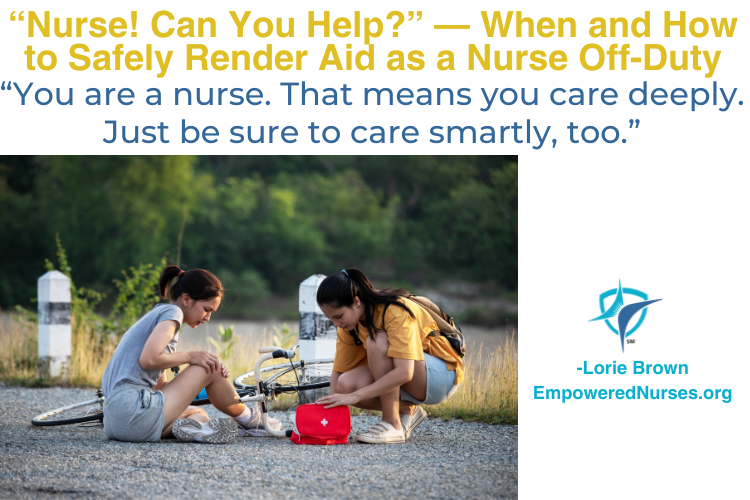
    As nurses, we’re hardwired to help. It doesn’t matter if we’re on the clock, in scrubs, or just trying to enjoy a day at the park—we hear a cry for help, and our instinct kicks in. But when you’re off-duty and a medical emergency unfolds in front of you, there’s something else you need to engage before you take action: your judgment.

    Because while the heart says, “Do something,” the professional reality whispers, “Be careful.”

    The Hidden Risks of Being the Helper

    Many nurses are surprised to learn that stepping in to help a stranger in a medical emergency can carry personal and legal risks. Even with the best of intentions, rendering aid in a public setting may open the door to potential liability, licensing issues, or even misunderstood outcomes—especially if the situation spirals or is witnessed through the lens of a smartphone.

    Even Good Samaritan laws, which are designed to protect well-meaning individuals who step in during emergencies, vary widely from state to state and may not always fully shield licensed professionals. Some states hold medical professionals to a higher standard of care—even when off-duty.

    Real-Life Scenarios

    Imagine you’re walking through a shopping mall and someone collapses. You rush to their side. Was it a faint? Cardiac arrest? A diabetic episode? You instinctively begin compressions or reach for a pen to use as an airway. Moments later, EMS arrives—but the family sues, claiming your actions caused harm.

    It’s not just fearmongering—it has happened.

    Or what if you inject Narcan into someone in a public space because you suspect an opioid overdose… but it turns out they were not overdosing at all?

    What Nurses Should Keep in Mind

    Here are some important tips to consider before jumping into action:

    1. Assess the scene—for safety and legality

    If the scene is unsafe (weapons, traffic, or violence), wait for trained responders. Your safety matters first. You’re no good to anyone if you become the second victim.

    2. Call 911 immediately

    Even if you begin CPR or render basic aid, always ensure emergency services are en route. If nothing else, make sure someone else is calling if your hands are occupied.

    3. Identify yourself—but carefully

    If you feel compelled to help, state, “I’m a nurse. May I help you?” That gives the bystander or family a choice—and shows you’re not forcing treatment.

    4. Stay within your scope and training

    Don’t improvise. Stick to the basics: airway, breathing, circulation. Avoid invasive procedures, diagnoses, or medications unless you’re absolutely certain and protected by local law.

    5. Document or mentally note your actions

    You might be called to explain what happened. Jot down your interventions and the time you provided them as soon as possible after the incident.

    6. Know your state’s Good Samaritan laws

    Some states fully protect licensed professionals who help in good faith. Others only protect untrained bystanders. Don’t assume you’re covered. If you’re unsure—check.

    7. Be aware of the optics

    In today’s world, someone may record your actions. What you do, how you speak, and how you manage the scene could be judged not just by attorneys, but by social media.

    A Final Word: You Are Still a Nurse—But You’re Also Human

    Being a nurse is part of your DNA. You carry it with pride. But when it comes to helping a stranger, you must also be wise. You’re not invincible, and you’re not immune to legal complications. Render aid when you feel safe, supported, and protected—but never out of guilt or pressure.

    Sometimes, the best way to help is to direct EMS to the scene, clear the crowd, and offer emotional support until help arrives.

    You are a nurse. That means you care deeply. Just be sure to care smartly, too.

  3. Is a Compact License Worth it?

    Leave a Comment


    This month, nurses in Pennsylvania received some long-awaited news: the Keystone State is officially a member of the Nurse Licensure Compact (NLC). For many of us, this milestone feels like a long-overdue acknowledgment of what nursing is today—a profession that transcends state lines, especially in an age of telehealth, travel nursing, and national emergencies.

    Yet, there’s still a glaring contradiction in this story: Illinois, the very home of the National Council of State Boards of Nursing (NCSBN)—the governing body that administers the compact—is not a compact state.

    Yes, you read that right.

    How is it that the organization leading the charge for nurse mobility is located in a state that refuses to join the movement?

    What Is the Nurse Licensure Compact?

    The NLC allows registered nurses and licensed practical/vocational nurses to have one multistate license, giving them the ability to practice in any participating compact state without needing to apply for a separate license. It’s like having a passport that lets you cross borders freely—except instead of tourism, it’s about delivering critical healthcare.

    For nurses who travel for assignments, live near state borders, or provide telehealth services, this license is more than convenient—it’s essential.

    Why Pennsylvania Joining Matters

    For years, Pennsylvania nurses have pushed for this legislation. Their voices were finally heard. As of 2025, they can practice freely in 41 other states that have enacted the compact. That means a Pennsylvania nurse can now respond to staffing crises, natural disasters, and national shortages with fewer bureaucratic barriers.

    It’s a win for nurses. And it’s a win for patients.

    But the celebration is bittersweet when we realize how many nurses are still stuck in licensing limbo due to state-level politics and outdated systems.

    The Illinois Irony

    Illinois, despite being the headquarters of the NCSBN and home to thousands of skilled nurses, has yet to adopt the NLC. The state’s reluctance seems rooted in concerns over oversight, union influence, and fears of losing state revenue from licensing fees.

    But at what cost?

    When a nurse from Iowa (a compact state) can’t cross the river to work in Moline, Illinois, because of a licensing technicality, patients lose. When a travel nurse wants to respond to a staffing crisis in Chicago but hits regulatory roadblocks, hospitals suffer. And when highly qualified nurses choose to work in compact states instead, Illinois loses talent.

    We’re not just talking about paperwork—we’re talking about real lives and real delays in care.

    The Pros and Cons of the Compact License

    Let’s break it down.

    Pros:

    · Mobility: Nurses can practice across state lines without needing multiple licenses.

    · Speed: During public health emergencies, nurses can be deployed more quickly.

    · Cost-effective: One license instead of paying for and maintaining several.

    · Telehealth: As virtual care grows, compact licensing eliminates legal barriers.

    · Workforce support: Easier to fill shortages where they’re most urgent.

    Cons:

    · State sovereignty: Some states fear losing control over nurse discipline or standards.

    · Oversight: Multistate licensure means disciplinary action in one state affects all others.

    · Union concerns: Some labor groups fear it could undercut wage negotiations or job security.

    · Initial confusion: Nurses must still understand and follow the Nurse Practice Act in each state where they work—even if they’re compact states.

    · Home State: you must live in the state where you have a compact license. If your home state is not a compact state, you cannot get a compact license.

    · Discipline: if you have discipline against your license, like probation, your compact license will be suspended and you can only work on a single state license.

    A Call for Progress

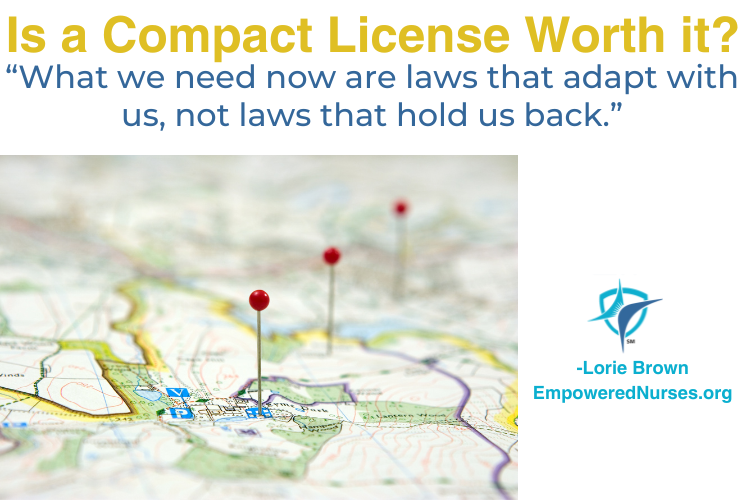
    As nurses, we have adapted time and time again. We’ve risen to every challenge thrown at us—from the COVID pandemic to the mental health crisis to rural care shortages. What we need now are laws that adapt with us, not laws that hold us back.

    It’s time for Illinois—and the remaining holdout states—to listen.

    If the NCSBN believes in this compact enough to promote it nationwide, perhaps it’s time the state it resides in starts walking the talk.

    Until then, we celebrate every win, like Pennsylvania’s, and keep pushing for change. Because nursing isn’t confined to one zip code. It’s a calling that reaches wherever the need is greatest.

  4. “One Foot in the Grave”: A Moment of Reckoning for Nursing Home Staffing

    Leave a Comment


    The recent decision by U.S. District Judge Leonard Strand, echoed by Judge Matthew Kacsmaryk in Texas, has struck down the federal nursing home staffing mandate—eliminating critical requirements such as 24/7 registered nurse coverage and minimum nursing hours per resident. While this is hailed as a major relief for nursing home operators, we must pause—and ask:

    Is this really a win for our most vulnerable residents?

    The Ruling: A Double-Edged Sword ⚖️

    · Legal limits versus lived realities The court found CMS had overstepped its authority, noting federal law only requires eight hours of RN care per day—not the omnipresent coverage the rule imposed reuters.com.

    · Partial relief, lingering obligations While staffing targets were vacated, CMS’s facility assessment and Medicaid-reporting provisions remain active—meaning long-term care providers still must justify how they meet resident needs whitefordlaw.com.

    Voices from the Field

    · Providers breathe easier… AHCA praised the decision as a protection against “unrealistic mandates” that could have shuttered nursing homes, especially in rural areas already struggling with workforce shortages.

    · …while advocates mourn a lost opportunity The Center for Medicare Advocacy reminds us that this rule could have prevented nearly 14,000 pressure ulcers and saved thousands of lives annually.

    What This Means for Residents, Families & Staff

    1. Immediate Relief vs. Quality of Care

    Facilities no longer face stringent nurse-hour mandates—but that ease may come at the cost of patient safety and well-being.

    2. The Ongoing Staffing Crisis

    This ruling underscores a critical truth: the staffing mandate didn’t cause today’s shortages—it merely exposed them. Without substantial investment in nurse recruitment, retention, and pipeline development, care quality remains at risk.

    3. A Call for Real Solutions

    Whether through flexible state standards, targeted funding, or innovative staffing models (e.g., telehealth, tech-supported workflows), the goal must be to meet real resident needs over meeting quotas..


    A Plea to Policymakers & Care Leaders

    While the legal victory is understandable, let’s commit to pushing for meaningful change, not just temporary reprieve:

    · Invest in people – Competitive wages, career pathways, and support for rural providers are non-negotiable.

    · Let data, not mandates, guide us – Staffing should respond to individual resident acuity and facility capability.

    · Collaborate across sectors – Policymakers, providers, advocacy groups, and families must work together to forge sustainable workforce strategies.


    Final Reflections

    This court decision may have one foot in the grave—but our collective resolve must not die here. Let’s use this moment to go beyond the legal technicalities and make a real, lasting impact on nursing home care:

    For every elder who deserves dignity. For every family seeking peace of mind. For every caregiver who shows up, day after day.

  5. Will AI Take Over My Business? A Message to Nurse Coaches and Legal Nurse Consultants

    Leave a Comment

    The headlines are everywhere.

    “AI can write your reports.” “AI will replace knowledge workers.” “Even healthcare professionals aren’t safe from automation.”

    As nurse coaches and legal nurse consultants, it’s natural to wonder: Will AI take over my business? Will there still be room for me in the future?

    Let’s take a deep breath and answer that with honesty and clarity:

    No—AI won’t take over your business.

    But the truth is… It could outpace you if you don’t adapt.


    🩺 What AI Can Do

    AI can do a lot:

    · Organize medical records lightning-fast

    · Flag potential charting inconsistencies

    · Generate content, summaries, even first drafts of reports

    · Identify patterns and trends that might take you hours to uncover

    But here’s what AI cannot do:

    · Build trust with a client

    · Recognize the unspoken trauma behind a patient’s journey

    · Understand the emotional nuance of a family’s loss

    · Coach a nurse through burnout with lived empathy

    · Present an expert opinion in court with credibility, presence, and poise

    AI lacks a soul. It lacks story. It lacks lived experience. And those are the things your clients pay you for.


    🧭 What This Means for You

    Rather than asking “Will AI take over my business?” The better question is: How can I use AI to make my business better, faster, and more impactful?

    Think of AI like a stethoscope: It’s a tool. It amplifies what’s already there—but it doesn’t replace your ears, your mind, or your judgment.


    💡 3 Ways to Future-Proof Your Practice

    1. Learn to Use AI—Don’t Compete with It Embrace AI tools that save time, like summarizing records, drafting emails, or outlining blog posts. That gives you more time for what truly matters—your expertise and client connection.

    2. Lean Into What Makes You Human Whether you’re coaching nurses through career transitions or analyzing a med-mal case, your emotional intelligence, insight, and lived experience are your biggest assets. AI doesn’t have those. You do.

    3. Position Yourself as a Guide in a Complex World Clients are overwhelmed. They need someone who can filter through the noise, offer grounded insight, and walk with them. That’s you. Not AI.


    🧡 Final Thoughts: You Are Still Needed

    AI is not a threat to nurse-led businesses. But resistance to change is.

    The nurse coach who adapts will thrive. The LNC who evolves will lead.

    You are not being replaced—you are being invited to rise. Rise into a role that only you, with your heart, knowledge, and experience, can fill.

    Let AI handle the busy work. Let you handle the human work.

  6. What Kind of Nurse Are You?

    Leave a Comment


    Find out which nursing specialty best matches your personality and strengths!

    Instructions: Choose the answer that best describes you for each question. Keep track of your answers (A, B, C, or D), then check your results at the end!


    1. How do you handle high-pressure situations?

    A. I thrive on adrenaline and love the challenge of critically unstable patients. B. I stay steady and flexible—I can juggle multiple patients and tasks at once. C. I focus on the moment and adapt quickly, especially when things change fast. D. I remain calm and present—I’m comfortable in emotional or spiritual intensity.


    2. What motivates you most as a nurse?

    A. Saving lives with quick interventions and advanced technology. B. Helping patients regain independence and manage chronic conditions. C. Supporting the beginning of life and empowering new families. D. Providing comfort, dignity, and peace at the end of life.


    3. How do you respond to change on your unit?

    A. Bring it on—fast-paced, unpredictable days are my jam. B. I prefer a solid routine, but I’ll adapt if needed. C. Change is constant—I go with the flow and adjust on the fly. D. I take change in stride with compassion and perspective.


    4. Which of these best describes your communication style?

    A. Direct, focused, and assertive under pressure. B. Clear and collaborative with patients and team members. C. Warm, encouraging, and emotionally intuitive. D. Gentle, empathetic, and deeply supportive.


    5. Which shift sounds most appealing to you?

    A. Nights or days—just give me the tough cases. B. Any shift where I can build rapport over time. C. Fast-moving days filled with intense, joyful (and chaotic) moments. D. Quiet, meaningful moments focused on comfort and presence.


    ✅ RESULTS

    Count which letter you chose most often:


    Mostly A’s – You’re an ICU Nurse 🧠⚡️

    You’re focused, analytical, and perform best under pressure. You thrive in critical care and enjoy the challenge of high-stakes decision-making. ICU nursing is a match for your intensity, resilience, and clinical precision.


    Mostly B’s – You’re a Med-Surg Nurse 🩹🧰

    You’re adaptable, detail-oriented, and the backbone of patient care. Med-Surg nurses manage multiple cases, shift gears seamlessly, and provide comprehensive care. You’re the master multitasker who keeps the unit running.


    Mostly C’s – You’re a Labor & Delivery Nurse 👶❤️

    You bring energy, empathy, and fast thinking to every birth. Labor & delivery nurses are strong, nurturing, and ready to pivot in an instant. You’re a calming force during one of the most intense moments in life.


    Mostly D’s – You’re a Hospice Nurse 🌅🕊️

    You’re grounded, emotionally present, and deeply compassionate. Hospice nurses bring comfort in the most sacred moments. You have a gift for creating peace, holding space for grief, and honoring life’s final journey.

  7. Embracing the Future: AI’s Promise for Nurses and Healthcare

    1 Comment

    In bustling hospital corridors and quiet patient rooms, something profound is unfolding: AI is stepping up as a new partner for nurses. From gently prepping patients over the phone to monitoring vital signs in real time, this technology is beginning to ease burdens—from administrative overload to burnout.

    Take “Ana,” an AI assistant developed by Hippocratic AI. Available 24/7, multilingual, and compassionate in tone, Ana handles routine patient communications—ensuring appointments are confirmed, pre-surgery screenings are answered, and lab results relayed. This frees nurses to focus more deeply on hands-on, compassionate care apnews.com.

    Another example: Qventus’s system is calling hundreds of surgical patients to collect pre-op information—saving nurses hours and improving prep efficiency apnews.com.


    🌟 Pros: What AI Brings to Nursing

    · Reducing administrative overload: AI tackles documentation, record retrieval, scheduling, and routine patient outreach—helping nurses reclaim precious time .

    · Proactive patient monitoring: AI-powered systems can flag early signs of deterioration—sepsis alerts, fall risk detections—supporting quicker response.

    · Extended care reach: Telehealth avatars and chatbots can support chronic disease management, post-discharge check-ins, and health coaching—all scalable and accessible from home.

    · Better diagnostics and workflows: AI excels at interpreting images, predicting disease risk, spotting drug interactions, and streamlining EHR data—helping clinicians make informed decisions faster.


    🛑 Cons: Where AI May Fall Short

    · False alarms and alert fatigue: Over-sensitive triggers can inundate nurses with non-critical alerts—degrading trust and increasing stress. One RN recalled a sepsis alert wrongly triggered on a dialysis patient.

    · Eroding human judgment: Blind trust in AI “protocols” can override nurses’ holistic assessments. One nurse warned: “Turning over our thought processes to these devices is reckless.”

    · Lack of empathy: AI lacks the emotional nuance behind a patient’s sigh or tear. Experts caution that empathy—a core nursing skill—cannot be automated.

    · Data bias and privacy risks: AI systems reflect their training data. Biases in demographics or exclusions can skew outcomes. And there are serious concerns about patient privacy and data misuse.


    ⚖️ Striking a Balance: AI as a Trusted Ally

    To harness AI’s full potential, healthcare must walk a thoughtful path:

    1. Human-in-the-loop design: AI should assist—not replace—clinical expertise. Nurses must lead decisions, not follow blind prompts.

    2. Alert optimization: Smart filtering and continuous feedback can reduce false alarms and preserve attention for true emergencies.

    3. Empathy retained: Deploy AI to handle routine interactions, freeing nurses to spend more meaningful time with patients.

    4. Guarding privacy & fairness: Diverse training data, transparent algorithms, and strict data governance are essential to build trust.

    5. Inclusive development: Nurses and frontline providers must help shape AI tools—ensuring technology truly aligns with real-world care.


    💖 A Hopeful Horizon for Nurses

    With over 100,000 nurses leaving the profession during COVID—the biggest drop in four decades—AI offers not just efficiency, but hope for human connection apnews.com+1en.wikipedia.org+1. It’s no silver bullet, but thoughtfully deployed, it can restore the heart of nursing.

    Imagine this: less time buried in paperwork, fewer nights burned out by constant alerts, more moments to reassure a frightened patient, teach a worried family member, or just hold a hand.

    By embracing AI with intentionality and empathy, we can help nurses reconnect with the deeper meaning of their calling: healing the whole person—with both science and heart.


    Let us tend to this transformation with care—balancing innovation with compassion, efficiency with humanity. Nurses deserve nothing less.

  8. Nurses on the Brink: A Call for Compassion, Support & Change

    Leave a Comment

    A Workforce Under Pressure

    Nurses across the U.S. are navigating a perfect storm of challenges: critical staffing shortages, emotional and physical exhaustion, stagnant compensation, and growing anxiety about AI and political instability. A recent survey of over 1 million clinicians highlights an all-too-familiar picture: 71% of nurses admit understaffing has directly impacted their workload—with 80% experiencing increased stress and 69% forced to cut back on direct patient care.

    Though nurses remain committed to healing, many feel unsung: 58% report feeling unsupported, 66% believe they’re underpaid, and 65% say economic stress factors have influenced their career choices.


    Emotional Toll: Burnout & Safety Concerns

    The data is hard to ignore:

    · Burnout fears peak: 29% say the shortage will push them closer to burnout, and 44% pin it on poor leadership.

    · Violence at work: Nearly half of nurses (46%) have faced verbal or physical assault from patients or families in the past year.

    · Mental health suffers: Just 25% describe their mental well-being as “very good,” and many feel unsupported emotionally.

    This crisis isn’t about numbers—it’s about people stretched beyond limits, risking both their health and that of their patients.


    The Economics: Compensation & Career Paths

    Despite heart and skill, nurses’ wallets and prospects are lagging behind:

    · A clear majority (66%) feel they’re not being fairly compensated.

    · Housing costs and loan rates keep 55% from considering relocating for better opportunities.

    · Though salaries are inching up (<$52.25/hr in 2024), signing bonuses are dipping, especially in less demanded roles.

    · Opportunities for growth are murky—only about a third feel satisfied with career advancement options. · One hospital in Texas is paying tuition for nursing school.

    The Political & Tech Landscape

    External pressures compound the stress:

    · A staggering 88% of nurses and technicians foresee Medicaid and Medicare cuts hurting their workplace.

    · 63% of nurses believe today’s political climate affects their work environment.

    · Technological change adds another layer of complexity—AI is slowly entering the field, with adoption still limited (~14%), yet 85% of nurses are asking for more hands-on training . While many see potential—like less paperwork—they’re also concerned about losing personalized care for patients.

    However, past implementation flaws in healthcare AI serve as cautionary tales: poorly calibrated alerts and algorithmic missteps have led to unnecessary interventions and distracted care apnews.com.


    Why Nurses Remain Hopeful

    Despite the weight of these challenges, nurses hold fast:

    · Commitment to care: 65% still endorse nursing as a profession—even when they acknowledge systemic flaws.

    · AI optimism rising: Once skeptical, only 38% now view AI as a threat—down sharply from last year’s 64%. They’re hopeful for administrative relief, improved workflows, and skill-building opportunities paces on pace with innovation.


    Charting a Better Path Forward

    To steer nursing back from the brink, leaders must act boldly:

    1. Fair, transparent pay – competitive compensation and signing bonuses that reflect frontline realities.

    2. Meaningful staffing improvements – safer nurse-to-patient ratios and more flexible scheduling options.

    3. Mental health and safety – robust support, de-escalation training, and purposeful leadership.

    4. Career clarity and growth – well-defined pathways, mentorship, and development programs.

    5. Responsible AI – co-designed, well-tested tools that relieve—not replace—nurses, preserving the human touch.


    A Moment of Reckoning—and Opportunity

    The 2025 findings are more than data—they’re a plea for empathy and action. Nurses and technicians remain the backbone of care. While burnout looms, their dedication endures. It’s time for healthcare leaders—hospitals, policymakers, administrators—to step up with tangible solutions: financial, operational, emotional, and technological.

    If we want a healthier system, we must start by healing its caregivers.

  9. When Going Live Goes Too Far: What Nurses Can Learn from the Yazz Scott Controversy

    Leave a Comment


    In today’s digital age, social media serves as a powerful tool for healthcare professionals to share knowledge, connect with peers, and advocate for the profession. However, it also presents potential pitfalls when not used responsibly. The recent incident involving nurse Yazz Scott underscores the importance of maintaining professionalism online.

    The Incident: A Cautionary Tale

    Yazz Scott, a Licensed Practical Nurse, faced significant backlash after livestreaming herself during a medication pass on TikTok. During the live session, she engaged in unprofessional behavior, including using inappropriate language and mocking viewers. The video raised serious concerns about patient privacy and professional conduct, leading to widespread criticism and potential disciplinary actions .TikTok+3YouTube+3YouTube+3Instagram

    Key Takeaways for Nurses

    1. Patient Confidentiality is Paramount: Even if patient identifiers aren’t explicitly shared, broadcasting from clinical settings can inadvertently compromise privacy. Always prioritize HIPAA regulations and institutional policies.

    2. Maintain Professionalism Online: Your online presence reflects your professional identity. Avoid sharing content that could be perceived as unprofessional or disrespectful.

    3. Understand Institutional Policies: Familiarize yourself with your employer’s social media guidelines. Non-compliance can lead to disciplinary actions, including termination.

    4. Use Social Media Constructively: Leverage platforms to share evidence-based information, support colleagues, and engage in professional development.

    5. Work Time is Work Time: Do not use your phone or do anything personal while on the clock.

    Moving Forward

    The nursing profession holds a position of trust and responsibility. As such, it’s crucial to navigate social media with caution and integrity. By reflecting on incidents like that of Yazz Scott, nurses can better understand the boundaries of online engagement and uphold the standards of the profession.

  10. What I Learned from business by taking the California Bar

    Leave a Comment

    When I decided to take the California Bar Exam, I expected to dive deep into constitutional law, torts, and civil procedure. What I didn’t expect was to come away with a clearer understanding of business—how it works, how it fails, and how it survives. Yes, the Bar Exam is a legal test, but embedded in its rigor is a masterclass in strategic thinking, discipline, risk management, and adaptability—qualities essential not only to attorneys but to anyone running a business.

    Here’s what the bar exam taught me that transformed the way I approach business:

    1. If You Don’t Take the Test (or start a business), You Can’t Pass (succeed)

    I actually began bar prep about 9 years ago before I moved to California.  I hired a tutor and he said “you can’t think like a lawyer.”  This bothered me greatly, after all, I have been an attorney for over 25 years at that point.  I also learned the pass rate was 33% for attorneys.  I was disheartened and quit.  You can’t succeed in business if you quit or don’t start.

    2. Belief

    This time around, I hired another tutor.  He suggested to write on a piece of paper each night “I am so happy and grateful now that I passed the February 2025 California Bar Exam.  This is paramount.  You have to believe you can succeed and then take the action to succeed.  If you don’t have the belief you can do it, you won’t.  My favorite saying is if you think you can, you can. If you think you can’t, you can’t.  Either way, you are right. (Henry Ford) I would rather be right thinking I can.

    3. Discipline Outperforms Talent

    To pass the California Bar, you can’t rely on intelligence alone. Success demands structure—meticulous planning, consistency, and a long-game mindset. The same goes for business. Entrepreneurs often romanticize the hustle, but without a disciplined plan, even the best ideas can fall flat. A business built on daily habits and disciplined execution will always outlast one that’s fueled solely by passion or charisma. You have to do the work to get the results.  There is no way around this.  I outworked others in studying for the bar and in my business.

    4. You Must Know the Rules Before You Can Bend Them

    Law school teaches theory; the bar exam tests application. In business, it’s the same. You can have a brilliant vision, but if you don’t understand the regulatory landscape, contracts, employment law, marketing or intellectual property protections, you’re flying blind. The bar reminded me that understanding the rules—really knowing the “why” behind the systems—gives you a powerful edge when building a successful business.

    5. Time Management Is a Non-Negotiable Skill

    Studying for the bar means juggling dozens of topics and formats: essays and performance tests—all within limited time. You can’t afford to spend too long on one subject. Business owners face a similar dilemma every day. Where do you focus your energy? How do you balance urgent tasks with long-term strategy? The ability to prioritize and pivot effectively became second nature—and it’s saved me from countless wasted hours (and dollars) in business. I was able to study for the bar running 2 businesses and planning an in person conference, Inside Litigation.

    6. Pressure Reveals Character—and Weak Points

    The stress of the California Bar is unlike anything I’ve ever experienced. It’s a psychological battle, and how you respond to that pressure teaches you a lot about your resilience. Business is full of high-stakes moments too—launches, setbacks, decisions that carry financial and reputational weight. The bar taught me to stay grounded in chaos and recognize my triggers and blind spots so I could lead more effectively when it really counted.  My coach told me to “be the lion”. There was lots of drama going on with this bar as it made national news.  I needed to focus on the prey/prize and say to myself if anyone is going to pass, it’s going to be me and not get sidetracked with all the drama.

    7. Invest in the Right Tools—and Know When to Ask for Help

    Bar prep is a multi-billion dollar industry for a reason. The right resources—tutors, courses, practice exams—make a massive difference. I also learned to reach out when I was stuck, rather than wasting hours trying to muscle through alone. In business, this lesson has been invaluable. Don’t be afraid to invest in tools, mentors, consultants, or training. Time is your most valuable asset—use it wisely.

    8. Confidence Comes From Preparation

    On test day, I realized that true confidence doesn’t come from hype or bravado. It comes from knowing you’ve done the work. That’s equally true in business. Whether it’s pitching to potential clients or launching a new service, preparation turns anxiety into assurance. It’s not about being fearless—it’s about being ready.

    Final Thoughts: The Bar as Business Bootcamp

    I didn’t expect the California Bar Exam to sharpen my business acumen, but it did—brutally and beautifully. The experience forced me to become more strategic, more focused, and more resilient. Because at the end of the day, both law and business demand the same things: clarity, discipline, strategy, and a relentless drive to improve.

As Seen On:

Women's Week