Join me for an exclusive in-person event for LNCs to hear the behind-the-scenes legal process from 12 attorneys! ❱❱

Empowering Nurses at the Bedside and in Business

Author Archives: Lorie A Brown, R.N., M.N., J.D.

  1. When Is Too Young Too Young? Rethinking Early Entry into Nursing

    Leave a Comment

    In our quest to address the nursing shortage, innovative solutions are essential. However, we must tread carefully when these solutions involve our youth. The recent case of Elliana Tenenbaum, who became a registered nurse at 16, and Indiana’s legislation to allow LPN training in high school, prompt a critical examination of the implications of such early entry into the nursing profession.

    Elliana Tenenbaum: A Remarkable Achievement

    Elliana Tenenbaum, hailing from Thousand Oaks, California, made headlines by earning her Bachelor of Science in Nursing from Arizona State University’s Edson College at just 16 years old. Her journey, marked by an accelerated program and unwavering dedication, showcases exceptional talent and determination. Now working in an emergency room, Elliana’s story is both inspiring and thought-provoking. https://www.wbrc.com+2KIRO 7 News Seattle+2ASU News+2ASU NewsNBC Los Angeles

    Indiana’s Legislative Proposal: A Double-Edged Sword

    In Indiana, Senate Bill 176 which passed now allows high school students to begin practical nursing programs before obtaining a high school diploma, aiming to address the state’s nursing shortage. While students would still need to graduate before licensure, this shift raises questions about the readiness of teenagers to handle the rigors of nursing education and practice.

    The Emotional and Ethical Considerations

    Nursing is not merely a technical profession; it’s an emotional and ethical commitment. Young individuals, though academically capable, may not yet possess the emotional maturity required to navigate the complexities of patient care, ethical dilemmas, and the psychological toll of the profession. Ms. Tenenbaum works in the emergency department. No 16 year old should be exposed to the rigors of the emergency department. What she will see cannot be unseen.

    Balancing Opportunity with Preparedness

    While it’s crucial to create pathways into nursing, especially amid shortages, we must ensure that these pathways are developmentally appropriate. Encouraging exploration through shadowing, volunteering, and foundational courses can spark interest without overwhelming young minds.

    Proceeding with Caution and Care

    Elliana’s story is a testament to what’s possible with support and exceptional ability. However, as we consider systemic changes like Indiana’s legislation, we must balance the urgency of workforce needs with the responsibility to protect and prepare our youth adequately.

    Nurturing future nurses requires more than academic opportunities; it demands a holistic approach that considers emotional readiness, ethical grounding, and long-term well-being. Let’s

    champion our youth by providing them with the tools, time, and support they need to thrive in such a vital and demanding profession.

  2. Keeping Your License Safe: Best Practices for Nurses When Passing Narcotics

    1 Comment


    You’ve made it through nursing school, passed the NCLEX, and earned your license—now the real responsibility begins. One of the most high-stakes tasks you perform is administering narcotics. Whether in the ER, med-surg, ICU, or long-term care, passing controlled substances is routine—and it’s also one of the fastest ways to put your license (and livelihood) at risk if you’re not careful.

    The Board of Nursing doesn’t take mistakes with narcotics lightly. Miscounts, poor

    documentation, or even one careless shortcut can lead to accusations of diversion, patient harm, or negligence. So how do you protect yourself while providing excellent care?

    Here are practical, no-nonsense strategies to help keep your license—and your patients—safe when handling narcotics.


    1. Follow the “Five Rights”—Every Single Time

    Yes, it’s basic. Yes, you’ve heard it a thousand times. And yes, it still matters.

    · Right patient – Always use two identifiers.

    · Right drug – Double-check—especially with similar-looking names.

    · Right dose – Confirm unusual dosages with pharmacy or the provider.

    · Right route – Don’t assume; verify.

    · Right time – PRNs and scheduled meds should be tracked precisely.

    These checks are your first defense against both patient harm and license jeopardy.


    2. Know—and Follow—Your Facility’s Policy

    Every facility has its own medication handling protocols. Review them. Understand them.

    Follow them precisely.

    If something goes wrong, “I didn’t know” is not a valid defense. Protect your license by making policy your daily guide.


    3. Remove Narcotics from Pyxis Responsibly

    Automated dispensing cabinets like Pyxis track everything. You’re being monitored, and the

    clock starts ticking the second you pull the med.

    · Administer the med within 30 minutes of removal—otherwise, you’re out of compliance in most institutions.

    · Do not carry narcotics in your pocket while doing other tasks. If something goes

    missing, it’s your name on the log.

    · If you pull a med and the patient refuses or it’s not needed, waste it within 30 minutes, with a witness and document why it was all wasted.

    · Be sure to scan the patient to document the administration of the medication.

    Don’t let narcotics sit around or become an afterthought. Treat each one like it’s being watched—because it is.


    4. Document Immediately—and Thoroughly

    Never chart after the fact when it comes to narcotics.

    · Record exact time, route, and dose.

    · Document patient response—especially for IV or PRN meds.

    · If a portion is wasted, record it immediately with a co-signature.

    Avoid generic notes like “pt comfortable.” Be specific: “Pt reports 7/10 pain, received 2 mg IV morphine, pain reduced to 3/10 in 10 minutes.”

    If you’re ever under review, clear and timely documentation is your best friend.


    5. Don’t Be the Outlier

    You may not think anyone’s watching how many narcotics you give—but someone is. Pharmacy, nursing management, and compliance teams regularly pull utilization reports.

    If you’re consistently:

    · Giving more PRNs than your peers,

    · Wasting more than others,

    · Pulling meds at odd hours or just before the end of shift,

    …you will stand out—and not in a good way. Even if you’re doing nothing wrong, being an outlier puts a target on

    your back.

    Stay aware of your usage patterns and keep communication open. If a patient is truly needing

    frequent pain management, document why—and make sure the care team is aligned.


    6. Never Pre-Pour or Pass Off Narcotics

    You should never:

    · Pre-pour narcotics for later,

    · Leave them at the bedside,

    · Hand them off to another nurse or tech to administer.

    These shortcuts are policy violations and potential diversion red flags. Always administer

    narcotics personally and watch the patient take them.


    7. Waste with a Witness—On the Spot

    Wasting narcotics is not a “do it later” task.

    · Waste it right after preparing the dose.

    · Always have a licensed nurse witness—and sign off together.

    · Never carry unadministered narcotics hoping to waste them later in the shift.

    Delays in wasting raise suspicion and increase your liability.


    8. Don’t Let Anyone Pressure You

    You might encounter a doctor, supervisor, or coworker who tries to rush you, question your

    judgment, or suggest bending a rule “just this once.”

    Stay firm. You are accountable for every medication you pass. Your license is not worth

    someone else’s shortcuts.


    Final Thoughts: Keep It Tight, Keep It Safe

    Handling narcotics is one of the most legally vulnerable aspects of bedside nursing. Every move you make—from removing meds from the Pyxis to documentation—must be done with precision, clarity, and integrity. Any discrepancy, the Board thinks you are using, selling or incompetent. It is a lose-lose situation.

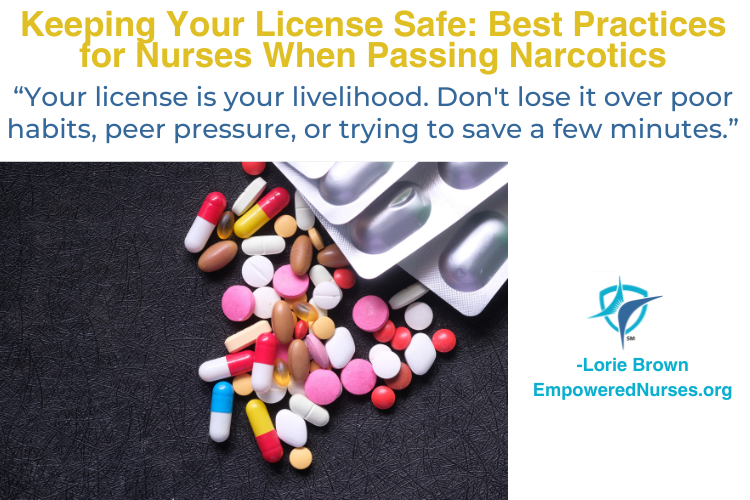
    Your license is your livelihood. Don’t lose it over poor habits, peer pressure, or trying to save a

    few minutes. Treat every narcotic administration like it’s being audited—because one day, it might be.


    What’s your best tip for safely passing narcotics? Drop it in the comments and help your fellow nurses stay safe, smart, and secure.

  3. It’s Not Selfish—It’s Survival: Why Nurses Must Start Giving to Themselves

    Leave a Comment

    They told us it would be hard. But they never told us that in the pursuit of saving everyone else, we might lose ourselves.

    As nurses, we are hardwired to care (it’s in our DNA)—for our patients, our colleagues, our families, and sometimes even strangers on the street. We are taught to push through exhaustion, set aside our own pain, and “just do what needs to be done.” And we do it. Day after day. Shift after shift. Code after code.

    But somewhere along the way, we forget that we are human too.

    We don’t hesitate to stay late for a coworker, take on an extra patient, or skip lunch to help a family understand their loved one’s prognosis. Yet we feel guilty for calling off when we’re mentally depleted or using our PTO for a real break instead of just running errands.

    Here’s the truth we need to say out loud: Taking care of yourself is not selfish. It’s essential.

    You cannot pour from an empty cup. You cannot heal others when you’re hurting inside. And you cannot give your best to anyone if you’ve given all of yourself away.

    When nurses neglect their own needs—physical, emotional, and spiritual—we see the fallout: burnout, moral distress, compassion fatigue, even medical errors. We suffer. Our patients suffer. Our families suffer.

    Self-care is not a luxury. It’s not bubble baths and lattes (though those are lovely). It’s boundaries. It’s rest. It’s therapy. It’s saying “no” without guilt. It’s recognizing that you are a person first and a nurse second.

    So if you need permission to stop doing everything for everyone, here it is: You’re allowed to put yourself first. You’re allowed to go home on time. You’re allowed to say, “I’m not okay,” and get help. You’re allowed to matter.

    Because the world doesn’t just need nurses. It needs whole, healthy, human nurses—starting with you

  4. The Top 6 Things to Look for When Hiring a Professional Licensing Defense Attorney

    Leave a Comment

    When your nursing license—your livelihood, your identity, and the career you poured your heart into—is at risk, you don’t just need a good attorney. You need the right one.

    As a nurse myself, I know the fear, shame, and uncertainty that can overwhelm you when that dreaded envelope or email arrives from the Board. Your stomach drops. You replay everything in your head. You wonder if your career is over.

    This is when you need someone in your corner who doesn’t just know the law—they understand you.

    Here are the top five things to look for when choosing a professional licensing defense attorney:


    1. Do They Offer a Flat Fee?

    Transparency matters. The last thing you need while navigating a board complaint is unpredictable legal bills that balloon over time. An attorney who offers a flat fee for representation shows they respect your budget, understand the financial strain you’re under, and are confident in the value they bring.

    A flat fee also allows you to call, ask questions, and be involved in your defense without watching the clock or dreading an hourly invoice.


    2. Are They Also a Nurse or Healthcare Professional?

    This can be a game-changer. Attorneys who are also RNs or have healthcare backgrounds get it. They understand scope of practice, nursing judgment, and the realities of short staffing and split-second decisions.

    They won’t need a crash course in what you do every day. They speak your language. And more importantly, they can translate your clinical reasoning into legal language the Board will understand and respect.


    3. How Often Are They in Front of the Licensing Board?

    You want someone who’s known to the Board—an attorney who shows up regularly, who understands the board members’ expectations, and knows how the process flows.

    These attorneys often have better insights into what works and what doesn’t. They can anticipate pitfalls. They know which arguments resonate and what the Board sees as red flags.

    This isn’t just about legal know-how—it’s about strategy, relationships, and experience.


    4. How Many Nurses Have They Represented?

    You wouldn’t want a surgeon performing their first procedure on you, and the same principle applies here. Ask how many nurses they’ve defended.

    Not all defense attorneys are created equal. Some focus on physicians, others on corporations. You want one who routinely and successfully defends nurses. Look for someone who has helped nurses in situations like yours: medication errors, boundary issues, substance use, documentation problems, or wrongful accusations.

    Their past experience is a powerful predictor of how well they can help you.


    5. Do They Make You Feel Heard and Respected?

    This might be the most important factor of all. The best attorney-client relationships are built on trust and open communication. You should feel safe, not judged. Informed, not intimidated.

    When you speak to them, do they listen? Do they explain the process clearly? Are they compassionate but realistic?

    You’re not just a case number. You’re a nurse who’s devoted your life to caring for others—and now it’s your turn to be cared for.

    ______________________________________________________________________________

    6. Do Your Homework!

    Check out the attorneys’ reviews on AVVO.com. A website for attorney reviews.


    Final Thoughts

    Your nursing license is too precious to entrust to just anyone. If you’re facing an investigation or complaint, take a deep breath and remember: you don’t have to go through it alone.

    Finding the right attorney can make all the difference—not just in the outcome of your case, but in your peace of mind throughout the process.

    If you’re in this situation, please know this: you are still a good nurse. You are still worthy of support. And there is a path forward.

  5. What Nurses Need to Know Now

    Leave a Comment

    If no one has told you lately—you are doing an incredible job. Not just at the bedside. Not just in documentation, delegation, or critical thinking. But in showing up, day after day, in a world that is heavier, faster, and more demanding than ever before.

    I don’t know your exact story, but I know the weight you carry. And today, I want to share a few things that every nurse—every single one of us—needs to know right now.


    🩺 1. You Are Not Alone

    When you feel tired to the bone, when you wonder if you’re making a difference, when you leave a shift questioning yourself—you are not alone. There are thousands of us who feel that ache. And thousands more who are standing with you, even if you can’t see us in the moment.


    🛑 2. It’s Okay to Set Boundaries

    Saying “no” to an extra shift. Leaving a toxic workplace. Protecting your mental health with the same vigilance you use to protect your patients’ vitals. Boundaries aren’t selfish. They are survival. And you have every right to put yourself first sometimes.


    🌱 3. Your Career Can Grow and Change

    Nursing doesn’t have to look like 12-hour shifts forever. It’s okay to pivot—to education, consulting, telehealth, leadership, research, business, or whatever calls your heart next. You are allowed to evolve. Nursing isn’t just a job; it’s a foundation. And you get to build whatever you want on top of it.


    🧠 4. It’s Not Weak to Ask for Help

    Struggling doesn’t mean you’re failing. Whether it’s leaning on a mentor, seeing a therapist, joining a support group, going to EAP or simply admitting to a friend that you’re not okay—asking for help is one of the bravest things a nurse can do.


    ❤️ 5. You Are Making a Difference

    Even on the days you can’t feel it. Even when patients forget your name. Even when management overlooks your efforts. You are part of someone’s healing story. You are often their hope, their safety, their one person in the chaos.

    You matter.


    ✨ A Final Word

    Nursing right now isn’t easy. The demands are higher. The stakes feel heavier. But underneath all of that, the heart of nursing is still beating strong—and so are you.

    If you hear nothing else today, hear this:

    You are enough. You are needed. You are deeply valued.

    And if you ever doubt it, come back to this letter. Because sometimes even the healers need healing words, too.

  6. From Courtside to Career: What a Lakers Game Taught Me About Business

    Leave a Comment


    I finally made it to a Lakers game in Los Angeles, and it was nothing short of amazing. What made it even more special? I got to share the experience with my son, Jordan, a huge sports fan. It had been years since we last attended a basketball game together, but when the Lakers hosted the Houston Rockets, we jumped at the chance.

    Years ago, we were regulars at Indiana Pacers home games. Watching those games, I started noticing something: three-point shots were rare, and even when attempted, they didn’t land often. But this Lakers game was a completely different scene—three-pointers dominated the court, and most of them found the hoop.

    That shift got me thinking.

    🎯 Skills Can Be Learned—and Improved

    Hitting a three-pointer isn’t easy. It’s a calculated risk, and it takes consistent practice to perfect. These players didn’t get good at it by accident—they trained, failed, learned, and kept showing up to practice.

    That game reminded me of something powerful:

    Any skill is learnable—with effort, intention, and practice.

    These athletes could’ve stuck to safe two-point shots. Instead, they pushed beyond their comfort zones, evolving their game to match today’s fast-paced strategy. And it paid off.

    🩺 From Nursing to Business: Your Skills Got You Here

    If you’re a nurse transitioning into entrepreneurship, this might sound familiar. You’ve already mastered a complex, high-stakes profession. You know what it means to show up day after day, learn new things, and improve through real-life experience.

    Just like the pros who had to adapt their game to stay competitive, you’re learning new moves in the business world. And yes—it might feel awkward at first. Marketing, pricing, contracts, and visibility? These may not be your “two-point shots.” But with repetition and coaching, they can absolutely become second nature.

    💡 The Takeaway: Business Skills Are Like Three-Pointers

    Success in business isn’t about being perfect right away. It’s about showing up, trying again, adjusting your aim, and giving yourself the space to grow.

    You already know how to learn and improve—that’s what made you an incredible nurse. Now it’s time to apply that same mindset to your business.

    With every attempt, you’re getting closer to your goal.

    And before long, you’ll be hitting nothing but net.

  7. Top 10 Ways to Lose Your Nursing License (Please Don’t Try This at Home)

    Leave a Comment

    We know you didn’t go through nursing school, boards, night shifts, and bodily fluids of every variety just to lose your license over something avoidable. But the truth is—even good nurses can get into hot water.

    So let’s break it down: the Top 10 Ways to Get in Trouble with Your Nursing License—and how to stay far, far away from them.


    🚩 1. Charting Before Doing the Thing

    Pre-charting your shift “because you know what you’ll do” might seem efficient—until it isn’t. If something changes and the record doesn’t match reality? That’s called fraud, friend. Chart in real time. Your license will thank you.


    💊 2. Pocketing or Mismanaging Meds

    Whether you forgot to return a refused med or signed off on a waste you didn’t witness, it’s a red flag or keeping a narcotic in your pocket for more than 30 minutes. If a narcotic audit doesn’t add up, your name could be in the spotlight. And that’s not the kind of attention you want.


    📱 3. Oversharing on Social Media

    Posting that patient room selfie might seem innocent (especially if no one’s in the photo), but HIPAA violations don’t play. And screenshots live forever. When in doubt, don’t post about work. Period.


    😬 4. Getting Too Friendly With Patients

    That sweet little old lady who wants you to take her bank card and PIN to the ATM? Or the discharged patient sliding into your DMs? Even dating a patient after your care is concluded. Set boundaries. What starts as kindness can end in a Board investigation.


    🍷 5. Showing Up… Under the Influence

    This one’s obvious, but still makes the list. Whether it’s alcohol, recreational substances, or misused prescriptions—don’t do it. Even one mistake can be career-ending. Get help if you need it. No shame in protecting your future.


    📄 6. Fluffing That Résumé or Job App

    Left off a job where things didn’t go so well? If your employer finds out (and they will), it’s not just termination—it could be a licensing board issue. Honesty > Hype.


    📞 7. Ghosting on Mandatory Reporting

    You see neglect, abuse, or unsafe conditions—and do nothing? That’s not just unethical, it could be illegal. Nurses are mandatory reporters for a reason. Don’t let silence cost someone their safety or cost you your license.


    🩺 8. Practicing Outside Your Scope

    Just because you can do something doesn’t mean you should. Policies differ between states and facilities. That skill you were allowed to do at Hospital A might not be allowed at Clinic B. When in doubt, check your scope and policy.


    📆 9. Letting Your License Expire

    You’d be amazed how many nurses forget to renew. Practicing with a lapsed license = unlicensed practice = big trouble. Set a reminder. Write it on your forehead. Tattoo it on your stethoscope. Just don’t let it lapse.


    🔐 10. Sloppy or Incomplete Documentation

    “If you didn’t chart it, it didn’t happen” is still the golden rule. Document thoroughly, factually, and in a timely fashion. The Board doesn’t care how short-staffed you were if something goes wrong and your notes are missing.


    💡 Final Thought:

    Nursing is in your DNA. Your license is your lifeline. Protect it like the precious gem it is. These top 10 aren’t just worst-case scenarios—they’re real reasons nurses end up under investigation every single day.

    So, stay sharp, stay ethical, and keep on doing what you do best: caring for others while caring for yourself and your career.

  8. What Did You Just Write About Me?!

    Leave a Comment


    Protecting Yourself in the Age of MyChart and Open Notes

    If you’re a nurse in 2025, chances are you’ve already had a patient quote your charting back to you — word for word — from their phone.

    Welcome to the age of MyChart, Open Notes, and patient transparency.

    We’re not in the pre-portal days anymore, friends. Everything you document is instantly available to patients and their families, and in some cases, their attorneys. So how do we stay honest, thorough, and legally safe while also not starting World War III with a note?

    We’re here to help. Nurse to nurse.


    🛡️ 1. Keep It Clean: Stick to the Facts

    What did you see? What did you hear? What did you do?

    That’s your safe space.

    · ✅ “Patient reports pain at 8/10. Grimacing noted. Morphine 2mg administered per order.”

    · ❌ “Patient seems drug-seeking and whiny.”

    Keep it clinical. Keep it objective. Save the venting for the breakroom — not the chart.

    🧠 2. Use Neutral, Professional Language

    We get it — when someone refuses meds, trashes the call light, or yells at you, it’s tempting to let that frustration leak into your notes. Don’t.

    Instead of:

    · ❌ “Non-compliant and argumentative.”

    Try:

    · ✅ “Patient declined ordered medication after education provided. Will continue to monitor and re-offer.”

    Tone matters. Patients (and their lawyers) are reading it.

    ✍️ 3. Document Conversations Clearly

    Anytime there’s a refusal, concern, or escalation, make sure you chart:

    · What the patient said

    · What you said

    · Their response

    · What you did next

    Example:

    “Patient stated, ‘I’m not taking that pill.’ Risks and benefits reviewed. Patient verbalized understanding but continued to decline. Will readdress later.”

    You’re not just writing it down — you’re building your legal defense.

    🔁 4. Chart in Real Time When Possible

    Let’s be real — end-of-shift charting happens. But if something significant occurred, document it as close to the time it happened as you can. The more time passes, the fuzzier the details — and the riskier the chart.

    🧾 5. Ditch the Emotion

    This one’s tough. Nurses are human. But the chart isn’t the place to process feelings.

    · ❌ “Patient was rude and disrespectful.”

    · ✅ “Patient raised voice and stated, ‘You’re not helping me.’ Attempted de-escalation and remained present.”

    Stick to behaviors. Not feelings.

    🔍 6. The Chart IS a Legal Document

    We’ve heard it a thousand times, but in today’s transparency culture, it’s more true than ever:

    “If it’s not documented, it didn’t happen. If it’s documented poorly, it did happen — in the worst possible way.”

    Protect your license by documenting with intention. Be honest, but be smart.


    👥 7. Ask for Backup When You Need It

    Not sure how to document something sticky? Ask your charge nurse, case manager, or risk management. You’re not on an island — and collaboration keeps everyone safer.


    🧰 Bonus: Know Your Charting System

    Some systems allow nurse-to-nurse notes or staff-only comments that aren’t visible in MyChart. Use those when appropriate — but still use professional language. HIPAA applies everywhere.


    Final Word

    Charting used to be just between us and our team. Now, it’s between us, our team… and the entire patient family group chat.

    But that doesn’t mean you stop being honest. It just means you sharpen your language, lean into objectivity, and chart with intention.

    Because in today’s healthcare world, your chart is your voice — and your shield.

  9. When the Shift Hits Hard: Real Talk on Surviving Bad Days in Nursing

    Leave a Comment

    Let’s be honest — not every day is a Florence Nightingale moment.

    Sometimes, it’s a patient yelling at you for something out of your control.
    Sometimes, it’s working short-staffed for the fifth shift in a row.
    Sometimes, it’s losing a patient — and having to walk into the next room like nothing happened.

    Bad days in nursing aren’t rare. But that doesn’t mean they don’t hit hard.

    As nurses, we carry a unique kind of weight — physical, emotional, spiritual. And when a bad day breaks us down, it’s easy to question everything: Why am I still doing this? Does this even make a difference? How much more can I take?

    If you’ve been there — or are there right now — this is for you.


    💢 First: Let Yourself Feel It

    This job demands so much strength that we sometimes forget we’re human. But suppressing emotion doesn’t make it disappear — it buries it until it leaks out in ways we don’t want.

    So if your shift crushed your spirit today?
    Cry in the breakroom. Vent in your car. Journal it out. Pray. Scream. Call your nurse bestie.
    Whatever helps you process it — do that.

    You’re not weak. You’re not dramatic. You’re human.


    🛑 Don’t Take It Personally (Even When It Feels Personal)

    That patient who lashed out? They’re scared.
    That family member with the attitude? They’re desperate for control.
    That supervisor who gave you grief? Might be barely keeping it together themselves.

    Yes, boundaries matter. And no, you don’t have to tolerate abuse.
    But sometimes, recognizing the hurt behind the hostility helps you carry it with less shame.


    🌊 Find One Anchor

    On a terrible shift, find one thing to cling to:

    • A patient who said “thank you”
    • A moment of laughter at the nurse’s station
    • The fact that you showed up when you didn’t have to

    Even on the worst days, there’s usually one thread of purpose or kindness. Grab onto it like a life vest.


    🔁 Decompress Before You Spiral

    If you go straight from a nightmare shift to home life without decompressing, everything starts to blend: the anger, the sadness, the exhaustion.

    Try this:

    • Sit in your car for five minutes in silence before you drive
    • Change your clothes before stepping inside
    • Take a hot shower as a ritual to wash off the day
    • Tell your people, “I had a hard shift. I just need some time to come down.”

    Protect your peace. You’ve earned it.


    🧠 Talk About It (Really)

    Nurses are notorious for bottling things up. We’re trained to power through — but that doesn’t mean we should.
    Whether it’s a co-worker you trust, a therapist, or your dog, let it out. You can’t pour from an empty cup, and stuffing it down doesn’t make you stronger — it makes you brittle.

    You deserve support. Not because you’re fragile, but because what you do is hard, and you shouldn’t have to carry it alone.


    ❤️ Remember Why You Started — But Also Know It’s Okay to Change

    Some days, your “why” will carry you.
    Other days, it won’t even show up.

    And that’s okay.

    If the bad days are piling up… if the joy feels far away… if you’re dreading the next shift — it’s not failure to consider a new path. Whether that means a different unit, a non-clinical role, or something outside the box entirely — you are allowed to evolve.

    Your nursing license is not a life sentence. It’s a foundation.


    ✨ Final Words from One Nurse to Another

    Bad days don’t make you a bad nurse.
    They make you a real one.

    You’re doing more than you know.
    You are holding the line between chaos and care.
    You are the steady hands in the storm.
    And even when you feel broken — you are making a difference.

    So take a breath.
    Take care of your heart.
    And when you’re ready… show up again.

    Because the world still needs nurses like you. Especially on the hard days.

  10. NO ROOM FOR “HE SAID/SHE SAID” IN NURSING PART 2

    Leave a Comment

    I often receive calls about communications or actions which are taken out of context usually leaving the nurse in trouble because there is no way for her to defend herself. It’s a “he said/she said” situation.

    Employers are likely going to believe the patients and not the nurse. Unfortunately, the same can be essentially true with the Board which can entertain hearsay, but it just can’t form the basis of their opinion.

    In the hustle of your 12-hour shift, the handoffs, the Code Blues, and constant interruptions, it’s easy for communication to get muddled or people to take things out of context. That’s when the dangerous “he said/she said” scenarios creep in. Especially if you are the only person in the room with the patient or doing home care.

    These moments can have real consequences, not just for our licenses, but for our patients. Anybody can report a matter to the Board which then has an obligation to investigate it. In fact, videos are the worst because sometimes they don’t have audio and, depending on the angle, things can look worse than they really are and can be taken out of context.

    I suggest acting as if it is a video that’s recording 24/7. Anything that you don’t want to be seen or heard on video, do not do!

    If you have a situation that you believe could be taken out of context, make sure you chart it. Charting who said what is your best defense because the they were charted at the time.

    Were you concerned about the patient and called the physician? Chart it! Was

    there a change in condition and you alerted the charge nurse? Chart it? Did the patient or their family refuse treatment? Chart it!

    Be specific. Be objective. Avoid emotional language or assumptions. Just the facts. The clinical, thoughtful, caring actions you took.

    If you have any concerns about a patient or a family member saying something that may get lost in translation, make sure that you go to the room with another nurse or witness with you.

    You became a nurse because you care. Because you show up with compassion, even on the hardest days. But caring doesn’t mean staying quiet. It does not mean trusting that you will remember what you said because things can be taken out of context. Be sure anything that could possibly be used against you is documented in the record. Don’t be afraid to write your part of the story.

    If you are terminated over one of these situations, be sure to put your version on the termination papers so that there is a record, and the Board can see it if further investigation is required.

As Seen On:

Women's Week