Join me for an exclusive in-person event for LNCs to hear the behind-the-scenes legal process from 12 attorneys! ❱❱

Empowering Nurses at the Bedside and in Business

Author Archives: Lorie A Brown, R.N., M.N., J.D.

  1. From Bedside to Business: Exploring Opportunities for Nurses

    Leave a Comment

    What if your nursing expertise could become the foundation of a thriving business? For many nurses, exploring entrepreneurial opportunities offers a chance to expand their impact and take control of their professional futures. Nurses possess a rare combination of clinical knowledge, communication skills, and problem-solving abilities, making them uniquely suited for diverse business ventures. Let’s explore some exciting paths where you can transform your expertise into business success.

    1. Legal Nurse Consulting

    Imagine turning your experience in patient care into a career as a legal nurse consultant (LNC). Attorneys need nurses to analyze medical records, interpret complex healthcare issues, and provide expert opinions in legal cases. Whether it’s malpractice claims or personal injury cases, your insights as an LNC can make a powerful difference.

    1. Health and Wellness Coaching

    With your background in health promotion and patient education, becoming a health and wellness coach is a natural fit. You can guide clients toward healthier lifestyles, offer disease prevention strategies, or support them in managing chronic conditions. This business allows you to work one-on-one with clients or even host group coaching sessions.

    1. Education and Training

    Nurses are natural educators, and there’s a huge demand for training in healthcare-related topics. You can create courses or workshops for healthcare professionals, patients, or caregivers. Topics like CPR certification, chronic disease management, or workplace wellness programs can be turned into profitable ventures.

    1. Freelance Writing and Content Creation

    If you love to write, consider becoming a freelance medical writer or content creator. Your expertise can shine in blog posts, patient education materials, or even textbooks. Companies and organizations are always looking for professionals who can translate complex medical information into clear, engaging content.

    1. Private Duty or Concierge Nursing

    Some patients or families seek personalized, high-quality care outside of the traditional healthcare system. Private duty nursing or concierge nursing services can allow you to offer one-on-one care, helping patients manage their health in the comfort of their own homes.

    1. Starting Your Own Clinic or Practice

    If you’re an advanced practice nurse, such as a nurse practitioner, opening your own clinic can be a fulfilling way to serve your community. Whether it’s a family practice, mental health services, or a specialized clinic, this path offers both autonomy and the chance to make a direct impact.

    1. Medical Device or Healthcare Product Consulting

    With insider knowledge of patient care, nurses are valuable consultants for companies developing medical devices or healthcare products. You can provide insights into functionality, usability, and patient needs, shaping products that improve outcomes.

    1. Creating a Product or Service

    Do you have an innovative idea? Many nurses have launched businesses creating products like nursing-specific gear, patient care tools, or even apps that address healthcare challenges. With the right support, your idea could become the next big thing.

    1. Nurse Influencing and Advocacy

    Social media platforms have given rise to nurse influencers who share tips, advocate for change, and promote healthcare products. If you’re passionate about educating the public or raising awareness, this can be both rewarding and financially sustainable.

    1. Consulting in Healthcare Systems

    Hospitals and clinics often seek consultants to improve workflow, compliance, or patient safety. As someone with firsthand experience, you can offer valuable insights to enhance operations and outcomes.

    Your Business, Your Legacy

    Starting a business is not without its challenges, but as nurses, we’re no strangers to hard work, dedication, and perseverance. The opportunities are vast, and the potential for personal and professional fulfillment is immense. Whether you’re looking to supplement your income, find a creative outlet, or fully transition into entrepreneurship, there’s a path that fits your strengths and passions.

    If you’ve ever thought, “Can I really do this?” the answer is a resounding yes. Nurses have the skills, the heart, and the drive to build businesses that change lives. So why not take that first step? Explore, dream, and create something extraordinary. The world is waiting for what only you can offer. If you would like to see 101 Ways to Become a Nurse Business Owner check it out at https://empowerednurses.org/101-ways/

    What business idea resonates with you the most? Share your thoughts—we’d love to hear your story and celebrate your journey!


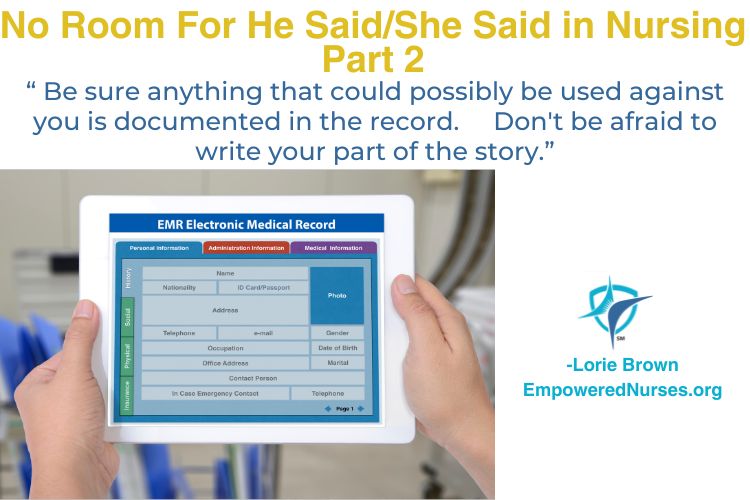
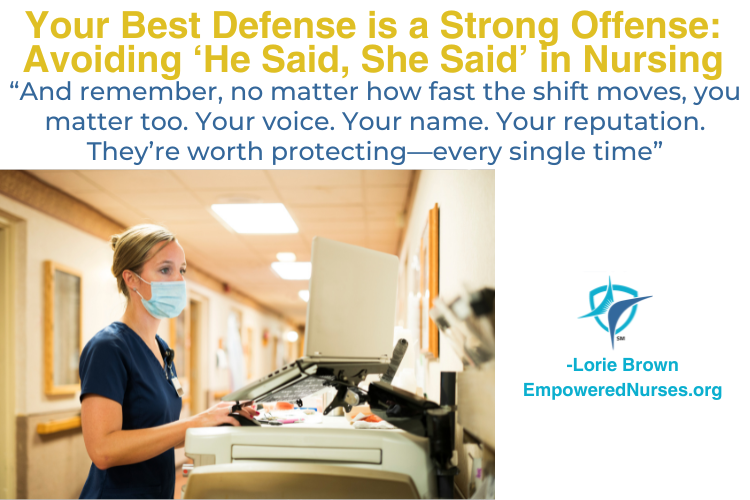
  2. Your Best Defense is a Strong Offense: Avoiding ‘He Said, She Said’ in Nursing

    Leave a Comment

    It was 2:45 a.m. when it happened. I had just sat down for the first time all night. One of my patients, a sweet elderly man with dementia, had been restless and in pain since midnight. I had given him his scheduled pain medication around 1:30 a.m., documented everything, and even noted his verbal response: “Thank you, honey. That’s better.”

    But an hour later, his daughter arrived for a surprise visit. I walked into the room to hear her saying, “You mean they haven’t given you anything for pain?”

    The patient, confused and tired, simply nodded.

    The daughter was furious. She stormed to the nurses’ station and demanded to speak to the charge nurse. “My dad said no one’s given him any medication all night—what happened to his morphine. Who took it?”

    Suddenly, I was under investigation. A missing narcotic. A patient who couldn’t clearly advocate for what had or hadn’t happened. And only my word against theirs.

    I thank God every day that I had documented the administration immediately—time given, response observed, and a double-check of the count with the Pyxis.

    That note saved me.

    That tiny timestamped detail was the only thing that kept a simple misunderstanding from becoming a reportable event.


    🖊️ If It’s Not Documented, It Didn’t Happen

    We say it all the time—but we forget how true it is until we’re standing in the hallway trying to explain something from memory.

    In my case, having accurate documentation of the med, the response, and the count saved me from a nightmare. It reminded me that our charting is our shield.

    Even when we’re exhausted, behind, or overwhelmed—documentation must come first. It’s not just about protecting ourselves—it’s about protecting our patients, our license, and the truth.


    🗣️ Say It, Repeat It, Document It

    Every interaction—especially those involving meds, verbal orders, or patient complaints—needs clarity and confirmation.

    Repeat the order back. Clarify what the patient wants. If someone questions your care, document that too. “Patient expressed concern that pain medication was ineffective” is a legitimate entry.

    You’re not just covering yourself—you’re building a clear, consistent trail of communication that can speak on your behalf if needed.


    👀 Keep Your Notes Objective and Professional

    What saved me wasn’t just that I charted. It was how I charted. No vague terms. No “seems like.” I included the direct quote from the patient and the specific time of administration.

    Let your chart reflect what you saw and heard—not what you think or assume. That’s the difference between a defensible note and a questionable one.


    🙋‍♀️ Don’t Be Afraid to Escalate

    If something doesn’t sit right—say something. If a family member is accusing you, bring in your charge nurse. If a provider’s order feels off, clarify it. Trust your instincts.

    And always, always write an incident report if you think the situation might come back around later. It’s not tattling—it’s protecting.


    🤝 Watch Out for Each Other

    Nursing isn’t a solo sport. If you’re administering a narcotic, ask a coworker to verify it with you. If you’re having a difficult conversation with a family, invite your charge nurse to be present.

    One witness can make all the difference.


    💬 Final Thoughts: This Could Happen to Any of Us

    That night, I didn’t do anything wrong. But if I hadn’t documented the med when I gave it—if I hadn’t written that the patient verbally responded—it could’ve been a very different story.

    We all became nurses to help people. But part of helping is protecting the care we give with clear, consistent communication.

    So to my fellow nurses: Chart like your license depends on it—because sometimes, it does.

    And remember, no matter how fast the shift moves, you matter too. Your voice. Your name. Your reputation. They’re worth protecting—every single time.

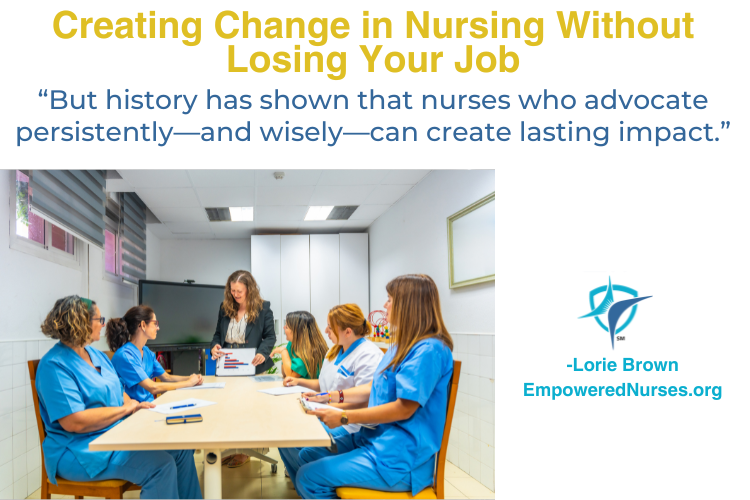
  3. Creating Change in Nursing Without Losing Your Job

    1 Comment

    Nurses see firsthand what works and what doesn’t in healthcare. We’re the ones at the bedside, coordinating care, catching medication errors, and advocating for patients who might otherwise be overlooked. But pushing for change in a system resistant to it? That can be risky.

    Too many nurses have faced retaliation—being labeled as “difficult,” denied promotions, or even fired—just for speaking up. So how do you drive meaningful change without putting your career on the line?

    1. Know Your Institution’s Policies

    Before making waves, know where the boundaries are. Every hospital or healthcare facility has policies on reporting issues, proposing changes, and escalating concerns. If your advocacy aligns with established procedures, you’re less likely to face backlash.

    Review your workplace’s policies on:

    • Patient safety reporting (incident reports, sentinel event procedures)
    • Chain of command (who to escalate concerns to)
    • Whistleblower protections (both internal and legal)

    Understanding these policies ensures you use the proper channels rather than stepping on the wrong toes.

    2. Build Allies, Not Enemies

    Change is easier when you have support. Identify colleagues who share your concerns, especially those in leadership roles. If you can present an issue as a collective concern rather than a personal grievance, it carries more weight.

    Ways to build alliances:

    • Join committees that focus on quality improvement
    • Engage respected senior nurses who can mentor you on navigating hospital politics
    • Collaborate with physicians, case managers, and other team members to strengthen your cause

    3. Frame the Problem as a Solution

    No hospital administrator wants to hear complaints without solutions. Instead of saying, “This is unsafe,” say, “Here’s how we can improve patient safety.” Propose ideas that:

    • Improve patient outcomes
    • Save time and money
    • Enhance compliance with regulations

    For example, instead of just pointing out that short staffing increases medication errors, present data on how an adjusted staffing model could reduce them and improve patient outcomes. Administrators respond better to well-structured proposals than to emotional arguments.

    4. Use Data, Not Just Emotion

    Passion alone won’t win battles—data will. Track incidents, outcomes, and trends that support your case. If you notice a pattern of falls in a certain unit, gather incident reports and compare them to staffing levels or patient acuity. Numbers get attention.

    Ways to collect data:

    • Use official hospital reports
    • Reference evidence-based research
    • Conduct informal surveys among staff to gauge widespread concerns

    5. Document Everything

    If you face resistance or retaliation, documentation is your best defense. Keep records of conversations, emails, and reports related to your advocacy. If management dismisses an issue and it leads to harm, your documentation could protect you and your license.

    Document:

    • Dates and times of discussions
    • Who was present
    • Any instructions or responses given
    • Follow-up actions taken (or not taken)

    If things escalate, having a paper trail ensures you can demonstrate that you acted professionally and responsibly.

    6. Know When to Escalate—And When to Walk Away

    Some battles are worth fighting. Others require a strategic retreat. If you’ve exhausted all avenues and leadership refuses to act on serious concerns, you may need to escalate outside the organization—through state nursing boards, patient safety agencies, or even legal channels.

    However, if your job becomes toxic and unsafe, sometimes the best move is to leave. No job is worth compromising your ethics or well-being.

    Final Thoughts

    Change in healthcare doesn’t happen overnight, and it rarely happens without resistance. But history has shown that nurses who advocate persistently—and wisely—can create lasting impact. The key is to be strategic, build support, and protect yourself along the way.

    Have you ever fought for change in your workplace? What strategies helped you succeed? Let’s continue the conversation.

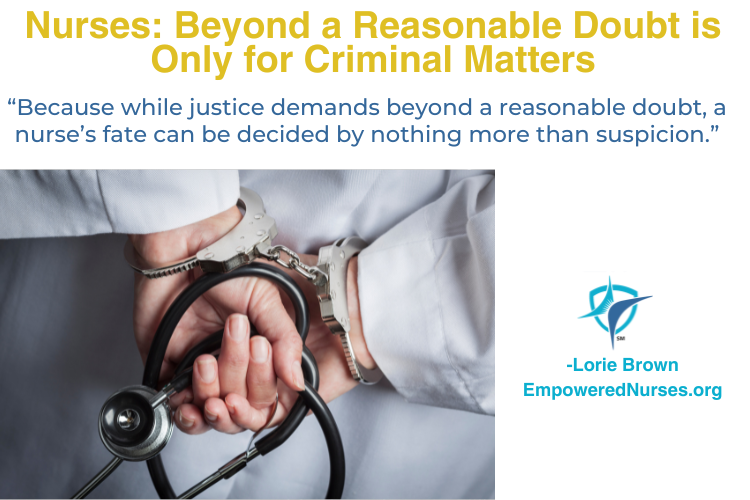
  4. Nurses: Beyond a Reasonable Doubt is Only for Criminal Matters

    Leave a Comment

    Imagine standing in a courtroom, accused of a crime. The prosecution must prove your guilt beyond a reasonable doubt, the highest standard of proof in the legal system. That means every shred of evidence must point so clearly to your guilt that no rational person could doubt it. This is how our legal system protects individuals from wrongful conviction.

    Now, shift that image to your job as a nurse. Here, the rules are different. Your employer doesn’t need any proof at all to terminate you. They don’t even need a reason. Most states follow “at-will” employment laws, meaning you can be fired for wearing the wrong color scrubs, questioning unsafe practices, or simply because someone in management doesn’t like you. There’s no trial, no evidence required, and no appeal process.

    But it gets worse. If your employer reports you to the state Board of Nursing, you enter yet another legal realm—one where the rules are stacked against you. Unlike a criminal trial, the Board doesn’t need to prove your wrongdoing beyond a reasonable doubt. They don’t even need clear and convincing evidence. All they need is a preponderance of the evidence—meaning that if they believe there is just 51% chance that you did something wrong, they can take action against your license.

    And here’s the most shocking part: hearsay is admissible. Hearsay is an out of court statement offered to prove the truth of the matter. A single complaint from a disgruntled patient, a misunderstanding between coworkers, or even an anonymous report can put your entire career on the line. You don’t have the right to cross-examine your accuser the way you would in a criminal case. You may never even know exactly who made the accusation.

    So why are nurses—trusted professionals who dedicate their lives to caring for others—held to such an unforgiving standard? Why is it that an alleged criminal gets more protections under the law than a nurse fighting for their livelihood?

    It’s a question that haunts those who have faced the system firsthand. A nurse can work 20, 30, even 40 years without a blemish on their record, only to have one accusation—without solid proof—lead to suspension, probation, or even revocation of their license. It’s a reality that too many nurses have faced, and one that too many don’t realize until it happens to them.

    So, what can nurses do?

    1. Document everything. If you didn’t document it, it didn’t happen. Keep personal records of incidents, concerns, and conversations—because when accusations arise, your best defense is solid evidence.

    2. Know your rights—but don’t assume they’ll protect you. If you’re called before the Board, understand that this is not a fair trial in the way you might expect. Seek legal representation immediately.

    3. Advocate for change. Nurses must push for reforms in how Boards handle complaints. No professional should lose their livelihood over unsubstantiated claims.

    4. Support each other. Nurses are often left to fight these battles alone. Stand with your colleagues, speak up when you see unfair treatment, and work together to protect the profession.

    Nursing is more than a job. It’s a calling, a passion, and for many, a lifelong identity. Yet, the system does not protect those who dedicate their lives to it. It’s time for nurses to recognize the precarious nature of their profession—not to live in fear, but to take action. Because while justice demands beyond a reasonable doubt, a nurse’s fate can be decided by nothing more than suspicion.

    And that is something that needs to change.

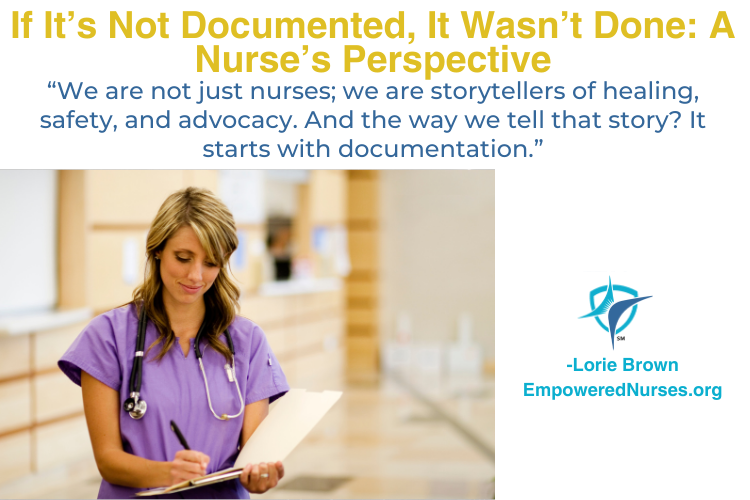
  5. If It’s Not Documented, It Wasn’t Done: A Nurse’s Perspective

    Leave a Comment


    I remember the first time a seasoned nurse looked me in the eye and said, “If it’s not documented, it wasn’t done.” I was a new nurse, fresh-faced and eager, still trying to keep my feet under me during a 12-hour shift that felt like a marathon. At the time, I thought documentation was just a formality—something we did at the end of our shift when we finally had a moment to breathe.

    But experience, and a few hard lessons, taught me otherwise.

    The Reality of Documentation

    Nurses do incredible things every single day. We assess, intervene, advocate, and sometimes perform miracles in the most challenging of situations. We hold hands, catch symptoms before they escalate, and make judgment calls that can mean the difference between life and death. But if none of that is documented, it’s as if it never happened.

    Documentation is not just about covering ourselves legally—though that is a very real and necessary part of our practice. It’s about continuity of care. It ensures that the next nurse, the physician, the entire care team, and even the patient’s family have an accurate picture of what is happening. It tells the story of our patient’s journey, one note at a time.

    When It Matters Most

    I’ll never forget a case where my documentation made all the difference. A patient had subtle but concerning neurological changes during my shift. I documented everything—his altered speech, slight confusion, and the increasing weakness on one side. I called the rapid response team and immediately pushed for a stat CT scan. That patient was having a stroke.

    Without thorough documentation, those early signs might have been overlooked. He might have been written off as just “a little off” that night. But because every nurse in his care documented carefully, he got the life-saving treatment he needed in time.

    The “I’ll Do It Later” Trap

    We all know the feeling—running from one patient room to another, answering a call light while hanging an IV, getting pulled in six different directions. It’s easy to say, “I’ll document later.” But later turns into hours, and by then, the details are fuzzy. Was it 10:30 or 11:00 when that BP dropped? Did I administer 4 mg or 2 mg? We are human, and memory is imperfect. Real-time documentation protects not only our patients but also ourselves.

    What Happens When It’s Missing

    I’ve seen cases where missing documentation created serious problems. A nurse who swore she turned a patient every two hours—but had no record of it—was blamed for a pressure ulcer that developed. A patient who received pain medication, but because it wasn’t documented, the next nurse unknowingly gave another dose, leading to an overdose. A legal case where a nurse’s care was called into question simply because there was no written proof of what she did.

    Nurses don’t go to work thinking about lawsuits, but documentation is our strongest defense when care is questioned. Your documentation will save you every time. If you didn’t chart it, you didn’t do it.

    Making Documentation a Habit

    So how do we make documentation a priority when we barely have time to breathe?

    · Chart as you go. If you wait until the end of the shift, details will slip through the cracks.

    · Be specific. Instead of “patient is confused,” write “patient confused, unable to recall place/time, repeating questions.”

    · Use objective language. Chart what you see, hear, and assess—not assumptions or opinions.

    · Double-check before signing off. A quick review can catch missing pieces before you clock out.

    The Nurse’s Legacy

    At the end of the day, our documentation is our voice when we’re not there to speak for ourselves. It is our patient’s history, our professional integrity, and our protection all in one. Every note, every entry, every little detail matters.

    We are not just nurses; we are storytellers of healing, safety, and advocacy. And the way we tell that story? It starts with documentation.

    So the next time you’re tempted to put it off, remember—if it’s not documented, it wasn’t done. And we all know better than that.

  6. Enjoying the Journey: A Nurse Business Owner’s Guide to Fulfillment

    Leave a Comment

    Building a business as a nurse entrepreneur is not for the faint of heart. It takes grit, determination, and a willingness to step into the unknown. You’ve poured your expertise into something beyond bedside care, and that leap alone is worthy of celebration. But in the pursuit of success, it’s easy to get caught up in the hustle and forget to enjoy the journey.

    The Trap of Constant Striving

    As nurses, we are wired to focus on outcomes—healing patients, completing tasks, and ensuring compliance. That mindset often carries over into business, where we push ourselves to meet deadlines, land clients, and achieve financial milestones. While goals are essential, they shouldn’t come at the expense of your well-being and joy.

    Too many business owners fall into the trap of, “I’ll be happy when…” thinking. When I hit six figures. When I land my dream client. When my schedule is full. But if you don’t learn to appreciate the process, you’ll find that each milestone quickly fades, replaced by the next big goal.

    Redefining Success

    Success isn’t just about revenue—it’s about building a life that aligns with your values. Why did you start this business? Was it for flexibility, financial freedom, impact, or creativity? When you reconnect with your ‘why,’ you’ll find joy in the small wins, not just the major victories.

    Did you receive positive feedback from a client? Did you finally master a new skill? Did you take a much-needed afternoon off without guilt? These moments matter. Your journey is made up of them, not just the finish lines. The goal of any business is to keep playing. That is the only way to win. There is no business nirvana like oh when I get this…The key is to enjoy the journey.

    Practical Ways to Enjoy the Process

    1. Celebrate Small Wins – Don’t wait for massive milestones to acknowledge your progress. Keep a journal or list of achievements, no matter how small.

    2. Take Breaks Without Guilt – Rest fuels creativity and productivity. Give yourself permission to step away, recharge, and return stronger.

    3. Find a Support System – Surround yourself with fellow nurse entrepreneurs who understand the highs and lows. A strong network can provide encouragement when challenges arise.

    4. Make Time for Passion Projects – Don’t let your business consume your identity. Whether it’s volunteering, a hobby, or spending time with loved ones, nourish the parts of yourself that exist outside of work.

    5. Reframe Setbacks – Every challenge is an opportunity to learn. Instead of seeing obstacles as failures, view them as stepping stones to growth.

    Final Thoughts

    Running a business is a marathon, not a sprint. If you wait until you’ve “made it” to enjoy yourself, you’ll miss the best parts of the adventure. Success is not just the destination—it’s found in the moments of learning, growing, and making a difference along the way.

    So, take a deep breath, appreciate how far you’ve come, and find joy in the journey. Because this is your story, and every step matters.

  7. Nurses Risk Their Lives Everyday

    Leave a Comment

    In a harrowing incident on February 18, 2025, at HCA Florida Palms West Hospital in West Palm Beach, Florida, a nurse was brutally attacked by a patient, resulting in critical injuries. The patient, 33-year-old Stephen Scantlebury, was under a Baker Act hold—a Florida law allowing for involuntary mental health examination—when he allegedly assaulted the nurse, causing severe facial injuries that may lead to the loss of both her eyes. Scantlebury has been charged with attempted second-degree murder, with a hate crime enhancement. My heart goes out to the injured nurse.

    This tragic event underscores a pervasive issue in healthcare: workplace violence against nurses. According to the American Nurses Association, nurses are at high risk for assaults due to their close proximity to patients, with two nurses assaulted every hour in acute care settings.

    Protective Measures for Nurses

    To enhance safety and mitigate the risk of such incidents, nurses and healthcare facilities can consider the following strategies:

    1. Comprehensive Training: Regular training programs focusing on de-escalation techniques, recognizing early signs of aggression, and self-defense can empower nurses to handle volatile situations effectively.

    2. Environmental Controls: Implementing security measures such as controlled access to sensitive areas, installation of surveillance systems, and ensuring adequate lighting can deter potential aggressors.

    3. Reporting Systems: Establishing a non-punitive, straightforward reporting mechanism encourages nurses to report incidents of violence, facilitating timely interventions and policy adjustments.

    4. Supportive Culture: Fostering a workplace environment where nurses feel supported by management and peers can alleviate the psychological impact of workplace violence and promote open communication.

    5. Legislative Advocacy: Engaging in advocacy for stricter laws and regulations that protect healthcare workers can lead to systemic changes, ensuring safer working conditions.

    The incident at Palms West Hospital serves as a stark reminder of the vulnerabilities nurses face daily. By implementing proactive measures and fostering a culture of safety, healthcare facilities can better protect their staff and ensure a secure environment for both caregivers and patients.

  8. The 5 Love Languages of Nurses: How Compassion Translates in Healthcare

    Leave a Comment

    Nurses are the heart of healthcare, giving their time, energy, and emotions to care for others. But have you ever thought about how nurses express and receive love—both in their personal and professional lives? If you know another person’s love language, it make communication much easier. Inspired by Dr. Gary Chapman’s book, The 5 Love Languages, let’s explore how these languages apply to the nursing profession and how they shape the way nurses care for patients, colleagues, and even themselves.

    1. Words of Affirmation – The Power of Encouragement

    For many nurses, words matter. A simple “You made a difference today” or “Thank you for your hard work” can lift their spirits after a grueling shift. Nurses thrive when they hear appreciation from patients, families, and fellow healthcare workers. Encouraging words fuel resilience, reminding them why they chose this profession.

    💬 How to Show It:

    · Managers and coworkers can uplift nurses with verbal praise.

    · Patients can express gratitude for the care they receive.

    · Nurses can use affirmations to support struggling colleagues.

    2. Acts of Service – Helping Hands Heal the Soul

    Nurses are natural caregivers, often showing love by doing rather than saying. Whether it’s covering a coworker’s shift, mentoring a new nurse, or taking a few extra minutes to comfort a patient, acts of service define the nursing profession.

    💡 How to Show It:

    · Team members can offer help when a nurse is overwhelmed.

    · Leadership can provide resources that make nurses’ jobs easier.

    · Nurses can support each other by anticipating needs and stepping in.

    3. Receiving Gifts – Small Tokens, Big Impact

    While nurses don’t expect grand gestures, small tokens of appreciation can go a long way. A cup of coffee, a handwritten note, or a simple snack in the break room can brighten a nurse’s day. In the fast-paced world of healthcare, these little gifts remind nurses that their work is valued.

    🎁 How to Show It:

    · Hospitals can provide self-care packages or meal vouchers.

    · Patients and families can offer small thank-you gifts.

    · Nurses can exchange thoughtful gestures among colleagues.

    4. Quality Time – Presence Over Presents

    With long hours and demanding shifts, nurses often crave meaningful connections with their peers, patients, and loved ones. Quality time for a nurse might mean an uninterrupted lunch break, a heartfelt conversation with a patient, or a few moments to breathe between tasks.

    How to Show It:

    · Leaders can schedule check-ins with their staff.

    · Patients can engage in genuine conversations with their nurses.

    · Nurses can prioritize self-care by spending time with friends and family.

    5. Physical Touch – The Healing Power of Compassion

    In nursing, physical touch isn’t just about human connection—it’s often a lifeline. Holding a patient’s hand, offering a comforting hug to a distressed family member, or even a reassuring pat on a coworker’s back speaks volumes in moments of stress or sorrow.

    🤲 How to Show It:

    · Nurses can offer gentle, compassionate touch to comfort patients.

    · Healthcare teams can recognize the emotional impact of physical care.

    · Hospitals can create environments where emotional and physical support are prioritized.

    Why the 5 Love Languages Matter in Nursing

    Understanding love languages in nursing isn’t just about personal relationships—it’s about creating a culture of appreciation, empathy, and support. When nurses feel seen, valued, and cared for, they can continue to provide the compassionate care that makes a difference in patients’ lives.

    So, the next time you interact with a nurse—whether as a colleague, leader, or patient—consider which love language speaks to them. A simple thank-you, a small act of kindness, or a few uninterrupted moments of connection could be the difference between burnout and fulfillment.

    💙 Nurses, what’s your love language? Drop a comment and let’s celebrate the many ways you give and receive love in your profession!

  9. Why Every School Needs a Full-Time Registered Nurse

    Leave a Comment

    In today’s rapidly evolving educational environment, student health and safety have never been more critical. Yet, many schools across the country lack a full-time registered nurse (RN) on staff, leaving students vulnerable in moments of crisis. While schools prioritize security with school resource officers (SROs), the presence of an RN is just as—if not more—essential for ensuring the well-being of students. From managing chronic conditions to addressing mental health crises, a registered nurse should be a non-negotiable presence in every school.

    A Lifeline for Chronic and Acute Health Needs

    Many children today live with chronic illnesses such as asthma, diabetes, and severe allergies. These conditions require regular monitoring, medication administration, and sometimes emergency intervention. Without an RN on-site, teachers and administrative staff—who are not medically trained—must step in, increasing the risk of mismanagement and delayed care. A school nurse ensures that these students receive the proper attention, allowing them to remain in school safely and thrive academically.

    Moreover, the role of an RN extends beyond chronic conditions. Children experience injuries, fevers, infections, and unexpected medical emergencies during the school day. Having a trained professional available at all times means these issues can be addressed promptly, preventing escalation and unnecessary emergency room visits.

    Addressing the Mental Health Crisis in Schools

    The mental health crisis among students is reaching unprecedented levels, with rising rates of anxiety, depression, and suicidal ideation. School nurses are uniquely positioned to recognize early warning signs and intervene before a situation becomes dire. They provide immediate support, connect students with appropriate mental health resources, and collaborate with counselors, teachers, and parents to create a safety net for vulnerable children.

    A registered nurse’s medical expertise also plays a crucial role in differentiating between physical symptoms caused by mental health struggles and actual medical conditions. This distinction is critical in ensuring that students receive the proper care, rather than being misdiagnosed or overlooked.

    Reducing the Burden on Teachers and Staff

    Without an RN on staff, teachers and administrative personnel are often left to handle student health concerns—something they are neither trained nor equipped to do. This not only puts students at risk but also diverts educators from their primary role: teaching. A dedicated school nurse alleviates this burden, allowing teachers to focus on instruction while ensuring that health concerns are managed appropriately and professionally.

    A Smarter Investment in Student Success

    Some may argue that budget constraints make hiring a full-time RN impractical. However, the cost of not having a school nurse can be far greater. When students do not receive proper medical care in school, absenteeism rises, learning is disrupted, and minor health concerns can escalate into serious issues that require costly emergency care. Schools that invest in registered nurses ultimately see improved attendance rates, better academic performance, and a safer, healthier learning environment.

    Conclusion

    The presence of a full-time registered nurse is not a luxury—it is a necessity. Schools are responsible for providing a safe and supportive environment, and that includes meeting students’ medical and mental health needs. By prioritizing the hiring of RNs, schools can ensure that students receive the care they need, when they need it, without compromise. Every child deserves to learn in an environment where their health is safeguarded by a trained professional. It’s time we make full-time school nurses a standard, not an exception.

  10. Help, I’m Being Sued!

    Leave a Comment

    These are the words of a nurse’s biggest nightmare. The last thing we want to do is to be sued in a medical malpractice case. But the good news is that it is unlikely that you will be sued because attorneys typically name the hospital. The hospitals have insurance, and they don’t know whether the nurse does.

    So, typically the hospital is named because the facility is responsible for the actions of their employees when they are acting within the scope of their employment. Should you commit an intentional act or perform outside the scope of your duty, the hospital may not have a duty to represent you.

    The healthcare facilities have the “deep pockets” and typically have the insurance that would cover these claims. Attorneys know that a nurse is unlikely to have the funds to pay if they are sued for any substantial judgment. However, the

    I have received calls from nurses saying, “I got a notice that they want to take my deposition.” If you are not named in a suit and you are requested for a deposition, your employer or previous employer should cover you for that.

    If that happens, get in touch with the facility’s attorney. But if you have your own insurance, you are entitled to your own attorney because if your interests are different than your healthcare facility, your attorney will be your advocate and speak up for you and protect you so the facility cannot throw you under the bus.

    Malpractice is a fancy word for “negligence: a civil wrong. There are four elements that an attorney must prove: (1) duty, (2) breach, (3) cause, and (4) harm. Let’s say you are driving and have a duty to stop at an intersection but blow the stop sign, you may get a traffic ticket! If no one is hurt, that is not negligence. But if you do fail to stop at a stop sign and hit another vehicle with the right-of-way causing an injury, that is negligence.

    In nursing, you have a duty to give the proper medication. If a physician orders aminophylline but you give ampicillin and the patient is not allergic, you may have made a medical error, but it did not cause harm.

    If you give ampicillin instead of aminophylline and the patient has no untoward effects, it is not malpractice. If the patient has an allergic reaction and must spend the night in ICU, then there is harm, and that is malpractice.

    Fortunately, much of what we do in nursing does not create harm, but often failing to notice changing conditions and failing to call the physician is one of the biggest areas of malpractice as would be failing to follow your facilities policies and procedures because that sets the standard of care and shows what is your duty.

    Therefore, if you do become involved in a malpractice action, your attorney will assist you through this process, whether it be through your own insurance or that of your employer or previous employer.

As Seen On:

Women's Week