Join me for an exclusive in-person event for LNCs to hear the behind-the-scenes legal process from 12 attorneys! ❱❱

Empowering Nurses at the Bedside and in Business

Author Archives: Lorie A Brown, R.N., M.N., J.D.

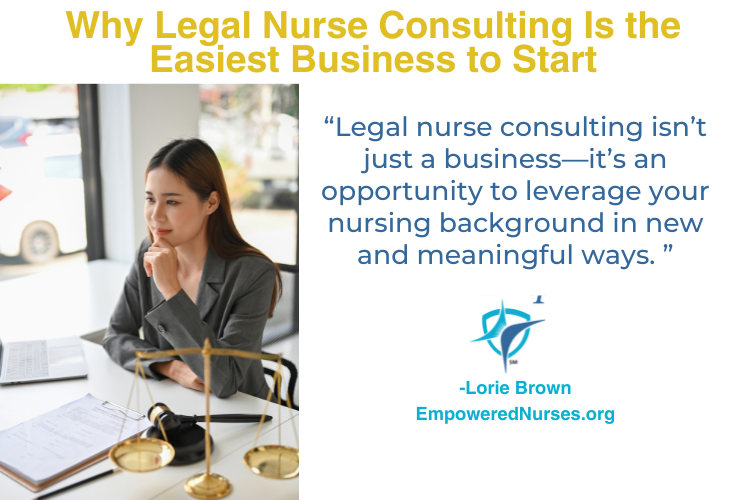
  1. Why Legal Nurse Consulting Is the Easiest Business to Start

    Leave a Comment

    Starting a business may sound intimidating, but as a nurse, you already have the perfect foundation to succeed in legal nurse consulting (LNC). In fact, among the many business opportunities available to nurses, legal nurse consulting stands out as one of the easiest and most lucrative to start. Here’s why:

    1. You Already Have the Expertise

    As a nurse, you bring years of clinical experience, critical thinking, and knowledge of medical terminology to the table. Legal nurse consulting doesn’t require you to learn a brand-new skillset—you simply apply your existing expertise in a different context. Attorneys rely on your ability to interpret medical records, understand healthcare standards, and explain complex issues in a clear, concise way. You’re already equipped to do this.

    2. Minimal Start-Up Costs

    Unlike many other businesses that require significant upfront investments, starting an LNC business is cost-effective. You don’t need expensive equipment, office space, or inventory. With a computer, internet connection, and a professional website, you can begin marketing your services. Some nurses also choose to invest in legal nurse consulting training programs, but even this is optional if you feel confident in your abilities. You don’t even need expensive training. Attorneys do not know what certification is. If you were given a medical record, could you determine what was done that should not have been done and what was not done that should have been done and did it cause harm? That is what legal nurse consulting is all about.

    3. Flexible Work Environment

    Legal nurse consulting allows you to work from virtually anywhere. Whether you prefer to work from home, a local coffee shop, or while traveling, this business model offers unparalleled flexibility. You can set your own hours and determine how much work you want to take on, making it ideal for nurses seeking work-life balance.

    4. High Demand for Your Skills

    Attorneys often struggle to understand the complexities of medical records and healthcare practices, and that’s where you come in. Your ability to bridge the gap between medicine and law makes you an invaluable resource. From medical malpractice cases to personal injury lawsuits, there’s no shortage of opportunities for skilled LNCs. The demand for your expertise is constant, giving you a reliable stream of potential clients. Attorneys are hiring you for your medical knowledge, not your legal knowledge.

    5. You’re Your Own Boss

    In legal nurse consulting, you have the freedom to design your business the way you want. You choose your clients, set your rates, and decide how to market your services. This autonomy is

    empowering and allows you to build a business that aligns with your personal and professional goals.

    6. It’s an Extension of What You Love

    Most nurses enter the profession because they care deeply about helping others. Legal nurse consulting allows you to continue making a difference—just in a different way. By helping attorneys understand medical issues, you’re playing a crucial role in ensuring justice and fairness in healthcare-related cases. I say you just have a different type of patient!

    7. Quick Startup Timeline

    Compared to other ventures, starting an LNC business can be done relatively quickly. You just need to start talking to attorneys about the value and benefits of your services. There’s no lengthy certification process or extensive infrastructure needed to get started.

    8. Endless Learning Opportunities

    If you love learning, legal nurse consulting is a perfect fit. Every case is different, and you’ll constantly be expanding your knowledge as you analyze medical records, research healthcare practices, and collaborate with attorneys. It’s a career that keeps you intellectually engaged and challenged.

    Take the Leap

    Legal nurse consulting isn’t just a business—it’s an opportunity to leverage your nursing background in new and meaningful ways. With low barriers to entry, high demand for your skills, and the flexibility to work on your own terms, it’s one of the easiest and most rewarding businesses a nurse can start.

    If you’ve ever dreamed of owning your own business or stepping outside traditional nursing roles, legal nurse consulting could be the perfect fit. The hardest part is taking the first step, but once you do, you’ll find that the path is more straightforward than you ever imagined.

    So why wait? The world of legal nurse consulting is waiting for you—step into it and discover just how far your nursing expertise can take you. Are you ready to meet attorneys and learn more about the legal system? Then join us at InsideLitigationEvent.com live and in person in Indianapolis, IN April 3-4, 2025.

  2. Anything You Say Can and Will Be Used Against You: A Nurse’s Perspective

    Leave a Comment

    It’s an unsettling thought, isn’t it? To consider that in the act of simply doing our job—communicating with patients, families, and colleagues—we might unintentionally put ourselves at risk. A casual comment can be perceived as a definitive medical opinion. A shared moment of empathy can be construed as overstepping professional boundaries. And when things go wrong, the words we spoke in the spirit of care can be dissected in courtrooms, disciplinary hearings, or even by our employers and board investigators.

    So, how do we navigate this reality? How do we continue to communicate with the authenticity that makes nursing so powerful while protecting ourselves from misinterpretation?

    Mindful Communication: Each word matters. Pause before you speak, especially in emotionally charged situations. Ask yourself, “How could this be perceived?” Document what you say and why you said it—your charting is your safeguard. Remember, even conversations with employers or board investigators can be scrutinized later and your words can be used against you.

    Empathy with Boundaries: We can be compassionate and professional at the same time. Reflecting back feelings—“I can see this is really hard for you”—shows care without committing to promises or definitive statements.

    Education and Advocacy: Understanding the legal landscape of our profession helps us protect ourselves. Join conversations about nursing practice standards. Seek guidance from mentors or legal counsel when situations feel unclear, especially when dealing with board investigations or disputes with employers. Read your state’s nurse practice act and know your policies and procedures.

    Support Each Other: We’re not alone in this. Share experiences with your colleagues, learn from each other’s stories, and foster a culture where we lift each other up. Create spaces where concerns can be voiced and explored safely.

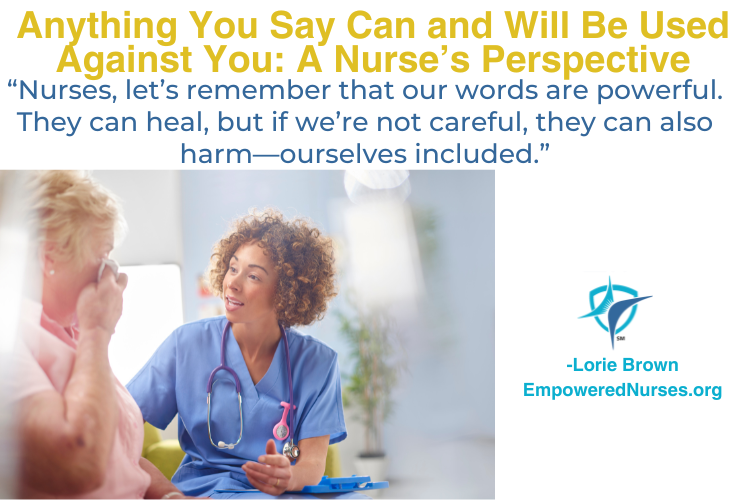
    Nurses, let’s remember that our words are powerful. They can heal, but if we’re not careful, they can also harm—ourselves included. Let’s use our voices wisely, with both courage and caution, and continue to be the advocates, healers, and pillars of strength that our patients need. Together, let’s find the balance between being human and being professional. We owe it to our patients—and to ourselves.

  3. You Have The Right To Remain Silent

    Leave a Comment

    We have all heard that you have the right to remain silent anything that you say can and will be used against you. However, we tend to forget this saying when it comes to being asked to speak to our supervisors or even investigators. We want to tell the truth and look good for our supervisor or investigators because we think we did not do anything wrong. As nurses, we are caregivers, advocates, and fierce protectors of our patients. Our days are filled with compassion, critical thinking, and moments where our skills can mean the difference between life and death. But what happens when the tables turn, and we find ourselves at the center of an investigation—whether it’s related to patient care, workplace issues, or even a misunderstanding?

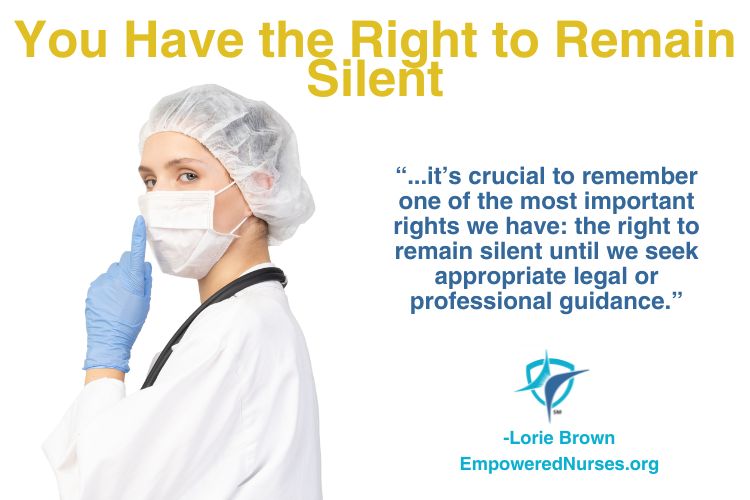
    It’s natural for us as nurses to want to explain, defend, and “fix” things. After all, we are problem-solvers. But in the face of an investigation—whether it’s by your employer, a licensing board, or even law enforcement—it’s crucial to remember one of the most important rights we have: the right to remain silent until we seek appropriate legal or professional guidance.


    Why Silence Matters

    The right to remain silent is not about hiding the truth or admitting guilt; it’s about protecting yourself from unintentional harm. In the chaos of questions and accusations, even the most innocent statements can be misunderstood, twisted, or used against you.

    · Stress Can Cloud Judgment: In moments of pressure, it’s easy to misspeak or forget details. These unintentional errors could be misinterpreted as dishonesty.

    · Investigators Are Not Neutral: Many times, investigators are not there to help you; their job is to gather evidence, which could include building a case against you.

    · You Are Not Obligated to Explain Right Away: You have the right to take a breath, consult with an attorney and ensure that any statement you make is clear, accurate, and well-considered.


    A Lesson in Boundaries

    Nurses are often taught to prioritize others over themselves. We work long hours, skip breaks, and put our own needs last because we care deeply about the lives we touch. But protecting yourself in an investigation isn’t selfish—it’s essential.

    By remaining silent, you’re not being uncooperative; you’re being wise. You’re taking the time to ensure that your voice is heard accurately and in the right context.

    Think of it as the ultimate form of self-care: safeguarding your career, your license, and your integrity.


    When to Speak and When to Stay Silent

    If you’re approached by an investigator—whether from your facility, the state board of nursing, or law enforcement—here’s what you should do:

    1. Stay Calm: Don’t let fear or anxiety pressure you into answering immediately.

    2. Ask for Representation: Politely state that you’d like to consult with an attorney or legal advisor before answering any questions.

    3. Know Your Rights: You are not obligated to provide a statement on the spot. It’s perfectly acceptable to say, “I’m happy to cooperate, but I’d like to consult with my legal counsel first.”

    4. Document Everything: Take note of who approached you, the questions asked, and the context of the interaction. This will help your legal representative guide you appropriately.


    Your Worth Is More Than Your Words

    As nurses, we carry an incredible responsibility, and with that comes the weight of accountability. But accountability does not mean forfeiting your rights. You have the right to protect yourself, just as much as you have the right to protect your patients.

    It’s easy to feel isolated and afraid when you’re under scrutiny. Remember this: you are not alone. There are attorneys, legal nurse consultants, and professional organizations that exist to support and guide you.

    Most importantly, know that your worth as a nurse—and as a human being—is not determined by a moment of silence. It’s determined by the countless lives you’ve touched, the compassion you’ve shown, and the integrity you uphold every day.

    So, the next time you find yourself in the hot seat, remember: sometimes, the most powerful thing you can say is nothing at all—until you’re ready.


    Final Thoughts

    As nurses, we give so much to others, but we must also learn to give ourselves grace and protection. Know your rights, stand firm, and don’t be afraid to advocate for yourself when it matters most. Silence isn’t weakness; it’s wisdom.

    If you ever find yourself in need of guidance, reach out to trusted professionals who understand your world and can help you navigate these challenges. Together, we can protect not just our patients but also ourselves—and the profession we hold so dear.

    Stay strong, stay wise, and know you are never alone.

  4. Should I Stay or Should I Go? A Guide for Nurses Deciding Whether to Leave Their Jobs

    Leave a Comment

    Nurses across the nation are grappling with burnout, dissatisfaction, and a healthcare system that often feels unresponsive to their needs. If you’re a nurse wondering, “Should I stay or should I go?”, you’re not alone. The decision to leave a job is never easy, but taking a structured approach can help you assess your situation and make the best choice for your career and well-being.

    1. Assess the Source of Your Discontent

    Start by identifying the specific factors causing you dissatisfaction. These might include:

    · Workload: Are chronic understaffing or unsafe patient ratios overwhelming you?

    · Leadership: Do you feel unsupported or undervalued by management?

    · Compensation: Are you being paid fairly for your skills and experience?

    · Workplace Culture: Are you dealing with toxic colleagues, bullying, or a lack of respect?

    · Personal Growth: Are there opportunities for advancement, education, or skill-building?

    Write down your frustrations and categorize them as fixable or non-fixable. For example, chronic understaffing might improve if leadership hires more staff, but a toxic workplace culture might be deeply ingrained and unlikely to change.

    2. Consider Your Professional and Personal Values

    Ask yourself:

    · Does this job align with my values as a nurse? If patient safety, teamwork, and ethical care are central to your identity, working in an environment that disregards these values can be deeply disheartening.

    · Is this job negatively affecting my personal life? If your physical health, mental health, or relationships are suffering due to work, it may be time to reassess.

    Your values and priorities may evolve over time. A job that worked for you five years ago may no longer align with who you are today.

    3. Evaluate Your Options

    Before making any decisions, research your alternatives:

    · Market Demand: Nurses are in high demand, and you likely have options. Look into roles in different specialties, locations, or settings (e.g., outpatient clinics, telehealth, education, legal nurse consulting).

    · Benefits of Staying: Are there opportunities to advocate for change in your current workplace? Could a conversation with leadership or HR address some of your concerns?

    · Risks of Leaving: Consider the financial implications and how a job change might impact your life. Do you have a financial cushion to support a potential transition?

    4. Talk to Trusted Advisors

    Sometimes, it’s hard to see the big picture when you’re in the thick of it. Speak with:

    · Colleagues or Mentors: They may offer perspective on whether your challenges are unique to your workplace or common across the field.

    · Family and Friends: Their insights can help you understand how your job is affecting your personal life.

    · Career Coaches or Professional Organizations: They can provide guidance on transitioning to a new role or specialty.

    5. Recognize When It’s Time to Go

    While every situation is unique, certain red flags might indicate it’s time to leave:

    · Your health is deteriorating: Chronic stress, anxiety, or physical ailments stemming from your job are serious warning signs.

    · Your ethical boundaries are compromised: If you’re being asked to work in unsafe conditions or cut corners, it may be time to seek a workplace that aligns with your values.

    · You’ve tried to address issues without success: If conversations with leadership, HR, or colleagues haven’t led to meaningful change, it may be time to move on.

    · You feel like your license may be at risk. My favorite saying is you can always find another job but you cannot get another license.

    6. Plan Your Exit Strategically

    If you decide to leave, take time to prepare:

    · Research new opportunities: Apply for jobs while still employed, if possible, to avoid gaps in income.

    · Update your resume and LinkedIn: Highlight your skills, certifications, and achievements.

    · Give proper notice: Maintain professionalism by providing appropriate notice and helping with the transition.

    · Exit gracefully: Avoid burning bridges. You never know when your paths might cross again.

    · Do your homework: When looking for a new job, speak to former employees, look for online reviews of the workplace, look at the department of health surveys. If the reviews are poor, don’t work there.

    7. Staying by Choice, Not Default

    If you decide to stay, make sure it’s a deliberate choice. Explore ways to improve your current situation:

    · Advocate for Change: Join committees, speak up about staffing concerns, or propose solutions to leadership.

    · Invest in Yourself: Pursue certifications, advanced degrees, or professional development to open doors for future growth.

    · Set Boundaries: Protect your time and energy by learning to say no when needed.

    Final Thoughts

    The decision to stay or leave is deeply personal. By thoughtfully evaluating your situation, considering your values, and planning your next steps, you can take control of your career path. Remember, your skills as a nurse are valuable and transferable. Whether you stay or go, prioritize your well-being—you can’t care for others if you don’t care for yourself.

  5. Are Employee-Employer Relationships a Marriage? A Response to “Can This Marriage Be Saved?”

    Leave a Comment

    There was an article in the American Nurses’ Association magazine titled “Can This Marriage Be Saved? Nurses and Health Systems in Crisis” draws an analogy between the relationship of nurses and their employers and that of a troubled marriage. While the sentiment of seeking reconciliation between nurses and the healthcare system is commendable, I must respectfully disagree with the premise. The employee-employer relationship is not, and should not be, likened to a marriage. Here’s why:

    1. Historical Context: Employer-Employee Origins

    The modern employer-employee relationship evolved from the servant-employer dynamic. Historically, this was a transactional relationship: labor was exchanged for compensation, often under conditions far from equitable. Over time, labor movements and legal protections have shifted the dynamic, but the essence remains transactional. A marriage, in contrast, is deeply personal and emotional, grounded in mutual love, respect, and shared goals.

    To equate these vastly different relationships risks romanticizing what is, at its core, a professional contract. Nurses do not “vow” loyalty to a hospital; they commit to their patients and their profession.

    2. Power Dynamics

    In any marriage analogy, we must address the inherent power imbalance between nurses and healthcare systems. Employers hold significant control over wages, working conditions, and job security. Nurses, while indispensable, often lack equal bargaining power. In a true marriage, both parties share power and decision-making. By framing this relationship as a marriage, the article obscures the reality that many nurses face systemic inequities and limited autonomy in their workplaces.

    3. Emotional Labor vs. Professional Boundaries

    Nursing is a profession that demands immense emotional labor, but this does not mean nurses owe emotional commitment to their employers. The marriage analogy risks perpetuating the expectation that nurses should “give more” to the system, just as one partner might sacrifice in a relationship for the greater good. This mindset undermines the professional boundaries essential to maintaining nurses’ well-being and dignity.

    4. The Risk of Blaming Nurses

    When we use the language of marriage to describe professional relationships, we risk placing undue blame on nurses for the “failure” of the relationship. Just as marriages often fail due to mutual fault—or systemic incompatibilities—the struggles between nurses and health systems are often rooted in systemic failures, such as inadequate staffing, poor leadership, and profit-driven motives. Nurses’ dissatisfaction is not a personal failure or a lack of commitment—it is often a reasonable response to unsustainable conditions.

    5. A Better Framework

    Rather than viewing the nurse-employer relationship as a marriage, we should adopt a framework of mutual respect and accountability. Employers are responsible for providing safe working conditions, fair compensation, and opportunities for professional growth. Nurses, in turn, fulfill their roles as healthcare providers. This is not about “saving” a relationship but creating a functional, professional partnership.

    The language we use matters. By moving away from the marriage metaphor, we acknowledge the professionalism of nurses and the systemic issues that need addressing. The goal should not be reconciliation at all costs but fostering workplaces where nurses feel respected, valued, and supported.

    Final Thoughts

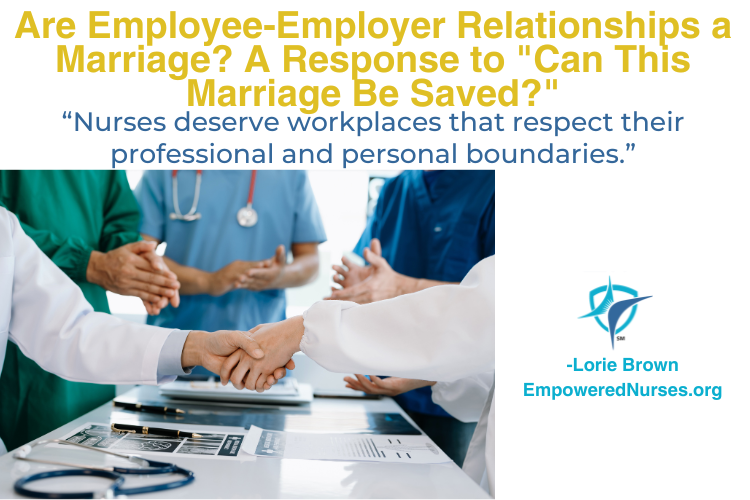
    Nursing is a calling, but it is also a career. Nurses deserve workplaces that respect their professional and personal boundaries. Let’s leave the marriage metaphors behind and focus on tangible solutions to the systemic problems in healthcare. Only then can we truly address the crisis facing nurses and the healthcare systems they serve.

  6. Good News For Nurses!

    Leave a Comment

    Nurses are no strangers to challenges—physical and verbal abuse, long hours, and demanding workplace politics often accompany their critical role in healthcare. Yet, despite these hurdles, an overwhelming 92% of nurses report they are glad they chose the nursing profession, according to Medscape’s 2024 Nurse Career Satisfaction Report.

    This fascinating report, based on a survey of 7,723 practicing U.S. nurses from March to June 2023, highlights not only the passion nurses have for their work but also their struggles and the factors that impact their job satisfaction.

    Let’s break it down:


    A Shared Sense of Satisfaction Across Specialties

    The report reveals that nurses across all specialties are largely satisfied with their careers:

    · Registered Nurses (RNs) – 91% satisfaction

    · Licensed Practical Nurses (LPNs) – 92% satisfaction

    · Nurse Practitioners (NPs) – 94% satisfaction

    · Certified Registered Nurse Anesthetists (CRNAs) – 97% satisfaction

    · Clinical Nurse Specialists (CNSs) – 98% satisfaction

    · Nurse Midwives – 94% satisfaction

    These numbers show that regardless of their role, nurses continue to take pride in their work, emphasizing a universal calling to care for others.


    If Given the Chance, Most Would Choose Nursing Again

    Despite the well-known challenges of the job, 73% of nurses said they would choose nursing again if they were starting their careers today. Additionally:

    · 72% would pursue the same education program.

    · 45% would stick with their current specialty.

    These responses reflect the deep-rooted commitment nurses have to their profession, even as they acknowledge areas where their career paths could have been slightly different. I always say nursing is in our DNA.


    Why Nurses Stay: The Biggest Reward

    For nurses, it’s not about the paycheck—it’s about people. The report found that helping people and making a difference in lives is the most rewarding aspect of the job:

    · 33% of APRNs said this was their top reward.

    · 32% of RNs and LPNs echoed the same sentiment.

    Nurses thrive on the knowledge that their work directly impacts patients and their families. For many, this intrinsic motivation outweighs the daily challenges.


    The Hardest Part of Nursing: Politics, Pay, and Burnout

    While job satisfaction is high, administration and workplace politics emerged as the worst part of the job for many nurses:

    · 22% of RNs and LPNs cited politics as their top frustration, followed closely by low pay (13%).

    · For advanced practice nurses, documentation requirements (11%) and lack of work-life balance (11%) also topped the list.

    The time spent navigating red tape, dealing with bureaucracy, and feeling undervalued financially continues to wear on nurses, particularly as their workloads grow.


    Abuse in the Workplace: A Critical Issue

    One of the most concerning findings from the report is the high prevalence of workplace abuse:

    · 87% of nurses reported experiencing physical abuse from patients in the last year.

    · 75% experienced verbal abuse from patients.

    · Nearly half faced emotional abuse from managers (48%) or coworkers (46%).

    · Alarmingly, 14% of nurses reported experiencing sexual harassment or misconduct.

    These statistics highlight a serious issue that must be addressed to protect nurses’ well-being and retain skilled professionals in the field.


    Who Are Today’s Nurses? A Demographic Snapshot

    The Medscape report also shed light on the demographics of the nursing workforce:

    · 88% of respondents identified as women; 11% as men. Love the Murses!

    · 76% work full-time, 18% part-time, and 6% per diem.

    · Age distribution shows a significant number nearing retirement:

    o 31% are 55-64 years old.

    o 25% are 45-54.

    o Only 7% are under 34.

    This aging workforce highlights the need for continued recruitment of younger nurses to sustain the profession in the coming years.


    The Path Forward: Challenges and Hope

    The nursing profession has always been built on resilience, compassion, and a desire to help others. The 2024 Nurse Career Satisfaction Report reminds us that while nurses are committed to their work, they face significant challenges—from workplace abuse to administrative burdens.

    For nursing leaders, healthcare organizations, and policymakers, these findings offer a clear call to action: support nurses, address their frustrations, and protect their well-being.

    For nurses themselves, the numbers confirm what many already know: despite everything, they wouldn’t trade their careers for anything. Nursing is more than a job; it’s a calling.

    Are you ready to celebrate your nursing journey? Share your thoughts below—we’d love to hear your story.

  7. Closing the Nurse Staffing Gap: Why Non-Skilled Support Isn’t the Solution

    Leave a Comment

    The nursing shortage is one of the most pressing challenges facing healthcare today.

    A recent article proposes a solution that sounds logical at first: shift tasks away from nurses and onto non-skilled workers or technology-enabled support systems. Obviously, this was not a solution promoted by nurses. This approach risks oversimplifying a complex issue and may even exacerbate the problem. Instead of relying on non-skilled personnel to close the gap, we need to focus on empowering highly skilled nurses and creating systems that maximize their expertise.

    The Critical Role of Expertise in Nursing

    Nursing is more than a checklist of tasks. Nurses bring a unique combination of critical thinking, clinical expertise, and compassionate care to every patient interaction. Their training equips them to make split-second decisions, identify subtle changes in a patient’s condition, and navigate complex healthcare environments.

    When non-skilled personnel are asked to perform tasks that overlap with nursing responsibilities, even if seemingly straightforward, the risk of errors increases. For example, a nurse’s assessment while performing routine tasks like wound care or medication administration often reveals critical insights that could be missed by someone without clinical training. Substituting skilled nurses with non-skilled workers can compromise patient outcomes, burden nurses with oversight duties, and erode trust in the care team.

    The Problem with Task Shifting

    Proponents of task-shifting argue that reassigning duties to non-skilled workers will free nurses to focus on their most critical responsibilities. But in practice, this often adds layers of complexity. Nurses may need to double-check the work of non-skilled personnel, provide constant supervision, or step in to correct mistakes, which negates any potential time savings.

    Moreover, the emotional and mental load of managing others without proper support only contributes to the burnout epidemic among nurses. Nurses don’t just want to do less; they want to do meaningful, high-quality work in a supportive environment. Task-shifting to non-skilled staff doesn’t address the root causes of the staffing crisis—burnout, under-resourcing, and a lack of recognition for the complexity of nursing work.

    Patient Safety: The Non-Negotiable Priority

    Patient safety must remain the cornerstone of any staffing solution. Studies consistently show that higher nurse-to-patient ratios are directly linked to better outcomes, fewer medical errors, and lower mortality rates. Substituting non-skilled workers for nurses in an effort to save costs or stretch resources undermines these outcomes.

    For example, during emergencies, the presence of a trained nurse can mean the difference between life and death. Their ability to anticipate complications and act swiftly isn’t something that can be replaced by someone without the same depth of training.

    Real Solutions Require Investing in Nurses

    Rather than leaning on non-skilled personnel as a stopgap, healthcare systems should prioritize sustainable strategies to support and retain skilled nurses:

    1. Improved Working Conditions: Addressing burnout by creating manageable workloads, providing mental health support, and fostering respectful workplace cultures.

    2. Competitive Compensation: Offering salaries and benefits that reflect the expertise and critical nature of the work nurses perform.

    3. Professional Development: Investing in continuing education and career advancement opportunities to help nurses feel valued and empowered.

    4. Streamlined Workflows: Implementing systems and technologies that truly reduce administrative burdens without compromising clinical care.

    The Way Forward

    The nursing shortage demands solutions that honor the expertise nurses bring to the table. Delegating responsibilities to non-skilled personnel may seem like an easy fix, but it risks diminishing the quality of care and further overburdening an already stretched workforce. Instead, we must invest in strategies that respect and elevate the nursing profession.

    Nurses are the backbone of healthcare. To solve the staffing crisis, we need to reinforce that backbone, not try to replace it with shortcuts. Patients deserve care from trained professionals who can deliver excellence, and nurses deserve the resources and support to meet that standard.

  8. Covenants Not to Compete: What Nurses Need to Know About the New FTC Rule

    Leave a Comment

    What happens when a contract limits your ability to work elsewhere? Covenants not to compete (non-compete agreements) have long been a controversial aspect of healthcare employment. These clauses, often tucked into contracts, restrict nurses and/or nurse practitoners from working for competing employers or starting similar businesses within a certain geographic area and timeframe after leaving a job.

    The Federal Trade Commission (FTC) recently proposed a sweeping rule to ban most non-compete agreements. This potential shift has significant implications for nurses and nurse practitioners across the U.S.

    What Are Non-Compete Agreements?

    A non-compete agreement is a contractual clause that restricts an employee’s ability to:

    · Work for a competitor within a specific geographic region.

    · Start a similar business in the same area.

    · Perform similar work for a set period after leaving the job.

    While common in fields like technology and sales, non-compete agreements are increasingly present in healthcare contracts, even for bedside nurses. Employers argue that these clauses protect proprietary information and investments in training. However, critics point out that they can trap workers in undesirable jobs and limit career growth.

    The New FTC Rule: A Game Changer

    In early 2023, the FTC proposed a rule to ban nearly all non-compete agreements in employment contracts. The rule would:

    · Prohibit employers from entering into or enforcing non-compete clauses.

    · Require employers to notify employees that existing non-compete agreements are void.

    · Include an exception for certain business sales, where a former owner may be restricted from competing with the new business.

    The FTC estimates that this rule could expand career opportunities for about 30 million American workers, including thousands of nurses.

    How This Affects Nurses

    For nurses, the FTC’s proposed rule could be a significant win. Here’s how:

    1. Increased Mobility: Nurses will no longer be restricted from taking jobs at competing hospitals, clinics, or agencies. This could lead to better pay, more desirable shifts, or improved work environments.

    2. Opportunities for Entrepreneurship: Nurses interested in starting businesses, such as consulting practices, wellness clinics, or educational programs, could do so without fear of violating non-compete agreements.

    3. Wider Access to Talent: Healthcare employers would have to compete on wages and working conditions to retain skilled nurses, benefiting the workforce as a whole.

    Are Non-Competes Legal for Nurses Now?

    The legality of non-compete agreements varies by state:

    · Some states, like California, already ban non-compete agreements as a matter of public policy.

    · Others enforce them with restrictions, such as reasonable time limits and geographic scope.

    · In healthcare, specific limitations exist in states like Texas and Florida, where the courts often consider whether enforcing a non-compete negatively impacts patient care.

    Concerns from Employers

    Healthcare employers argue that non-compete agreements are essential for protecting sensitive information, such as proprietary treatment protocols or patient lists. They also claim that banning non-competes could lead to higher turnover, disrupting patient care. However, the FTC contends that such protections can be addressed through less restrictive measures, like confidentiality agreements or non-solicitation agreements.

    What Nurses Should Do Now

    1. Review Your Contract: If you’ve signed a non-compete agreement, consult an attorney to understand your rights and obligations under state law.

    2. Stay Informed: The FTC’s rule is now final, but there is an implementation period. Pay attention to updates, as employers may challenge the rule in court.

    3. Advocate for Change: Use your voice to share how non-competes impact your career. The FTC accepted public comments during its rule-making process, and continued advocacy may influence future decisions.

    Key Takeaways

    The FTC rule to ban most non-compete agreements is a promising development for nurses. It could provide greater freedom, enhance job mobility, and create new opportunities for career advancement.

    Have you experienced challenges with a non-compete agreement in your nursing career? Share your story in the comments and help empower other nurses to navigate this important issue.

  9. Can a Nurse or Nurse Practitioner Be a 1099 Employee?

    Leave a Comment


    As healthcare professionals, nurses and nurse practitioners often find themselves navigating a maze of employment arrangements. With the rise of telehealth, staffing agencies, and healthcare consulting opportunities, the question arises: Can a nurse or nurse practitioner work as a 1099 independent contractor? And how does California’s unique labor laws play into this?

    Understanding 1099 Employment for Nurses

    A 1099 employee, also known as an independent contractor, is not considered a traditional employee but rather a self-employed individual providing services to a business. As a 1099 contractor, you enjoy more autonomy in your work schedule, control over how you perform your duties, and the ability to work with multiple organizations. However, this comes with increased responsibilities, including:

    · Paying self-employment taxes.

    · Purchasing your own liability insurance.

    · Covering benefits like health insurance and retirement savings.

    For nurses and nurse practitioners, 1099 arrangements are common in roles such as:

    · Telehealth providers.

    · Locum tenens positions.

    · Consulting in legal or healthcare settings.

    · Per diem or temporary staffing roles.

    However, transitioning to a 1099 role requires careful consideration of your financial and legal responsibilities. You will pay the portion of taxes that your employer would have paid on your behalf but you can also write off more.

    The California Complication

    California adds an additional layer of complexity. Under Assembly Bill 5 (AB 5), signed into law in 2019, the state tightened the rules on who can qualify as an independent contractor. The law uses the ABC Test to determine employment status, requiring that:

    1. The worker is free from the control and direction of the hiring entity.

    2. The work performed is outside the usual course of the hiring entity’s business.

    3. The worker is customarily engaged in an independently established trade, occupation, or business.

    For nurses and nurse practitioners, the sticking point is often part (B) the second point. If the hiring entity’s primary business is healthcare, the nurse’s work could be considered integral to that business, potentially classifying them as an employee. However, AB 5 does carve out exemptions for certain professionals, including physicians, surgeons, and some nurse practitioners under specific circumstances.

    What Should Nurses in California Do?

    If you’re a nurse or nurse practitioner in California considering 1099 work, keep these steps in mind:

    1. Understand Your Role: Determine if your work qualifies for an exemption under AB 5. For example, are you functioning in a role that allows more independence, such as consulting or telehealth?

    2. Review Contracts Carefully: Ensure your contracts clearly outline your status as an independent contractor and your responsibilities, such as obtaining liability insurance and filing taxes.

    3. Seek Legal Advice: Consult with an attorney familiar with California labor laws to confirm your classification and avoid potential penalties for misclassification.

    4. Build Your Business Structure: If you plan to work as a 1099 contractor regularly, consider forming an LLC or another business entity to manage your operations.

    Ramifications of Improper Classification

    Employers and workers alike must understand the risks of improper classification as a 1099 contractor. Misclassifying an employee as an independent contractor can lead to significant consequences for both parties:

    1. Financial Consequences for Employers:

    o Employers who misclassify workers may face back taxes, including unpaid Social Security, Medicare, and unemployment insurance contributions.

    o Penalties can also include interest on unpaid taxes and fines for intentional misclassification.

    2. Legal Implications for Workers:

    o Misclassified workers may lose access to benefits like health insurance, workers’ compensation, and retirement plans.

    o In cases of workplace injury, a misclassified nurse may have difficulty seeking compensation or protections available to employees. However, if you are a travel nurse depending on your agencies contract with the facility, you may be covered at least for work comp.

    3. Tax Liabilities for Workers:

    o As a 1099 contractor, you are responsible for both the employee and employer portions of payroll taxes (self-employment taxes). If misclassified, you may find yourself unexpectedly burdened with additional tax liabilities.

    o The IRS may scrutinize your tax filings if there’s a dispute over classification, which could lead to audits and penalties.

    4. Impact on Legal Protections:

    o Independent contractors are not covered by many workplace protections, such as anti-discrimination laws and wage/hour regulations. Misclassification may leave you without recourse if your rights are violated.

    While nurses and nurse practitioners can often work as 1099 independent contractors, California’s strict labor laws under AB 5 make it essential to carefully evaluate your role and classification. For those outside California, the rules may be more lenient, but you should still be mindful of tax obligations and benefits. Remember, what happens in California and New York, typically spreads to the rest of the country.

    As nursing evolves and new opportunities arise, understanding the nuances of employment law is critical. Whether you’re embracing the flexibility of 1099 work or sticking with W-2 employment, staying informed ensures you can make the best choice for your career.

    Have you worked as a 1099 nurse or nurse practitioner? Share your experiences and tips in the comments below!

As Seen On:

Women's Week