


When AI Feels Scary: A Nurse’s Perspective on Embracing the New
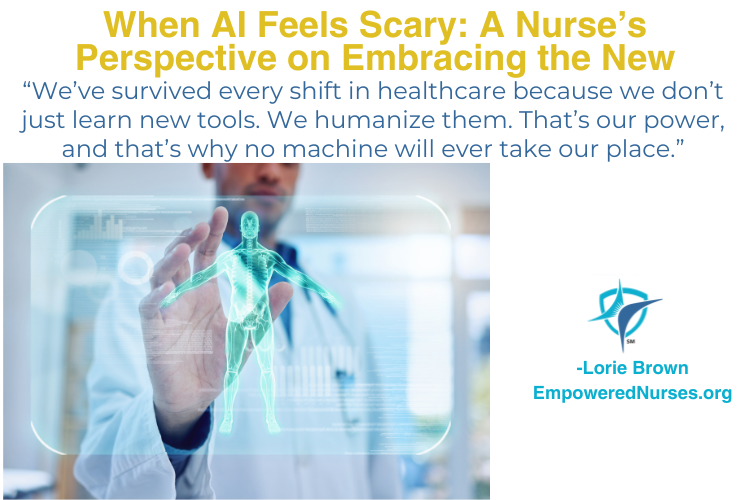
Let’s be honest — AI is intimidating. The headlines make it sound like robots are rolling into the hospital tomorrow, ready to push meds, chart assessments, and even give report. For many nurses, it feels like one more threat to our profession, our livelihoods, and even our sense of purpose.
But here’s the truth: this isn’t the first time something new has scared us.
Think back.
· When electronic medical records (EMRs) showed up, we all groaned. Paper charts were simple, quick, and familiar. Suddenly, we were staring at endless clicks, passwords, and “nursing note templates.” Many of us thought, This will never work. Now? We can’t imagine trying to manage a 30-patient load without an EMR flagging drug interactions or trending lab results.
· Remember when smart pumps were introduced? At first, we didn’t trust them. Nurses double- and triple-checked every calculation, worried that a machine would override our critical thinking. Now, they’re standard — catching errors that save lives every day.
· And let’s not forget telehealth. Once upon a time, the idea of caring for patients through a screen felt cold and impersonal. Today, it’s expanded access, brought specialists into rural communities, and kept vulnerable patients safe during a pandemic.
Each time, fear whispered: This will replace us. Each time, experience proved: This will support us.
AI is just the next chapter in that story.
What’s Different — and What Isn’t
AI can scan, summarize, and highlight patterns faster than we can. That’s true. But what AI cannot do is bring the depth of lived experience, empathy, and judgment that nurses carry. AI doesn’t know what it feels like to hold a patient’s hand before surgery. It doesn’t notice the way someone’s color changes when their O2 dips. It doesn’t connect the dots between “something feels off” and a subtle but life-threatening decline.
We’ve always been the bridge between technology and humanity. That’s not going to change.
Moving Forward with Courage
Instead of resisting, what if we leaned in? What if we learned how AI works — and then made it work for us? Just like EMRs, smart pumps, and telehealth, this new tool can become a partner, not a replacement.
Nursing has always been about adaptation. Our profession is built on it. The stethoscope, the ventilator, the IV pump — all once “scary new things.” And every time, nurses rose up, embraced the change, and kept our focus where it belongs: on the patient.
Final Thought
AI may feel scary today. But so did every other innovation we now take for granted. The heart of nursing hasn’t changed — and it never will.
We’ve survived every shift in healthcare because we don’t just learn new tools. We humanize them. That’s our power, and that’s why no machine will ever take our place.


Comments are closed