


“If It Wasn’t Documented, It Wasn’t Done”: The Nurse’s Reality Check
We’ve all heard it a thousand times. That phrase has been tattooed on the heart (and charting hand) of every nurse since Florence Nightingale picked up her first pen: “If it wasn’t documented, it wasn’t done.”
It’s part warning, part wisdom—and let’s be honest—part trauma response. Because we’ve all had that moment where you know you did something—gave the med, changed the dressing, repositioned the patient—but the next day someone says, “It’s not charted.” And your stomach drops faster than a patient’s O₂ sat during suctioning.
🩹 Why Documentation Matters (More Than Ever)
Documentation isn’t just paperwork—it’s protection. It’s the only witness that never forgets. Your chart is your defense, your memory, your voice when you’re not in the room. In a world where healthcare is scrutinized by lawyers, boards, and insurance companies, that little click in the EMR could mean the difference between you being seen as a hero or a hazard.
You might roll your eyes when you hear, “Chart like your license depends on it.” But here’s the truth: sometimes, it actually does.
⚖️ The Legal Side: Protecting Your Practice
If you ever find yourself before a Board of Nursing—or heaven forbid, in court—what matters isn’t what you remember, but what’s recorded. Even the best nurses can get questioned when the chart is silent. A missing note can make excellent care look like neglect. And when the record’s incomplete, the assumption isn’t “She probably did it.” It’s “She didn’t.”
I’ve represented too many nurses who said, “I swear I did it!”—and I believe them. But the Board believes the documentation.
💻 Charting is a Form of Advocacy
Think of documentation not as busywork, but as storytelling. You’re telling the story of your patient’s journey—and your part in keeping them safe. That shift you just powered through? You assessed, comforted, intervened, saved. Your chart is how that story gets remembered. Without it, your care disappears into the ether like it never happened.
When you document, you’re advocating not only for your patient—but for yourself.
🧠 A Few Tips for “Real World” Charting
· Chart in real time when possible. Your brain after a 12-hour shift is like a crashed computer trying to reboot on decaf.
· Stick to the facts—no drama, no assumptions. The chart is no place for your inner novelist.
· Be specific. “Dressing changed” tells us nothing. “Dressing changed to right hip incision, site clean, no drainage, patient tolerated well” speaks volumes.
· Don’t forget the follow-up. Interventions mean nothing without outcomes.
❤️ The Bottom Line
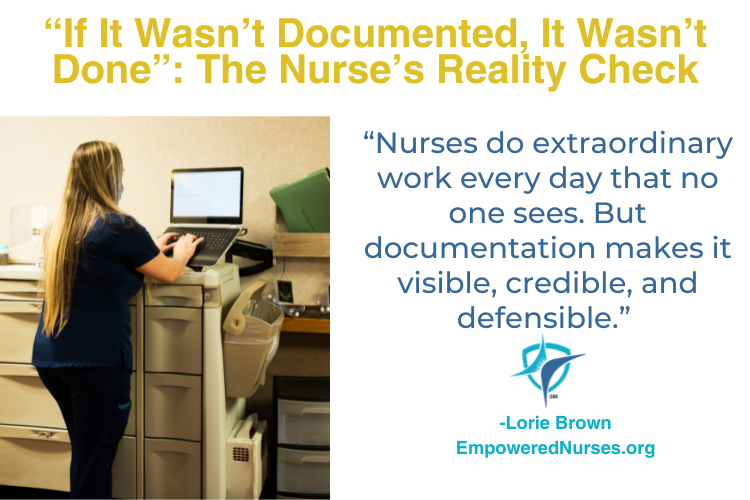
Nurses do extraordinary work every day that no one sees. But documentation makes it visible, credible, and defensible. It’s not about mistrust—it’s about memory, accountability, and respect for the profession we love.
So next time you sigh and mutter that age-old phrase, “If it wasn’t documented, it wasn’t done,” remember—it’s not punishment. It’s protection. For your patients. And for you.
Because you did do it—and the world deserves to know.


Comments are closed