


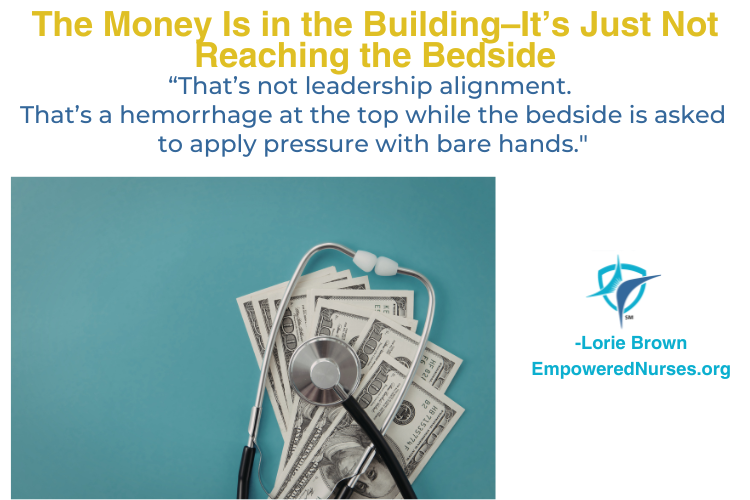
The Money Is in the Building—It’s Just Not Reaching the Bedside
If you’ve ever worked a shift so short-staffed that you skipped water, skipped the bathroom, skipped your own humanity—while being told, “There’s just no money right now”—this one’s for you.
Because here’s the uncomfortable diagnosis healthcare doesn’t want to chart:
The problem isn’t a lack of money. It’s a failure of distribution.
This isn’t a revenue issue.
It’s an ethical one.
“There’s No Budget” Is the New “It’s Probably Just Anxiety”
Nurses have been gaslit for years.
We’re told there’s no funding for safe staffing.
No money for meaningful raises.
No flexibility for benefits.
No room in the budget for retention.
Yet when you pull the financial labs, the numbers tell a very different story.
Some of the largest healthcare systems in the country are posting record-breaking revenues—the kind of numbers most bedside clinicians can’t even conceptualize because we’re too busy calculating whether we can afford groceries and gas in the same week.
Healthcare isn’t broke.
It’s just allocating resources like a patient circling the drain while admin argues over the color of the drapes.
Follow the Money—It’s Loud
While bedside staff are told to “do more with less,” major systems are reporting billions in operating revenue:
- Kaiser Permanente reported over $115 billion in revenue
- HCA Healthcare surpassed $75 billion
- AdventHealth brought in nearly $20 billion
- NewYork-Presbyterian Hospital reported more than $10 billion
That’s not survival money.
That’s thriving money.
Yet somehow, the bedside is still running on skeleton crews and pizza parties.
Executive Pay: A Different Planet, Same Building
Let’s talk compensation—because this is where the numbers start to feel like satire.
Healthcare executives are pulling in eight-figure compensation packages while the people keeping patients alive are told to be grateful they still have jobs.
When a CEO makes $20+ million a year, that’s:
- Over $1.6 million a month
- Roughly $10,000 an hour
- More in a single day than many nurses earn in an entire year
That’s not leadership alignment.
That’s a hemorrhage at the top while the bedside is asked to apply pressure with bare hands.
And when you look at CEO-to-worker pay ratios—400:1 in some systems—it’s clear this isn’t about sustainability.
It’s about priority.
Branding Over Bodies
If there’s “no money” for staffing, explain this like we’re in a deposition.
Why are nonprofit health systems paying millions to slap their names on stadiums while units are in crisis?
Naming rights.
Luxury boxes.
Private charters.
Executive perks.
Meanwhile, nurses are doubling assignments, CNAs are stretched past safe limits, and support staff are leaving because they can’t afford to stay.
Patient safety doesn’t come from logos.
It comes from people.
The People Doing the Actual Work
Let’s refocus the camera where it belongs.
The people catching subtle changes before they become codes.
The ones running toward alarms, not away from them.
The ones cleaning rooms, delivering meals, managing airways, titrating drips, and holding hands when families can’t.
Median U.S. salaries tell the real story:
- Environmental services, dietary, CNAs—barely scraping livable wages
- LPNs, RNs, RTs—asked to shoulder impossible responsibility
- Advanced practice clinicians—still nowhere near executive compensation, despite enormous liability
These aren’t replaceable roles.
They are the infrastructure of healthcare.
Those billions in revenue?
They exist because of bedside care.
When Workers Say “Enough”
Strikes don’t happen because healthcare workers are greedy.
They happen because the system stopped listening.
Standing on a picket line means choosing patient safety over a paycheck—knowing full well the rent is still due.
That’s not abandonment.
That’s advocacy.
Healthcare workers don’t strike because they don’t care.
They strike because they care too much to keep pretending this is sustainable.
Final Assessment
The money is in the system.
The staffing crisis is a choice.
And “there’s no budget” is no longer a credible explanation.
It’s time nurses and healthcare workers stop internalizing a lie that was never ours to carry.
You are not expendable.
You are not the problem.
And you are not wrong for demanding better.
Healthcare runs on your labor.
It’s time the resources reflected that reality.


Comments are closed