


Medical Errors: Why This Healthcare Crisis Deserves Far More Attention
When most people think about the leading causes of death in the United States, they think of heart disease, cancer, and accidents.
What they usually do not think about is medical error.
That is part of the problem.
A widely cited 2016 BMJ analysis estimated that medical error may account for more than 250,000 deaths annually in the United States, which would place it behind only heart disease and cancer. That estimate helped spark national attention to patient safety. At the same time, experts have since debated whether the “third leading cause of death” phrasing is the best way to describe the problem, because medical errors are difficult to define and are not consistently captured on death certificates. Even with that debate, the larger truth remains: preventable harm in healthcare is a major public health crisis.
Healthcare is supposed to heal. But too often, patients are harmed not because of the illness that brought them in, but because something in the system broke down. A medication was ordered incorrectly. A critical lab value was missed. A diagnosis was delayed. A handoff was incomplete. A warning sign was documented, but not acted on. The patient pays the price for a chain of failures that should never have lined up in the first place. AHRQ notes that medical errors can occur across the healthcare system, including hospitals, clinics, surgery centers, physician offices, nursing homes, and pharmacies.
That is why this issue hits so hard for nurses.
Nurses are at the bedside. We are often the first to see the subtle change, the near miss, the medication discrepancy, the family concern that does not quite fit the chart, or the patient who “just doesn’t look right.” We know patient safety is not an abstract policy topic. It is the pulse ox alarming at 3 a.m., the unread note, the missed follow-up, the staffing shortage, the rushed handoff, the quiet dread that comes when too many tasks are stacked on too few shoulders.
In other words, medical errors are rarely just “bad individual choices.” More often, they are symptoms of a sick system.
And just like in clinical practice, if you treat only the symptom and ignore the underlying condition, the patient gets worse.
The Real Problem Is Bigger Than Blame
One of the most damaging responses to medical error is the rush to find a single person to blame.
Yes, individuals must be accountable. But if we stop there, we miss the diagnosis.
Patient safety experts have long emphasized that harm usually results from multiple breakdowns rather than one reckless act. Poor communication, fragmented documentation, understaffing, fatigue, confusing technology, production pressure, inadequate training, and flawed protocols all contribute to preventable harm. AHRQ and PSNet both frame patient safety as a systems issue, not merely an individual issue.
Think of it like sepsis. The fever may be what everyone sees first, but the fever is not the whole disease. If you only chase the temperature and ignore the infection, you have not solved the problem.
Medical errors work the same way. The error you can see is often just the final manifestation of deeper operational failures.
Why the Numbers Are So Hard to Measure
One reason this crisis remains underappreciated is because our reporting systems do a poor job of capturing it.
The CDC’s official leading-cause-of-death tables are based on death certificate coding, and medical error is not listed as its own category. That means many deaths involving preventable harm are folded into categories such as heart disease, cancer, or respiratory failure, even when a serious error contributed to the outcome. This coding structure obscures the true toll of medical error.
That does not mean every estimate is precise. It means the opposite: the true number is hard to know because the system was not built to measure it well. Later commentary from patient safety experts has argued that some estimates may be too high, while still acknowledging that preventable in-hospital deaths remain alarmingly common.
So whether someone agrees with the exact ranking or not, this is not a rounding error. It is not a footnote. It is a flashing red warning light on the dashboard.
What This Means for Nurses
For nurses, this conversation is personal.
Because when systems fail, nurses often carry the emotional aftermath.
We are the ones explaining delays to families. We are the ones catching the discrepancy before it reaches the patient — or living with the pain when it does. We are the ones expected to hold the line for safety while working inside environments that can make safe practice harder than it should be.
That is why the conversation about medical errors cannot stop at awareness. It has to move into advocacy.
Nurses must feel empowered to speak up about unsafe staffing, broken workflows, poor communication, inadequate orientation, and retaliation against those who report concerns. A culture of fear does not create safer care. It creates quieter units and sicker outcomes.
Silence is not safety. It is just delayed charting on a disaster.
Patients Need Transparency, Not Spin
Patients deserve honest conversations about risk.
They deserve healthcare organizations that do more than hang posters about safety week and call it progress. They deserve systems that learn from near misses, encourage reporting, analyze root causes honestly, and invest in prevention before harm occurs.
Safety is not built through slogans. It is built through staffing, training, communication, humility, and accountability.
And perhaps most importantly, safety is built when healthcare leaders stop treating frontline warnings like background noise.
Because the bedside usually knows before the boardroom does.
Where Do We Go From Here?
We need a healthcare culture that treats patient safety the way clinicians treat a deteriorating patient: urgently, systematically, and without denial.
That means:
· improving reporting systems for preventable harm
· strengthening handoff communication
· addressing fatigue and staffing shortages
· designing smarter, safer workflows
· reducing punitive responses that discourage reporting
· listening to nurses and other frontline clinicians before harm escalates
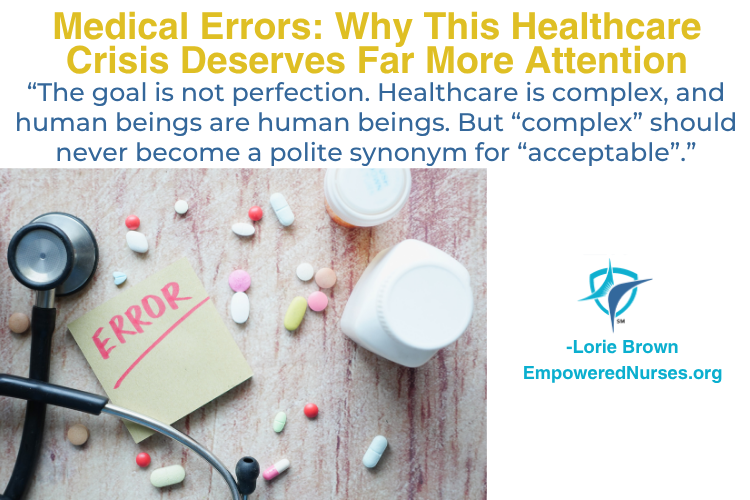
The goal is not perfection. Healthcare is complex, and human beings are human beings.
But “complex” should never become a polite synonym for “acceptable.”
Preventable harm should provoke the same response as any other emergency: assess quickly, intervene early, and fix the underlying cause before more lives are lost.
Final Thought
Whether medical error is labeled the third leading cause of death or described more cautiously as one of the most significant sources of preventable harm in U.S. healthcare, the conclusion is the same: this is a crisis we cannot afford to normalize.
Behind every statistic is a patient who trusted the system.
Behind every preventable death is a family whose life changed forever.
And behind many of those tragedies is a nurse who saw the cracks, spoke up, and still had to watch the system move too slowly.
That should break our hearts.
And it should also move us to action.


Comments are closed