


The Dumbest Things Nurses Say to Patients (And How One Stupid Comment Can Put Your Nursing License at Risk!)
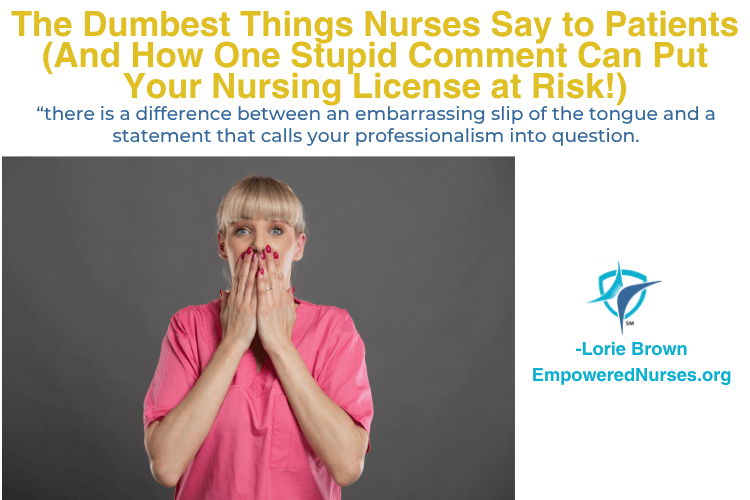
We have all had those moments when our mouths move faster than our brains. Unfortunately, in nursing, one off-the-cuff remark can turn into a patient complaint, a trip to Human Resources, or even an investigation by the Board of Nursing.
I recently came across a hilarious BuzzFeed article about awkward things nurses have said to patients, and I have to admit, some of these stories had me laughing out loud. Others made me cringe because, as a nurse attorney, I know how easily an innocent comment can be taken the wrong way.
One nurse told a family looking for their loved one that he was no longer with them. Imagine the family’s horror! Fortunately, the nurse quickly clarified that the patient had simply been transferred to another floor.
Another nurse told a patient who had been hit by a truck that he probably felt like he had been hit by a truck. Apparently, the patient’s wife did not appreciate the humor, and the nurse reported being fired.
And then there was the nurse who jokingly exclaimed that she was having a stroke, right in front of a patient who had actually suffered a stroke!
You cannot make this stuff up!
Nurses have an incredible sense of humor. Sometimes, humor is how we survive the stress, the heartbreak, the bodily fluids, and the twelve-hour shifts that somehow turn into fourteen. But there is a big difference between laughing with a patient and saying something that could cost you your career.
Take the classic nursing station comment: “If that patient pushes her call light one more time, I am going to kill her!”
Now, we know that the nurse probably has no intention of harming anyone. She is exhausted, frustrated, and has answered that call light seventeen times in the past hour. Maybe she has not eaten lunch, her bladder is about to explode, and three other patients need her attention.
But imagine that a family member overhears the comment.
Or another nurse reports it to management.
Or, worse yet, someone records it on their phone.
Suddenly, what was intended as an expression of frustration could be interpreted as a threat against a vulnerable patient. Depending on the circumstances, the nurse could face an employer investigation, termination, or a complaint to the Board of Nursing.
And believe me, explaining to the Board that you were only joking is not always a successful defense.
Then there are the comments that make patients feel like they are a burden.
“You’re not my only patient, you know!”
“I was just in here!”
“You’re going to have to wait. I have patients who are actually sick.”
Have you ever thought any of these things? Of course! We are human. But saying them aloud is another matter entirely.
Patients do not see the five admissions waiting in the emergency department, the physician who has not returned your page, or the mountain of documentation you still need to complete. They only know that they are frightened, uncomfortable, or in pain, and the person they are depending on just made them feel insignificant.
A patient who feels dismissed may be less likely to ask for help the next time. What happens if that patient decides not to push the call light when they need assistance getting to the bathroom and subsequently falls?
Now that careless remark may become part of a much bigger discussion about patient safety.
Another favorite is the nurse who says, “Don’t worry, I’ve done this a million times,” right before missing the IV three times.
Or the nurse who announces, “This won’t hurt a bit!” just before administering an injection that feels like someone is driving a nail into the patient’s arm.
While these comments may be intended to reassure patients, they can undermine trust. It is much better to be truthful. Tell the patient what to expect, acknowledge discomfort, and explain what you are doing.
And please, be careful about what you say regarding other healthcare professionals.
“I don’t know why that doctor ordered this.”
“The night shift never does anything.”
“Whoever started this IV didn’t know what they were doing.”
Those comments may feel harmless, especially when you are frustrated, but they can erode the patient’s confidence in the entire healthcare team. They may also trigger complaints and raise questions about professionalism.
As a nurse attorney, I have seen how statements made in frustration can come back to haunt nurses. Sometimes the issue is not the care that was provided but how the nurse communicated with the patient, family, or coworkers.
Remember, a Board of Nursing does not necessarily need a patient to suffer physical harm before investigating allegations of unprofessional conduct. Depending on the state’s Nurse Practice Act and the circumstances, threatening, abusive, discriminatory, or inappropriate language may raise concerns about a nurse’s fitness to practice.
And here is something else to remember: Patients and families do not always understand our nursing humor.
We may joke about needing a vacation before we end up in the psych unit ourselves. We may say that a shift is killing us or that a patient is driving us crazy. Among trusted colleagues, those expressions may be understood as exaggerations.
But when patients or families hear them, the meaning can change dramatically.
A comment that takes three seconds to make could require months of explanations, meetings, legal fees, and sleepless nights.
Does this mean nurses should never joke with patients? Absolutely not!
Humor can be therapeutic. It can reduce anxiety, establish rapport, and bring some much-needed humanity into an otherwise frightening experience. I think laughter is one of the greatest gifts nurses bring to the bedside.
But good nursing humor should make patients feel better, not smaller, frightened, embarrassed, or threatened.
And if something inappropriate slips out, address it immediately. A sincere apology and clarification can go a long way. If the comment involves a threat or a serious patient-safety concern, follow the appropriate reporting procedures rather than assuming an apology resolves everything.
My advice is simple: Before you say something, ask yourself whether you would be comfortable hearing your words played back during a Board of Nursing hearing.
If the answer is no, perhaps that thought is better left unsaid!
The bottom line is that your nursing license is far too valuable to risk over a moment of frustration or a joke that falls flat.
We all make mistakes. We all say things we wish we could take back. And sometimes the funniest nursing stories are the ones that make us want to crawl under the medication cart and hide.
But there is a difference between an embarrassing slip of the tongue and a statement that calls your professionalism into question.
So keep your sense of humor, keep your compassion, and remember that your words are part of the care you provide.
After all, you worked too hard for those letters after your name to lose them over something you said before your second cup of coffee!
Now I would love to hear from you. What is the funniest, most embarrassing, or most inappropriate thing you have ever accidentally said to a patient?
Just remember to leave out identifying patient information. We do not want your funny story to turn into a HIPAA problem, too!


Comments are closed