


A Victory for Nursing: Federal Judge Temporarily Blocks Rule That Excluded Nursing as a Professional Degree
For the past several months, nurses across the country have been asking the same question:
“How can nursing not be considered a profession?”
That question sparked outrage after the U.S. Department of Education issued a rule that would have excluded graduate nursing degrees from the definition of a “professional degree” for federal student loan purposes. The consequences were significant. Graduate nursing students pursuing an MSN, DNP, or Ph.D. could have faced substantially lower federal borrowing limits than students in medicine, dentistry, law, and other professions.
Fortunately, there is encouraging news.
Just days before the rule was scheduled to take effect on July 1, a federal judge issued an order blocking the Department of Education from enforcing that portion of the rule while the lawsuit proceeds.
Although this is not the final decision in the case, it is an important victory for nursing.
The court found that the Department of Education likely exceeded the authority Congress gave it when it attempted to redefine which programs qualify as “professional degrees.” Congress had incorporated an existing regulatory definition into the law, and the judge concluded that the Department could not simply rewrite that definition to exclude nursing and other healthcare professions.
Why does this matter?
Because access to affordable education directly affects the future nursing workforce.
Graduate nursing education is expensive. Whether a nurse is pursuing a Nurse Practitioner degree, becoming a Certified Registered Nurse Anesthetist, earning a doctorate to teach the next generation of nurses, or preparing for executive leadership, many rely on federal student loans to make that education possible.
Under the challenged rule, many graduate nursing students would have been subject to much lower federal loan limits than students enrolled in programs still classified as “professional degrees.” That financial barrier could have forced some nurses to delay graduate education, take on costly private loans, or abandon their educational goals altogether.
At a time when healthcare organizations continue to struggle with workforce shortages, limiting opportunities for advanced nursing education seemed counterproductive.
The lawsuit challenging the rule was brought by a coalition of nursing and healthcare organizations, including the American Association of Colleges of Nursing and the American Association of Nurse Practitioners. Their argument was straightforward: nursing is unquestionably a profession requiring advanced education, licensure, certification, and specialized clinical expertise.
The federal court agreed that they are likely to succeed on the merits, at least enough to justify temporarily stopping the rule from taking effect while the litigation continues.
It is important to understand what this ruling does—and does not—do.
The court has not issued a final decision. The temporary order simply preserves the current status while the case proceeds through the judicial system. The Department of Education may appeal, and additional litigation is expected before there is a permanent resolution.
Still, this decision sends an important message.
Nursing is not simply another graduate program. Advanced practice nurses diagnose illnesses, prescribe medications, manage chronic diseases, provide primary care, deliver anesthesia, educate future nurses, conduct research, and serve as healthcare leaders in virtually every community across the country.
Our healthcare system depends on highly educated nurses.
Policies that make graduate nursing education less accessible ultimately affect patients as much as they affect nurses.
As nurses, we often advocate for our patients. Sometimes we also need to advocate for our profession.
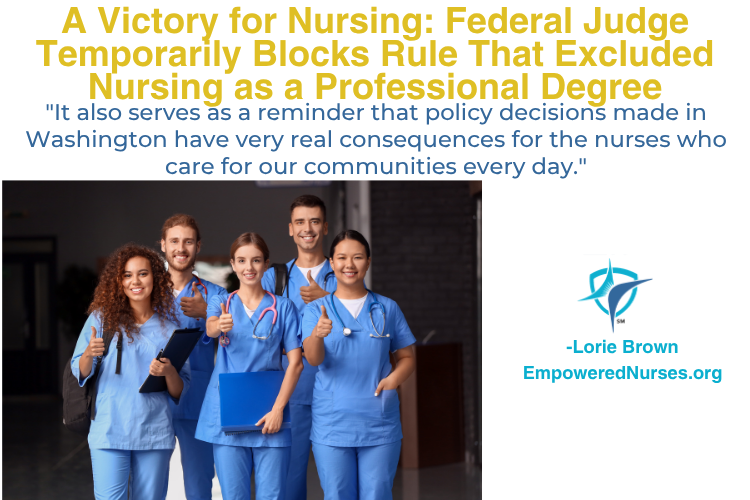
This temporary ruling gives nursing organizations, educational institutions, and students reason to be hopeful while the legal process continues. It also serves as a reminder that policy decisions made in Washington have very real consequences for the nurses who care for our communities every day.
We’ll continue watching this case closely because its outcome could shape graduate nursing education—and the future nursing workforce—for years to come.


Comments are closed