


ANA Is Expanding Its Membership. But Is It Expanding Its Mission?
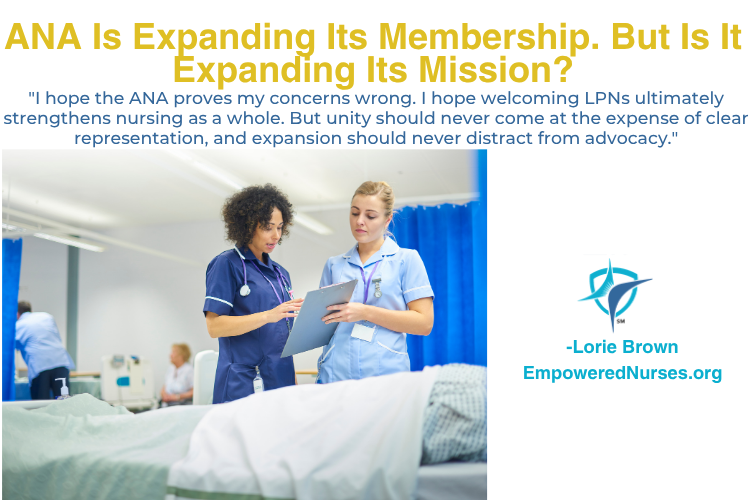
The American Nurses Association (ANA) recently made a historic decision to open its national membership to licensed practical nurses (LPNs) and licensed vocational nurses (LVNs). For the first time in its 130-year history, LPNs will be eligible to join the nation’s largest nursing organization. According to the ANA, the goal is to create a more unified nursing profession and strengthen the collective voice of nurses. (ANA)
Let me begin by saying this: I have tremendous respect for LPNs.
LPNs are nurses. They provide compassionate, skilled care every day in long-term care facilities, clinics, physician offices, home health, rehabilitation centers, and many other settings. They are an essential part of the healthcare team and deserve professional organizations that advocate fiercely for their interests.
My concern is not with LPNs.
My concern is with the ANA.
For decades, the ANA has marketed itself as the professional organization representing registered nurses. Registered nurses complete a different educational pathway, hold a broader scope of practice, and carry different legal responsibilities. Those distinctions have always been reflected in the profession’s organizations, educational standards, and licensure requirements.
Expanding membership changes the identity of the organization. It raises an important question: Who is the ANA primarily representing?
More importantly, is the ANA effectively representing registered nurses now?
That is where I believe the conversation should begin.
Many bedside nurses have questioned whether the ANA has been the strong advocate they expected it to be. One example that continues to generate discussion occurred during the Massachusetts ballot initiative on mandatory nurse-to-patient staffing ratios. Rather than supporting the proposed law, the ANA publicly urged voters to reject it, arguing that fixed ratios were not the best solution for safe staffing.
Reasonable people can disagree about whether mandated ratios are the best policy. However, many frontline nurses viewed the ANA’s position as failing to stand behind nurses seeking safer working conditions. For nurses who routinely care for too many patients with too few resources, that decision damaged trust.
Since then, the profession has continued to face enormous challenges. Workplace violence remains common. Burnout continues to drive experienced nurses away from the bedside. Documentation requirements have increased. Moral distress has become part of everyday practice. Many nurses feel their voices are still not being heard.
Against that backdrop, expanding membership feels premature.
Before broadening its reach, I believe the ANA should strengthen its commitment to the nurses it already represents.
Growing membership is not the same as growing influence.
Adding hundreds of thousands of potential members may increase dues revenue and expand the organization’s footprint, but size alone does not create credibility. Credibility comes from consistently advocating for nurses—even when doing so is politically difficult.
Imagine if the ANA became known as the organization that never compromised on safe staffing.
Imagine if it aggressively fought workplace violence, administrative overload, unsafe assignments, mandatory overtime, and protections for nurses who advocate for patients.
Imagine if bedside nurses once again believed the ANA was unequivocally in their corner.
That is the kind of leadership our profession desperately needs.
I hope the ANA proves my concerns wrong. I hope welcoming LPNs ultimately strengthens nursing as a whole. But unity should never come at the expense of clear representation, and expansion should never distract from advocacy.
LPNs deserve a powerful voice.
Registered nurses deserve one too.
The question isn’t whether the ANA should represent more nurses.
The question is whether it is fully representing the nurses who have been counting on it all along.


Comments are closed