


She Went to Heal — Not to Die: The Story of Nurse Joyce Grayson
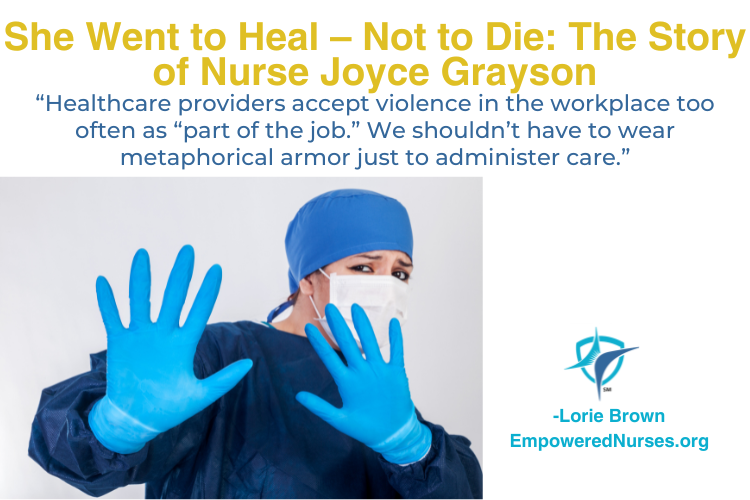
It was just another October day in 2023, but for Licensed Practical Nurse Joyce Grayson, it was the beginning of a final chapter that would ripple across the nation of caregivers. Joyce walked into a home clinical setting — a halfway house in Willimantic, Connecticut — carrying her nursing bag, her years of experience (36 of them), and that nurse’s instinct to help. What she didn’t carry were the tools she needed to protect herself from what she already knew could be a dangerous situation.
A Hazard We Knew Was There — But Didn’t Fully Protect Against
Home health nursing is like being a solo paramedic clinician walking into a dynamic scene: the environment is uncontrolled, the patient’s history may be incomplete, and the safety net is thin. Joyce’s employer, one of the country’s largest home health care agencies, knew — or should have known — that the client visited that day was a convicted violent offender with a history of aggression. Yet Joyce went in without systems in place to protect her: no comprehensive background info, no panic alert device, no safety escort — nothing to buffer the unpredictable tension inherent in that setting.
OSHA’s investigation later concluded that the employer failed its legal duty to protect its workers from a recognized hazard: workplace violence in a home care environment. They cited the agency for not having adequate measures to reduce that risk — a general duty violation that cost a nurse her life.
The Cost of Caring
Nurses are trained to triage, to assess, to plan — but no amount of clinical skill can substitute for a broken system that doesn’t prioritize caregiver safety. When Joyce stepped into that home, she was simply doing her job. But the job, in this case, included hazards no nurse should face without protection.
Workplace violence in healthcare isn’t rare — OSHA reported hundreds of worker deaths from violence in 2022 alone — yet too often, the shield meant to protect clinicians is missing.
A Family, A Community, a Profession Changed
Joyce was more than a statistic. She was a 63-year-old nurse, a mother, a veteran of healthcare, and a heart full of care that outlived her body. Her death sparked outrage, grief, and a fierce conversation about how we protect those who protect life. Within legislatures and nursing organizations, the call for workplace violence prevention standards is growing louder — fueled by hearts broken but not silent. In Connecticut, lawmakers moved forward with new safety requirements for home care workers — tools clinics should have offered her long before she walked into harm’s way.
What Nurses Deserve — Always
Joyce’s story is tragic — this should have never happened. But it’s also a stark reminder:
· Every nurse deserves a workplace that recognizes and mitigates risks.
· Every home visit must come with intelligence, tools, protocols, and backup.
· Every agency must do more than train — they must protect.
Healthcare providers accept violence in the workplace too often as “part of the job.” We shouldn’t have to wear metaphorical armor just to administer care.
A Call to Action
We owe it to Joyce, and to every clinician who shows up wearing scrubs and compassion, to demand safety systems that work before tragedy strikes. The best protocol in the world can’t bring her back — but it can save the next nurse.
That’s how we honor her — not with statistics, but with real safety change.
