


“Stay in Your Lane”: How Good Nurses Cross the Line Without Even Knowing It
Most nurses who cross a scope-of-practice line don’t do it out of arrogance, recklessness, or a
desire to overstep.
They do it because they’re trying to help.
They do it because a patient needs something now, the unit is short, and someone says, “Can you
just…?” And in that moment, it doesn’t feel like crossing a line. It feels like being a nurse and
wanting to help.
That’s what makes scope-of-practice issues so dangerous — the nurses who get into trouble
rarely think they’re doing anything wrong.
They think they’re doing what they’ve always done. What the unit expects. What keeps the day
from unraveling.
And most of the time, nothing bad happens. Until it does.
Scope of practice isn’t something nurses wake up thinking about at the start of a shift. It doesn’t
announce itself with a red flag or a stop sign. It rarely says, Warning: License risk
ahead. Instead, it sneaks in quietly — wrapped in teamwork, urgency, and good intentions.
A nurse helps because a coworker is overwhelmed. A nurse fills a gap because the system has
trained them to be the safety net. Over time, those small accommodations become normalized.
The line doesn’t feel like a line anymore. It feels like the job.
But here’s the hard truth: intent does not redefine scope.
Scope of practice isn’t determined by how competent a nurse feels or how many times they’ve
done something without incident. It’s defined by law. And the law doesn’t adjust based on
staffing shortages, patient acuity, or good deeds.
Nurses often assume that if an action is part of unit culture, it must be allowed. Or that if a
supervisor approves it, they’re protected. Or that if a facility policy permits it, it must be within
scope.
That’s where the disconnect lives.
Most nurses who face Board investigations are shocked. They replay the moment over and over,
thinking, I was helping. I wasn’t being careless. I didn’t know this was a problem. And they mean
it — because no one ever stopped them before.
Healthcare systems quietly benefit from this gray area. Nurses are expected to stretch, adapt, and
compensate without being fully informed of the legal boundaries they’re crossing. The lane
widens when it’s convenient and narrows when accountability arrives.
And when that accountability arrives, it doesn’t land on the system.
It lands on the nurse.
This is where “stay in your lane” becomes deeply unfair. You can’t stay in a lane that isn’t clearly
marked, especially when you’ve been praised for drifting outside it in the name of helping.
Saying “that’s outside my scope” requires more than knowledge — it requires courage. It means
slowing down care in a profession that values speed. It means risking eye rolls, frustration, or
being labeled “not helpful.” And for nurses who define themselves by service, that’s not easy.
But boundaries are not the opposite of caring. They are part of caring.
In medicine, we understand that skill without safeguards is dangerous. That’s why we have
protocols, dosing limits, and checklists — not because clinicians aren’t capable, but because
systems fail and fatigue happens. Scope of practice is one of those safeguards.
Instead of asking, Can I do this? nurses need to start asking, Would I be stunned if this were
questioned later? If the answer is yes, pause. Ask for clarification. Document concerns. Protect
yourself before something goes wrong.
Because the nurses who cross scope lines aren’t trying to break rules.
They’re trying to keep patients safe or they just want to help.
And ironically, it’s that instinct — unchecked and unsupported — that puts their own careers at
risk.
Staying in your lane isn’t about withholding care. It’s about practicing nursing in a way that
honors both the patient in front of you and the license you carry.
You shouldn’t have to sacrifice one to keep the other.
Your license is not a group project.
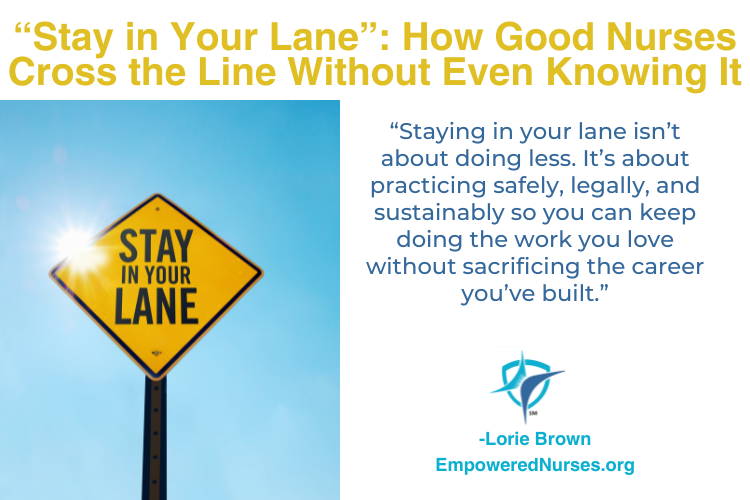
Staying in your lane isn’t about doing less. It’s about practicing safely, legally, and sustainably so
you can keep doing the work you love without sacrificing the career you’ve built.
And in today’s healthcare climate, that’s not weakness.
It’s wisdom.
