


The Most Important Document: Your Performance Review
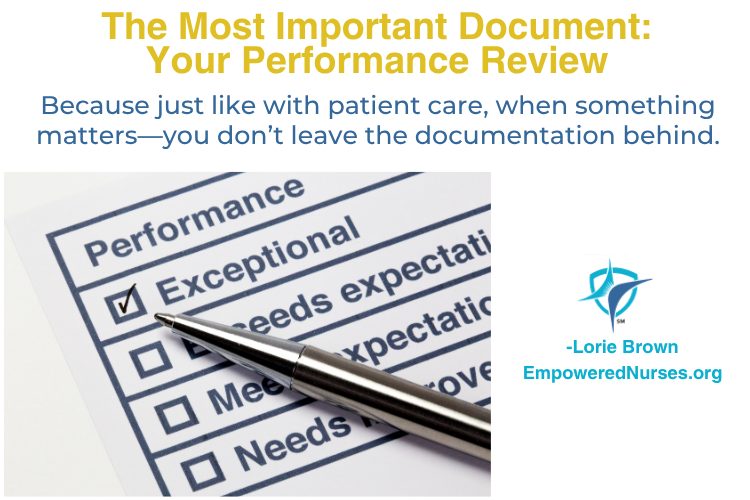
A performance review is one of the few documents your employer creates that formally evaluates your competence, behavior, and overall practice as a nurse. And yet, most nurses sign it, maybe skim it, and never think about it again.
That’s a mistake.
You should always keep a copy of your performance review—because it can protect you, support you, and, in some situations, save you.
First, it’s objective evidence of your practice. In nursing, we live and die by documentation. If it’s not charted, it didn’t happen. The same principle applies to your career. A performance review is written proof that, at a specific point in time, your employer evaluated you as competent, safe, or even exemplary. If your job is ever questioned later—whether internally, legally, or before a board—that document becomes part of your defense. It shows who you were before any issue arose.
Second, it protects you from shifting narratives. Healthcare environments change fast. Leadership turns over. Policies evolve. What was acceptable practice one year may be scrutinized the next. And sometimes, when there’s a problem, organizations look backward and start building a story. If you don’t have your own records, you’re relying on theirs. Keeping your performance reviews ensures you have your version of the documented truth.
Third, it gives you leverage. When you’re applying for a new role, negotiating compensation, or stepping into something outside of traditional nursing, you need more than confidence—you need proof. Performance reviews highlight your strengths, consistency, and contributions in a way that resumes and interviews simply can’t. They’re third-party validation, and that carries weight.
Finally, it keeps you grounded in reality. Nursing has a way of making even very good nurses question themselves. A tough manager, a bad shift, or one mistake can distort how you see your own competence. Your performance review cuts through that noise. It’s a written record of how you’ve actually been performing—not how you feel on your hardest day.
The bottom line is simple: keep your performance reviews somewhere you control. Download them. Print them. Email them to yourself. Don’t assume you’ll always have access to your employer’s system.
Because just like with patient care, when something matters—you don’t leave the documentation behind.
