


The Most Powerful Word in Nursing Isn’t “Yes.” It’s “No.”
There’s a moment every nurse knows far too well.
You’ve just clocked out. Your scrubs feel glued to your skin. Your feet are screaming louder than a trauma bay. You’re dreaming of your pillow the way most people dream of winning the lottery.
And then it comes… That familiar voice from staffing… “Hey, can you stay an extra four? We’re short.”
Suddenly, your heart rate spikes. Not because you want to stay. But because saying no feels like you’re letting your patients’ down or your coworkers.
Nurses—let’s talk about it.
No is not a failure.
Somewhere along the way, we were conditioned—trained, even—to believe that “yes” equals dedication, and “no” equals letting the team down.
But here’s the truth we don’t say loud enough:
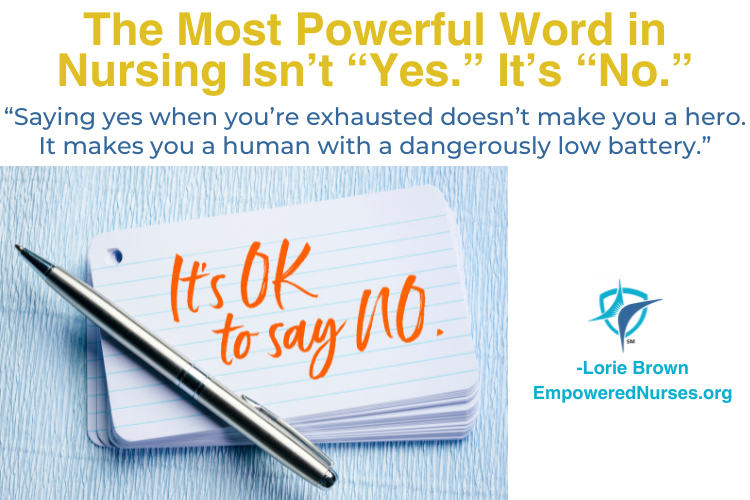
Saying yes when you’re exhausted doesn’t make you a hero. It makes you a human with a dangerously low battery.
And just like with any patient, when a system is running on fumes, mistakes happen, burnout escalates, and compassion fatigue snowballs into resentment.
Your “no” doesn’t harm anyone. Your no protects something precious: you.
Nurses have been conditioned to people-please—and it’s costing them.
We’re wired to fix, soothe, save, patch, and rescue. We want to be reliable. We want to be helpful. We want to be the one who keeps everything running.
But hospitals have taken advantage of that trait for decades.
They rely on your guilt. Your desire to “be a team player.” Your fear of looking lazy, uncommitted, or not strong enough.
Let me say this clearly and lovingly:
🩺 You are not a backup generator for a broken staffing system. 🩺 You are not an emotional support human for your manager’s scheduling mistakes. 🩺 You are not obligated to sacrifice your wellbeing to save a shift that was already sinking.
No is a complete sentence. And a life-saving intervention.
You don’t need to say:
“I’m sorry, but…” “I would, except…” “I feel bad, however…” “I wish I could, but…”
Nope. Full stop. End of story.
Just: “No, I can’t stay.” “No, I’m not available.” “No, that doesn’t work for me.”
No apologies. No guilt. No emotional CPR required.
Because here’s the magic: Every no you say to someone else is a yes to yourself.
A yes to rest. A yes to your mental health. A yes to the family who hasn’t seen you vertical in three days. A yes to your sanity.
If you need permission to say no… here it is.
From one nurse to another, from someone who’s seen the disciplinary cases, the burnout, the injuries, the tears:
✨ You are allowed to protect your energy. ✨ You are allowed to go home. ✨ You are allowed to refuse extra shifts. ✨ You are allowed to not be everything to everyone. ✨ You are allowed to put yourself first.
And if someone makes you feel guilty? That’s a reflection of their staffing problems — not your commitment.
**The healthiest nurses aren’t the ones who say yes the most.
They’re the ones who know when to say no.**
So today, draw your line in the sand. Let your “no” be your IV bolus of empowerment. Let it be the boundary that keeps you whole. Let it be the word that reminds you: You matter. Your rest matters. Your life outside the hospital matters.
Because you’re not “just a nurse.” You’re a human being with one precious body, one precious mind, and one precious life.
And none of those are replaceable.
So go ahead. Say it. Strong, steady, and with your chin high: No.
Your future self will thank you.
