


The NCLEX is too Important for Pajamas and WIFI
Imagine this: You’ve just finished nursing school, you’ve pulled all-nighters, survived on bad coffee, and practiced every skill from inserting IV’s to perfecting head-to-toe assessments. And now comes “the moment of truth – the NCLEX.”
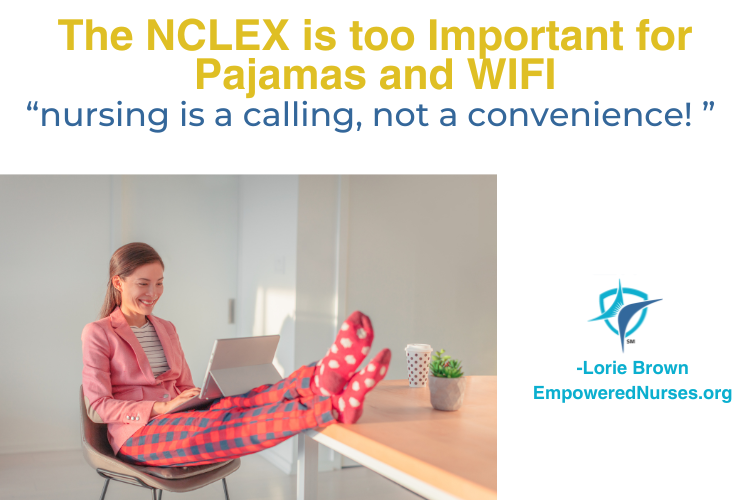
But instead of walking into a secure testing center, you are now sitting at your kitchen table with a camera that provides a 360° view of your surroundings, you’re sitting in pajamas with your laptop.
Well, that sounds comfortable, right? The problem is that nursing is not about comfort but about accountability, ethics, and trust. That’s exactly why allowing the NCLEX exam to be taken at home is not a good idea.
I had the opportunity to take the California bar exam in the next best place to my home, a hotel! I chose to go to a hotel so I would not be disturbed in the middle of the exam by barking dogs, dirty dishes in the sink, laundry to be washed and dried or someone ringing my doorbell.
When I checked into the hotel, I noticed the Wi-Fi was not really that good. I spoke with the manager and they put a router in my room to improve my access. Fortunately, it turned out well for me, but for hundreds, if not more than a thousand test takers faced problems with their Internet and the tech associated with taking the exam to the point that they could not properly complete the examination.
I reached out to the National Council of State Boards of Nursing to tell them about my experiences and why if the NCLEX goes virtual in the home, it would be a bad idea.
In my situation, I had to turn my computer around 360° for them to check my surroundings after every essay. We were allowed to have a dry erase board next to us, but they never asked me to lift up the dry erase board to look under it or under my
computer or even my desk.
Of course I didn’t have any notes there, but I felt it could have been easy to cheat. In addition, we had a 5-minute break every hour and I could have used that brief time to, say, go to the bathroom and review my notes. When I took the Bar exam the previous year in a standard testing scenario, there was a proctor monitoring the bathroom.
I am concerned about the NCLEX being done in the candidate’s home because:
1. The integrity of the profession is at stake! Nursing is one of the most trusted professions in the world and that trust is built on knowing that every RN and LPN was obligated to prove themselves by passing the same secure standardized exam.
Even with remote proctoring software at a test site, there have been documented instances of cheating where some nurses purposely ignore stowing everything into their locker to use “cheat sheets” during the exam and facing the possibility of being disqualified.
· Use of concealed electronic devices: In one case, nursing students were caught using earpieces hidden under head coverings to receive answers from an outside source during an exam.
· Irregular behaviors: A candidate may be dismissed from the testing center for violating rules, such as accessing prohibited aids (phones, smartwatches, etc.) or creating a disturbance. One individual on Quora described being reported for using their phone in a prohibited area shortly after completing the exam. · Intentional irregularities: According to Credentialing Insights, examples of intentional cheating include using proxy test takers, falsifying identification, and unauthorized communication with others.
2. Patient safety comes first! When you step into a patient’s room, no one cares if you aced an examination in a quiet home environment, they care that you can think critically under pressure.
In the testing environment, it is quiet but structured with strict rules. Allowing at-home testing lowers the stakes in the wrong way. Patients’ lives depend on nurses who bring their license under conditions that reflect the weight of the role.
3. Equity and access are a concern! Not everyone has a stable Internet connection, acquired environment or the right technology at home. While testing centers will still be available, imagine what would happen if your home Wi-Fi dropped out mid exam, or a family member comes barging in. A secure testing center levels the playing field. Everybody gets the same environment, the same rules, and the same level of seriousness.
4. It erodes public trust in nursing licensure! When patients hear that the nurses could take the licensing exam at home, it chips away at confidence. It plants doubt. “Did my nurse really earn that license?” Public trust is fragile and the NCLEX is the cornerstone of protecting it. Making the test less secure undermines the credibility of every nurse who worked hard and played by the rules.
5. It sends the wrong message to future nurses! Becoming a nurse isn’t just about knowledge, it’s about discipline, responsibility, and ethics. The NCLEX is not just another exam. It is a gateway into a profession where people’s lives are in your hands. Taking the test at home trivializes the process, and it turns what should be a sacred milestone into just another online quiz.
6. The bottom line – nursing is a calling, not a convenience! And while the in-home NCLEX testing might sound easy in theory and practice, it threatens the very things that our profession is built on: integrity, patient safety, and public trust. When you pin on that RN or LPN badge, the world needs to know that you earned it and that means passing NCLEX the right way — not in your living room, but in a secure, standardized environment worthy of the responsibility that comes with being a nurse.
