


When Robots Don’t Relieve the Pressure
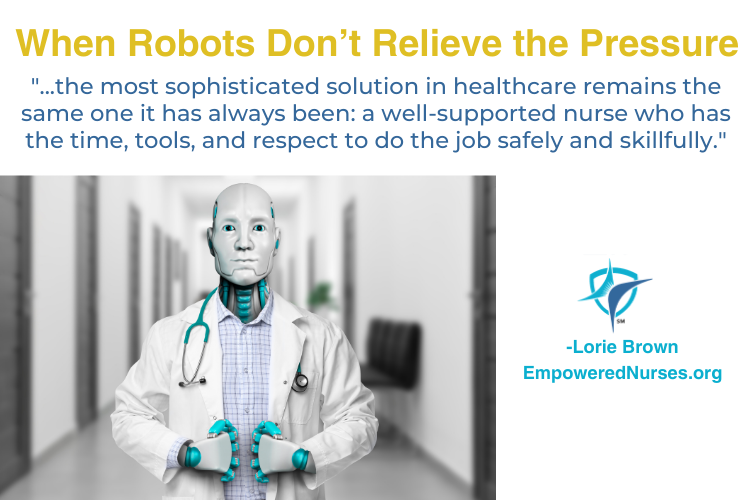
Recently, MultiCare Health System made headlines after discontinuing its use of Moxi service robots at Tacoma General Hospital and Mary Bridge Children’s Hospital. The robots were introduced with big promises: reduce nurse walking time, transport supplies, handle specimen runs, and free nurses to spend more time at the bedside. On paper, it sounded like the clinical equivalent of calling in extra staff during a surge. In reality, many nurses reported the robots became obstacles rather than relief—slowing traffic in hallways, requiring supervision, and adding one more variable to an already unpredictable shift.
The coverage by nurse.org highlighted what many bedside clinicians quietly know: technology that isn’t built around real workflow doesn’t reduce workload. Instead of eliminating steps, the robots sometimes created them. Nurses had to help them navigate elevators, maneuver around tight corners, and troubleshoot glitches. It’s a little like adding a new electronic health record update mid-shift—technically designed to “help,” but practically increasing cognitive load when you’re already triaging five priorities at once.
The robots, developed by Diligent Robotics, have shown success in some health systems. But healthcare isn’t a sterile lab environment; it’s fluid, emotional, and constantly adapting. A unit can shift from calm to chaos in seconds. Nurses anticipate needs before alarms sound. We read rooms the way cardiologists read EKGs. That intuition—honed by experience—doesn’t translate easily into algorithms.
What’s especially telling is where MultiCare ultimately redirected its investment: into its nursing workforce, including significant pay increases through newly negotiated contracts. That decision speaks volumes. When administrators stepped back and evaluated cost versus impact, they chose people over programming. In a time when burnout feels like a chronic condition across the profession, that shift matters.
Artificial intelligence and robotics are not inherently the enemy. Like any intervention, the question isn’t whether the tool is powerful—it’s whether it’s appropriate. In medicine, we don’t treat hypotension with antibiotics simply because antibiotics are advanced. We choose interventions that address the root problem. Burnout and staffing strain are human issues. If AI is layered on top without redesigning workflow around the nurse experience, it risks becoming another task to manage rather than a support to lean on.
The deeper lesson here is this: innovation must begin at the bedside, not in the boardroom. Nurses don’t need shiny gadgets that require babysitting. They need staffing ratios that make sense, compensation that reflects responsibility, and systems that decrease friction instead of increasing it. Technology can absolutely play a role—but only when nurses are central to its design, implementation, and evaluation.
Until then, the most sophisticated solution in healthcare remains the same one it has always been: a well-supported nurse who has the time, tools, and respect to do the job safely and skillfully.
