


Honesty Heals: Why Transparency After Mistakes Matters More Than Ever
Healthcare is built on trust. Patients trust nurses, physicians, hospitals, and healthcare systems with their bodies, their fears, and sometimes their lives. But what happens when something goes wrong?
Mistakes in healthcare are devastating for everyone involved. Patients and families may be left frightened, angry, grieving, or searching for answers. Healthcare professionals often carry overwhelming guilt, shame, and fear. Institutions frequently go into protection mode, guided by risk management concerns and legal fears rather than human connection.
Yet study after study continues to show something incredibly important: honesty, transparency, and compassionate communication after patient harm matter deeply to patients and families. In many cases, they matter even more than people realize. Research from the University of Washington and other organizations has found that patients overwhelmingly want healthcare providers to tell them the truth about what happened, explain how it occurred, apologize when appropriate, and discuss what will be done to prevent it from happening again. (UW Homepage)
What patients often remember most is not only the mistake itself. It is how they were treated afterward.
Silence creates suffering.
Families know when something feels off. When communication suddenly becomes guarded, when questions are avoided, or when nobody will look them in the eye, it can deepen the trauma. Many patients and families describe hitting what researchers call a “wall of silence” after adverse events. (Wikipedia)
That silence can destroy trust faster than the original error.
On the other hand, compassionate and honest communication can preserve dignity even in heartbreaking situations. It does not erase harm. It does not magically undo loss. But it acknowledges humanity. It says: “You matter enough to deserve the truth.”
One of the biggest misconceptions in healthcare is that honesty automatically increases lawsuits. Interestingly, many hospitals that adopted transparency and communication-resolution programs actually saw reductions in litigation costs and claims. (AAMC) Patients and families are often less interested in revenge than they are in understanding what happened and knowing someone genuinely cares.
People want to be heard.
They want acknowledgment.
They want accountability.
And they want reassurance that lessons were learned.
This is especially important for nurses because nurses are often the ones standing at the bedside during the hardest conversations. Nurses witness the emotional aftermath firsthand. They see the confusion in a spouse’s face. They sit with families after devastating outcomes. They carry the weight of knowing that communication can either build a bridge toward healing or create even deeper wounds.
None of this is easy.
Healthcare culture has historically punished mistakes harshly. Many professionals fear losing their license, reputation, job, or livelihood. Some are advised to say as little as possible. Others internalize overwhelming shame and isolate themselves emotionally after an error. But creating cultures of fear does not improve patient safety. It often drives problems underground.
Transparency creates opportunities for learning.
Silence protects dysfunction.
A growing number of healthcare systems are recognizing that responding to patient harm with honesty, empathy, and accountability is not weakness. It is leadership. Communication-and-resolution programs across the country are encouraging early disclosure, compassionate conversations, emotional support, and meaningful follow-up after adverse events. (AAMC)
At the center of all of this is something simple but powerful: human connection.
Patients and families do not expect perfection. They do expect honesty.
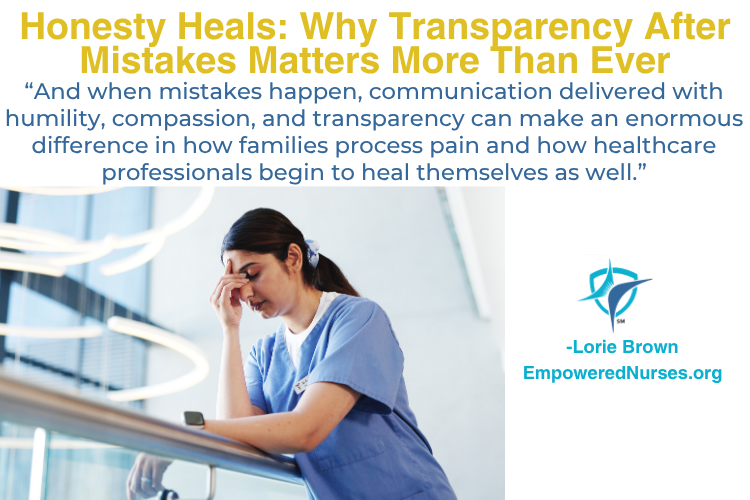
And when mistakes happen, communication delivered with humility, compassion, and transparency can make an enormous difference in how families process pain and how healthcare professionals begin to heal themselves as well.
Because honesty is not just the best policy.
In healthcare, honesty is part of healing.


Comments are closed