


Nursing Malpractice Claims Are Moving From Hospitals to Homes: What Every Nurse Needs to Know
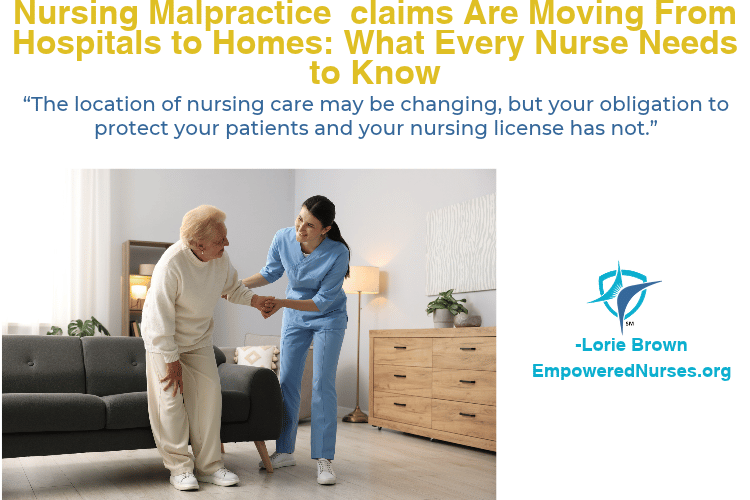
For years, when we thought about nursing malpractice, we pictured something going wrong in a hospital. Perhaps a medication error, a failure to recognize a patient’s deteriorating condition, or a breakdown in communication between nurses and physicians. However, the landscape of nursing malpractice is changing, and the latest findings from Nurses Service Organization (NSO) and CNA should get every nurse’s attention.
According to the Nurse Professional Liability Claim Report, 5th Edition, home healthcare now represents the largest share of closed nursing malpractice claims by specialty. This is a significant shift from the days when hospitals dominated nursing liability claims. More care is being provided in homes.
In 2009, hospital inpatient settings accounted for 38.2% of closed nursing malpractice claims, while care provided in patients’ homes represented only 12.7%. By the 2025 dataset, claims involving care in patients’ homes accounted for 21.5%, compared with just 11.6% for hospital inpatient settings. Looking specifically at nursing specialties, home healthcare nurses accounted for 21.7% of closed malpractice claims, the largest percentage of any specialty.
Even more concerning is the financial impact. The average total incurred cost of a malpractice claim involving a home healthcare nurse reached $301,031, an increase of 39.3% from the previous reporting period. These statistics do not necessarily mean that an individual home healthcare nurse is more likely to be sued than a hospital nurse. The report examines closed claims, not the total number of nurses practicing in each setting. However, the findings demonstrate how professional liability exposure is changing as more complex patient care moves into the home. It is also my observation that more home care nurses are getting in trouble or at least being investigated by the Boards of Nursing.
Think about what happens when a patient begins to deteriorate in a hospital. The nurse can call a rapid response team, consult with another nurse, notify the physician, or obtain immediate assistance from other healthcare professionals. Now imagine that same patient deteriorating at home. The nurse may be the only healthcare professional present. There is no rapid response team down the hall, no respiratory therapist
immediately available, and no charge nurse to step into the room and provide a second opinion.
The home healthcare nurse must independently assess the situation, recognize changes in the patient’s condition, determine the appropriate intervention, and communicate with the physician or emergency services. Add to that the challenges of unfamiliar environments, family dynamics, limited equipment, and increasingly complex treatments being delivered outside the hospital. Home healthcare offers patients tremendous benefits, including comfort, independence, and the opportunity to recover in familiar surroundings. However, it also places significant responsibility on the nurse providing that care.
One particularly troubling example discussed in the NSO/CNA report involved a newly licensed nurse caring for a ventilator-dependent infant at home. The infant experienced a medical emergency and subsequently died. The nurse reportedly lacked adequate training and experience in caring for pediatric ventilator patients, and the claim was settled for more than $475,000 on behalf of the nurse. This case illustrates why nurses must never accept assignments for which they lack the necessary competency, regardless of staffing pressures or employer expectations.
Although the location of nursing malpractice claims is shifting, the leading category of allegations has remained remarkably consistent. In 2009, treatment and care allegations accounted for 55% of closed malpractice claims. In the 2025 dataset, they accounted for 56.2%. In other words, more than half of nursing malpractice claims continue to involve allegations that the nurse failed to provide appropriate treatment or care.
These allegations may involve failing to recognize a change in condition, delaying necessary treatment, inadequately monitoring a patient, or failing to carry out appropriate nursing interventions. What concerns me as a nurse attorney is that many of these situations involve fundamental nursing responsibilities. Assessment, intervention, evaluation, and communication remain the foundation of safe nursing practice. It does not matter whether you are caring for a patient in an intensive care unit, a nursing home, or someone’s living room. Your responsibility to exercise appropriate nursing judgment remains the same.
Another important consideration involves documentation. Years ago, defending a nursing malpractice case often involved reviewing handwritten nurses’ notes, physician orders, and medication administration records. Today, the evidence can extend far beyond the medical record. Electronic health record audit trails, patient portal messages, text messages, emails, videos, and information generated by medical devices may all become relevant during litigation.
Imagine documenting that you notified a physician about a patient’s deteriorating condition at 10:00 a.m., but the electronic communication records show that the message was not actually sent until noon. That discrepancy could become a significant issue in defending your care.
Nurses should also understand their employer’s policies, their state’s Nurse Practice Act, and their professional scope of practice. Working independently does not eliminate these responsibilities. Equally important is evaluating professional liability insurance coverage. Do not assume that your employer’s insurance will necessarily protect your individual interests in every situation. Employer coverage and individual professional liability policies may provide different protections, particularly when a complaint is filed with the Board of Nursing.
There is another important consideration that I want nurses to understand. A malpractice lawsuit and a nursing board investigation are two separate matters. A nurse may be named in a malpractice lawsuit alleging negligent care and also face a complaint before the Board of Nursing arising from the same incident. Even if the malpractice case is settled, the Board may independently investigate whether the nurse violated the Nurse Practice Act or applicable standards of nursing practice.
The NSO/CNA report also found that the average payment per license defense matter increased by 18.3%, from $5,330 to $6,304. Professional conduct matters represented 38% of closed license protection matters. As a nurse attorney, I frequently remind nurses that their license is their livelihood. A malpractice settlement may resolve a financial claim, but it does not automatically resolve concerns about professional licensure. This is why understanding your insurance coverage, including whether it provides license defense benefits, is so important.
Healthcare is changing. Patients are receiving increasingly sophisticated treatments in their homes, nurses are practicing with greater independence, and technology is transforming how care is delivered and documented. But despite all these changes, the fundamentals of safe nursing practice remain the same. Assess your patient. Recognize changes in condition. Communicate concerns. Intervene appropriately. Document accurately. And never allow an employer, staffing shortage, or technology to pressure you into practicing beyond your competency.
I believe home healthcare will continue to grow, and nurses will play an increasingly important role in helping patients remain safely in their homes. However, greater independence must come with appropriate training, adequate support, and a clear understanding of professional responsibility.
The location of nursing care may be changing, but your obligation to protect your patients and your nursing license has not. You have worked too hard for your nursing license to put it at risk.


Comments are closed