


From the Bedside to Capitol Hill: Why We Need More Nurses in Politics
For years, nurses have been the voices advocating for patients who could not advocate for themselves. We have stood at bedsides, held the hands of frightened families, questioned unsafe orders, and fought to make sure our patients received the care they deserved. We have witnessed firsthand what happens when the healthcare system works and, more importantly, what happens when it fails.
But there is one place where our voices have been missing for far too long: the rooms where the laws governing healthcare are written.
That is why I was so excited to read the recent Nurse.org article about two nurses who were elected to Congress in November 2026. Mitchell Berman, an emergency room nurse from Wisconsin, and Kristina Knickerbocker, a nurse practitioner and Air Force veteran from Ohio, will join nurses Lauren Underwood of Illinois and Sheri Biggs of South Carolina, who won reelection.
Think about that for a moment. Four nurses serving in the United States Congress. While I am thrilled that nurses are being elected, I also find it remarkable that a profession representing millions of healthcare professionals has so few members serving in Congress.
We need more nurses at the table because we know what is happening at the bedside. Politicians can debate healthcare costs, staffing ratios, insurance coverage, and access to care. They can study statistics, listen to lobbyists, and review reports. But nurses have lived the consequences of these decisions.
We have cared for patients who could not afford their medications. We have cared for homeless patients who are discharged with nowhere to go. We have watched families struggle to make impossible decisions about treatment because of insurance limitations. We have worked shifts where staffing was so inadequate that we went home wondering whether we had done enough for every patient. And we have seen wonderful nurses leave a profession they once loved because the demands became unbearable.
These are not abstract policy issues to us. These are real people, real experiences, and real consequences.
What particularly touched me about these two newly elected nurses is that their experiences with patients helped motivate them to seek public office. Berman has spoken about seeing patients ration medications because they could not afford refills. Knickerbocker has described patients having to choose between purchasing medication and buying groceries. She has also raised concerns about how our healthcare reimbursement system fails to recognize the full value of nursing services.
They are bringing something to Congress that cannot be learned from a briefing paper: the perspective of someone who has actually cared for patients. And that perspective is desperately needed.
As a nurse attorney, I see another side of this problem. I represent nurses whose licenses and livelihoods are at risk, sometimes because they were placed in situations where they did not have the resources, staffing, or support necessary to provide safe care. I see nurses held accountable for outcomes that may have involved failures far beyond their individual control. I see how laws, regulations, and policies written by people who may never have worked a nursing shift can profoundly affect a nurse’s career.
I have often wondered how different some of these laws might look if more nurses had been involved in writing them. Would we have better protections against workplace violence? Would we have more realistic staffing policies? Would we better understand the importance of retaining experienced nurses rather than continually replacing them? Would we have a regulatory system that protects patients while also treating nurses fairly?
I certainly believe nursing experience could make these conversations more informed.
But nurses bring something else to politics that is equally valuable. We know how to listen. When a patient tells us something is wrong, we do not simply dismiss the concern because it does not fit our expectations. We ask questions. We assess. We gather information. We look for solutions.
We also know how to work with people who have different perspectives. In healthcare, we collaborate with physicians, therapists, social workers, administrators, patients, and families. We may disagree about the best approach, but ultimately, we must find a way to move forward in the patient’s best interest. Imagine bringing more of that approach into politics.
And this is not about Democrats or Republicans. Nursing is not a partisan profession. Patients do not ask about our political affiliation before allowing us to care for them, and we do not decide who deserves compassionate care based on how they vote. In fact, the nurses elected to Congress represent both political parties. That is exactly as it should be. We do not need nurses in politics who all think alike. We need nurses who bring their professional judgment, ethical responsibilities, and firsthand experiences into the legislative process.
Of course, being a nurse does not automatically make someone a good legislator. Public policy requires knowledge of economics, law, government, and the needs of many different communities. But nursing provides an extraordinary foundation for public service because it teaches us to recognize problems, evaluate evidence, make difficult decisions, and understand the human consequences of those decisions.
And I want nurses to understand something important. You do not have to run for Congress to make a difference in politics. You can serve on a school board, city council, or state legislature. You can testify before legislative committees. You can contact your elected representatives when legislation affecting nursing is being considered. You can become involved with your professional nursing organizations and advocate for policies that protect patients and the profession. You can even start by attending a local government meeting and speaking up about an issue that matters to you.
Too often, nurses underestimate the value of their own experience. We think we need another degree, another certification, or permission from someone else before we can lead. But who better to explain the consequences of unsafe staffing than a nurse who has experienced it? Who better to discuss barriers to healthcare than someone who has watched patients struggle to obtain treatment? Who better to help shape nursing regulations than someone who understands what it actually means to practice nursing?
For much of our profession’s history, nurses have been expected to carry out decisions made by others. We have been extraordinarily good at making difficult systems work, often at tremendous personal sacrifice. But perhaps it is time for more of us to help design those systems instead.
I am proud of Mitchell Berman and Kristina Knickerbocker for stepping outside their comfort zones and pursuing public office. I am equally proud of the nurses from both parties who have served before them and those who ran this year but did not win. It takes courage to put yourself out there, especially in today’s political climate.
Their willingness to serve reminds us that our nursing education and experience can take us far beyond the bedside. We have spent our careers caring for individuals, one patient at a time. Through public service, we have the opportunity to improve the lives of entire communities.
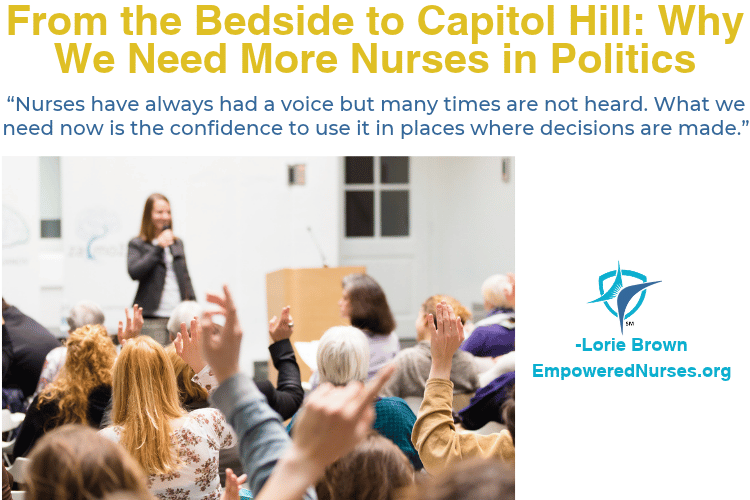
Nurses have always had a voice but many times are not heard. What we need now is the confidence to use it in places where decisions are made.
And maybe, just maybe, the next nurse elected to Congress is someone reading this article today. I would love to see that happen.
What do you think? Should more nurses run for political office? And what is the first healthcare issue you would want a nurse in Congress to address?


Comments are closed