Both Ohio and Kansas have pending legislation to allow advanced practice nurses to treat patients without physician oversight. The Federal Trade Commission (FTC) has endorsed this legislation. The FTC relied on research showing that autonomous advanced practice R.N.s and physicians have comparable prescribing practices and patient outcomes. Currently there are 22 states that allow full practice authority for advanced practice practitioners. However, in Ohio the FTC has put a restriction that every advanced practice R.N. must have over 4,000 hours of licensed active practice as an advanced practice nurse to have independent prescribing practices.
This is significant because there are many online schools which allow A.P.R.N. students to coordinate their own clinicals with a provider in order to get their degree.
Physicians are required to have significantly more clinical practice hours than nurse practitioners do. It only makes sense that nurse practitioners should have more hours in their clinicals to overcome objections by physicians.
The FTC also cites that advanced practice R.N.’s help alleviate physician shortages in underserved areas. Requiring physician supervision creates an uneven playing field giving doctors the competitive advantage that ultimately costs consumers.
Interestingly, there is an initiative by the National Council of State Boards of Nursing are also starting an advanced practice registered nurse compact to allow an advanced practice nurse to practice in multiple states without physician supervision. This would be a great help as it would allow nurse practitioners to do more telemedicine or do more holistic health to reach people on a broader scale and not just in their home state.
What are your thoughts for autonomy for advanced practice nurses? How do you feel about the number of clinical practice hours required? Let me know your comments below.
Maybe you’re frustrated with nursing or maybe you’ve had a dream that you’ve always wanted to turn into a reality. When is now a good time to start?
Nurses are uniquely qualified to start their own businesses because they have excellent organizational skills, they have critical thinking and have great relationships with their patients. Unfortunately, nurses are used to relying on their employment paycheck so in starting their own businesses, it can be very scary.
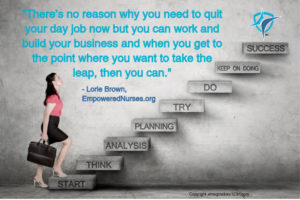
I always say, “Build the plane as you fly.” There’s no reason why you need to quit your day job now but you can work and build your business and when you get to the point where you want to take the leap, then you can.
Nurses are lucky that many nurses work 12-hours shifts, leaving 3 or 4 other days in the week to devote to a business.
QUESTION 1: What kind of business should I start?
There are so many businesses that nurses can start including legal nurse consulting, nurse on staffing agency, home health care agency, wellness coaching, diabetes coaching, case management, private duty, nursing in home, senior care, hospice services, respite care, foot care services, childbirth education, lactation consulting, fertility consulting, concierge nurse service, patient care consulting, telehealth service, health coaching, public speaking, continuing education, mindfulness coaching, home IV therapy, holistic health services, nutrition counseling, to name a few.
My recommendation is to chose something you love doing because on the days where it’s hard to get out bed, your passion will keep you going.
QUESTION 2: Do I need a certification?
You have an R.N. license and the scope and education. Even though certificates cost time and money, most clients won’t even ask if you have a certificate. There is no national certification and, therefore, certifications may not be necessary. However, the education that you take to obtain the certification may be helpful to you in knowing how to do this job but not necessarily how to get business.
QUESTION 3: What type of entity should I be?
I always say there is no reason to be an entity unless you’re making money. The sole purpose of having an entity is to protect you from liability. But how can there be liability if you are not providing services and making money?
It depends on your risk tolerance but starting your business and making sure are successful first, then investing in creating an entity.
For example, if you start a staffing agency, you may want to form an entity right away. But, if you want to do one-on-one services like providing coaching, wellness services, case management, legal nurse consulting and those kinds of services, you may not need to spend that kind of money creating an entity right away.
QUESTION 4: Should I have my own business insurance?
Again, the only reason why you would need business insurance is if you are successful and concerned about liability. It depends on your own risk tolerance. I suggest getting business insurance at some point but when you’re just starting, wait until you have a client, it may not be necessary right out of the box.
QUESTION 5: Do I need a website, brochure and business cards?
I always say, “The easiest way to make money fast is to start talking to people.” That is the easiest way to get clients. If people don’t know you’re out there, they are not going to know to search for you. So, creating an elaborate website may just be a waste of money unless you know how to drive traffic there when people are actively looking for your services.
If you’re starting a home healthcare agency or senior care or where people would like for those type of services online, then create a website. Legal nurse consulting, wellness coaching, nutritional consulting or case management, a website at this point may not necessarily be prudent.
Go out and start talking to people, get clients and as you get encouraged and make money, then invest in peripherals such as website, brochures and cards.
You can see I take a very practical approach to starting a business!
QUESTION 6: Do I need to be licensed in the state that my client is in?
That is a controversial question. If you are providing any type of nursing services then, obviously, the answer is yes. However, if you are providing wellness coaching for which anybody can obtain a certificate, then it’s debatable. If you are using your nursing knowledge and promoting yourself as a nurse, then it could be considered nursing care in which case you would need to be licensed. There may be creative legal solutions to this though.
However, the Nursing Boards see you wherever you are working as being a nurse 24/7. And if you are using your nursing background to get clients, then you should be licensed. Unfortunately, the State Nurse Practice Act does not catch up with the changing times and expanded roles of nursing. For example, health coaches at insurance companies are required to have licenses in 50 states.
What questions do you have about starting a business? Feel free to set up a 15 minute strategy session with me to see how I can assist you. Call (317) 465-1065 to schedule.
I don’t think you can be a nurse without having an intuition or sixth sense. Actually, I think everyone has it, but some have the trait better developed.
That sixth sense is when you go into a patient’s room and you know that something is wrong. You take vitals, do your assessment and everything seems to be fine with the patient. Yet, there’s a nagging feeling in your gut that says something is wrong.
You’re afraid to call the doctor because you think he will yell at you and think you’re crazy. Yet, you know that something is amiss.
Our gut is there for a reason. There are times we need to act on our gut feeling no matter the consequences because it might save a life.
When I was in nursing, I had a patient who I knew had something wrong even though I couldn’t put my finger on it. I was new, I was green, I was scared, I didn’t know what to do.
Within 5 minutes, she was screaming, “Lord, I’m coming!” She was stroking out and immediately was transferred to the ICU. Those few minutes could have been very helpful had I acted on my gut and identified this a little earlier.
So, what can you do to develop your intuition, your sixth sense? My intuition talks to me with a very quiet voice but at times it is overshadowed by that loud, screaming, annoying, demeaning voice in my head.
The art is to put that latter voice that is not serving you to the side and focus on the quiet, calm voice of your intuition.
Another thing I do to calm my mind is meditation. I meditate daily and prefer to do so with some guided meditation rather than just quietly sitting there.
I believe that mediation calms and grounds me. I always have a much better day on the mornings when I can meditate.
I also do yoga to quiet my mind because while doing that I am totally in my body rather than thinking about the day facing me. It really helps center me.
Taking a walk-in nature and being with the beautiful sights and sounds while being truly present can go a long way in helping you connect with your higher self.
In nursing school, we learn that we should take care of the whole person, body, mind and spirit so that may mean if your patient wants to spend a minute to pray with you, you take care of their needs. Spirituality is defined as “the quality of being concerned with the human spirit or soul as opposed to material or physical things.”
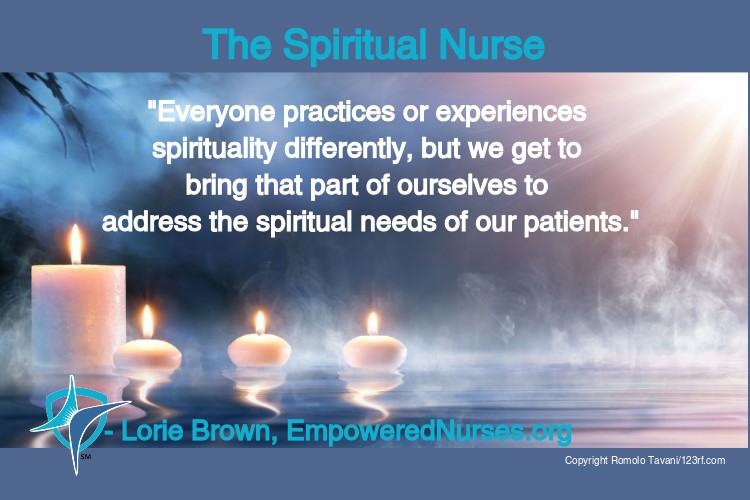
Everyone practices or experiences spirituality differently, but we get to bring that part of ourselves to address the spiritual needs of our patients.
What do you do to access your intuition and how do you bring spirituality into your workplace? Share with us your comments below.
Recently I read an opinion piece in The New York Times magazine, written by a New York Belleview Hospital physician, titled “The Business of Healthcare Depends on Exploiting Doctors and Nurses.” It discusses how electronic medical records (EMR) are designed to save us time and get documentation that can be easily searchable but, unfortunately, it’s a burden.
Data entry is mind-numbing and voluminous. The Annals of Family Medicine reports “[P]rimary care doctors spent nearly two hours taken into the E.M.R. for every one hour of direct patient care.” The article goes on to discuss how there are 10 administrators for every doctor. If 5 of those salaries were taken to hire additional nurses and doctors, there may be enough clinical staff to handle the work.
To me, this article is sad but true. We know that doctors and nurses will not walk away from their patients and are loyal to the core but also know that they will get exploited every day to keep the healthcare system running while taking care of patients.
At some point, we’re going to have to say “uncle” and that we can no longer do this. We nurses are required to stay late to finish our charting but we’re not provided overtime unless it’s approved because the administration feels that we should get our charting completed in the time we have been allotted.
The article gives an analogy that if 30% more items were suddenly dropped on a factory assembly line, the process would come to a grinding halt. But many nurses don’t take lunch breaks to try to squeeze in care for extra patients.
This is not only unacceptable … it is NOT safe!
As long as we are complacent with the hospital demands because we fear loss of our jobs, the problem will continue.
Even when patients are harmed because of lack of staffing, the facilities continue to function the way they are because they are designed like McDonald’s franchise. Whoever can take care of the patient cheaper and quicker is the one that gets the insurance contract.
It’s sad that healthcare is run these days like a McDonald’s instead of like the community and religious organizations designed to take care of our community and tribe.
Something has to give or the healthcare system is going to implode. Complacently sitting back is contributing to the problem.
I would never want to be a patient because healthcare workers are stretched too thin.
I believe nurses have the solutions to the problems in healthcare but either we are afraid to say something, or we don’t feel any one hears our solution.
I would love to hear your thoughts on the McDonald’s of medicine and what solutions you have.
If you have not read the book “Think and Grow Rich,” I would highly recommend that you do so. Noted in the book is the story of someone approaching Andrew Carnegie, founder of Carnegie Steel which later became U.S. Steel, and asked him “If I could share a business secret with you that will be the most powerful advise you ever received, would you want it?”
Of course, Carnegie said “Yes!”
The person’s advice was to do any 3 small things each day to move your business forward and this made such a difference thing for Carnegie that he sent a letter and a huge check to the person who gave him this advice and said, “You’ll never know how much this advice has helped me. I wish I could give you enough money that would adequately pay for it, but I can’t. But please accept this to show what a difference your advice made in my life.”
If doing 3 small things a day could make such a difference for Andrew Carnegie, imagine what effect it could have on your business. I have been choosing 3 things to move my business forward each day and it has made a huge difference. Things get done and it creates focus and intention although sometimes I stay up late to complete it!
Give it a try, you will be surprised by the results.
Artificial intelligence (AI) is here and it is impacting health care. The question will become will the jobs for nursing decrease with the expanding AI?
We see it at grocery self-checkouts, being able to sign up online for a checking account leading to banks closing, etc. And the need for humans to do these jobs has been decreasing at an increasing rate.
We know that surgical robots have become the staple in health care. There are robots that can take vital signs, turn patients and even bathe them.
As AI continues to grow, one problem we see is that artificial intelligence cannot differentiate between a blueberry muffin and a chihuahua. Try this, are you able to distinguish muffins from dogs in the pictures below?
Unfortunately, AI is not yet at a point where it can distinguish the 2 but once we develop AI to the point it can tell one from the other, we are going to see a massive change in health care.
With AI, we no longer will need lab technicians. The machines will be able to read the lab tests so there will be no need for human participation.
I have heard that some doctors visit patients in a critical access hospital online rather than in person. In that case, I would think that the doctor would have to rely on the nurse’s assessment for palpation of the abdomen and other subtle signs that an AI would not be able to determine.
AI is coming and we need to be prepared. There are lots of AI initiatives being used in hospitals to optimize hospital efficiency, better engage with patients and improve treatment. Additionally, AI is helping doctors with differential diagnoses.
Just look up “artificial intelligence in health care” and you will find tons of developments on the horizon.
Here are some examples of how AI can efficiently diagnose and reduce errors. AI can predict and diagnose disease at a faster rate than most medical professionals. It is more accurate in making cancer diagnoses. AI is helping in radiology by automatically analyzing and reviewing scans.
So, what does all this mean for nursing?
I would love to say that health care will always be nurses for the high touch part of our process but as we’ve already seen the trends that people are getting released to home quicker and quicker and they are not staying inpatient for long.
There are even E-ICUs where nurses and doctors can watch several patients at the same time, requires less staff.
What do you think the future of AI means for you and your practice? I would love to hear your comments below.
I recently finished an 8-week class on mindfulness-based stress reduction. I chose to take the class because my sister had attended it and came out like a different person. She is much more relaxed and focused in her life.
The purpose of mindfulness based stress reduction is to be mindful in everything that we do. Including eating! There were formal and informal practices. Informal practice is called “Mini, Many Moments All Day Long.” We were given dot stickers to put in places to remind us to breathe. Just taking that one deep breath can help change your physiologic state from the stress of sympathetic nervous system to the calm of the parasympathetic nervous system.
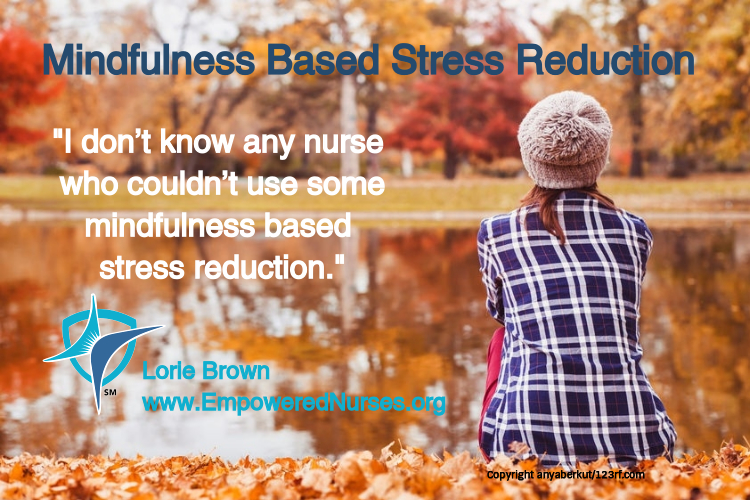
The goal of mindfulness is to stay in the parasympathetic nervous system but be able to switch over to the sympathetic nervous system when needed. That’s a very important part of our physiology as well. I don’t know any nurse who couldn’t use some mindfulness-based stress reduction. Mindfulness is the most important part of nursing. When we go on auto pilot, that is when mistakes happen.
What I liked about this program is that it was very medically based, and it was backed by medical studies and science.
The formal practice is the meditations which are primarily breathing protocols where I was introduced to a number of them. In fact, when I was in nursing, I would wake up at night wondering whether I had missed something in my documentation that was important or forgot to give a med. Even today, I still wake up thinking about my clients and my cases. With mindfulness based stress reduction, I now am able to regulate my breathing to relax my nervous system and allow me to quickly fall back asleep.
It was a very interesting class from which I learned a lot about my physiology. I highly recommend taking the class.
What do you do to relax, destress and to be mindful?
I thought I’d go “old school and nostalgic” to let you read about what it was like when I first became a nurse in 1980s. Nursing is still the largest group of health care professionals.
One of the biggest changes from yesterday to today is what we wear. I recall being so excited to get my white cap and pin for graduation. For the nursing job, most of us wore white dresses while some wore white pants and shirt which we bought from a uniform store.
One year the Internal Revenue Service audited me because I wrote off my white stockings. They were support hose and considered by the IRS to be in vogue meaning the stockings could be used as normal wear outside my nursing career and, as such, were not deductible. Today, we don’t even wear panty hose!
Another change in nursing since then is that all nurses’ notes are electronic. We used to handwrite all of our nursing notes and had virtually countless forms and checklists to complete.
Back in the day, there were very few IV pumps. We would have to calculate the drops per minute going into the IV tubing chamber to determine the proper IV rate.
We used to have stock medications that we could access whenever we needed for our patients. Each medication is barcoded today, specific for each patient.
There used to be a pneumatic tube system where an order would be put into a canister and shipped from the unit to central supply, lab, radiology or pharmacy just like the system you see today at any bank drive through. Today we get that job electronically.
We once had wet-to-dry dressing using Betadine or Dakin’s solution, but it was learned these substances were too damaging to the tissue.
We used to unclog a G tube using Coke.
Unlike today, where oxygen and suction come out of the wall, in the 80s we had to get a suction apparatus from central supply where we also had to go to retrieve portable 20-gallon oxygen tanks.
Back then, we used a saline solution in a trach to thin the secretions before suctioning but that is no longer the standard of care.
Foley catheters used to have to be below by the body to facilitate urinary drainage but now the Foleys have a back-flow valve where the drainage bag can be kept on the bed.
And, we used to milk chest tubes to facilitate drainage however today it is thought that the practice can cause air leakage in the tube.
Lots has changed. If you have not practiced in a while and are planning on returning to the job, I strongly suggest that you go through a nurse residency program or a nurse refresher course to get yourself updated.
Not only do things change overall but they change from facility-to-facility. Thus, make sure that you are up to date by reviewing the policies and procedures to fully know what the clinical practice is in your facility so that you are safe to practice.
Thanks for joining me on this trip down memory lane. I hope you are enjoying the ease at which we can practice nowadays.
Let me know how you find nursing today to be different from the time you first became a nurse. Please share your comments below.
I’ve always known that your gut plays a huge role in helping you be successful as a nurse.
Take the case of a nurse who was working with a patient who had a cervical spine fusion the previous day. He complained of having a raspy voice and trouble swallowing. His vital signs were all normal. The nurse knew in her gut that something was wrong. Both the raspy voice and trouble swallowing were expected symptoms after a cervical spine surgery.
The nurse called the doctor and said that she was not sure of what the patient’s problem was, “but my gut tells me that something is wrong.” She asked the physician to double-check to make sure the patient was OK.
The doctor came in, examined the patient, confirmed her concern and found the patient had an epidural hematoma. The patient was taken back to surgery to remove the hematoma.
This nurse saved the patient’s life by trusting her gut and getting a second opinion rather than just relying on vital signs and objective measures to know something was wrong.
According to The Journal of American Medical Informatics Association, a study was done at the Mayo Clinic using a 5-point rating system. 100 nursing professionals were asked to predict each of the patients for a potential decline within the next 24 hours.
“To confirm the accuracy, a separate group of physicians, nurses, nurse practitioners were asked the same question during the bedside assessment and the result was that of the 492 cases in which nurses rated a high level of worry, enough to call for medical attention, 77% were backed up by the reviewers.”
Seventy nine percent (79%) of the nurses with more than 1 year of experience were significantly more accurate as opposed to 68% of nurses with less than 1 year of experience on the job.
What is interesting about this study is that (1) the more experienced the nurse, the better the patient’s outcome and (2) this is the first measure of the accuracy of nurses’ judgment to direct or predict acute inpatient deterioration.
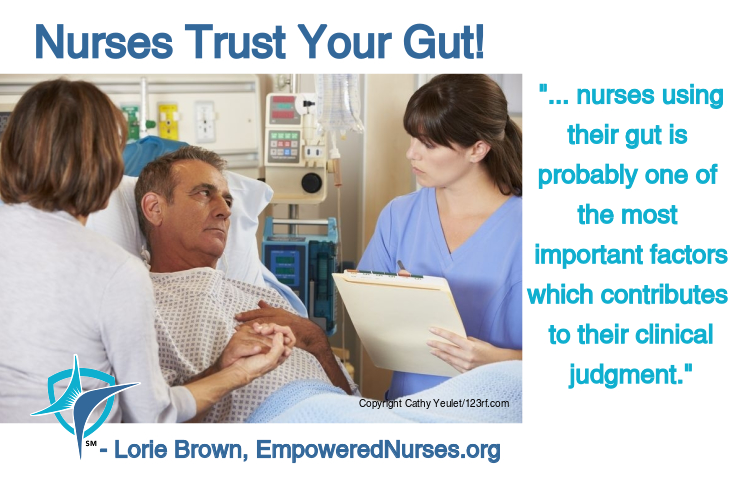
Therefore, nurses using their gut is probably one of the most important factors in medicine which contributes to their clinical judgment.
If you know my work, you know I have the GIFTS system. GIFTS is an acronym for Giving, Integrity, Focus and Follow Through, Trust and Source. And now we have validation that the T for trusting your gut works.
Does your gut help you in your practice? Do you listen to your gut?
I would love to hear stories of how intuition has served you and your patients.
Maybe you’re frustrated with nursing or maybe you’ve had a dream that you’ve always wanted to turn into a reality. When is now a good time to start?
Nurses are uniquely qualified to start their own businesses because they have excellent organizational skills, they have critical thinking and have great relationships with their patients. Unfortunately, nurses are used to relying on their employment paycheck so when thinking about starting their own businesses, it can be very scary.
I always say, “Build the plane as you fly.” There’s no reason why you need to quit your day job now but you can work and build your business and when you get to the point where you want to take the leap, then you can.
Nurses are lucky because many nurses work 12-hours shifts, leaving 3 or 4 other days in the week to devote to a business.
QUESTION 1: What kind of business should I start?
There are so many businesses that nurses can start including legal nurse consulting, nurse owned staffing agency, home health care agency, wellness coaching, diabetes coaching, case management, private duty nursing, nursing in home, senior care, hospice services, respite care, childbirth education, lactation consulting, fertility consulting, concierge nursing services, patient care consulting, telehealth service, health coaching, public speaking, continuing education, mindfulness coaching, home IV therapy, holistic health services, and nutrition counseling, to name a few.
My recommendation is to chose something you love doing because on the days when it’s hard to get out bed, your passion will keep you going.
QUESTION 2: Do I need a certification?
You have an R.N. license and the scope of your education. Certificates cost time and money, most clients won’t even ask if you have a certificate. There is no national certification and, therefore, certifications may not be necessary. However, the education that you learn to obtain the certification may be helpful to you in creating your business.
The certification may be helpful to you and learning the knowledge necessary to succeed in your business.
QUESTION 3: Do I need a website and brochures?
I always say, “The easiest way to make money fast is to start talking to people.” That is the easiest way to get clients. If people don’t know you’re out there, they are not going to know to search for you. So, creating an elaborate website may just be a waste of money unless you know how to drive traffic there when people are actively looking for your services.
If you’re starting a home healthcare agency or senior care or where people would look for those type of services online, then a website may be important. Legal nurse consulting or nurse wellness coaching or case management, a website at this point may not necessarily be prudent.
Go out and start talking to people, get clients and as you get business, use your income to invest in services such as websites and brochures.
You can see I take a very practical approach of starting a business!