


Should a Nurse Self-Report to the Board of Nursing?
Something happens at work. You are terminated. You are convicted of a crime. Another state takes disciplinary action against your nursing license. Then comes the question that can make even the most seasoned nurse’s heart rate jump: Do I have to report this to the Board of Nursing?
The answer is not always yes. One of the biggest mistakes nurses can make is assuming that anything negative in their professional or personal lives automatically needs to be reported to the Board. The opposite mistake is assuming that if the Board needs to know, someone else will tell them. Neither approach is safe. Every state has its own Nurse Practice Act and regulations governing what a nurse must self-report. Before telling the Board anything, the first step should be determining whether the law actually requires you to report it.
What if you are terminated from your nursing job? Being fired does not automatically mean that every nurse in every state must report the termination to the Board of Nursing. The first question is what your state’s Nurse Practice Act and regulations require. Illinois is a good example. The Illinois Department of Financial and Professional Regulation’s Nursing Self-Report Form identifies termination from employment as an example of an adverse final action that can be reportable. However, the circumstances surrounding the termination matter. Losing your job because a hospital eliminated your department is very different from being terminated following allegations of diversion, falsification of medical records, patient abuse or another issue that could constitute grounds for discipline against your nursing license. The word “termination” should not end the analysis. It should begin it.
If you are terminated, find out whether your state’s Nurse Practice Act or regulations require you to report the termination, whether the circumstances surrounding your termination fall within that requirement and how long you have to make the report. Do not simply assume that because your employer says it is reporting you to the Board, you do not have to do anything. An employer’s obligation to report and your obligation to self-report can be two completely separate legal requirements.
What about a criminal conviction? Again, there is no single rule that applies to every nurse in every state. Some states require nurses to report certain criminal convictions within a specific period of time. The reporting requirement may depend on whether the offense was a felony or misdemeanor or involved drugs, violence, dishonesty, patient care or conduct related to nursing practice.
It is also important to understand the difference between an arrest, criminal charge, guilty plea, deferred disposition and conviction. Those terms are not interchangeable, and a Nurse Practice Act may treat them differently. If you are involved in a criminal matter, do not assume that an arrest automatically must be reported, but do not assume that you can wait until license renewal either. Read the actual language of your state’s law and regulations. If the law requires a
conviction to be reported within 30 days, for example, disclosing it eight months later on your renewal application may not satisfy your reporting obligation. It is not enough to eventually address it. Timing matters.
What happens if another state disciplines your nursing license? This is especially important for nurses who hold or have held licenses in multiple states. Suppose you hold nursing licenses in three states and one Board takes disciplinary action against your license. That action may trigger a self-reporting obligation in the other two states. Many states specifically address disciplinary action taken by another licensing jurisdiction.
This is where one Board matter can create a domino effect. One state takes disciplinary action. That action triggers a reporting requirement in another state. The second state opens a case and takes its own action, which may then need to be reported somewhere else. Nurses holding multiple licenses need to look at the reporting requirements in every state where they are licensed or authorized to practice. The Nurse Licensure Compact does not mean there is one universal reporting rule that replaces individual state law.
There is another side to this discussion that is just as important: Do not automatically self-report something you are not legally required to report. Sometimes employers tell you to self report when you are not required to do so. Nurses are trained to communicate, document and disclose. When something happens, our instinct may be to tell everyone everything because transparency feels like the safest course. But a Board of Nursing is a regulatory agency. It is not your employer, your therapist or your confessor.
If your Nurse Practice Act and regulations do not require you to report an event, think carefully before voluntarily placing that information before the Board. Once information is submitted, you cannot rescind it. A voluntary disclosure can potentially result in questions, requests for records or an investigation that otherwise might not have occurred.
That does not mean you should ever conceal something you are legally required to disclose. If the Nurse Practice Act or regulations require reporting, comply with the requirement and meet the deadline. The point is that nurses should report what the law requires them to report rather than creating a reporting obligation that does not exist.
Before submitting a self-report, look carefully at the exact language of the law. Does it require reporting an “arrest” or a “conviction”? Does it require reporting every “termination,” or only certain adverse employment actions related to conduct that could constitute grounds for professional discipline? Does it require reporting another state’s investigation, or only final disciplinary action? Does the reporting obligation begin when the event occurs, when a decision becomes final or at license renewal? Those distinctions can make an enormous difference.
And please do not rely solely on what happened to another nurse. Your coworker may be licensed in another state, may have different facts or may simply be wrong. Asking a Facebook group whether you have to report something to the Board is a little like asking the waiting room to interpret your CT scan. You may get plenty of opinions, but that does not mean you are getting the correct answer.
Go directly to the Nurse Practice Act and regulations for every state in which you are licensed. Determine exactly what must be reported, what triggers the reporting obligation and when the report is due. If the answer is unclear, particularly when the underlying event itself could lead to disciplinary action, consider consulting a nurse license defense attorney before submitting anything to the Board.
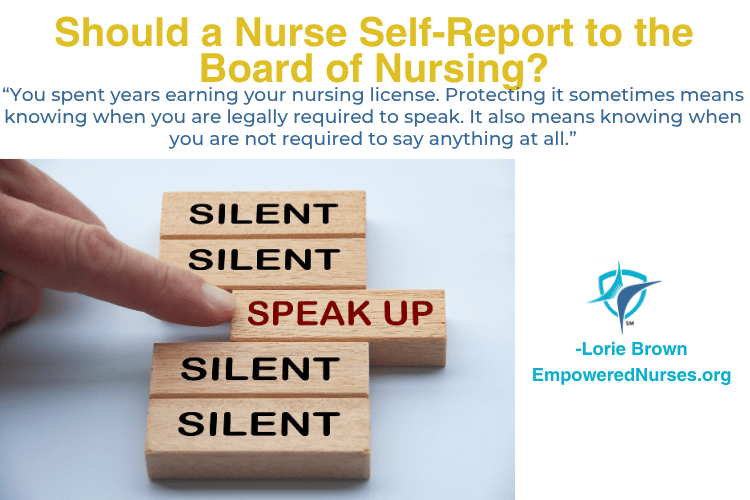
You spent years earning your nursing license. Protecting it sometimes means knowing when you are legally required to speak. It also means knowing when you are not required to say anything at all.


Comments are closed