Join me for an exclusive in-person event for LNCs to hear the behind-the-scenes legal process from 12 attorneys! ❱❱

Empowering Nurses at the Bedside and in Business

Author Archives: Lorie A Brown, R.N., M.N., J.D.

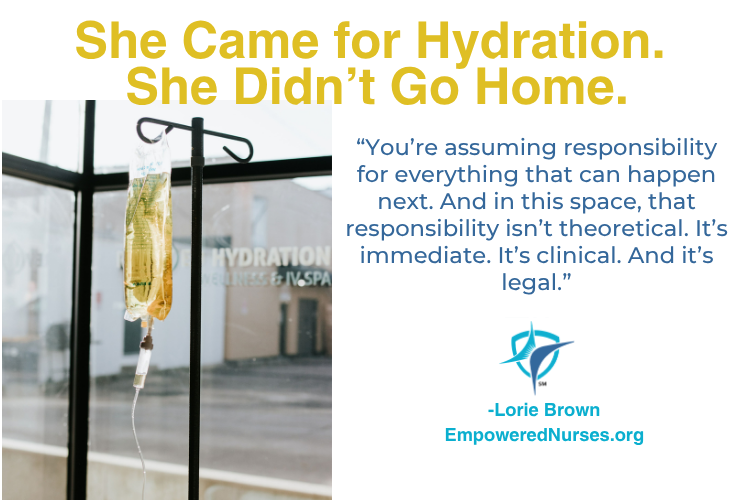
  1. She Came for Hydration. She Didn’t Go Home.

    Leave a Comment


    There’s a quiet shift happening in nursing—and it’s not happening in hospitals.

    It’s happening in med spas, IV lounges, and private treatment rooms where nurses are stepping into esthetics and wellness-based services. On the surface, it looks like freedom. Better hours. Cash-based services. Autonomy. Control. And for many nurses, it is exactly that.

    But beneath that opportunity is something far less talked about—and far more dangerous.

    Recently, a patient death tied to IV therapy in a non-hospital setting sent shockwaves through the healthcare and legal communities. Not because IV therapy is inherently dangerous—we both know it isn’t when done appropriately—but because of how quickly things can go wrong when clinical judgment, oversight, and safeguards are diluted outside of traditional settings.(A phlebotomist did the IV infusion, not a nurse).

    This is where the conversation needs to get real.

    In a hospital, you have layers of protection. Protocols. Rapid response teams. Pharmacy oversight. Equipment within arm’s reach. Colleagues who can step in when something feels off. If a patient has a reaction, decompensates, or crashes, you are not alone.

    Now remove those layers.

    Place a nurse in a spa setting. A client in a reclining chair. A bag of fluids marketed as “wellness,” “hydration,” or “energy boosting.” Maybe a cocktail of vitamins. Maybe a medication adjunct. The environment feels relaxed. The client feels healthy. The perceived risk feels low.

    But physiology does not care about the setting.

    Anaphylaxis doesn’t announce itself politely. Fluid overload doesn’t ask whether this is a spa or an ICU. Electrolyte imbalances don’t adjust themselves because the patient paid cash.

    And when something goes wrong, the margin for error is razor thin.

    The case involving a patient death during IV therapy underscores several critical fault lines that nurses stepping into esthetics must understand with absolute clarity.

    First, scope of practice is not flexible just because the setting is. Whether you are in a hospital, a med spa, or a mobile IV business, your license follows you. State boards do not make exceptions for “wellness environments.” If anything, they scrutinize them more closely because of the variability in oversight.

    Second, medical screening is not optional—it is the standard of care. Every IV infusion carries risk. Cardiac history, renal function, medication interactions, allergies—these are not

    checkboxes. They are clinical decision points. Skipping or minimizing this process is where liability begins to build.

    Third, standing orders and medical direction must be legitimate, active, and meaningful. A “medical director on paper” who is not truly engaged is not protection. It is exposure. If something goes wrong, investigators will look closely at the relationship, the protocols, and whether real supervision existed.

    Fourth, emergency preparedness is not a formality—it is survival. Do you have emergency medications? Do you know your exact protocol for anaphylaxis? Is your equipment functional and immediately accessible? Can you manage an airway until EMS arrives? In a hospital, these are assumed. In a spa, they are often overlooked—until it is too late.

    And finally, documentation and informed consent must reflect reality, not marketing language. If a service is positioned as casual or low-risk, but the intervention is clinical, that disconnect becomes a liability problem the moment an adverse event occurs.

    This is where many nurses get blindsided.

    They enter esthetics for the right reasons—autonomy, income, flexibility—but underestimate the legal weight of what they are doing. IV therapy is not just a “service.” It is a medical intervention. And the standard of care doesn’t lower just because the lighting is softer and the music is better.

    The patient who died didn’t expect that outcome. No one ever does.

    But from a legal perspective, the question is never whether harm was intended. The question is whether the standard of care was met—and whether the nurse recognized, anticipated, and prepared for foreseeable risks.

    That’s the part that separates a thriving nurse business from one that ends in a board complaint, a lawsuit, or worse.

    There is absolutely a place for nurses in esthetics. In fact, nurses are uniquely positioned to elevate the safety and integrity of this space. But that only happens when clinical rigor travels with you—when you bring the same level of assessment, vigilance, and accountability into every setting, regardless of how it looks on the outside.

    Because the moment you hang that IV bag, you’re not just offering hydration.

    You’re assuming responsibility for everything that can happen next.

    And in this space, that responsibility isn’t theoretical. It’s immediate. It’s clinical. And it’s legal.

  2. You Don’t Need to Prove Anything to Build Something Powerful

    Leave a Comment

    There’s a fork in the road that every nurse business owner hits—usually more than once—and it doesn’t come with a sign. It shows up in your calendar, your pricing, your conversations, and in that end-of-day feeling when you’re wondering if what you did was enough. It’s the difference between building your business to prove something… or building it to express who you are.

    Ego desires are about proving, comparing, and arriving. They sound like, “I need to hit this number,” “I should be further along,” “Other nurses are doing better than me.” It becomes a constant internal audit—measuring your worth against revenue, followers, credentials, or who just landed the case/client you wanted. And if you’ve ever worked a shift where nothing you did felt like enough, you already understand the physiology of this. It behaves like a chronic condition—always present, flaring under pressure, never fully resolved. You can hit a milestone—a great month, a new client—and instead of relief, your mind immediately recalculates. Now what? Is it enough? Can I keep this going? That “not enough” driver creates urgency, but it also leads to overworking, underpricing, and saying yes to opportunities that don’t truly fit.

    Soul desires operate from a completely different baseline. They are about expressing, contributing, and becoming. They don’t ask you to prove anything; they ask you to show up as who you are. Instead of asking, “How do I measure up?” you begin asking, “What am I here to build? Who do I want to serve? What actually aligns with me?” This isn’t passive or indulgent—it’s precise. It allows you to make decisions with clarity instead of fear. Your business stops feeling like a performance review and starts feeling like ownership.

    When you build from that place, everything shifts. You price based on the value you bring, not the fear of losing the client. One of my coaches said “my value is not based on the size of your wallet.” You market in a voice that sounds like you, not like what you think will impress. You become more selective, because you recognize that not every opportunity deserves your time or energy. And just like in clinical practice, the source of the issue matters. If you only treat the symptoms—work harder, post more, push more—without addressing the underlying driver, the same patterns will keep resurfacing.

    Many nurses were trained in environments where value was tied to output, compliance, and endurance. That conditioning doesn’t disappear when you start a business; it simply changes form. It shows up in how you price, how you market, and how you evaluate your own success. So, the real question isn’t just how to grow your business. It’s this: are you building it to prove you’re enough, or from the place that already knows you are? Because one will keep you chasing, and the other will actually move you forward.

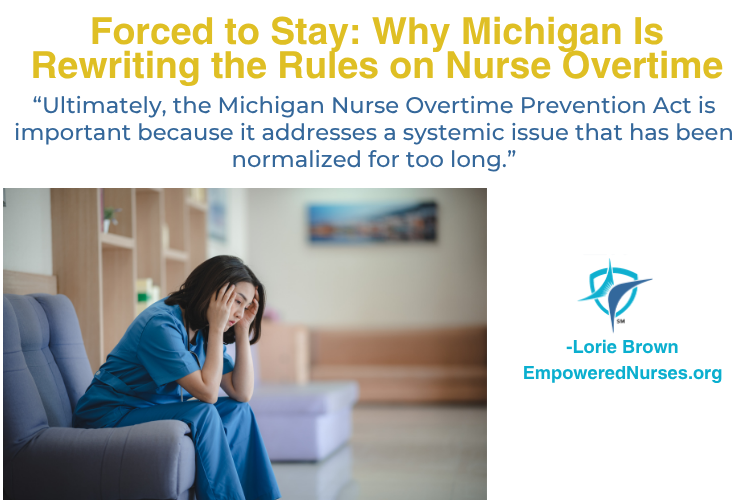
  3. Forced to Stay: Why Michigan Is Rewriting the Rules on Nurse Overtime

    Leave a Comment

    The proposed Michigan Nurse Overtime Prevention Act, reflected in Senate Bills 296 and 297, addresses a long-standing gap in workplace protections for nurses by placing limits on mandatory overtime. For years, many hospitals have relied on extending nurses’ shifts beyond their scheduled hours to fill staffing gaps. In Michigan, there has been no meaningful statutory ceiling on how long a nurse can be required to work, which has allowed shifts to extend well beyond what most would consider reasonable or safe. This legislation is designed to correct that imbalance by restricting when and how employers can require additional hours.

    Under the proposed framework, hospitals would generally be prohibited from mandating overtime beyond a nurse’s scheduled shift or agreed-upon on-call time. The law does recognize that healthcare is not entirely predictable, so it allows limited exceptions in clearly defined circumstances such as declared emergencies, disasters, or unforeseen situations where patient care would be compromised if a nurse left immediately. Even in those cases, the extension is tightly constrained. The legislation also introduces a required rest period, ensuring that nurses have a minimum number of consecutive hours off between shifts, and it explicitly prohibits retaliation against nurses who decline overtime that falls outside of those narrow exceptions.

    This matters because fatigue is not just a workforce issue; it is a patient safety issue and a legal risk issue. When individuals are required to work extended hours without adequate rest, the likelihood of errors increases. In a clinical environment, those errors can have serious consequences. Despite that, accountability has historically been placed on the individual nurse rather than on the system that created the conditions. By establishing enforceable limits, the law shifts some responsibility back to institutions and requires them to plan staffing in a way that does not depend on overextending their workforce.

    There is also a fairness component that cannot be ignored. Mandatory overtime places nurses in a position where refusing additional hours can carry professional consequences, even when the refusal is grounded in legitimate concerns about safety or capacity. The proposed protections change that dynamic by giving nurses a legal basis to decline overtime without fear of discipline. That shift reinforces the idea that professional judgment includes recognizing one’s limits, not ignoring them.

    Opposition to the legislation has largely centered on concerns about staffing shortages and operational flexibility. Healthcare organizations argue that restricting mandatory overtime could make it more difficult to cover shifts, particularly in already strained systems. However, that argument highlights the underlying issue: many facilities have been relying on overtime as a primary staffing solution rather than a contingency. The legislation forces a reevaluation of that approach and encourages more sustainable workforce planning.

    The implications extend beyond Michigan. Standardizing limits on mandatory overtime would create more consistent expectations across states, reducing variability in working conditions and helping to establish a national baseline for safe staffing practices. It would also provide clearer

    parameters for liability. When there are defined legal limits on work hours and required rest periods, it becomes easier to assess whether an employer met its obligations or contributed to unsafe conditions.

    Adopting similar laws nationwide would represent a structural shift in how healthcare systems manage staffing. It would move the industry away from reactive, short-term fixes and toward proactive planning that prioritizes both workforce sustainability and patient safety. It would also align healthcare with other industries where fatigue-related risks are already regulated, such as aviation and transportation.

    Ultimately, the Michigan Nurse Overtime Prevention Act is important because it addresses a systemic issue that has been normalized for too long. It establishes boundaries, creates accountability, and recognizes that safe care depends not only on skill and training, but also on conditions that allow professionals to perform at their best.

  4. The $30,000 Sign-On Bonus: Opportunity or Inequity?

    Leave a Comment

    Indiana University Health is offering registered nurses up to $30,000 in sign-on bonuses. At first glance, that sounds like a win. It is significant money, and for many nurses it could ease financial pressure, help with loans, or make a transition possible that otherwise would not be. There is no question that healthcare systems are competing for nurses right now, and this is one way they are trying to fill open positions quickly.

    But this is where the conversation needs to slow down, because the headline number does not tell the whole story. These bonuses are not simply a gift. They are tied to a commitment. In most cases, nurses are required to stay for a set period of time, often one to three years, and if they leave early, they are required to pay that money back. That changes the nature of the offer. It is not just a bonus. It is a contractual obligation. If the job turns out to be very different than expected, leaving can come with a financial consequence that feels heavy and limiting.

    There is also another issue that is much harder to ignore. Nurses who are already working in these systems are watching this happen in real time. They have stayed, contributed, trained others, and carried the workload, and now they are seeing new hires come in with large financial incentives that they themselves never received. That creates a sense of imbalance. It is not about jealousy. It is about fairness. When loyalty and experience are not recognized at the same level as recruitment, it can feel like the people who stayed are being overlooked.

    This is not just about one organization. It reflects a broader pattern across healthcare. Systems are putting significant resources into bringing in new nurses, but not always investing at the same level in keeping the ones they already have. Over time, that creates instability. It becomes a cycle where nurses leave, incentives increase, new nurses come in, and the same challenges continue. The focus stays on filling positions rather than addressing why those positions keep opening.

    From a business standpoint, offering large sign-on bonuses is a strategy. It is designed to respond quickly to staffing shortages. From the perspective of the nurse, it can feel inequitable. Both of those realities exist at the same time. What matters is understanding what this really represents. If an organization is willing to offer $30,000 to bring someone in, that says something very clear about the demand for nursing skills.

    For nurses considering one of these roles, it is important to look beyond the number. The terms of repayment, the length of the commitment, the work environment, and the reason the position is open all matter. For nurses already working within these systems, this may be a moment to reassess compensation, ask questions, and consider whether their current role reflects their true value in the market.

    A $30,000 sign-on bonus is not just a financial offer. It is a signal. The question is not simply whether it is attractive. The question is whether the full picture aligns with what you want for your career, your finances, and your future.

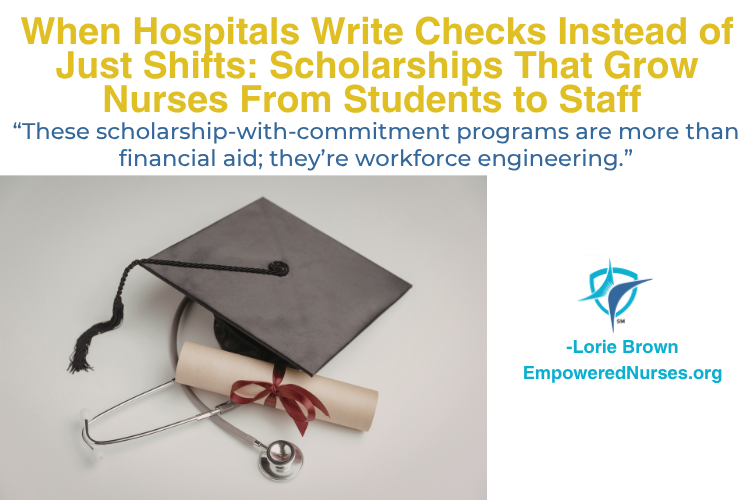
  5. When Hospitals Write Checks Instead of Just Shifts: Scholarships That Grow Nurses From Students to Staff

    Leave a Comment

    Imagine a hospital unit on its busiest night shift: alarms beeping like a broken metronome, IV pumps humming, nurses darting like seasoned ballet dancers between rooms—all trying to keep the patient carousel moving safely. Now imagine doing that with fewer dancers every year. That’s the reality hospitals are facing across the country—a rhythm of care stretched thin. Enter a strategy that feels almost like a heart-to-heart intervention: hospitals paying nurses’ tuition in exchange for committed years of service.

    Recently, Methodist College launched a bold scholarship tied to work commitment: full tuition for students in its accelerated nursing program—if they agree to work at a Methodist Hospital for four years after graduation. It’s as if the hospital is saying, “We’ll invest in your future—if you’ll invest in ours.”

    Let’s unpack the story in a way that resonates with nurses and future nurses alike.


    💉 The Nursing Shortage Isn’t Theoretical—It’s Real

    Healthcare leaders talk about nursing shortages the way clinicians talk about sepsis: it’s not something that might happen—it’s happening now and has been happening for a long time. Nationwide, hospitals are losing more nurses than they can replace year after year, especially in acute care settings where patient acuity is rising faster than the workforce.

    From a nurse’s perspective, this isn’t just a staffing number—it’s longer hours, more burnout, and the constant pressure of keeping patient care safe with fewer hands on deck.


    📚 Scholarships With Strings—But Meaningful Ones

    You might read “scholarship with a work commitment” and think, strings attached! But in reality, these are often lifelines:

    · Financial relief on tuition—nursing school isn’t cheap, and many students graduate with heavy loan burdens.

    · Guaranteed job placement—a promise of work after graduating (and passing boards) gives students peace of mind.

    · Experience in practice settings that need you most—often the high-acuity units that keep hospitals humming.

    That’s exactly the equation with the Methodist program: full tuition in exchange for four years of service. You can picture that commitment like a clinical rotation with purpose—you learn, you

    give back, and you grow into the nurse you trained to be. The problem becomes what if you do not like being a nurse in acute care or do not feel like it is a healthy work environment. You are stuck or will have to pay back the money. I always say you can always find another job but not another license.


    ❤️ A Win-Win That Feels Like Team Nursing

    From a nursing analogy, think of this as primary assignment continuity: when the nurse knows the patient, the story, the trends, and has the time and support to intervene early. That continuity reduces errors, builds relationships, and improves outcomes.

    Hospitals are essentially saying, “We want that kind of continuity with your career.” They aren’t just hiring bodies—they’re building teams.

    For students, it’s like entering a longitudinal clinical experience with housing, tuition, and income support already in place. For hospitals, it’s investing in workforce sustainability in the same way you’d invest in a critical piece of technology—because the alternative is always more costly in time, staffing, and compassion fatigue.


    📈 Why This Matters to Nursing’s Future

    These scholarship-with-commitment programs are more than financial aid; they’re workforce engineering. They’re designed to:

    · Attract career changers like the adult learner who spent decades in another field before pursuing nursing.

    · Reduce new grad anxiety about employment and financial stress.

    · Grow loyalty and mentorship pathways within hospitals.

    Think of it as starting orientation before school even begins—students are part of a system that values them, supports them, and in return, asks them to be part of the solution.


    🏥 Beyond One Hospital—A National Trend

    Programs like the federal Nurse Corps Scholarship Program work on a similar principle: pay for tuition in exchange for service in critical shortage facilities after graduation. There are also tuition assistance and work-commitment programs in other health systems across the country.

    These initiatives are healthcare systems thinking like nurse educators and clinical managers: prevention first. Prevent the shortage by investing in the people who actually give the care.


    ✨ In Nurse Terms: A Healing Plan for the Profession

    If the nursing workforce were a patient, this would be one of the early order sets in its treatment plan:

    · Reduce financial stress

    · Improve staffing continuity

    · Support career development

    · Enhance retention with meaningful commitments

    And just like in clinical practice, solid teams with adequate support have better outcomes—not just for patients, but for the clinicians who care for them.

    Here’s to hospitals that step up not just as employers, but as partners in training the next generation of nurses. Here’s to students who answer the call even when it feels like a long haul. And here’s to the profession itself, finding creative, grounded ways to keep its heart beating strong.

  6. The Board Matter No Nurse Sees Coming

    Leave a Comment

    Most nurses do not walk into a shift thinking, One day I may have to defend my license.

    They worry about patients. They worry about staffing. They worry about whether they charted enough, moved fast enough, caught enough, documented enough, and gave enough. They worry about being a good nurse.

    And that is exactly why a board matter hits so hard.

    Because when a nurse gets that letter, that notice, that complaint, the reaction is often not arrogance. It is disbelief.

    Me? How could this happen? I am a good nurse.

    That is the part people do not talk about enough. Many nurses who find themselves facing a licensing issue are stunned. They never saw themselves as reckless or dangerous. They saw themselves as caring, committed, stretched thin, doing their best in a system that often asks for more than any human being can safely give. And yet, according to NSO, citing National Practitioner Data Bank data, nursing professionals were on average 47 times more likely to be involved in an adverse licensing action than a medical malpractice payment in 2020. (NSO)

    That number should stop every nurse in her tracks.

    For years, nurses have been taught to fear the lawsuit. The malpractice case is the boogeyman. It is the thing that sounds dramatic, and career-ending. But the more likely threat may not be a malpractice payment at all. It may be the Board of Nursing.

    And when that happens, many nurses make another painful mistake: they assume the board will “understand.”

    They assume the board is made up of nurses, so surely it will see what the shift was like. Surely the Board members will understand the chaos, the impossible assignment, the split-second judgment call, the patient who was spiraling, the physician who never called back, the coworker who did not help, the manager who threw them under the bus. Surely someone will look at the full picture and say, This nurse was trying her best.

    But that is not the board’s job.

    Boards of nursing exist to protect the public, not to protect the nurse. NCSBN states that nursing regulators exist in their mandate to protect the public, and that boards of nursing were established to protect the public’s health and welfare by ensuring safe nursing practice and taking action when nurses exhibit unsafe practice.

    That truth can feel brutal when you are the one under investigation.

    It does not mean the board is evil. It does not mean every complaint is valid. It does mean that the nurse who walks into the process expecting understanding may be walking into it with the wrong mindset. The Board is not there to be your preceptor, your mentor, your union rep, your therapist, or your best friend from night shift who knows you have a good heart. The Board is there to evaluate whether the public needs protection.

    And that is why so many nurses are caught emotionally flat-footed.

    They think, If I just explain what happened, they will see I am a good nurse.

    But being a good nurse and being the subject of a board matter are not mutually exclusive. Good nurses get reported. Good nurses make mistakes. Good nurses work in broken systems. Good nurses get accused. Good nurses sometimes say the wrong thing, document poorly, trust the wrong person, react badly under pressure, or fail to realize that what felt like a hard day at work has now become a licensing issue.

    NSO also explains that board-related matters can arise from far more than classic bedside negligence. License defense matters may stem from complaints involving clinical care, but also issues such as substance use, unprofessional conduct, billing fraud, scope-of-practice concerns, and documentation problems. (NSO)

    That is what makes this so frightening.

    A nurse can be faithfully showing up, working overtime, covering holes, trying to keep patients safe, and still end up blindsided by a complaint. Then comes the shame. The panic. The nausea. The sleepless nights. The fear of telling a spouse. The terror of wondering whether the career you worked so hard for could be scarred, suspended, or stripped away.

    Because a license is not just a piece of paper.

    It is years of sacrifice. It is tired feet and missed lunches. It is holidays worked and family dinners missed. It is studying when you were exhausted, crying in your car, learning on the fly, and carrying responsibility that most people will never fully understand. So, when your license is threatened, it does not feel like an administrative matter. It feels personal. It feels like someone has reached into the center of your identity and put a question mark where your confidence used to be.

    That is why nurses must stop assuming, I’m a good nurse, so this could never happen to me.

    That belief is comforting, but it is not protective.

    The more protective belief is this: I am a good nurse, and because my license matters, I must follow the Nurse Practice Act to the letter, follow the facilities policies and procedures to the letter and take any Board issue seriously from the very beginning.

    Not because you are guilty. Not because you are weak. Not because you have failed.

    But because the Board’s mission is not to reassure you. Its mission is to protect the public.

    Nurses need to understand that early. The nurse who treats the first board letter like a minor misunderstanding may be making the worst mistake of all. Hope is not a response strategy. Good intentions are not a legal defense. And shock is not a shield.

    If there is one takeaway every nurse should carry, it is this:

    Do not wait until your world is upside down to understand what is at stake.

    Protect your license with the seriousness it deserves. Respect the process for what it is. And never assume that because you are a good nurse, you are immune from scrutiny.

    Sometimes the nurses most surprised by a board matter are the very ones who never imagined they would need to prepare for one.

    And that is exactly why they should.

  7. When a Nursing Board Is Overhauled, Nurses Should Pay Attention

    Leave a Comment

    Most nurses do not wake up in the morning thinking about the Board of Nursing.

    They think about their patients. Their charting. Their coworkers. Their family. Their next shift. Their next cup of coffee that will probably be cold before they get to finish it.

    And that is exactly why stories like this matter.

    Because while nurses are busy taking care of everyone else, the rules that govern their licenses can change quietly, dramatically, and with life-changing consequences. In Kansas, lawmakers have now pushed through a major overhaul of the state nursing board system through House Bill 2528, a bill that passed both chambers and was reported on March 27, 2026, as headed to the governor’s desk. The bill does not nibble around the edges. It reaches back more than 20 years and would void certain disciplinary actions and records tied to non-practice licensing and renewal issues dating to January 1, 2005. (Kansas Reflector)

    Sit with that for a moment.

    Twenty years.

    That is not a policy adjustment. That is not a paperwork cleanup. That is a defibrillator shock to a regulatory system.

    Supporters of the bill have argued that Kansas nurses were being disciplined too harshly for matters that did not involve patient care — things like licensing, renewal, reinstatement, or practicing while a license had lapsed or expired. Legislative materials and testimony summaries reflect that concern directly. Opponents, including board representatives and others, warned about implementation problems and public-safety concerns if too many “unprofessional conduct” matters were swept away. (Kansas State Legislature)

    As if the overhaul itself were not dramatic enough, the board’s executive administrator also announced her retirement in the middle of it all. Carol Moreland’s March 25, 2026 retirement announcement came while the Legislature was pushing HB 2528, a bill designed to significantly curb and restructure the board’s authority. That kind of timing does not read like business as usual. It reads like a system under pressure. And for nurses, that should be a wake-up call: the rules, the regulators, and even the leadership of the agency overseeing your license can change faster than most nurses ever imagine.

    And that tension is the real story.

    Because this is not just about Kansas.

    This is about a question every nurse should be asking: What is a board of nursing actually for?

    The Kansas State Board of Nursing says plainly that its role is to protect the citizens of Kansas and to assure minimum competence through regulation, licensing, and investigation when conduct is questioned. That is the standard line for boards across the country, and nurses need to remember it. The board is not your coworker. It is not your preceptor. It is not your nurse friend from night shift who “gets it.” It is a regulatory body. Its mission is public protection. (ksbn.kansas.gov)

    That misunderstanding hurts nurses every single day.

    Too many nurses believe that if they are a good nurse, if they meant well, if no patient was harmed, someone at the board will surely understand.

    Sometimes that happens.

    Sometimes it does not.

    And when a board starts treating administrative or renewal issues like character defects rather than what they really are, nurses can end up carrying disciplinary baggage that follows them for life. A missed renewal. A lapsed license. A technical violation. Something that did not involve bedside care at all can still become a stain that affects employment, reputation, income, and peace of mind. HB 2528 directly targets that kind of discipline by voiding specified actions related to non-practice violations and by redefining “unprofessional conduct” so it does not include behavior unrelated to the nurse’s practice, such as failure to timely renew a license or late payment for civil debts.

    That should make every nurse pause.

    Not because this bill necessarily got everything right.

    But because it exposes something nurses already know in their bones: a licensing issue can become a career issue faster than most people realize.

    One minute you think you are dealing with a technical problem.

    The next minute you are trying to explain a board matter on job applications, credentialing forms, insurance panels, and future opportunities. Your stomach drops. Your confidence drains. You are not just defending a license. You are defending your name.

    That is why I believe nurses need to pay close attention whenever a legislature starts restructuring board power.

    Under HB 2528, the changes go beyond voiding past discipline. The bill also requires more renewal notices, creates a process for late renewal, limits some investigations, adds protections against retaliation for certain lawful acts done in good faith, provides for Senate confirmation of board members, and requires more communication from the board to licensees. The fiscal note says the board itself projected more than $1.6 million in additional FY 2027 expenditures and 21 added positions to carry out the bill’s requirements, which tells you this is not a cosmetic rewrite. It is a full-scale operational overhaul.

    So, what should nurses take from this?

    First, never assume the board will view your situation the way you do.

    You may see a renewal issue. The board may see noncompliance. They believe you would not let your driver’s license expire so why would you allow this with your nursing license.

    You may see an honest mistake. The board may see grounds for action.

    You may see your years of good practice. The board may focus on the one moment that fits inside a statute or rule.

    Second, nurses need to stop treating licensure issues like they are minor until they are not.

    A board matter is never just administrative once it has your name attached to it.

    Third, this Kansas story is a reminder that regulatory systems are built by people, and what people build can be changed. If lawmakers are willing to say that years of prior enforcement went too far, then nurses elsewhere should be asking hard questions about how their own boards investigate, prosecute, and discipline non-practice conduct.

    There is also a deeper emotional truth here that the legal language can miss.

    When nurses get that letter from the board, many are blindsided.

    They are good nurses.

    They worked short-staffed.

    They stayed late.

    They skipped lunch.

    They held hands, caught errors, advocated, documented, and did the work.

    So, when the board comes calling, it feels personal. It feels like betrayal. It feels like being told that all the good they did somehow evaporated because of one accusation, one technical issue, one lapse, one complaint.

    That is why this moment in Kansas matters.

    It shines a harsh light on the gap between what nurses think boards are there to do and what boards are actually empowered to do.

    And if this bill becomes law, it may offer relief to some nurses whose records were marked by non-practice disciplinary actions that lawmakers now believe should never have carried that weight in the first place. At the same time, it raises serious questions about where the right line should be between accountability, fairness, and public protection. (Kansas Reflector)

    Nurses should care about that line.

    Because your license is not just a credential.

    It is your livelihood. It is your leverage. It is your professional identity. And once the machinery of discipline starts moving, it can feel a lot less like a fair review.

    Kansas is reminding the country of something important: licensing power matters. Board power matters. And nurses ignore those realities at their own peril. (ksbn.kansas.gov)

    Your legislators may be able to help if you believe you are being treated unfairly by the Board. It took a few nurses to speak up in Kansas and look what happened!

  8. Clarity is not something you wait for. It’s something you create.

    Leave a Comment


    Confusion is just a trick of your mind to prevent you from living your dream.

    Most nurse business owners don’t lack information—they’re drowning in it. Courses, webinars, strategies, templates. On paper, it looks productive. In reality, it often becomes a sophisticated way to avoid making a decision.

    When you feel stuck or uncertain, the issue usually isn’t confusion. It’s a lack of a decision-making filter.

    David Neagle offers a simple four-question framework that forces clarity. Not motivational. Not abstract. Just direct.

    1. Is this something I want to be, do, or have?

    Start here. Strip away what you “should” do or what others are doing.

    Do you actually want this?

    For example, you might say yes to a web class. You want the knowledge, the exposure, the potential opportunity. That’s valid. This question simply confirms desire—it doesn’t justify action.

    2. Is this taking me closer to my goal—or further away?

    This is where most decisions fall apart.

    You can want something and still recognize it’s not the right move right now.

    If your goal is to enroll clients and you already know the most direct path is making sales calls, then another web class—no matter how valuable—moves you further away from your goal in this moment.

    Not because it’s bad. Because it’s not the priority.

    Clarity requires distinguishing between what is useful and what is necessary.

    3. Is this in alignment with Universal Law (more life to all)?

    This is your alignment check.

    Does this action contribute in a positive way? Does it create value without manipulation or scarcity?

    Most business activities—learning, marketing, networking—will pass this test. They are not harmful. They are not unethical.

    But passing this question doesn’t automatically mean you should do it. It simply confirms that the action is clean.

    4. Does this violate the rights of others?

    This is your ethical boundary.

    Are you pressuring, misleading, or taking away someone else’s ability to choose?

    In most cases, the answer is no. You’re operating within integrity.

    When you run decisions through these four questions, the noise drops quickly.

    You stop defaulting to more learning when what you actually need is execution.

    You stop confusing activity with progress.

    And you start making decisions based on your goal—not your mood, not your fear, and not what everyone else is doing.

    Here’s the uncomfortable truth:

    Most nurse business owners already know what will move their business forward.

    They just hesitate to do it.

    So instead, they look for one more class, one more strategy, one more piece of reassurance.

    These four questions don’t give you new information.

    They remove your ability to hide from what you already know.

  9. Medical Errors: Why This Healthcare Crisis Deserves Far More Attention

    Leave a Comment

    When most people think about the leading causes of death in the United States, they think of heart disease, cancer, and accidents.

    What they usually do not think about is medical error.

    That is part of the problem.

    A widely cited 2016 BMJ analysis estimated that medical error may account for more than 250,000 deaths annually in the United States, which would place it behind only heart disease and cancer. That estimate helped spark national attention to patient safety. At the same time, experts have since debated whether the “third leading cause of death” phrasing is the best way to describe the problem, because medical errors are difficult to define and are not consistently captured on death certificates. Even with that debate, the larger truth remains: preventable harm in healthcare is a major public health crisis.

    Healthcare is supposed to heal. But too often, patients are harmed not because of the illness that brought them in, but because something in the system broke down. A medication was ordered incorrectly. A critical lab value was missed. A diagnosis was delayed. A handoff was incomplete. A warning sign was documented, but not acted on. The patient pays the price for a chain of failures that should never have lined up in the first place. AHRQ notes that medical errors can occur across the healthcare system, including hospitals, clinics, surgery centers, physician offices, nursing homes, and pharmacies.

    That is why this issue hits so hard for nurses.

    Nurses are at the bedside. We are often the first to see the subtle change, the near miss, the medication discrepancy, the family concern that does not quite fit the chart, or the patient who “just doesn’t look right.” We know patient safety is not an abstract policy topic. It is the pulse ox alarming at 3 a.m., the unread note, the missed follow-up, the staffing shortage, the rushed handoff, the quiet dread that comes when too many tasks are stacked on too few shoulders.

    In other words, medical errors are rarely just “bad individual choices.” More often, they are symptoms of a sick system.

    And just like in clinical practice, if you treat only the symptom and ignore the underlying condition, the patient gets worse.

    The Real Problem Is Bigger Than Blame

    One of the most damaging responses to medical error is the rush to find a single person to blame.

    Yes, individuals must be accountable. But if we stop there, we miss the diagnosis.

    Patient safety experts have long emphasized that harm usually results from multiple breakdowns rather than one reckless act. Poor communication, fragmented documentation, understaffing, fatigue, confusing technology, production pressure, inadequate training, and flawed protocols all contribute to preventable harm. AHRQ and PSNet both frame patient safety as a systems issue, not merely an individual issue.

    Think of it like sepsis. The fever may be what everyone sees first, but the fever is not the whole disease. If you only chase the temperature and ignore the infection, you have not solved the problem.

    Medical errors work the same way. The error you can see is often just the final manifestation of deeper operational failures.

    Why the Numbers Are So Hard to Measure

    One reason this crisis remains underappreciated is because our reporting systems do a poor job of capturing it.

    The CDC’s official leading-cause-of-death tables are based on death certificate coding, and medical error is not listed as its own category. That means many deaths involving preventable harm are folded into categories such as heart disease, cancer, or respiratory failure, even when a serious error contributed to the outcome. This coding structure obscures the true toll of medical error.

    That does not mean every estimate is precise. It means the opposite: the true number is hard to know because the system was not built to measure it well. Later commentary from patient safety experts has argued that some estimates may be too high, while still acknowledging that preventable in-hospital deaths remain alarmingly common.

    So whether someone agrees with the exact ranking or not, this is not a rounding error. It is not a footnote. It is a flashing red warning light on the dashboard.

    What This Means for Nurses

    For nurses, this conversation is personal.

    Because when systems fail, nurses often carry the emotional aftermath.

    We are the ones explaining delays to families. We are the ones catching the discrepancy before it reaches the patient — or living with the pain when it does. We are the ones expected to hold the line for safety while working inside environments that can make safe practice harder than it should be.

    That is why the conversation about medical errors cannot stop at awareness. It has to move into advocacy.

    Nurses must feel empowered to speak up about unsafe staffing, broken workflows, poor communication, inadequate orientation, and retaliation against those who report concerns. A culture of fear does not create safer care. It creates quieter units and sicker outcomes.

    Silence is not safety. It is just delayed charting on a disaster.

    Patients Need Transparency, Not Spin

    Patients deserve honest conversations about risk.

    They deserve healthcare organizations that do more than hang posters about safety week and call it progress. They deserve systems that learn from near misses, encourage reporting, analyze root causes honestly, and invest in prevention before harm occurs.

    Safety is not built through slogans. It is built through staffing, training, communication, humility, and accountability.

    And perhaps most importantly, safety is built when healthcare leaders stop treating frontline warnings like background noise.

    Because the bedside usually knows before the boardroom does.

    Where Do We Go From Here?

    We need a healthcare culture that treats patient safety the way clinicians treat a deteriorating patient: urgently, systematically, and without denial.

    That means:

    · improving reporting systems for preventable harm

    · strengthening handoff communication

    · addressing fatigue and staffing shortages

    · designing smarter, safer workflows

    · reducing punitive responses that discourage reporting

    · listening to nurses and other frontline clinicians before harm escalates

    The goal is not perfection. Healthcare is complex, and human beings are human beings.

    But “complex” should never become a polite synonym for “acceptable.”

    Preventable harm should provoke the same response as any other emergency: assess quickly, intervene early, and fix the underlying cause before more lives are lost.

    Final Thought

    Whether medical error is labeled the third leading cause of death or described more cautiously as one of the most significant sources of preventable harm in U.S. healthcare, the conclusion is the same: this is a crisis we cannot afford to normalize.

    Behind every statistic is a patient who trusted the system.

    Behind every preventable death is a family whose life changed forever.

    And behind many of those tragedies is a nurse who saw the cracks, spoke up, and still had to watch the system move too slowly.

    That should break our hearts.

    And it should also move us to action.

  10. The Most Important Document: Your Performance Review

    Leave a Comment


    A performance review is one of the few documents your employer creates that formally evaluates your competence, behavior, and overall practice as a nurse. And yet, most nurses sign it, maybe skim it, and never think about it again.

    That’s a mistake.

    You should always keep a copy of your performance review—because it can protect you, support you, and, in some situations, save you.

    First, it’s objective evidence of your practice. In nursing, we live and die by documentation. If it’s not charted, it didn’t happen. The same principle applies to your career. A performance review is written proof that, at a specific point in time, your employer evaluated you as competent, safe, or even exemplary. If your job is ever questioned later—whether internally, legally, or before a board—that document becomes part of your defense. It shows who you were before any issue arose.

    Second, it protects you from shifting narratives. Healthcare environments change fast. Leadership turns over. Policies evolve. What was acceptable practice one year may be scrutinized the next. And sometimes, when there’s a problem, organizations look backward and start building a story. If you don’t have your own records, you’re relying on theirs. Keeping your performance reviews ensures you have your version of the documented truth.

    Third, it gives you leverage. When you’re applying for a new role, negotiating compensation, or stepping into something outside of traditional nursing, you need more than confidence—you need proof. Performance reviews highlight your strengths, consistency, and contributions in a way that resumes and interviews simply can’t. They’re third-party validation, and that carries weight.

    Finally, it keeps you grounded in reality. Nursing has a way of making even very good nurses question themselves. A tough manager, a bad shift, or one mistake can distort how you see your own competence. Your performance review cuts through that noise. It’s a written record of how you’ve actually been performing—not how you feel on your hardest day.

    The bottom line is simple: keep your performance reviews somewhere you control. Download them. Print them. Email them to yourself. Don’t assume you’ll always have access to your employer’s system.

    Because just like with patient care, when something matters—you don’t leave the documentation behind.

As Seen On:

Women's Week