


She Came for Hydration. She Didn’t Go Home.
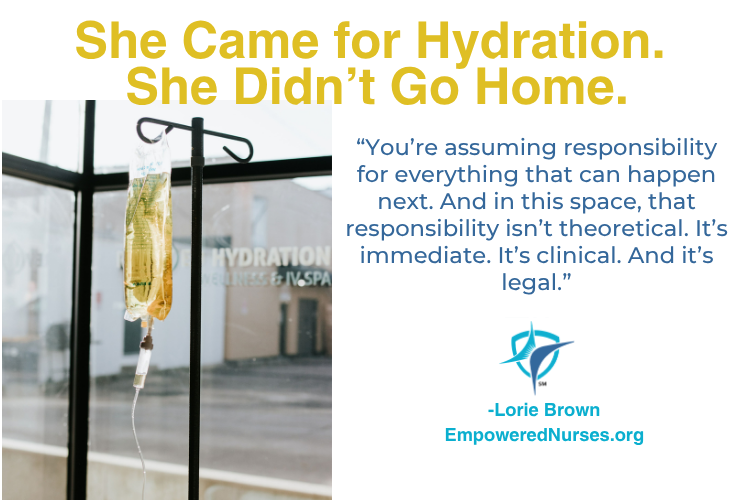
There’s a quiet shift happening in nursing—and it’s not happening in hospitals.
It’s happening in med spas, IV lounges, and private treatment rooms where nurses are stepping into esthetics and wellness-based services. On the surface, it looks like freedom. Better hours. Cash-based services. Autonomy. Control. And for many nurses, it is exactly that.
But beneath that opportunity is something far less talked about—and far more dangerous.
Recently, a patient death tied to IV therapy in a non-hospital setting sent shockwaves through the healthcare and legal communities. Not because IV therapy is inherently dangerous—we both know it isn’t when done appropriately—but because of how quickly things can go wrong when clinical judgment, oversight, and safeguards are diluted outside of traditional settings.(A phlebotomist did the IV infusion, not a nurse).
This is where the conversation needs to get real.
In a hospital, you have layers of protection. Protocols. Rapid response teams. Pharmacy oversight. Equipment within arm’s reach. Colleagues who can step in when something feels off. If a patient has a reaction, decompensates, or crashes, you are not alone.
Now remove those layers.
Place a nurse in a spa setting. A client in a reclining chair. A bag of fluids marketed as “wellness,” “hydration,” or “energy boosting.” Maybe a cocktail of vitamins. Maybe a medication adjunct. The environment feels relaxed. The client feels healthy. The perceived risk feels low.
But physiology does not care about the setting.
Anaphylaxis doesn’t announce itself politely. Fluid overload doesn’t ask whether this is a spa or an ICU. Electrolyte imbalances don’t adjust themselves because the patient paid cash.
And when something goes wrong, the margin for error is razor thin.
The case involving a patient death during IV therapy underscores several critical fault lines that nurses stepping into esthetics must understand with absolute clarity.
First, scope of practice is not flexible just because the setting is. Whether you are in a hospital, a med spa, or a mobile IV business, your license follows you. State boards do not make exceptions for “wellness environments.” If anything, they scrutinize them more closely because of the variability in oversight.
Second, medical screening is not optional—it is the standard of care. Every IV infusion carries risk. Cardiac history, renal function, medication interactions, allergies—these are not
checkboxes. They are clinical decision points. Skipping or minimizing this process is where liability begins to build.
Third, standing orders and medical direction must be legitimate, active, and meaningful. A “medical director on paper” who is not truly engaged is not protection. It is exposure. If something goes wrong, investigators will look closely at the relationship, the protocols, and whether real supervision existed.
Fourth, emergency preparedness is not a formality—it is survival. Do you have emergency medications? Do you know your exact protocol for anaphylaxis? Is your equipment functional and immediately accessible? Can you manage an airway until EMS arrives? In a hospital, these are assumed. In a spa, they are often overlooked—until it is too late.
And finally, documentation and informed consent must reflect reality, not marketing language. If a service is positioned as casual or low-risk, but the intervention is clinical, that disconnect becomes a liability problem the moment an adverse event occurs.
This is where many nurses get blindsided.
They enter esthetics for the right reasons—autonomy, income, flexibility—but underestimate the legal weight of what they are doing. IV therapy is not just a “service.” It is a medical intervention. And the standard of care doesn’t lower just because the lighting is softer and the music is better.
The patient who died didn’t expect that outcome. No one ever does.
But from a legal perspective, the question is never whether harm was intended. The question is whether the standard of care was met—and whether the nurse recognized, anticipated, and prepared for foreseeable risks.
That’s the part that separates a thriving nurse business from one that ends in a board complaint, a lawsuit, or worse.
There is absolutely a place for nurses in esthetics. In fact, nurses are uniquely positioned to elevate the safety and integrity of this space. But that only happens when clinical rigor travels with you—when you bring the same level of assessment, vigilance, and accountability into every setting, regardless of how it looks on the outside.
Because the moment you hang that IV bag, you’re not just offering hydration.
You’re assuming responsibility for everything that can happen next.
And in this space, that responsibility isn’t theoretical. It’s immediate. It’s clinical. And it’s legal.


Comments are closed