


Forced to Stay: Why Michigan Is Rewriting the Rules on Nurse Overtime
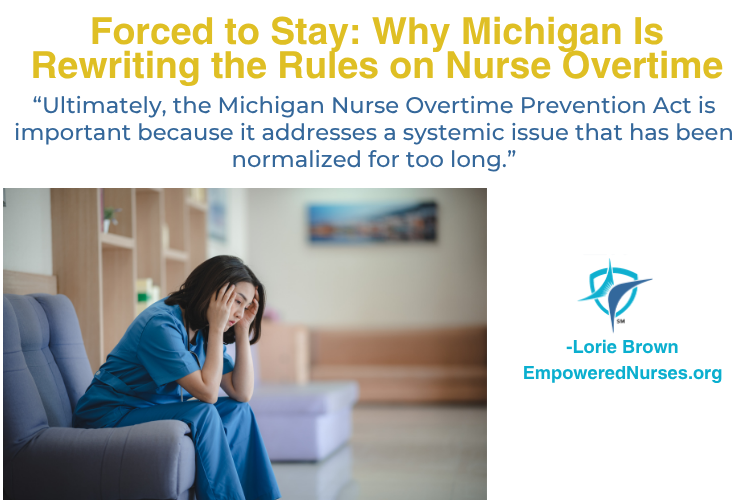
The proposed Michigan Nurse Overtime Prevention Act, reflected in Senate Bills 296 and 297, addresses a long-standing gap in workplace protections for nurses by placing limits on mandatory overtime. For years, many hospitals have relied on extending nurses’ shifts beyond their scheduled hours to fill staffing gaps. In Michigan, there has been no meaningful statutory ceiling on how long a nurse can be required to work, which has allowed shifts to extend well beyond what most would consider reasonable or safe. This legislation is designed to correct that imbalance by restricting when and how employers can require additional hours.
Under the proposed framework, hospitals would generally be prohibited from mandating overtime beyond a nurse’s scheduled shift or agreed-upon on-call time. The law does recognize that healthcare is not entirely predictable, so it allows limited exceptions in clearly defined circumstances such as declared emergencies, disasters, or unforeseen situations where patient care would be compromised if a nurse left immediately. Even in those cases, the extension is tightly constrained. The legislation also introduces a required rest period, ensuring that nurses have a minimum number of consecutive hours off between shifts, and it explicitly prohibits retaliation against nurses who decline overtime that falls outside of those narrow exceptions.
This matters because fatigue is not just a workforce issue; it is a patient safety issue and a legal risk issue. When individuals are required to work extended hours without adequate rest, the likelihood of errors increases. In a clinical environment, those errors can have serious consequences. Despite that, accountability has historically been placed on the individual nurse rather than on the system that created the conditions. By establishing enforceable limits, the law shifts some responsibility back to institutions and requires them to plan staffing in a way that does not depend on overextending their workforce.
There is also a fairness component that cannot be ignored. Mandatory overtime places nurses in a position where refusing additional hours can carry professional consequences, even when the refusal is grounded in legitimate concerns about safety or capacity. The proposed protections change that dynamic by giving nurses a legal basis to decline overtime without fear of discipline. That shift reinforces the idea that professional judgment includes recognizing one’s limits, not ignoring them.
Opposition to the legislation has largely centered on concerns about staffing shortages and operational flexibility. Healthcare organizations argue that restricting mandatory overtime could make it more difficult to cover shifts, particularly in already strained systems. However, that argument highlights the underlying issue: many facilities have been relying on overtime as a primary staffing solution rather than a contingency. The legislation forces a reevaluation of that approach and encourages more sustainable workforce planning.
The implications extend beyond Michigan. Standardizing limits on mandatory overtime would create more consistent expectations across states, reducing variability in working conditions and helping to establish a national baseline for safe staffing practices. It would also provide clearer
parameters for liability. When there are defined legal limits on work hours and required rest periods, it becomes easier to assess whether an employer met its obligations or contributed to unsafe conditions.
Adopting similar laws nationwide would represent a structural shift in how healthcare systems manage staffing. It would move the industry away from reactive, short-term fixes and toward proactive planning that prioritizes both workforce sustainability and patient safety. It would also align healthcare with other industries where fatigue-related risks are already regulated, such as aviation and transportation.
Ultimately, the Michigan Nurse Overtime Prevention Act is important because it addresses a systemic issue that has been normalized for too long. It establishes boundaries, creates accountability, and recognizes that safe care depends not only on skill and training, but also on conditions that allow professionals to perform at their best.


Comments are closed