


Think Before You Post: As a Nurse, Social Media Is Not Free Speech
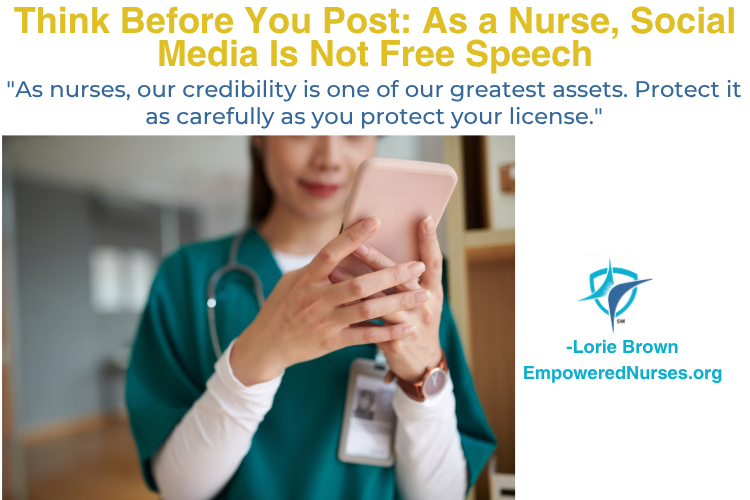
Many nurses believe that what they post on their personal social media accounts is protected by free speech. While the First Amendment protects people from government censorship in many circumstances, it does not protect most nurses from the employment consequences of what they choose to post online. If you are employed by a private hospital, healthcare system, or clinic, your social media activity can absolutely affect your job and, in some cases, even your nursing license.
A recent case illustrates this reality. A nurse employed by the University of Texas Medical Branch (UTMB) was terminated after posting a video that appeared to show her backing out of a patient’s room because Fox News was playing on the television. The video was intended by many to be humorous or satirical, but it was widely interpreted as suggesting that the nurse would treat patients differently based on their political beliefs. After an investigation, the hospital terminated her employment, stating that the video was inconsistent with its commitment to providing compassionate, unbiased care to every patient. (www.ndtv.com)
Whether you agreed with the nurse’s political views is completely beside the point.
The issue is public trust.
Patients come from every political party, religion, race, culture, and background imaginable. They must believe that when they enter a hospital, they will receive the same quality of care regardless of who they voted for, what news channel they watch, or what opinions they hold. When a nurse publicly posts content suggesting otherwise, it can damage not only that nurse’s credibility but also the public’s confidence in the nursing profession.
This is why nurses must think differently about social media than the average person.
As nurses, we are licensed professionals. We are held to standards that extend beyond our shifts. Boards of Nursing expect nurses to maintain professionalism, and employers expect conduct that reflects their mission and values. A single post made in frustration, as a joke, or in an attempt to gain followers can quickly become viral, be taken out of context, or remain online forever through screenshots—even after it has been deleted.
I frequently hear nurses say, “It’s my personal Facebook page,” or “I have the right to express my opinion.”
You certainly have the right to hold your opinions. But having the right to speak does not mean you are free from professional consequences. Your employer also has the right to determine whether your public statements undermine patient confidence, violate workplace policies, or create concerns about your ability to provide impartial care.
This applies far beyond politics.
Nurses have faced discipline or termination for posting patient information, complaining about employers, making derogatory comments about patients or coworkers, posting photographs from work, engaging in online bullying, or making statements that call into question their professionalism. Even when no patient names are mentioned, enough details may exist for someone to identify the individual, creating potential HIPAA violations and serious legal consequences.
Before you hit “Post,” ask yourself a few questions.
Would I be comfortable if my employer saw this?
Would I want my state’s Board of Nursing reviewing this post during an investigation?
Would I feel comfortable if one of my patients saw it?
Would I want this shown to a jury if I were ever involved in litigation?
If the answer to any of those questions is “no,” it is probably best not to post it.
The internet has a very long memory. Social media rewards instant reactions, but nursing demands thoughtful judgment. Those two worlds do not always work well together.
Your nursing license represents years of education, sacrifice, clinical experience, and trust. Don’t risk your career for a few seconds of online attention. The temporary satisfaction of posting something controversial is rarely worth the permanent professional consequences that may follow.
As nurses, our credibility is one of our greatest assets. Protect it as carefully as you protect your license.


Comments are closed