You’re a charge nurse on a Saturday night in a short-staffed (5 nurses) Washington state emergency room with 45 patients in the waiting room! What would you do?
One brave nurse finally had enough and decided to call 9-1-1 to ask for help from the fire and rescue team. Two firefighters went to the hospital and for almost 2 hours cleaned rooms, beds and took patient vital signs. Those “extra sets of hands” helped relieve the pressure for the beleaguered nurses.
I do not know whether administration was upset about this incident but, as nurses, we tend to feel like we must do everything ourselves and we cannot ask for assistance, much less venture outside the facility to seek help.
One notable benefit from this situation was the hospital developed a new relationship with the community fire department that provided its help and support at a most crucial time.
Previously, the local fire department had been transporting patients to this hospital and for months had been growing upset about the repeated delays in getting patients accepted for treatment.
However, this was only a temporary “Band-Aid” solution as it did not solve the hospital’s overall staffing problem.
Things in nursing are getting tougher and tougher. The healthcare system cannot keep going like this.
I am curious to see what changes are made to improve our system so no nurse ever needs to feel pressured like this.
DonQuenick Joppy was a good nurse who received three Daisy Awards while working at the Medical Center of Aurora in Colorado where she was the only black nurse on staff. Sadly, she was frequently humiliated and ignored by many of her coworkers and was denied growth opportunities.
At the Center, Ms. Joppy was assigned three patients in the ICU where the nurse-to-patient ratio should have been only one or two patients. She had tried to transfer out of the unit, but all of her requests were denied. She had been chastised for her presentation of improper body language and tone.
A physician had ordered “end-of-life care” for a 97-year-old patient and directed that the man’s ventilator be removed. When nurse Joppy tried to arrange for a respiratory therapist to remove the ventilator, she found the therapist was busy. However, the therapist walked Ms. Joppy through the steps to shut off the ventilator and the therapist then disconnected the ventilator after which the patient passed away, primarily due to septic shock, constant pneumonia, and bowel infarction.
Following an investigation, the hospital fired Ms. Joppy for not waiting until the arrival of the respiratory therapist to proceed. A year after she was terminated, the matter was turned over to a prosecutor and Ms. Joppy was charged with manslaughter, negligent death of an at-risk person and neglect of an at-risk person.
Fortunately, the criminal charges were dismissed “in the interest of justice.” But even though Ms. Joppy still has an active nursing license, she claims now that she is unable to get a job because of the manslaughter charge despite that charge being subsequently dropped. Ms. Joppy followed up by filing a discrimination complaint against the Medical Center.
My heart goes out to Ms. Joppy. Hers is a story that seems to be frequently heard. Currently, she is practically homeless for want of a job. For those sympathetic to Ms. Joppy’s situation, there is a GO FUND ME page to help.
I will be watching what happens with this lawsuit. Often attorneys do not want to take these types of cases because such are difficult to prove. However, I hope she will be vindicated.
The Nursing Service Organization (“NSO”) frequently gathers their claim status, data for nurses and nurse practitioners. Recently they finished the fifth edition of Claims for Nurse Practitioners.
Previously, there have been several studies showing that claims against Nurse Practitioners were fewer than those against physicians. They also show NPs tend to spend more time with patients and have better relationships with those they care for.
However, since 2017, malpractice claims against NPs have risen 10.5% and license discipline claims have gone up 19.5%. This is the largest increase in any 5-year-period. The study adds that neonatal, family practice and adult gerontology primary care NPs had the highest growth in malpractice claims.
It is interesting that these are the high-risk areas for Nurse Practitioners but according to the license defense claims data, it says that the number one area of professional licensing issues arises from professional misconduct and prescribing medications.
It would make sense that Nurse Practitioners who work in family practice and adult gerontology primary care would prescribe the most medications.
It is unfortunate that what is happening in nursing is also happening to Nurse Practitioners who are working an inordinate number of hours and are doing the same job as a physician for less pay, yet their malpractice and disciplinary claims are increasing.
I would love to see Nurse Practitioners being able to see a patient every 15 minutes rather than 10 minutes, thereby giving them time to see the patient and complete their documentation within the allotted period so they are not as stressed and can feel accomplished. If this scheduling occurs, I suspect we will see a decrease in malpractice and license protection claims.
As a business owner, it is so important that we are masters of our minds.
Dr. Joe Dispenza says that our body is really our mind because we are a system of habits. When we awaken, we unconsciously get out of bed, go to the bathroom, brush our teeth, put the coffee on and do the same habits we do every day. We’re thinking about what’s ahead of us or reflecting on what happened yesterday, whatever, but you’re not thinking about what you’re doing in the present moment.
Our bodies are running the show, not our minds.
As a business owner, it is so important that we master our minds and be conscious of what is happening around us, being present in the moment.
When I started as a business owner, I worked with my laptop from my son’s bedroom during the day and from my own bed at night going through medical records.
My work would be distracted frequently. “Oh, I need to do laundry,” or “I need to go to the grocery.” Something was always getting in the way. “I have to get to the bank!”
Then, every once in a while, I would feel like I just do not want to review medical records, “I’ll do some research, instead.” Or “I’m tired of doing research. I’ll call that attorney.” I was very controlled by my feelings.
It would be unusual if you felt like you wanted to work all the time. When you think about it, we work as a means to an end. Now, as much as I enjoy my work, I love my free time as well.
When I say I want to master my mind and emotions, it means if I am going to do something, I do it! Tony Robbins takes a cold plunge every morning, no matter where in the world he might be. It could be a pool; it could be a river. He doesn’t negotiate with himself but says, “When I say go, I go!”
Your mind will try to talk you out of doing things that you don’t like. But to be a successful business owner, there are always things that you just won’t like but there will be lots of things that you love. At times we have to go past “the yuck” to get to the good.
Therefore, mastering your mind is the most important thing to do to be a successful business owner.
Now, having read this, what are your takeaways? I would love to read your comments below.
I don’t know about you but when I was practicing (and even now), certain things would trigger me. So, I thought I would share these steps to help you work through times when you are triggered because being triggered at work can lead to mistakes in your practice, upset, frustration, resentment and makes you appear to your coworkers like you are not a team player.
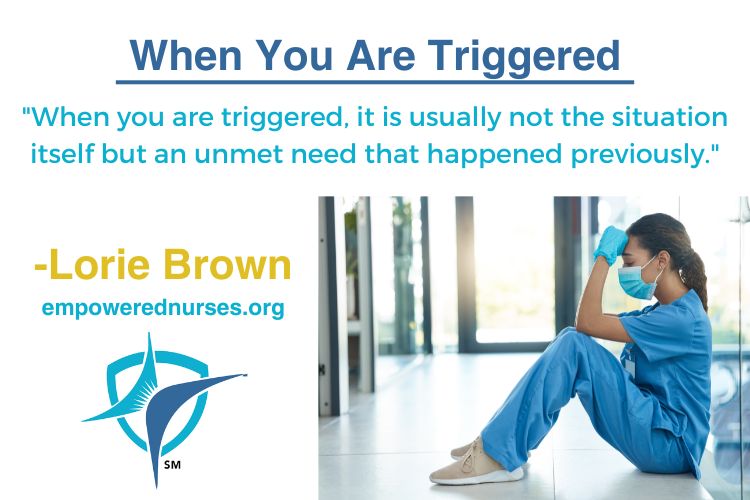
When you are triggered, it is usually not the situation itself but an unmet need that happened previously. For example, just the other day, a car cut me off in traffic. I got triggered. Was I really mad at the person that cut me off? No, it was deeper. It came from my childhood where I felt unseen, and it followed me today where I felt unseen when the driver cut me off. So, what do we do with these triggers?
I’ve been involved with a leadership program and these techniques came from leadership trainers Lisa Kalmin and Lynne Sheridan who provided these steps to navigate when you are being triggered.
1. Think about your most common triggers ahead of time, it helps.
2. In the moment, name what you are experiencing or feeling. I always joke you have to “name it to claim it.”
3. Allow yourself to experience it. So many times, in nursing we don’t have time to experience our feelings and we have to block them. This is not healthy, and it leads to obesity and all kinds of disease.
I understand that following the 2017 Las Vegas sniper shooting that claimed 60 lives, the organization “Show Me Your Stethoscope” created a meditation room at the responding hospital that treated so many of the victims so that nurses could separate themselves during a difficult shift and have a few minutes to themself.
4. It is said that emotions can last up to 7 minutes if you experience it fully and sometimes for only 90 seconds! But when you allow yourself to experience the emotions, as opposed to just hanging onto them, that’s the important stuff.
5. Usually, if we are triggered, it comes from an experience we had when we were younger. When have you felt this way before?
6. What unmet need is being revisited emotionally? Usually, it’s not even related to the actual current event. Unmet needs can be things such as connection, distraction, security, physical, relief or timing.
7. Rather than relive the past, how can you relate in this present moment? Certainly, you do not wish to relive the past, but should you be able to work through this emotion. How would you like to show up where the person who caused the event to trigger you to experience you now?
I would love to hear how, if you’ve tried these steps and how they have helped you in your practice.
In nursing, documentation is everything! Figuratively speaking, I believe that you will live or die by your documentation. And when it comes to license defense and protecting your license, the same is true.
I am not talking about just documentation in a medical record but I’m talking about protecting your license. You need a paper trail! So many times, I have clients that were reported to the Board for a “he said, she said” situation. Here are some recommendations to create a paper trail.
If you resign, where is your letter or email of resignation? On the latter, make sure you blind copy yourself and keep a copy of the sent mail to show it was actually sent. That way you have proof that you notified the proper person that you have tendered your resignation.
Should you choose to mail the letter, send it certified. If you choose to hand deliver your resignation letter, be sure that you provide an extra copy, request the person receiving it to acknowledge in writing that they received it. Otherwise, they could deny they were ever notified.
Furthermore, they must accept your resignation and you must follow the facility’s policies in terms of providing your number of weeks’ notice because, if you do not give notice, it could be construed as job/patient abandonment.
If you feel you’re not working in a safe situation and if you communicate with your charge nurse, again keep your paper trail, and send an email to your supervisor that you are concerned about your assignment and explain why. Be sure you put it in writing and, again, bcc yourself with your email and keep a copy of the sent mail. This way should any question arise as to whether you properly resigned, you will be able to verify that you reported your resignation to the supervisor.
“He said/she said” circumstances can arise too and trying to get evidence after the fact to confirm your provision of proper notice might be difficult. The Board is going to side with your employer if a “he said/she said” contest pops up.
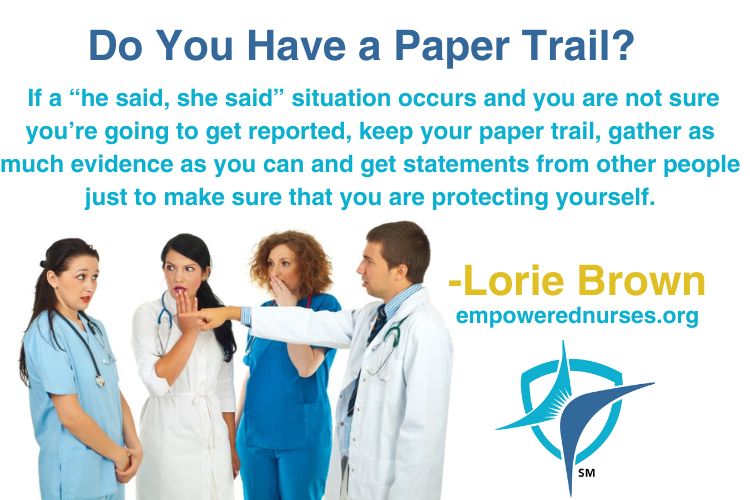
So, if a “he said, she said” situation occurs and you are not sure you’re going to get reported, keep your paper trail, gather as much evidence as you can and get statements from other people just to make sure that you are protecting yourself.
It is unfortunate that we have to keep a paper trail but just like the medical record, it is your best protection of what happened, therefore create contemporaneous documentation and keep your paper trail.
Beverly Ann Bratcher was an LPN working in Michigan at the Grand Rapids Home for Veterans in December 2020 when she became aware that 2 incorrect medication doses had been administered to one specific patient. Ms. Bratcher failed to report this error to her supervisor and now faces a criminal charge of second degree vulnerable adult abuse. [Story]
I took the opportunity to look up her Michigan license and it is still active despite the outstanding criminal charges. What is interesting is that RaDonda Vaught, who I have mentioned in earlier reports as the Tennessee nurse who mistakenly gave the wrong medication to a patient resulting in the latter’s death and for which she was convicted and sentenced to 3 years of supervised probation, was completely honest and up front about her medical mistake. Yet, she was criminally charged and convicted. However, Ms. Bratcher is facing criminal charges for not reporting the medications mix up in her situation and wound-up facing criminal charges.
This is a sad state we live in where nurses are expected to report medication errors and then get criminal charges and when a nurse does not report, she gets criminal charges. Many healthcare facilities claim to have just culture and the purpose is for full disclosure so that when mistakes are made, the facility can do a root cause analysis to figure out the source. Unfortunately, either way, when medication errors are reported, a nurse could be subject to criminal charges and when a medication error is not reported the nurse can also be subject to criminal charges.
This is unfortunate and scary for every nurse because who knew that you could go to jail for just for doing your job. Things need to change in nursing. It is no wonder that there is a nursing shortage. Hopefully, things will change.
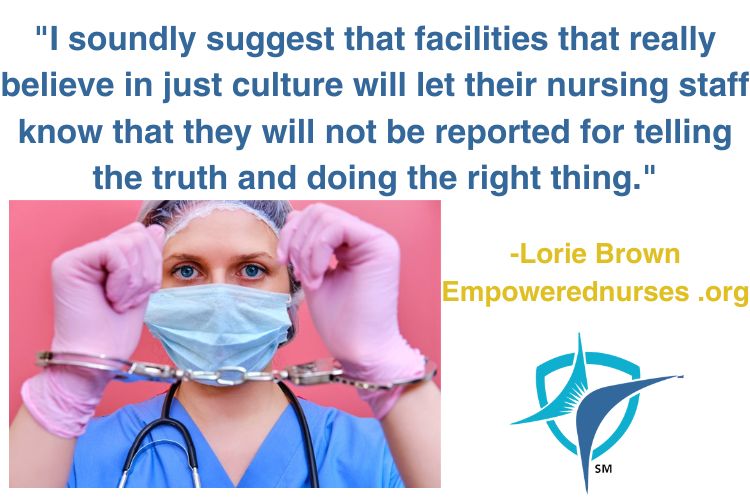
I soundly suggest that facilities that really believe in just culture will let their nursing staff know that they will not be reported for telling the truth and doing the right thing.
During the pandemic, several institutions had to resort to what is called “crisis staffing.”
This is when facilities find themselves operating under extreme circumstances such as emergencies, disasters or overburdening situations such as pandemics and they are required to change circumstances.
A number of hospitals have experienced examples of crisis staffing including Penn Medicine.
At Penn, when there is a crisis level 1, nurses go from 1:1 or 1:2 to team-based nursing which is, “1 ICU nurse and 2 non-ICU nurses caring for 4 to 6 patients with documentation by non-ICU nurses.”
With crisis level 2, “1 ICU nurse and 2 non-ICU nurses can care for 8 to 12 patients with documentation by non-ICU nurses.” Can you imagine taking care of 8 to 12 ICU patients with 2 non-ICU nurses?
As a medical malpractice attorney and professional licensing defense attorney, this is extremely concerning to me because there needs to be notation of who provided the actual care. If it is not documented, it was not done!
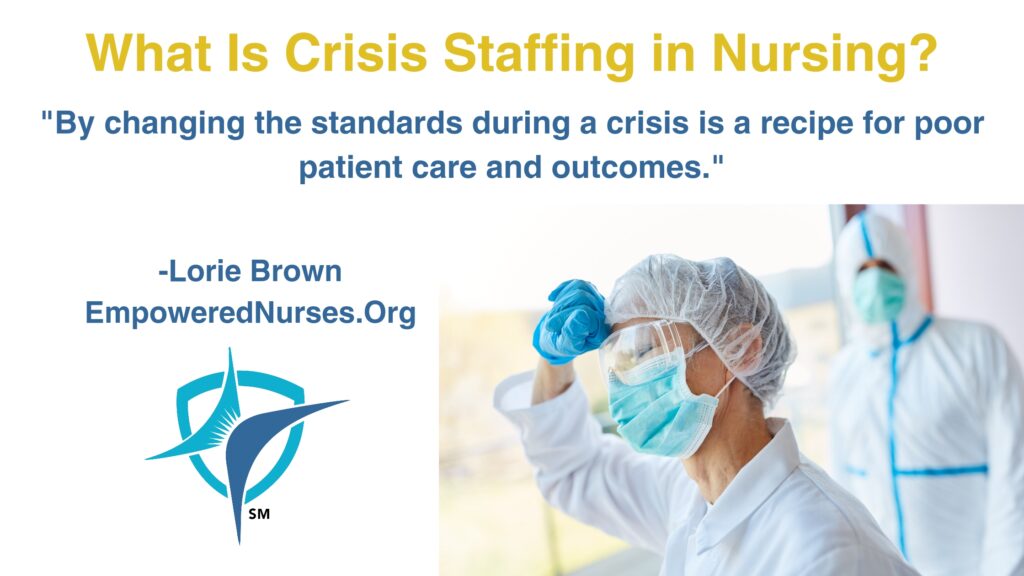
By changing the standards during a crisis is a recipe for poor patient care and outcomes.
Certainly, in a crisis, there needs to be flexibility but who determines when the crisis occurs. Is it just because there isn’t enough staff or is it because of something else? [more information]
During COVID, legislation was passed saying that nursing homes could not be sued. However, the Indiana law was applied retroactively, and nurses were still being reported to the Board. So, even if medical malpractice claims were not allowed, claims against licenses of individual nurses could still be brought forth.
With crisis staffing, the same thing could be true except that there will be malpractice cases and, of course, a nurse can still get reported to the Board.
Does your facility have a policy for crisis staffing and, if so, what are your thoughts about this topic?
I have had the privilege to study with some of the best coaches on the planet including Tony Robbins. Tony told the story of a man named Mel Fisher. In 1969, Mel thought that he knew where the wreck of the Nuestra Señora de Atocha, a Spanish galleon, could be found. The ship had carried a treasure worth an estimated half-billion dollars when it sunk during a hurricane off the Florida Keys in 1622.
The crazy part of this story is that it took this man 16 years to locate this missing treasure. He never gave up!
What would you have to believe to keep at that quest for so long?
His first belief was that the treasure was there. Do you believe that the “treasures” in your business are there?
The second belief is that “I will” or “I must follow this.” No one else is going to find it but you. Do you have that faith and that belief that you are going to find it?
The third belief is “is it worth it?” To Mr. Fisher, the 16 years he devoted to find the sunken treasure was worth it.
One of the drawbacks to Fisher’s search was that for eight years he was tied up in litigation. It goes without saying that once a treasure is found, everybody wants at least a part of it, if not all of it.
First it was the state of Florida and then it was the U.S. government, but the matter was settled when a judge ruled for Fisher by saying, “finders keepers!”
It took me 5 long years to build my business! (Fortunately, not 16!)
At first, I thought it would be easy. I knew everyone in my legal community, either working as co-counsel or opposing them in matters, plus I had a great service to offer assisting attorneys with medical issues in their cases.
But building my business was not so simple, it took me 5 long years. However, it was definitely worth it!
During that half-decade, I had to take uncomfortable actions to grow my business. I had to look at new ways to market to attorneys because the traditional ways were just not working.
For me, my big why was my children and then as I became more successful, my big why was my freedom. I want to work when I want to work, I want to go on vacation when I want to go on vacation, and I want to afford the lifestyle to which I have grown accustomed. I wanted to live where I want. Even though my law practice is in Indianapolis, I choose to live in San Diego.
What is your big WHY? What is it that gets you out of bed in the morning to do the hard work you need to do?
What treasures are you searching for? What treasures are you are determined to find no matter what? You’re not going to quit and will devote your life to the search.
What difference are you going to make in this world?
I had the good fortune to discover the Mel Fisher Museum containing countless artifacts from the sunken ship. It was so interesting to see these beautiful assets which had been encrusted over centuries by the sea’s salt water.
Again, what is your big WHY to start your business and make it grow? Are you worth it to have the business of your dreams? Let me know in the comments below.
In addition, if you would like to have a 15-minute strategy talk to discover your treasure, feel free to schedule a CallWithLorie.com.
Well, it happened with RaDonda Vaught and now, there is another nurse who has been charged with murder.
This past May, a Lexington, Kentucky nurse, 52-year-old Eyvette Hunter, was charged with the murder of James Morris, a 97-year-old World War II and Korean veteran and patient at Baptist Health. Nurse Hunter allegedly administered Ativan that she reportedly had taken from another patient.
Sometime later, Mr. Morris was found experiencing labored breathing and the oxygen saturation equipment had been turned off! Nurse Hunter never called for the rapid response team! The veteran had aspirated on either food or medication, developed pneumonia, and died 2 days later in hospice.
Nurse Hunter was seen walking out of the patient’s room when she was asked “What’s going on?” She reportedly tersely replied, “None of your business!” There is evidence that Nurse Hunter took Ativan for another patient and allegedly gave it to Mr. Morris without an order.
It was found later that Nurse Hunter had edited her documentation of administering the Ativan stating that the pharmaceutical was NOT given.
Ms. Hunter’s license has been suspended by the Kentucky Board of Nursing and now she must deal with this criminal matter.
Even if the Ativan had been ordered for this patient, it is forbidden to “borrow” someone else’s medication if that ordered medication is not available for your patient. Such a determined act is considered theft.
There are proper channels to get the appropriate medication in such a situation and calling the supervisor is absolutely necessary.
Making an insurance company pay for a medication that was used for a different patient is a crime: insurance fraud.
This case is virtually indistinguishable from that of RaDonda Vaught in 2017 in that Ms. Hunter allegedly administrated the stolen medication to ease Mr. Morris’ suffering after which she purposely decided not to call for the needed life-saving services of a rapid response team.
I do not know whether Mr. Morris was a code; nurses cannot take it upon themselves to generate such a situation and then fail to perform required life-saving services.



 I have had the privilege to study with some of the best coaches on the planet including Tony Robbins. Tony told the story of a man named Mel Fisher. In 1969, Mel thought that he knew where the wreck of the Nuestra Señora de Atocha, a Spanish galleon, could be found. The ship had carried a treasure worth an estimated half-billion dollars when it sunk during a hurricane off the Florida Keys in 1622.