Four (4) nurses in the labor and delivery unit of Emory University Hospital Midtown recently lost their jobs because they posted an “ICK” video on TIK TOK. An ICK video is a trend where people complain about things they find icky. The quartet made the ICK video to complain about patients.
Unfortunately, the administration of the Atlanta hospital learned about the posting and promptly terminated the nurses involved. Though their recording complaining was in general and did not mention any specific patients, it was, nevertheless, unprofessional to create and post such a video. What if one of their patient’s heard this and was like “I did that.” They would feel awful.
Anything you put on social media puts you under a microscope. Posting the wrong thing can get you in deep trouble. If your employer discovers what you posted is in violation of their core values or a nurses’ ethics or professionalism, they will take action.
I am not sure how a facility can afford to lose 4 labor and delivery nurses in this day and time. However, that’s what happened in this case. Similarly, I wonder what they will tell their future employers and whether the Board will get involved in this specific case.
Just because it seems to be a craze to post an ICK video on TIK TOK (or any social media) does not mean that you must jump into madness as well. Use your common sense.
Though we nurses are human, we make mistakes like everyone else. I hope their Board and their future employers will be forgiving of their improper actions. Most importantly is that they hopefully have learned from this mistake.
People make mistakes, it is what you learned from the mistake that makes the difference.
I recommend that you post absolutely nothing anywhere about your work or anything personal that can be perceived as unbecoming for a nurse.
I hear frequently of nurses who complain about conduct that they feel is unethical or improper that could affect patient care. As nurses, we are first and foremost patient advocates. We are concerned about our patients getting top quality care. Yet our concerns often fall on deaf ears or worse, they face retaliation. We want to report concerns when a facility is short-staffed, practitioners do not respond to phone calls or proper care is not provided.
A nurse whistleblower is one who goes to a state or federal agency to report a facility’s misconduct after their complaints were not addressed by the facility or the “the public exposure of organizational wrongdoing.” Many nurses believe being a whistleblower is complaining to your facility. This is not true.
Fortunately, nurse whistleblowers may be protected from retaliation by both state and federal laws depending on what is reported. And nurse.org has put together a list of every state and the laws that protect you in each one and here is another one.
There is a federal Whistleblower Protection Act which protects federal employees from retaliation from disclosing information that violates laws regulations mismanagement, rules, waste of funds, abuse of authority and endangering public health and safety. However, this law protects only federal employees, not those working in private institutions or state facilities
There is also the National Labor Relations Act, Occupational Safety and Health Act and False Claims Act which protect employees who submit complaints in hope of improving working conditions
However, state law may better protect you. For example, Indiana nurses are protected by the Indiana False Claims and Whistleblower Protection Act, the Indiana Medicaid False Claims and Protection Act and Indiana Code 22-5-3-3 which protects Indiana employees from retaliation for filing a complaint, testifying, or assisting with an investigation against an employer in the state.
Whistleblower retaliation can take the form of termination, demotion, denying a promotion, denying benefits, denying overtime, failing to hire, pay cuts, reduction of hours, intimidation or harassment and other disciplinary actions.
What bothers me most is why would a nurse continue to work in a place that doesn’t provide proper care?
If you feel that the care provided to your patients is compromised based on poor staffing, poor care of coworkers, lack of physician or NP availability, why would you stay there? Sometimes the grass may be greener on the other side.
Even though the law protects you, finding an attorney to assist you can be expensive and time consuming. And, even if you win the battle, you may not win the war. What I mean by that is that if your position is reinstated, you will be walking on the proverbial “eggshells” and the facility likely will find another reason to terminate you.
When you are scared and have been disciplined or questioned about something, it’s natural to be super careful but that can lead to mistakes
I think the only way to improve care in this country is to, yes, be a whistleblower but then leave if you have not left already and don’t rely on the laws to protect you.
Go somewhere you can work within the standards that you want which provides safe patient care.
Usually, inspirations for my blogs come from either my own past experiences or recent news items. However, the one I’m about to share here came to me from Nurse Erica by way of Facebook Reels. She had been hearing of a director in Houston who directed their staff not to document any provider’s name nor to quote what the provider had said.
This goes against Nursing 101 and documentation!
The whole purpose of documentation is to create a legal record of what actually happens. If you are not allowed to document the provider’s name or even what the provider said, how is this fulfilling the exact requirement of keeping a legal record of what happened?
This is flat-out wrong and will get you in s-e-r-i-o-u-s trouble!
If you are working in an environment where you are told to do something that YOU ABSOLUTELY KNOW to not be the proper way to do things, remember what I always say, “You can always find another job, but you can’t get another license.”
I guess I probably shouldn’t say that I am shocked at the lengths to which some facilities will go to protect themselves and their providers from malpractice, but, if this is true to any degree, it is truly sad.
Can you imagine what a jury would think if nurses had been told to hide a doctor’s name or omit any record of what the doctor had said?
I am just curious to hear if you have ever been told anything like this where you work. I would love to hear in the comments below.
I loved the 2011 Justin Timberlake and Amanda Seyfried film titled “IN TIME”. If you have not seen it, you can catch it on Amazon Prime and I highly recommend you watch it.
In this sci-fi thriller, people stop aging at 25 when a device on their arm notes they have 2 years left to live. If you work, time is added to your reserve; when you make a purchase, you spend time. You can give away or be given time. But should you run out of time, your life is over.
Literally, in this futuristic world, time IS money!
In the real world, right now, you and I need to treat our time as a precious resource like money. Are we frittering away time on social media and other pleasures? Or are we spending quality time with our loved ones?
As a business owner, I realize that time is the equalizer. We all have the same 24 hours in a day, but it is exactly how we spend that time that makes the difference. Those who spend their time wisely, creating and developing their businesses, tend to be more successful than those who are not too sensible about their use of time.
Having a calendar with everything important to do in your day scheduled is quite helpful. This way you will not have a big to-do list that drains your energy.
In addition, should you not be able to get to something, just reschedule it.
I suggest you make a list of everything you do in a typical day. Then decide which, if any, of those activities are not essential and those that are important for your health and wellbeing such as relationships, quality of life and then your business.
I suggest that you first calendar what is important to you and then your business activities because once you fill your cup, you have energy and time to give to others.
How are you apportioning your time for this day? I would like to hear from you in the comments below.
A doctorly prepared nurse practitioner, Sarah Anne Erny of Arroyo Grande, California, has been fined for publicly referring to herself as “Doctor Sarah” or “Doctor Erny” in contradiction to that state’s laws.
Now, to be sure, there are many doctorly prepared professions in which a person may call themselves “doctor.” For example, look at the First Lady who earned a Doctor of Education degree and asks to be publicly referred to as Dr. Jill Biden.
The title is also allowed for other doctorate-based career professionals such as pharmacists, psychologists, naturopaths, physical therapists, acupuncturists, or optometrists who all put the title “doctor” before their name.
However, in Ms. Erny’s case, the Board felt that she misrepresented herself by addressing herself as a doctor. In fact, she lost her case before the Board and since California requires the defendant to pay the cost of the investigation as well as face possible civil penalties, she now must pay $20,000. From that, she must pay $16,000 no later than 30 days of the final judgment (whoosh, that is harsh!) And the remainder is to be paid no later than 90 days.
If you have a Doctor of Nursing Practice degree (DNP) in a state other than California, don’t get worried. Apparently, the Board in Ms. Erny’s case relied on California’s Business and Professional Code which allows only a few select professionals to call themselves doctors. Other states have their own restrictions and allowances.
Indeed, California says a nurse can call themselves a Certified Nurse Practitioner or Advanced Practice Registered Nurse but, again, they cannot refer to themselves as “doctor.”
This is a very disappointing opinion because as NPs are establishing themselves as the leaders in primary care and they have a doctorate degree they should be allowed to use the title of doctor. One can say I am Dr. X, an advanced nurse practitioner but not in California.
To me, it makes more sense for a DNP to be addressed as “doctor” than, say, a person with a Doctor of Economics or even a Doctor of Education degree.
I hope California will see the light and change their statute,
I’ve told you more than once that I believe nurses are the hardest working people on Earth! You cannot pay most people enough money to do what nurses everywhere do every day and with a smile on their face.
Nurses should be celebrated every day because they made it through nursing school. Nursing schools are one of the most difficult programs for professionals. Nurses must memorize tons of medical terminology, endure clinicals and pass the NCLEX examination. The stress of passing nursing school should be celebrated: YOU DID IT!
I say too that, despite seeing more pain, suffering and death than anyone else, nurses are the kindest humans on the planet. They give so much to their patients to make their lives better during their most troublesome, vulnerable, and uncertain times. A nurse will see more pain, suffering and death than anyone else.
A nurse can go into a room to immediately establish trust with a patient to help them with their most personal care and situations. They are there to support those who are facing their final hours, to help them transition comfortably. Nurses also comfort the grieving family members who wait out those final hours for the patient.
Nurses are the smartest people, flat out geniuses I say, having to be creative, organized, prioritized and be able to critically think on their feet. They continually introduce new technology and must learn new things all the time. Nurses work 24/7. There is seldom such a thing as a holiday or a weekend.
They give to others and are not always available for their children’s sports activities, school events and sometimes not available for holidays with the family.
Nurses deserve every day to be one noteworthy in their honor because they are not afraid to get their hands dirty. They are exposed to every type of bodily substance and pathogen, known and unknown.
Lastly, nurses have huge hearts. They are such givers and care more about everyone else. I honestly believe nursing is in our DNA and that is why we became nurses.
I will tell you again that every day should be Nurses’ Day to honor this dedicated group from our nation’s medical healthcare professionals. Thank you for all you do!
Nurses Services Organization (NSO) and CNA recently published their claims data report which tracked malpractice claims against nurse practitioners (NP) as well as claims for violations of the Nurse Practice Act. The data shows that malpractice costs are on the rise!
What this report showed is that the number of claims against nurse practitioners had settled for an amount 10.5% more than 2017, when the last claims report was issued.
Professional liability claims are now settling at an average of $332,137. I’m not sure if this is a result of inflation, or because there are more NPs or because more harm is occurring or any combination of those 3 considerations.
A big surprise is that of all the claims filed, the highest average number is attributed to neonatal nurse practitioners. This is because any injuries to babies are significant. But considering OB is one of the highest areas of malpractice for physicians, it would seem to be true for nurse midwives. But it is not.
Compared to the neonatal statistic, it was no surprise that 23% of claims were in the area of aging services which had gone up 3.1% over the last 5 years.
The top 3 locations where NP claims were made are (1) physician office practices, (2) aging services facilities and (3) nurse practitioner office practices. Considering that the majority of NPs work outside of the inpatient setting, except for aging services facilities, that is not all that surprising.
The highest number of complaints involved diagnosis-related claims. That was a 37.11% increase and those claims settled for an average higher than the professional liability claims, averaging at $385,947.
Death and cancer were the 2 most common injuries representing more than half of the claims. This was due to the failure to diagnose cancer claims since more people go to nurse practitioners for basic wellness issues.
One nice thing is that the number of claims without payments increased by 11.1%. I’m not sure whether more claims without merit were filed since 2017 or if they were winning more claims, but this is good news.
Interestingly, for license protection matters, the highest 3 claims were regarding professional conduct, medication prescribing and scope of practice.
Lastly, about 43% of overall board license matters involved some type of action against the NP’s license. This is good news because it means more than half of the claims are closed with no action taken.
I always find these types of reports interesting, and I like to see the trends they expose to help you protect your license against malpractice or license discipline.
I recently watched a movie on Netflix, THE GOOD NURSE, which is based on a true story. Have you seen it?
If you have not and plan to, please be warned this article contains spoilers.
What I liked about this story is that it focused on the good nurse, Amy Loughan, rather than her fellow nurse, Charles Cullen, who we eventually learn is the serial killer.
Cullen would take Digoxin and Insulin from the Pyxis for a patient, he’d cancel the order and the drawer remained opened, a defect that at the time was fairly rampant in a number of hospitals.
Cullen would take out Insulin and Digoxin and inject those into IV bags in the supply room. He would not know which patients would receive the contaminated bag of fluids. I can see the reason it took so long for him to be caught.
Now, I had a couple of concerns after watching the movie.
First, it is crazy how we can work with a nurse, grow close to them, and then discover a deep dark secret that changes everything you thought about them.
I would be surprised to befriend a serial killer but, unfortunately, we nurses tend to be so kind and giving that many of us only see the good part of individuals and humanity.
I once met a person who claimed she once actually dated a serial killer! She does not believe he was killing at the time of their relationship but began his murderous spree sometime after they parted.
Another thing about the movie was that Cullen had worked at 9 other hospitals before this one. Each hospital suspected something was up but none of them did
anything. No one investigated him so there was no one to stop him. In fact, he commented when asked why he did it and said, “No one stopped me.”
He went on to plead guilty to 29 murders but there may have been as many as 400 victims. He managed to avoid the death penalty but was sentenced to spend the rest of his life in prison. Despite his sentence, there were never any actions taken against the hospitals. That was wrong!
I once personally took a deposition of a nurse who said she was terminated from her job. Based on my knowledge as a professional licensing defense attorney, I asked if she reported her termination to the Board to which she said, “No.”
I asked why she was terminated from the hospital, she replied, “Positive drug screen.”
When I ask why she was terminated from the previous hospital, she repeated, “Positive drug screen.”
And what about the hospital prior to that? Again, “Positive drug screen.”
I was shocked that those hospitals would terminate her but never report her to the Board. She claimed it was just marijuana and, to her, it didn’t matter. However, marijuana is still illegal in Indiana and really for any nurse.
By hospitals not doing their part in reporting suspicious activities or employees with suspected impairments, nurses are being allowed to move on to the next hospital to do the same thing.
I applaud the bravery of the good nurse, Ms. Loughan, who befriended Cullen and eventually got him to confess to his crimes. It was her bravery and commitment to ensure the safety of other patients that is so endearing.
Since these events, nurse Loughan has left nursing to, as she put it, work on herself.
As nurses we tend to jump all into our job and want to help everyone. However, many times we forget that the most important person we can help is our self.
Recently there was a nurse in North Carolina who has been charged with killing 2 people with Insulin. Unfortunately, in those cases, the bad apple succeeded in causing harm to her patients.
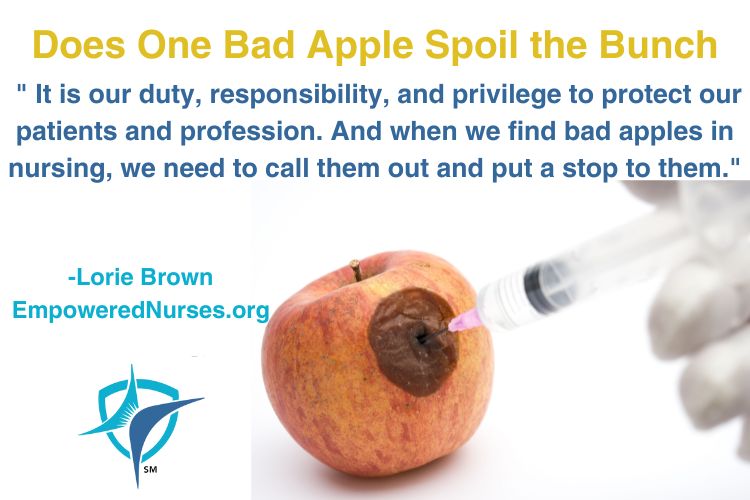
Let’s not let a few bad apples spoil our whole profession. It is our duty, responsibility, and privilege to protect our patients and profession. And when we find bad apples in nursing, we need to call them out and put a stop to them.
We all know the story of the little engine that could where the small locomotive was climbing a hill chanting, “I think I can … I think can …I know I can … I can … I know I
We all know the story of the little engine that could where the small locomotive was climbing a hill chanting, “I think I can … I think can …I know I can … I can … I know I can … I can!”
In business, “if you think you can and know you can and can …” is just not going to cut it.
There are four levels of this.
The first is “I think I can.” Often you must think that you can do something in order to say, “Yes” and then actually do it. But knowing only that you can is not enough. Many of you have a business idea and think you can do it.
The second level is, “I will do it.” Similarly, just because you will do it does not mean that anything is happening. Just the thought of willpower alone to have your business be successful will not make it truly successful. Once you think you can do it, then the questions becomes will you do it?
Level number three is “I must do this.” It is so important if you want to have a successful business that you know that you must do it because wishing, hoping, wanting, and trying does not necessarily mean success. But must will not cut it either!
The fourth level is that you are doing it. The only way to have a successful business is to take the actions and just do it. Nike had it right. Just do it!!
Once the little engine that could started climbed to the top of the hill, he was successful and was doing it. The only way to be successful is to take action so you can get the results that you want. Just because you can, you will and you must, without action, you will fall flat.
I was sickened in learning of the death of psychiatric nurse practitioner June Onkundi who had started her job at the Freedom House Recovery Center in Durham, North Carolina only 3 months ago.
Ms. Onkundi, married with 4 children, was fatally stabbed while doing the work that she loved by the patient, James Gomes, a man who spent half of his life in prison. He has been charged with first-degree murder and is being held without bond.
Elsewhere this past week, a shooting at the Methodist Dallas Medical Center claimed the life of a nurse and a social worker. Jaqueline Pokuaa was a 45-year-old maternity ward nurse. Nestor Hernandez, on parole for aggravated robbery and wearing an active ankle monitor at the time, is being held on capital murder charges.
A study released this past summer showed that two nurses are attacked every hour in the U.S. These events are unacceptable. Nurses should never have to risk their lives just by going to work. Something needs to be done to ensure that events like these never happen again to any healthcare provider.
While I’ve read the public-issued statements from these facilities regarding the loss of life, I would really like to see what the facilities are going to do to protect their employees.
Press statements about the above murders make it seem like these two situations were unavoidable. But that is absolutely not true!
Methodist Hospital in Dallas has had previous incidences of their nurses being attacked by patients but apparently the facility has done nothing to protect them.
I highly endorse supporting Nurses Against Violence Unite, a community about awareness, education, and empowerment with a mission to eliminate violence.
Activist Doctorate nurse Sandra Risoldi formed this organization in 2017 with a strong commitment to promoting mental wellness and supporting all healthcare workers while promoting violence prevention training. I admire Dr. Risoldi for following her passion and her dedication.
If facilities are not willing or able to protect their nursing staffs, we must stand together to have legislation in place to require facilities to do that or at a minimum, hospitals take steps to protect their staff and train ALL nurses in self defense and de-escalation techniques.