Join me for an exclusive in-person event for LNCs to hear the behind-the-scenes legal process from 12 attorneys! ❱❱

Empowering Nurses at the Bedside and in Business

Author Archives: Lorie A Brown, R.N., M.N., J.D.

  1. Unable To Find A Nursing Job?

    Leave a Comment


    Recently, Katie Duke stated no hospitals have hired her. If you don’t know of Katie, she was on a popular reality TV show called NY Med.

    She was fired from the hospital where she was working because she posted a picture on social media of a room where the life of a trauma patient had been saved following a subway accident. She accompanied the post with a comment describing the scene of the results of man vs. train.

    Afterwards, Katie told a blogger she had to, “[T]ell my truth, own my bad decisions, be transparent and keep pushing through the disapproval and judgment of others.”

    Now a motivational speaker and host of a podcast titled Bad Decisions, Katie tells Becker’s Hospital Review that she cannot get a job in the nursing field. She also is an Instagram influencer and brand ambassador for FIGS designer scrubs while, interesting enough, performs as a stand-up comedian.

    Some question whether her social media posting was a HIPAA violation, but consider that anyone looking at the picture and knowing somebody was hit by a train in New York City, will easily be able identify the victim.

    People get terminated from their positions primarily for three reasons.

    Reason one is because they are a “squeaky wheel.” They keep complaining about working conditions rather than identifying solutions that will help.

    The second reason is that they usually have seniority and are being paid at the highest wage levels. If a hospital wants to cut its budget, they are the first to go.

    And lastly are cultural differences between the nurse and the facility, that is, the job is a bad fit.

    Nurses have come to me and, like Katie Duke, say they can’t get hired. They believe that someone is blackballing them. Or that they had previous discipline on their license. For those nurses, I always ask, “How do you know this?” And seldom do they have a response; it’s just an assumption they make. It is really difficult to prove that someone is blackballing you.

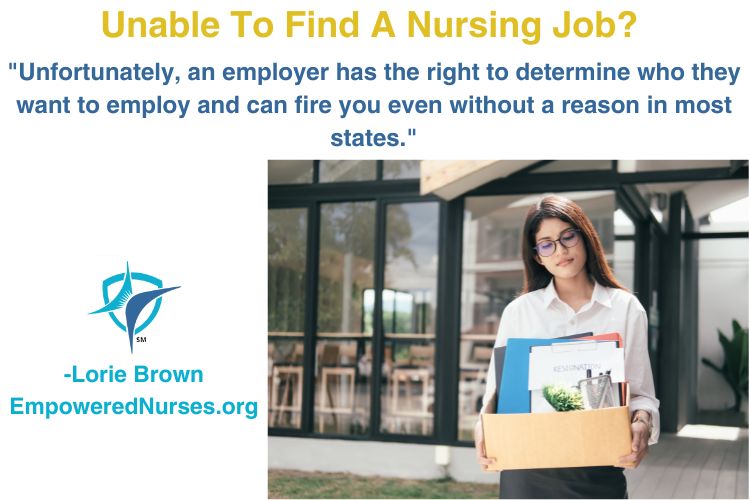
    Unfortunately, an employer has the right to determine who they want to employ and can fire you even without a reason in most states..

    People don’t always know why it is that they can’t get another job. So, we need to keep those three things in mind: don’t be a squeaky wheel, if you can help it, and make sure that you are the right fit for the job. I don’t have a response for if you are the highest paid.

  2. Money Is Everywhere

    Leave a Comment

    When I was growing up, I could always tell what items in the refrigerator were bought “on sale” because there would be tons of it in the refrigerator.  As a kid, it was pretty funny to open the freezer to find boxes of Lean Cuisine alongside cartons of Häagen-Dazs ice cream.  I could always tell what my parents bought that was on sale by simply looking in the fridge and freezer to see what they stocked up.

    Our own relationships with money is very often learned from our parents.  I always thought we could buy things only when they were on sale, because that’s what my parents did.  However, this is called lack thinking.

    Just like nursing, we are conditioned and programmed to believe in lack, lack of equipment, lack of supplies, lack of support, lack of time and most importantly, the lack of money.  It is all these thought processes that are difficult to undo.

    The truth is that money is everywhere!  In fact, 3% of the human population owns 98% of the world’s riches.  The remaining 2% are in the hands of everyone else. If you divide all the money in the world among all the people, each person would have over 1 million dollars.

    This is crazy to me. Money is everywhere . . . all you have to do is just ask.

    If you find yourself struggling with money, here’s an exercise to try.  Write down 50 ways that you can make money right now.  It could be anything like teaching English as a second language to immigrants.  It could be going through your house and determining just what you might sell in the Facebook marketplace.  It could be teaching cooking lessons in your home.  Right here you already are 3 of the 50 suggestions as a starter.

    Come up with 50 ways that you can make money now, don’t stop at 35, keep going to 50.  There’s magic towards the end.  Once you have your list, then pick the 3 ways that you can make the most money in the least amount of time. Of course, make sure that the ways are all legal (*wink*)!

    This will help change your belief system to realize that money is everywhere!

    How many times have you found a coin on the ground?  It happens all the time.  Don’t walk past the pennies, nickels and dimes because you feel it’s not worth the effort to pick them up.

    One of my friends would take any change he found or had left in his pockets at the end of the work day and place it in a large replica of a soda bottle. One time, he found he had garnered over $300 in the bottle. 

    Now, if you’re thinking, “Oh, that’s not it. Amassing coins is not worth the effort,” It is!  It’s worth every single cent.

    Really, money is everywhere.  Just look around.  There are numerous opportunities to make money.  And money is energy; it’s all about circulation. Money is meant to be circulated.

    You pay others to help you with things that you’re not particularly good at.  You pay the doctor.  The doctor pays his attorney.  The attorney pays their staff.  Money circulates and flows everywhere.

    The choice is yours to have money or not.  There are so many things you can do to create a source of money.  If you solve a problem that people have, people will pay for it.  Think about the problems you want to solve for which you are willing to pay. It’s just an energetic circle and the money keeps circulating.

    Money is meant for you to receive and then to give, not hold onto like it is a scarce commodity.  

    Questions: while growing up, what were your beliefs about money?  And what now are your remedies to change those beliefs?  I would love to hear your thoughts in the comments below.


  3. Do Virtual Nurses Really Exist?

    Leave a Comment

    Apparently, a number of hospital systems are implementing “virtual nurses” to help the bedside nurses who have been chronically short staffed. 

    Virtual nurses can assist with the admissions paperwork and the discharge education.  They can answer questions, talk to family members and, after the patient is discharged, can be a communication loop between the patient and their primary care physician.  In addition, virtual nurses can do a virtual visit after the patient is discharged to home. 

    I have joked that I was a nurse when “dinosaurs roamed the earth.”  At that time, we still wore whites while some wore their caps and graduation pins.  In those days of giving, nurses on the evening shifts were even required to give patients back rubs. 

    Having said that, and no pun intended, I believe the “hands-on art” of nursing is getting lost in the tasks of nursing.  However, given the challenging times in which we now live, maybe these virtual nurses can be of great help to bedside nurses and lesser experienced nurses.  It sounds like a great job to me, but truly I would miss the patient contact. 

    Becker’s Hospital Review interviewed several chief nursing officers, many of whom believe that virtual nursing is here to stay.  However, one chief nursing officer said that virtual nursing does not create the trust that bedside nursing does. And it’s a challenge to have a real human connection through virtual care. 

    He believes that if this trend continues, we will all lose.  “Nurses put the humanity into care and need to be present at the bedside.”   

    I agree with him. I believe that nursing is a calling that’s in our DNA and by replacing or supplementing nursing staffs with virtual nurses we will not provide the holistic care that patients need.  It makes health care 2D instead of 3D. 

    What are your thoughts?  Please let me know in the comments below. 

  4. Will License Discipline Affect My Future Education?

    Leave a Comment

    Many nurses who think the grass is always greener on the other side will continue their education by becoming nurse practitioners.

    But let me tell you, the problem is that the grass there is not greener because even if you become a nurse practitioner, the problems in health care still exist.  They’re just different problems.

    I have been asked if a nurse has discipline on their license, will they be able to continue their education?  There is no simple answer to this.

    The nursing educational program you plan to attend will have to decide whether you’re a candidate in reflection of any past discipline.  If your license is on probation or other restriction, you will be unable to take part in clinicals because you need an active license to participate.  If you are currently in school for higher education and have a complaint pending against your license, many want to complete the education before you resolve the matter, if possible. However, I believe honesty is the best policy. If you have discipline pending, you should tell the school. It is public record and if they find out and you did not tell them…

    Sometimes attorneys don’t have control over how long a case will last or how soon it can be settled.  However, just know that if you have discipline on your RN license, most likely you will have discipline on your APRN license too and both can be trouble in getting a job.

    Getting an APRN license, especially with a complaint pending or discipline on your license can complicate things.  Just know that each situation is different and unique.  If you have past or present discipline on your license, it may affect your ability to continue your education as well as determining your ability to get an APRN license.


  5. Non-Competes in Nursing

    Leave a Comment

    The Federal Trade Commission (“FTC”) has proposed a ban on non-compete employment contracts thinking this will improve wages of health care workers. 

    Covenants not to compete, also known as non-compete agreements, are legally binding contracts between an employee and an employer.  These agreements prohibit employees from working for a competitor or starting their own competing business for a certain period of time after their employment with the original employer has ended. 

    These agreements are used to protect the employer’s interest in the training and development of their employees.  However, due to the high demand for nurses, these agreements can limit a nurse’s ability to find new employment and advance their career. It is a restraint on trade (ability to work). 

    The nurse would either have to move away or provide care in a different type of patient care setting in order to be compliant with the covenant not to compete.  In some states, covenants not to compete for nurses are illegal or unenforceable because it restricts the essential service of health care professionals to provide care in the community. 

    The National Nurses Association, the largest union for registered nurses, agrees with the FTC proposed ban.  Otherwise, non competes hold nurses hostage to working in that facility and they cannot speak out about unsafe conditions and can’t exercise professional judgment required to provide safe and effective nursing care.  When these types of agreements are in place, patients suffer. 

    The FTC is also considering banning “training repayment agreement provisions” (TRAP) where employers pay for training and the nurse is required to stay there for a certain period of time.  These are common with nurse residency programs or sign on agreements.  If a nurse chooses to leave early because they were not given what they were promised or the patient care at the facility is poor or the staffing ratio is unsafe or for any reason, the nurse will have to repay the facility some, if not all, of the money incurred in training. 

    In law, covenants not to compete are illegal.  I have not seen many nurses sign a covenant not to compete agreement, but I have seen them sign the training repayment agreement provisions.  Either way, I think these covenants not to compete should be illegal because nurses should feel free to go where they want to find an environment that best suits them. 

    By giving nurses the freedom to go where they choose, I believe it will improve patient care.  Holding nurses hostage and requiring them to stay for a period of time because the facility paid the money towards their training should also be banned. 

    If a nurse chooses to leave because of unsafe patient care and poor staffing ratios, why should the nurse be punished?  Or if the nurse loses her job for whatever reason. Maybe because the employment was “a bad fit” and the nurse is required to pay it back, that’s a problem as well. 

    Lastly, if you work for an agency and sign an agreement that the facility where you are placed is unable to hire you directly should also be banned.  If you work for the agency for a period of time at the facility, you should be able to work there as a direct hire. 

     Until the FTC ban is an official regulation, if you are asked to sign an agreement with a covenant not to compete or a training repayment agreement provision, I suggest you speak to an attorney who may be able to negotiate these terms for you in your best interest. 

    Have you been asked to sign a contract with a covenant not to compete?  Or a training repayment provision?  I’d love to hear what you have to say in the comments below. 


  6. Fraudulent Nursing Diploma’s and Transcripts

    Leave a Comment


    The Department of Justice recently arrested 25 people scheming to sell bogus nursing diplomas and transcripts, charging them with wire fraud and wire fraud conspiracy.

    Thousands of people who had hoped to take a shortcut toward becoming a licensed nurse were fooled into obtaining these items that are necessary to sit for the NCLEX.

    The enforcement action spanned 5 states: Delaware, Florida, New Jersey, New York and Texas. In Florida, nurses who were part of this scheme are having their licenses suspended even as you read this.

    This is really scary because more than 7,600 fake nursing diplomas and certificates were issued. However, now that these nurses’ licenses are in jeopardy or being suspended, the phones are ringing off the hook in the offices of many members of The American Association of Nurse Attorneys.

    It is unfortunate that nurses would succumb to these scam tactics and many nursing candidates paid as much as $15,000 for fraudulent diplomas. Do your homework. Make sure your nursing school is approved by your state Board of Nursing which is charged with regulating nursing education.

    There have been nurses who have gone to other programs that have closed. These schools told the nurses that they would accept their credits and they could finish up their education only for them to find later that they paid lots of money to get a fraudulent diploma that was not approved by the Board of Nursing and a fraudulent transcript that allowed them to take the test.

    It’s very unfortunate that so many nurses fell for the scam and will no longer be able to practice which eventually will leave an even greater shortage of nurses for the country.

    If somebody is offering you something too good to be true, BEWARE because shortcuts never work and can get you in trouble.

  7. Stopping Negative Self Talk

    Leave a Comment


    Do you know that inner critic, the little voice in your head that doesn’t stop? The one that keeps saying, “Who are you to start your own business? Who are you to charge this kind of money? How can you grow a business when you’re having enough trouble finding time with your day job?”

    The inner critic is there to keep you safe. In fact, many of the thoughts that you hear in your head each day are not your own. They are things that you heard from your parents or were indoctrinated in you by society. So, why listen to them?

    The inner critic is from your reptilian brain, which was from our caveman days, when our ancestors would walk out of our cave only to be eaten by a saber tooth tiger or brontosaurus.

    Even though you know now where we live is safe, we still can push that panic button at any time. The reptilian brain is designed to keep you safe and in your comfort zone because if you do start a business, you could get hurt. Or what if you don’t make enough money? What if you don’t get clients?

    You can’t fail because there is no failure. As long as you are solving the problem that keeps people up at night, then you can’t fail.

    Remember that there was a time when we lived in tribes where the men hunted the food and the women cooked the meals? People then acted as a community and worked together to get the job done. Every problem in the tribe could be handled by one of the tribe members.

    However, in society today, money circulates and changes hands to fix problems. When we have a problem, we seek the experts who resolve it. For example, if we have a problem with our teeth, we go to the dentist. If we have a problem with our health, we go to the doctor. If we want to keep our money safe, we keep it in a bank.

    Each of these businesses solves a problem and, as a business owner, you get to solve a problem too. Whether that may be helping attorneys with medical cases, helping people to improve their health by nurse coaching, we ,as business owners, solve problems.

    That negative voice in your head is not real! It is designed to keep you safe and remember that voice is not even yours, so there is no need to listen to it. What I do with my negative self-talk is I can choose the pain or pleasure route. Of course, I chose the pain and I put a rubber band around my wrist so every time I had a negative thought I would snap it just to remind me that those thoughts are not serving me.

    The more gentle way of doing this is to journal the negative thoughts and replace them with thoughts that are empowering. These techniques really work because you can’t just get rid of a thought, you have to replace it.

    I can tell you when I used to do yoga, my negative self-talk would be. “What are you doing here? You’re older, you’re overweight and you can’t bend like a pretzel.” But now my inner critic is more like my inner cheerleader. “Oh, look how much further you can go to touch your toes today,” which, of course, is such a nice feeling.

    So, let’s turn your inner critic into an inner cheerleader.

  8. Murder Charges For Two EMT’s

    Leave a Comment

    Have you heard the shocking news that 2 EMS workers have been charged with 2nd degree murder after a man died in their care?  An officer’s body cam filmed the entire incident involving an extremely inebriated man.

    During the event, the EMS workers spoke cruelly to the man as he was thrown forcefully facedown onto the cart.  Rather than turning him over, they strapped him face down to the cart.  Tragically, in that position he suffocated!

    It is so sad to hear of an incident like this where healthcare providers’ actions result in criminal charges.  Regardless, the EMS workers were clearly unkind in dealing with the patient, making comments such as, “We hate carrying you” and “I am seriously not in the mood for this dumb” stuff! 

    NO one deserves to be treated this way, especially a patient!

    This is clear malpractice, an unintentional result that resulted in criminal charges being filed.  One news article said the charge was for 1st degree murder while another said it was a 2nd second degree murder. A 2nd degree charge makes more sense because the death was unintentional.  That is, negligent homicide where the death was not deliberate or premeditated.

    If you recall the Radonda Vaught matter that I have mentioned in the past, that Ms. Vaught was doing her job negligently which resulted in a death.  She did not intend to cause harm which makes it negligence and should not rise to the level of a criminal matters.

    But in this matter with the EMTs, I feel a little differently. But that is only because it was clear that this man was in distress and lost his life due to the actions of the EMTs which were aggravated by their comments during that treatment.

    What do you think about this case?  Do you think that this should have resulted in criminal charges?

    I look forward to hearing your comments below.

  9. The Nurses’ Strike Resolved

    Leave a Comment


    Last week in New York City, 7,100 nurses went on strike to improve patient care and ask for mandatory safe staffing.  A resolution was reached after 72 hours.  Pay was never the issues as an almost 20% raise over the next 3 years.  The nurses negotiated an 

    -increase in over 170 nursing positions, 

    -maintaining fully-funded healthcare for eligible nurses and 

    -lifetime health coverage for eligible retired nurses, 

    -increase in preceptor and charge nurse pay of $5 per hour over standard wages, 

    -an increase for float pool nurses adding more registered nurses and nurse practitioners in the emergency departments, and 

    -continuing to increase nurse education infrastructure in emergency departments.

    Mount Sinai nurses are back to work with safe staffing ratios for all inpatient units “with firm enforcement so that there will always be enough nurses at the bedside to provide safe patient care, not just on paper.” It is also nice that the new staffing ratios will be implemented immediately.  

    At Montefiore nurses received new safe staffing ratios in the Emergency Department, with new staffing language and financial penalties for failing to comply with safe staffing levels in all units. 

    I love that nurses stood their ground for safe staffing.  California has had mandatory safe staffing ratios for years and the nurses love it.  For years, nurses have been fighting for federal legislation for safe staffing but have been unsuccessful.  This result in New York is a great start because change usually occurs on the coasts first.  I hope nurses elsewhere will stand their ground as safe staffing not only improves patient care but also decreases nurse burnout. 


  10. The Mess In Healthcare Gets Messier

    Leave a Comment


    7,000 nurses walked out at 2 hospitals in New York City. I am so proud of these nurses who are saying, “NO,” that they will no longer put up with short staffing. That is the sticking point for the nurses to walk out.

    It seems contrary that nurses would walk out on patients if they’re concerned about having sufficient staff, but this seems to be the only way to emphasize that point.

    The hospital systems offered an almost 20% salary increase but the nurses are more concerned about safe patient care. I believe the nurses did everything they could to reach an agreement.

    According to the New York State Nurses’ Association, there are also over 500+ open positions in 1 health system and 700+ positions that were not being filled at the other health system. There may have been a question as to whether the positions were either frozen or even posted.

    There was a 3rd health system targeted for a walkout as well but in that situation, the parties were able to resolve their differences.

    The question now arises, “Will you cross the picket lines, or will you stand with your fellow nurses?” Many nurses will cross the lines because the pay is very lucrative. However, I would ask that the pay be put toward hiring nurses rather than putting what amounts to a band aid on things if everything falls apart.

    You’re the one who needs to wrestle with your conscience should you choose to cross the picket line. This is not about money. It’s about fighting for safe patient care. You get to decide if you want to put money first and walk past your sister and brother nurses who are trying to make a real difference and improve patient care.

    The hospital claims the strike impacts patients because babies are transferred from NICUs, cancer patients are forced to find alternative locations for treatment, elective surgeries are being postponed and ambulances are being diverted.

    It appears the hospital is trying to shame the nurses for walking out for what they believe. Nurses should not carry 3 times the load. They should not have 20 patients in the ER when the average is 3.

    Nurses should be treated with respect and dignity and given proper staffing. To do this work, day after day, with short staffing is a recipe for disaster.

    No wonder there is a nursing shortage. So many are being burned out and leaving the profession. Many in the nursing population find it getting harder to handle that kind of stress and workload as they get older.

    The decision to strike and leave your patients is undoubtedly a difficult one. You must battle with your feelings about being there for your patients or abandoning them, but I can say that this is one way to make a change. These 7,000 nurses are not just doing this for themselves but for all in the nursing profession.

    According to the National Council of State Boards of Nursing, the average age of a registered nurse is 52 which is 10 years older than the average for the rest of the nursing workforce: 42.

    According to healthaffairs.org, during the year 2021 alone, over 100,000 nurses left the profession, the largest drop in the last 4 decades!

    In addition, the American Association of Colleges of Nursing says that in that same year, 2021, nursing schools turned away almost 92,000 applicants because of a shortage of qualified instructors.

    We are at a crossroads with our profession. We can either be part of the problem or part of the solution. I believe the strike is part of the solution by saying that we are not going to tolerate having too many patients because it is not healthy for the patients or for us. It contributes to increased acts of malpractice and can easily put our licenses in jeopardy.

    Interview with Nancy Hagans, R.N., President of New York State Nurses Association.

As Seen On:

Women's Week